Back to the on-screen lesson ·
Active nuclei outshine galaxies from light-days across, powered by accretion onto supermassive black holes at L = 0.1 Mdot c^2; the Eddington limit and reverberation mapping weigh the holes, and orientation explains their many types.
Paper packet. Every task here also exists on screen, where it is checked automatically; answers written on paper are not assessed by Nydus. When you are back at a device, enter your answers there.
By the end of this lesson you will be able to explain active galactic nuclei from accretion onto supermassive black holes and estimate their luminosities, feeding rates and masses.
You know from lesson 13 that accretion onto a compact object releases a large share of the infalling mass's rest energy and is capped by the Eddington luminosity, and from lesson 14 that a four-million-solar-mass black hole sits at the Milky Way's center. You can weigh a mass from an orbit. This lesson scales those ideas up to the most luminous steady sources in the universe, the active nuclei of galaxies.
| Term | What it means |
|---|---|
| Active galactic nucleus | A galaxy's center that outshines its stars, powered by accretion onto a supermassive black hole. |
| Quasar | The most luminous kind of active nucleus, often outshining its whole galaxy a hundredfold or more. |
| Supermassive black hole | A black hole of millions to billions of suns at a galaxy's center. |
| Eddington ratio | A source's luminosity divided by its Eddington luminosity, the share of its maximum steady output. |
| Reverberation mapping | Weighing a black hole by timing how long its surrounding gas takes to respond to changes in the central light. |
| Unified model | The idea that different kinds of active nuclei are one structure seen from different angles. |
An active nucleus outshines its galaxy from a region light-days across, and accretion onto a supermassive black hole is the only engine that fits:
$$L = \eta\,\dot M c^2, \qquad \eta \approx 0.1.$$
A quasar of $10^{39}$ W swallows about two suns a year. The Eddington limit sets the least mass, $M \ge L/(1.26 \times 10^{31}\ \text{W})$ suns, and reverberation mapping weighs the hole directly,
$$M = \frac{R v^2}{G}, \qquad R = c\,\tau.$$
The unified model reads quasars, Seyferts, radio galaxies and blazars as one engine seen from different angles.
Another way: picture
Picture a city seen from an airplane at night: a vast spread of lights, dimmer than a single searchlight pointed straight at you from the middle of it. An active nucleus is that searchlight, a source smaller than our solar system outshining hundreds of billions of stars, and it is powered not by stars at all but by matter spiraling into a black hole.
Another way: steps
In 1943 Carl Seyfert, at Mount Wilson, described spiral galaxies with unusually bright, star-like nuclei whose spectra showed broad emission lines from gas moving at thousands of kilometers per second. In 1963 Maarten Schmidt at Palomar recognized that the spectrum of the star-like radio source 3C 273 was a familiar pattern of hydrogen lines redshifted by $16$ percent, placing it about two and a half billion light-years away. To look so bright from so far, it had to outshine an entire galaxy hundreds of times over: the first quasar.
Active nuclei now include quasars, Seyfert galaxies, radio galaxies with jets hundreds of thousands of light-years long, and blazars. Their total power can exceed $10^{40}$ watts.
Quasars vary in brightness, some in days or hours. A source cannot vary coherently faster than light can cross it, because light from its far side arrives later than light from its near side and smears out any sudden change. So a source that varies in time $\Delta t$ has a size $R \lesssim c\,\Delta t$.
A day's variation means a source no more than about $170$ astronomical units across, smaller than the solar system's outer reaches, emitting more than a thousand galaxies. No collection of stars can do that: they would collide, merge and collapse. Only gravity acting on a compact mass can.
Gas spiraling into a black hole through an accretion disk releases a fraction $\eta$ of its rest energy, about $0.06$ for a nonrotating hole and up to $0.42$ for a fast-spinning one; $0.1$ is a typical working value. So
$$L = \eta\,\dot M c^2.$$
A quasar of $10^{39}$ W needs $\dot M = L/(0.1 c^2) \approx 1.1 \times 10^{23}$ kg/s, about two suns a year: a modest diet for such power, because accretion is so efficient. Fusion, at $0.007$, would need fourteen times as much fuel, and the fuel would have to sit in stars occupying far more space than the variability allows.
A black hole cannot steadily shine much brighter than its Eddington luminosity, $1.26 \times 10^{31}$ W per solar mass, because radiation pressure would then halt the inflow. So a source of luminosity $L$ needs a black hole of at least
$$M_{\min} = \frac{L}{1.26 \times 10^{31}\ \text{W}}\ M_\odot.$$
For a $10^{39}$ W quasar that is about $80$ million suns; for the most luminous quasars, billions. The Eddington ratio, $L/L_{\text{Edd}}$, says how hard a black hole is feeding: quasars often run at a tenth to one, while the Milky Way's black hole, at about $10^{29}$ W, runs at a few billionths.
Clouds of gas orbiting a few light-days to light-weeks from the black hole glow in broad emission lines, lit by the central source. When the center brightens, the clouds brighten too, after the delay $\tau$ it takes light to reach them, so their distance is $R = c\tau$. The width of their lines gives their speed $v$. The virial theorem then weighs the black hole: $M = f R v^2/G$, where $f$, a factor near one, describes the clouds' geometry.
Delays of days to weeks and speeds of thousands of kilometers per second give masses of millions to billions of suns, consistent with the Eddington minimum.
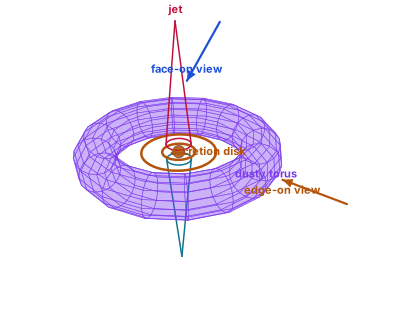
The unified model explains the zoo of active nuclei by orientation. Around the black hole and its disk lies a thick torus of dust. Seen from above, we look into the center and see the broad lines of fast-moving gas: a type 1 Seyfert or quasar. Seen edge-on, the torus hides the center and only slower gas farther out shows, in narrow lines: a type 2.
Some nuclei also launch jets of particles at nearly light speed along their spin axes. With the jets across the sky we see a radio galaxy with huge lobes; looking straight down a jet we see a blazar, its light boosted and rapidly varying. Luminosity and the presence of jets add further variety.
Every large galaxy seems to host a central black hole, and its mass tracks the galaxy's central bulge: black holes are about a thousandth of the bulge mass, and their masses correlate tightly with the speeds of the bulge's stars. Since the black hole's gravity reaches only a tiny region, the link suggests the two grew together, with energy from the active nucleus heating or blowing away the gas that would otherwise form stars. Quasars were most common about ten billion years ago, when galaxies were growing fastest.
Quasars, Seyfert galaxies, radio galaxies and blazars look very different, yet many may be one engine seen from different directions. The scene shows its parts: the black hole and its hot disk, a thick torus of dust around them, and jets along the spin axis. Looking down the jet we see the disk directly, or the jet itself in a blazar; looking edge-on, the dust hides the disk and we see only the glow of gas above it.
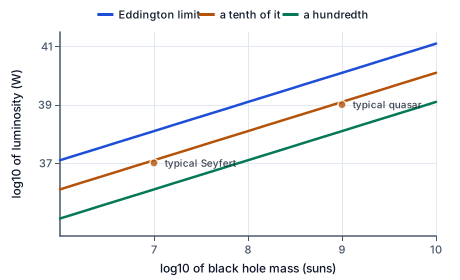
The figure plots the logarithm of luminosity against the logarithm of black hole mass. The top line is the Eddington limit, and the lines below it a tenth and a hundredth of it; each is straight with slope one, because the limit is proportional to mass. A typical Seyfert, ten million suns at $10^{37}$ W, and a typical quasar, a billion suns at $10^{39}$ W, both sit near a tenth of their limits. Reading across from any luminosity to the top line gives the least mass that could power it.
A variability size must grow in proportion to the variability time: an hour's variation means about seven astronomical units, a day's about $170$. An accretion rate for a quasar should be fractions of a sun to tens of suns per year; thousands means the efficiency or $c^2$ was dropped. A minimum mass must be millions to billions of suns for a luminous nucleus. And an Eddington ratio above about one for a steady source signals either strong outflows, a beamed view or a mass that is too small.
3C 273, in Virgo, is bright enough to see in a backyard telescope, at about magnitude $12.9$, yet it lies about two and a half billion light-years away. When Maarten Schmidt at the Palomar Observatory in California read its redshift in 1963, he realized the "star" was emitting more light than hundreds of large galaxies. Astronomers later found it varies over months and launches a jet visible in radio, optical and X-ray light across about two hundred thousand light-years.
Its black hole, weighed by reverberation mapping and by interferometry of its broad-line gas, has a few hundred million to a billion suns, the two methods differing. A black hole that heavy swallowing a few suns a year accounts for all of that power; nothing else known does.
Surveys such as the Sloan Digital Sky Survey, run from the Apache Point Observatory in New Mexico, have catalogued hundreds of thousands of quasars. The most distant known are seen as they were when the universe was less than a billion years old, yet they already hold black holes of about a billion suns, and the James Webb Space Telescope has since found active black holes even earlier.
Growing a billion suns that quickly is hard: feeding at the Eddington limit, a black hole doubles its mass only about every $50$ million years. How the first supermassive black holes grew so fast, whether from heavy seeds or bursts above the limit, is an open question that Webb's observations are now testing.
Quasars outshine whole galaxies, so it is natural to imagine an enormous, dense swarm of stars. But their brightness changes in days, which limits the emitting region to light-days across, and no swarm of stars that small and that luminous could survive. The power comes from gas spiraling into a black hole of millions to billions of suns, which turns about a tenth of the infalling mass into energy.
A second slip is thinking the black hole itself shines. Nothing escapes from inside the horizon; the light comes from the hot disk and gas just outside it, heated as matter falls in.
A quasar varies in one day. Convert the time to seconds.
$1\ \text{day} = 86{,}400\ \text{s}$
SI units.
Write the size limit.
$R \lesssim c\,\Delta t$
Light-travel time.
Multiply light speed by the time.
$R \lesssim 3.00 \times 10^{5} \times 86{,}400 = 2.59 \times 10^{10}\ \text{km}$
Kilometers.
Divide by the kilometers in an astronomical unit.
$2.59 \times 10^{10} \div 1.496 \times 10^{8} = 173\ \text{AU}$
About four times Pluto's distance.
Compare with a galaxy.
$173\ \text{AU vs } 10^{5}\ \text{light-years}$
Tens of millions of times smaller.
A quasar shines at $10^{39}$ W with efficiency $0.1$. Write the accretion rate.
$\dot M = \dfrac{L}{0.1\,c^2}$
From L = eta Mdot c squared.
Multiply the efficiency by c squared.
$0.1 \times 9 \times 10^{16} = 9 \times 10^{15}\ \text{J/kg}$
Energy released per kilogram.
Divide the luminosity by it.
$\dot M = 10^{39} \div 9 \times 10^{15} = 1.11 \times 10^{23}\ \text{kg/s}$
Kilograms per second.
Convert to suns per year.
$1.11 \times 10^{23} \times 3.156 \times 10^{7} \div 1.989 \times 10^{30} = 1.76$
Suns per year.
Find the least black hole mass.
$M_{\min} = 10^{39} \div 1.26 \times 10^{31} = 7.9 \times 10^{7}\ M_\odot$
About eighty million suns.
Compare with fusion.
$0.1 \div 0.007 \approx 14$
Fusion would need fourteen times the fuel.
A nucleus's broad lines lag its continuum by $20$ days and are $4{,}000$ km/s wide. Find the distance to the gas.
$R = c\tau = 20\ \text{light-days}$
Light-travel delay.
Convert to kiloparsecs.
$R = 20 \times 8.4 \times 10^{-7} = 1.68 \times 10^{-5}\ \text{kpc}$
Matching 1/G's units.
Square the speed.
$4{,}000^2 = 1.6 \times 10^{7}\ (\text{km/s})^2$
Line width squared.
Write the virial mass.
$M = 2.325 \times 10^{5} \times R \times v^2$
Taking the geometry factor as one.
Multiply the three factors.
$M = 2.325 \times 10^{5} \times 1.68 \times 10^{-5} \times 1.6 \times 10^{7} = 6.2 \times 10^{7}\ M_\odot$
Sixty million suns.
Find its Eddington luminosity.
$L_{\text{Edd}} = 1.26 \times 10^{31} \times 6.2 \times 10^{7} = 7.8 \times 10^{38}\ \text{W}$
Its maximum steady output.
Compare with a luminosity of $10^{38}$ W.
$10^{38} \div 7.8 \times 10^{38} = 0.13$
Feeding at about a tenth of its limit.
Convert the time to seconds.
$10 \times 3{,}600 = 36{,}000\ \text{s}$
SI units.
Multiply by the speed of light.
$300{,}000 \times 36{,}000 = 1.08 \times 10^{10}\ \text{km}$
The light-travel size.
Divide by 150 million km.
A quasar outshines a thousand Milky Ways, yet its brightness doubles in a single day. What does the variation tell us about the source?
Complete the worked solution: an active nucleus varies in $10$ hours, which is $36000$ seconds. With light at $300{,}000$ km/s and an astronomical unit of $150$ million km, how large can the varying region be?
Multiply light speed by the time in seconds.
$R \lesssim$ r $\text{billion km}$
The light-travel size.
Divide by the kilometers in an astronomical unit.
$R \lesssim$ a $\text{AU}$
Compare with the solar system.
Interpret the size in words.
$\text{smaller than the solar system, yet brighter than a galaxy}$
Only accretion onto a black hole fits.
Match each kind of active nucleus to the view of the same engine that produces it.
| seen from above the dusty torus | seen edge-on, through the torus | seen straight down its jet | seen with its jets crossing the sky | |
|---|---|---|---|---|
| a Seyfert galaxy with broad emission lines | ||||
| a Seyfert galaxy with only narrow lines | ||||
| a blazar | ||||
| a radio galaxy with giant lobes |
An active nucleus shines at $1 \times 10^{39}$ W. Taking an efficiency of $0.1$, $c^2 = 9 \times 10^{16}$ J/kg, a solar mass of $1.989 \times 10^{30}$ kg and a year of $3.156 \times 10^{7}$ s, fill in its accretion rate in suns per year and the least black hole mass that could power it, in units of $10^7$ suns.
| value | |
|---|---|
| accretion rate (suns per year) | |
| least mass (10^7 suns) |
In an active nucleus, the broad emission lines respond to changes in the central light $20$ days later. Taking $M = Rv^2/G$ with $R = c\tau$, $1/G = 2.325 \times 10^{5}$ suns per (km/s)$^2$ per kpc and a light-day as $8.4 \times 10^{-7}$ kpc, write the black hole's mass, in units of $10^6$ suns, as a function of the line width $v$ in units of $1{,}000$ km/s.
Answer:
An active nucleus shines at $5 \times 10^{37}$ W around a black hole of $1 \times 10^{7}$ suns. What is its Eddington ratio, $L/L_{\text{Edd}}$, with $L_{\text{Edd}} = 1.26 \times 10^{31}$ W per solar mass?
Answer: of the Eddington limit
A survey finds an unfamiliar quasar shining at $4 \times 10^{39}$ W, and reverberation mapping gives its black hole $5 \times 10^{8}$ suns. Taking an efficiency of $0.1$, $c^2 = 9 \times 10^{16}$ J/kg, a solar mass of $1.989 \times 10^{30}$ kg and a year of $3.156 \times 10^{7}$ s, fill in its accretion rate in suns per year and its Eddington ratio.
| value | |
|---|---|
| accretion rate (suns per year) | |
| Eddington ratio |
Lesson test: one question per skill, one attempt each, no hints. Your answers are checked when you submit.
In an active nucleus, the broad emission lines respond to changes in the central light $10$ days later. Taking $M = Rv^2/G$ with $R = c\tau$, $1/G = 2.325 \times 10^{5}$ suns per (km/s)$^2$ per kpc and a light-day as $8.4 \times 10^{-7}$ kpc, write the black hole's mass, in units of $10^6$ suns, as a function of the line width $v$ in units of $1{,}000$ km/s.
Answer:
You can account for a quasar. Find the size of a source that varies in a day, and the accretion rate and least black hole mass of a quasar shining at 10^39 W.
21. Your turn: an active nucleus varies in $10$ hours. How large can it be, in astronomical units?, step 3
$R \lesssim 72\ \text{AU}$
About twice Pluto's distance.