Back to the on-screen lesson ·
When core hydrogen runs out, a shell burns and the envelope swells into a red giant; a Sun-like star flashes into helium burning, climbs the asymptotic giant branch, sheds a planetary nebula and leaves a white dwarf, while stars above 8 suns burn to iron.
Paper packet. Every task here also exists on screen, where it is checked automatically; answers written on paper are not assessed by Nydus. When you are back at a device, enter your answers there.
By the end of this lesson you will be able to follow a star's evolution after the main sequence by its mass and read its track on the H-R diagram.
You know how long a star stays on the main sequence, that helium fusion releases much less energy per kilogram than hydrogen fusion, and that degenerate gas resists compression whatever its temperature, a point lesson 12 develops. You can read a radius from a luminosity and a temperature. This lesson follows a star after its core hydrogen is gone, mostly the Sun's own future, and contrasts it with the lives of heavier stars.
| Term | What it means |
|---|---|
| Shell burning | Fusion in a thin layer around an inert core, rather than in the core itself. |
| Red giant branch | The track a low-mass star climbs as a hydrogen shell burns around a contracting helium core. |
| Helium flash | The runaway ignition of helium in a degenerate core, at about 100 million kelvins. |
| Horizontal branch | Where a low-mass star burns helium in its core, for about 100 million years. |
| Asymptotic giant branch | The second giant phase, with helium and hydrogen shells around a carbon-oxygen core. |
| Planetary nebula | The glowing shell of gas a dying low-mass star sheds, lit by its exposed hot core. |
When core hydrogen runs out, fusion moves to a shell. The inert helium core contracts and heats, and the energy from the shell swells the envelope: the star climbs the red giant branch to hundreds of solar radii. A Sun-like star's degenerate core ignites helium in a flash at about $10^8$ K, burns it on the horizontal branch for about $100$ million years,
$$t_{\text{He}} \approx \frac{9{,}600\ \text{Myr} \times M_{\text{core}}/M_\odot}{L/L_\odot},$$
climbs the asymptotic giant branch, sheds its envelope as a planetary nebula and leaves a white dwarf of about $0.109\,M + 0.394$ solar masses. Stars above about $8$ suns burn on to iron.
Another way: picture
Picture a campfire whose center has burned to ash. The fire does not go out; it creeps outward in a ring around the ash, and the ring burns hotter than the original fire because the hot ash beneath it keeps it toasted. The smoke and heat billow higher. A red giant is a star whose core has burned to helium ash, with a fierce ring of fusion around it puffing up everything outside.
Another way: steps
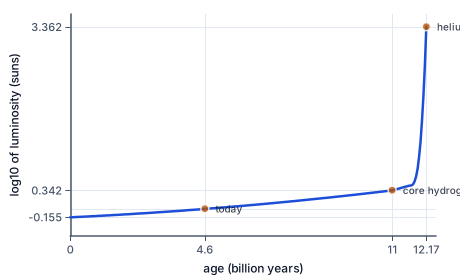
On the main sequence the core slowly fills with helium, raising its mean molecular weight; to keep its pressure, the core contracts and heats, and the Sun brightens, as the figure shows. When the core's hydrogen is exhausted, fusion stops there. The helium core, with no energy source, can support itself only by contracting further and heating, while hydrogen keeps fusing in a shell just outside it.
The shell sits on a hotter, denser base than the old core did, so it burns faster. The star crosses the H-R diagram to the right as a subgiant, its surface cooling while its luminosity rises.
As the shell eats outward, it adds helium to the core, which grows heavier and denser. In a Sun-like star the core becomes degenerate, supported by electrons packed so tightly that quantum mechanics, not temperature, sets their pressure. The shell's output rises steeply with the core's mass, and the energy pours into the envelope, which expands enormously and cools to about $3{,}000$ K.
This is a mirror principle often seen in stellar evolution: when a core contracts, the envelope expands. At the tip of the red giant branch the Sun will reach about $2{,}300$ times its present luminosity and about $170$ times its radius, about $0.8$ AU, swallowing Mercury and Venus. Whether it reaches Earth depends on how much mass it has lost, which loosens the planets' orbits.
Helium fuses by the triple-alpha process, three helium-4 nuclei making carbon-12, which needs about $100$ million kelvins and is extraordinarily sensitive to temperature, roughly as $T^{40}$. When the degenerate core reaches that temperature, helium ignites. In ordinary gas, heating would raise the pressure, expand the core and cool it, a safety valve. In degenerate gas the pressure does not depend on temperature, so the core heats without expanding, the rate soars, and a runaway follows: the helium flash.
For a few seconds the core's output may reach a hundred billion suns, yet none of it reaches the surface; the energy goes into lifting the core's degeneracy. Within minutes the core becomes an ordinary gas again and settles down.
After the flash the star burns helium in its core, making carbon and some oxygen, with hydrogen still burning in a shell. It shrinks to about ten solar radii and sits on the horizontal branch, or, for metal-rich stars like the Sun, in the red clump, at about $50$ solar luminosities.
Helium releases only about a tenth as much energy per kilogram as hydrogen, and the star is far brighter than it was on the main sequence, so this stage is short. A core of half a solar mass at $45$ suns lasts about $9{,}600 \times 0.5/45 \approx 110$ million years, roughly a hundredth of the main-sequence life.
When core helium is exhausted, the star has an inert carbon-oxygen core inside a helium-burning shell inside a hydrogen-burning shell. It climbs the H-R diagram again on the asymptotic giant branch, growing larger and brighter than before. The helium shell burns unstably in thermal pulses every hundred thousand years or so; these dredge carbon to the surface and build heavy elements by slow neutron capture.
Powerful winds strip the envelope, and the exposed hot core lights the expelled gas as a planetary nebula, which glows for some tens of thousands of years before dispersing. The core remains as a white dwarf. Measurements of white dwarfs in star clusters of known age give an initial-final mass relation, roughly $M_{\text{WD}} = 0.109\,M + 0.394$: the Sun will leave a white dwarf of about half its present mass.
Stars above about two solar masses ignite helium before their cores become degenerate, so there is no flash; during helium burning many cross the instability strip and pulsate as Cepheid variables. Stars above about eight solar masses go much further. Each time a fuel is exhausted, the core contracts and heats until the next ignites: carbon at about $600$ million kelvins, then neon, oxygen and, at about three billion kelvins, silicon, leaving the star layered like an onion.
Each stage is shorter than the last: for a $25$-solar-mass star, hydrogen lasts about seven million years and silicon about a day. Silicon burning makes iron, from which no fusion releases energy, and the iron core's collapse ends in a supernova, the subject of lesson 12.
Giants lose mass in winds because their surface gravity is so weak: at $170$ solar radii, the Sun's surface gravity would be thirty thousand times weaker than now. Over the red giant and asymptotic giant branches the Sun will lose about half its mass. Mass loss decides whether a star leaves a white dwarf or explodes, how large its planets' orbits grow, and how much carbon, nitrogen and heavy elements return to the galaxy to build new stars. It is also the least certain part of stellar evolution, measured from observations rather than derived.
The figure shows the Sun's luminosity against its age, on a logarithmic scale. For eleven billion years it rises only gently, from $0.7$ of today's value to about $2.2$, as helium accumulates in the core; today, at $4.6$ billion years, it is exactly $1$. Then the curve turns sharply upward: through the subgiant stage and up the red giant branch it climbs about three powers of ten in roughly half a billion years, to about $2{,}300$ suns at the helium flash. Stars spend most of their lives on the main sequence, which is why most stars we see are there.
A red giant's radius should be tens to hundreds of solar radii, and its temperature below about $5{,}000$ K; a radius smaller than the Sun's means the temperature ratio was inverted. A helium-burning lifetime must be much shorter than the main-sequence lifetime of the same star. A white dwarf's mass must be less than the starting mass and, for single stars, between about $0.5$ and $1.4$ suns. And stages must come in order of the fuels: hydrogen in the core, hydrogen in a shell, helium in the core, helium and hydrogen in shells.
Between late 2019 and February 2020, Betelgeuse, the red supergiant at Orion's shoulder, faded from its usual magnitude of about $0.5$ to about $1.6$, losing nearly two-thirds of its visible light. Some wondered whether it was about to explode. Observations with the Hubble Space Telescope and ground-based telescopes showed instead that a huge bubble of gas had erupted from its surface and cooled into a cloud of dust that blocked part of the star.
The event was a mass-loss episode caught in the act, the same process that will strip the Sun's envelope, on a much larger scale. Betelgeuse, about $18$ solar masses and burning helium in its core, is expected to explode as a supernova sometime in the next hundred thousand years or so.
In August 2023 the James Webb Space Telescope released images of the Ring Nebula, a planetary nebula about $2{,}600$ light-years away in the constellation Lyra. They show a glowing ring of gas expanding from a white dwarf at its center, with thousands of clumps and concentric arcs that record pulses of mass loss as the dying star shed its outer layers.
The nebula's gas is rich in carbon-bearing molecules, made in the star's interior and brought up during its asymptotic giant branch phase. Planetary nebulae like this return carbon and nitrogen to interstellar space; much of the carbon in living things on Earth was made inside stars that ended this way.
Red giants are red because their surfaces are cool, so it is easy to think the whole star is cooling down as its fuel fails. In fact a red giant is hundreds to thousands of times more luminous than the main-sequence star it came from. Its core is hotter than ever, and a shell is burning hydrogen furiously; the envelope is cool only because it has swollen so large that each square meter radiates little.
A second slip is thinking the Sun will explode as a supernova. Only stars above about eight solar masses do; the Sun will end gently, as a planetary nebula and a white dwarf.
At the tip, the Sun will have $L \approx 2{,}300$ suns and $T \approx 3{,}100$ K. Write its radius.
$R = \sqrt{L}\,(5{,}772 \div T)^2$
In solar units.
Take the square root of the luminosity.
$\sqrt{2{,}300} = 47.96$
Luminosity grows with area.
Square the temperature ratio.
$(5{,}772 \div 3{,}100)^2 = 3.467$
A cooler surface needs more area.
Multiply the two.
$R = 47.96 \times 3.467 = 166\ R_\odot$
Solar radii.
Divide by 215 for astronomical units.
$166 \div 215 = 0.77\ \text{AU}$
Past Venus's orbit at 0.72 AU.
A star burns a helium core of $0.5$ suns at $45$ suns. Write the lifetime.
$t = \dfrac{E}{L}$
Energy over power.
Find helium fusion's efficiency.
$7.275\ \text{MeV} \div (3 \times 4.0026 \times 931.5\ \text{MeV}) = 6.5 \times 10^{-4}$
Triple alpha releases 7.275 MeV.
Express the energy per solar mass of helium.
$6.5 \times 10^{-4} \times M_\odot c^2 \div L_\odot = 9{,}600\ \text{Myr}$
In solar-luminosity million years.
Multiply by the core mass.
$E = 9{,}600 \times 0.5 = 4{,}800\ L_\odot\ \text{Myr}$
The core's energy.
Divide by the luminosity.
$t = 4{,}800 \div 45 = 107\ \text{million years}$
About 100 million years.
Compare with the main sequence.
$107 \div 10{,}000 \approx 0.011$
About a hundredth as long.
Take the Sun's present mass, $1.0$ sun. Write the initial-final mass relation.
$M_{\text{WD}} = 0.109\,M + 0.394$
Measured from cluster white dwarfs.
Multiply the mass by the slope.
$0.109 \times 1.0 = 0.109$
The part that grows with mass.
Add the constant.
$M_{\text{WD}} = 0.109 + 0.394 = 0.503\ M_\odot$
About half a solar mass.
Subtract from the starting mass.
$1.0 - 0.503 = 0.497\ M_\odot$
Shed into space.
Find the fraction lost.
$0.497 \div 1.0 = 50\%$
Half the Sun.
Compare with the core at the helium flash.
$0.47\ M_\odot \to 0.50\ M_\odot$
The core grows a little more on the asymptotic giant branch.
Say where the mass goes.
$\text{winds and the planetary nebula}$
Returned to the galaxy for new stars.
Write the conversion.
$1\ \text{AU} = 215\ R_\odot$
The Sun's radius fits 215 times into an AU.
Divide the radius by 215.
$430 \div 215$
Solar radii to AU.
State the result.
When the Sun's core runs out of hydrogen, its core will contract but its outer envelope will expand to over a hundred times its present radius. Why?
Complete the worked solution: a horizontal-branch star burns a helium core of $0.6$ solar masses at a luminosity of $80$ suns. One solar mass of helium supplies one solar luminosity for $9{,}600$ million years. How long does its helium last?
Multiply 9,600 by the core mass.
$E =$ e $L_\odot\ \text{million years}$
The energy in the core.
Divide the energy by the luminosity.
$t =$ t $\text{million years}$
Lifetime is energy over power.
Compare with the main sequence in words.
$\text{about a hundred times shorter than core hydrogen burning}$
Helium releases less energy and the star is brighter.
Put these stages of the Sun's life in order, earliest first.
Number the steps in order (write the number in the box):
A Sun-like star early on the asymptotic giant branch has a luminosity of $1000$ suns and a surface temperature of $3500$ K. Taking the Sun's temperature as $5{,}772$ K and an astronomical unit as $215$ solar radii, fill in its radius in solar radii and in astronomical units.
| value | |
|---|---|
| radius (solar radii) | |
| radius (AU) |
Fusing one solar mass of helium into carbon and oxygen releases enough energy to supply one solar luminosity for about $9{,}600$ million years. A star burns a helium core of $0.8$ solar masses. Write its helium-burning lifetime $t$, in millions of years, as a function of its luminosity $L$ in suns.
Answer:
A planetary nebula has a radius of $0.05$ pc and expands at $30$ km/s. Assuming a steady expansion, about how many years ago was it ejected? Use $3.086 \times 10^{13}$ km per parsec and $3.156 \times 10^{7}$ s per year.
Answer: years
Sirius A has about $2.06$ solar masses. Using the initial-final mass relation measured from white dwarfs in star clusters, $M_{\text{WD}} = 0.109\,M + 0.394$ in suns, fill in the mass of the white dwarf it will leave and the mass it will shed on the way.
| value | |
|---|---|
| white dwarf mass (suns) | |
| mass shed (suns) |
Lesson test: one question per skill, one attempt each, no hints. Your answers are checked when you submit.
Fusing one solar mass of helium into carbon and oxygen releases enough energy to supply one solar luminosity for about $9{,}600$ million years. A star burns a helium core of $0.6$ solar masses. Write its helium-burning lifetime $t$, in millions of years, as a function of its luminosity $L$ in suns.
Answer:
You can trace a star's later life. Find the Sun's radius at the tip of the red giant branch, and how long a 0.5-solar-mass helium core lasts at 45 suns.
20. Your turn: a giant has a radius of $430$ solar radii. How many astronomical units is that?, step 3
$2\ \text{AU}$
Beyond the orbit of Mars.