Back to the on-screen lesson ·
A core too heavy for any pressure collapses to a black hole with a horizon at R_s = 2 G M / c^2, about 3 km per solar mass; X-ray binaries, stellar orbits, horizon-scale images and the gravitational waves of mergers reveal them.
Paper packet. Every task here also exists on screen, where it is checked automatically; answers written on paper are not assessed by Nydus. When you are back at a device, enter your answers there.
By the end of this lesson you will be able to describe black holes with the Schwarzschild radius, weigh the evidence for them including gravitational waves, and tell a black hole from a white dwarf or neutron star.
You know neutron stars have a maximum mass of about two to three suns, how to weigh an unseen companion from a binary orbit, and how accretion makes compact objects glow in X-rays. You know escape speed is $\sqrt{2GM/r}$. This lesson follows a collapse that nothing can stop to its end, a black hole, and the evidence, from orbits, images and gravitational waves, that such objects are real.
| Term | What it means |
|---|---|
| Black hole | A region of space where gravity is so strong that nothing, not even light, can escape. |
| Event horizon | The boundary of a black hole, beyond which escape is impossible. |
| Schwarzschild radius | The radius of a nonrotating black hole's horizon, 2 G M / c^2, about 2.95 km per solar mass. |
| Innermost stable orbit | The smallest circular orbit gas can keep around a nonrotating black hole, at three Schwarzschild radii. |
| Gravitational time dilation | The slowing of clocks deep in a gravitational field, by sqrt(1 - R_s / r) near a black hole. |
| Gravitational waves | Ripples in space and time, radiated by accelerating masses such as merging black holes. |
If a collapsing core is too heavy for neutron degeneracy, nothing stops it, and it becomes a black hole. Its event horizon lies at the Schwarzschild radius,
$$R_s = \frac{2GM}{c^2} = 2.95\ \text{km}\ \times \frac{M}{M_\odot},$$
inside which even light cannot escape. Far outside, its gravity is that of any mass $M$. Near it, gas can orbit stably only beyond $3R_s$ and clocks run slow by $\sqrt{1 - R_s/r}$. Black holes are found by their companions' orbits, by horizon-scale images, and by the gravitational waves of their mergers.
Another way: picture
Picture a river flowing toward a waterfall, faster and faster near the edge. A fish far upstream swims wherever it likes; nearer the falls it must swim harder just to stay put; past a certain line the water flows faster than any fish can swim, and it is carried over. For light near a black hole, the event horizon is that line.
Another way: steps
A neutron star can support only about two to three solar masses; above that, even neutron degeneracy and nuclear forces give way. A collapsing core heavier than this, or a neutron star pushed over the limit by accretion or a merger, has no pressure left that can resist gravity. General relativity predicts that it collapses to a point of infinite density, hidden inside an event horizon. The singularity itself marks where the theory breaks down; the horizon is where the physics we can observe ends.
In 1783 the English clergyman John Michell noticed that if a star were dense enough, its escape speed, $\sqrt{2GM/r}$, would exceed the speed of light, and it would be dark. Setting $\sqrt{2GM/R} = c$ gives $R = 2GM/c^2$. In 1916, weeks after Einstein published general relativity, Karl Schwarzschild found the exact solution for a point mass, and the same radius appeared as the event horizon:
$$R_s = \frac{2GM}{c^2} = 2.95\ \text{km per solar mass}.$$
The Sun would have to be squeezed below $3$ km to become a black hole, and Earth below $9$ mm. The horizon is not a surface; anything crossing it simply cannot return.
Far away, a black hole's gravity is ordinary: Earth's orbit would not change if the Sun became a black hole of the same mass. Close in, relativity takes over. At $1.5R_s$, light itself can orbit, on the photon sphere. Inside $3R_s$, the innermost stable circular orbit, no orbit is stable, and gas spirals straight in, so an accretion disk ends there; gas that reaches it has radiated $5.7$ percent of its rest energy, and up to $42$ percent around a fast-spinning hole.
A clock held at radius $r$ runs slow by the factor $\sqrt{1 - R_s/r}$ compared with one far away, and the factor goes to zero at the horizon. Tides grow too: near a stellar black hole, the difference in pull between head and feet would stretch a falling astronaut apart.
A black hole on its own is nearly invisible, but in a binary its companion's orbit weighs it, exactly as in lesson 5. In Cygnus X-1, a blue supergiant orbits an unseen object every $5.6$ days; its velocity curve and distance give the companion a mass of about $21$ suns, in a region small enough, from its rapid X-ray flickering, to be compact. No neutron star can be that heavy. Dozens of such X-ray binaries are now known, with unseen companions from about $5$ to over $20$ suns. Gaia has also found dormant black holes, such as Gaia BH3, about $33$ suns, revealed only by a companion star's wobble.
For three decades, teams led by Andrea Ghez at UCLA, using the Keck telescopes on Mauna Kea in Hawaii, and Reinhard Genzel in Germany tracked stars orbiting the center of the Milky Way in the infrared, through the dust. The star S2 follows an ellipse with a semimajor axis of about $1{,}030$ AU every $16.0$ years. Kepler's third law gives the mass inside its orbit: $M = a^3/P^2 \approx 1{,}030^3/16.0^2 \approx 4.3$ million suns, in a region smaller than our solar system's outer edge. Only a black hole fits. Ghez and Genzel shared the 2020 Nobel Prize in Physics.
A black hole's horizon bends light around it, so in front of glowing gas it should cast a dark shadow about $2.6$ times the horizon's size. The Event Horizon Telescope links radio dishes across the globe, including telescopes on Mauna Kea, at Kitt Peak in Arizona and at the South Pole, into one Earth-sized telescope. In 2019 it released the first image of a black hole's shadow, at the center of the galaxy M87, a black hole of about $6.5$ billion suns; in 2022 it imaged the Milky Way's own, Sagittarius A*. Both shadows matched the sizes general relativity predicts from the measured masses.
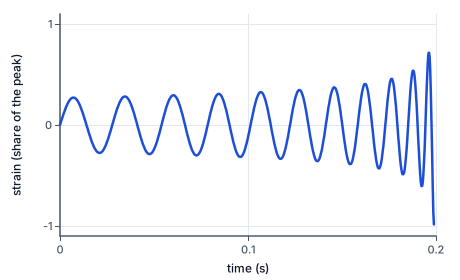
Accelerating masses send ripples through space and time, gravitational waves, which stretch and squeeze distances as they pass. Two black holes in orbit radiate them, lose energy, and spiral together faster and faster, producing a chirp of rising frequency and amplitude, as the figure shows, ending in a merger and a ringing down of the new black hole.
On September 14, 2015, the twin LIGO detectors recorded such a chirp, GW150914: black holes of about $36$ and $29$ suns merged into one of about $62$, and the missing $3$ suns, $5.4 \times 10^{47}$ J, left as gravitational waves in a fraction of a second, briefly outshining every star in the observable universe combined.
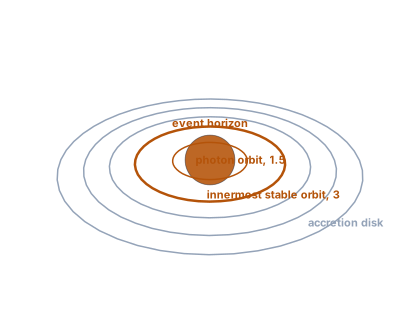
Three radii, all fixed multiples of the Schwarzschild radius, organize the space around a nonrotating black hole. The scene draws them to scale against one another: the event horizon at $R_s$, the photon orbit at $1.5 R_s$, where light can circle, and the innermost stable circular orbit at $3 R_s$, inside which matter spirals straight in. An accretion disk's inner edge sits at that last radius, which sets how much energy the disk can release.
The figure is a schematic of a merger's gravitational-wave signal over its last two tenths of a second. At first the waves arrive about $35$ times a second with small amplitude. As the orbit shrinks, the holes circle faster, so both frequency and amplitude climb, reaching about $250$ cycles a second and the largest swing just before merger, where the signal ends. The way the frequency rises measures the binary's masses; the final ringing, not drawn here, measures the new black hole's mass and spin.
A Schwarzschild radius must grow in proportion to mass: about $3$ km for each solar mass, so a few tens of kilometers for a stellar black hole and millions of kilometers for a supermassive one. The innermost stable orbit must be three times the horizon for a nonrotating hole. A clock's rate near a black hole must lie between $0$ at the horizon and $1$ far away. The energy radiated in a merger must be a few percent of the total mass, never more than the mass that went in. And a compact object with a surface, pulses or bursts cannot be a black hole, however heavy it seems.
The Laser Interferometer Gravitational-Wave Observatory has two detectors, at Hanford, Washington, and Livingston, Louisiana, about $3{,}000$ km apart. Each splits a laser beam down two $4$-kilometer arms at right angles and recombines it. A passing gravitational wave stretches one arm and squeezes the other by a tiny fraction of a proton's width, shifting the recombined light.
On September 14, 2015, both detectors recorded the same chirp, seven milliseconds apart, from black holes merging $1.3$ billion light-years away. Rainer Weiss, Barry Barish and Kip Thorne shared the 2017 Nobel Prize in Physics. Since then, with the Virgo detector in Italy and KAGRA in Japan, the network has recorded hundreds of mergers, including two neutron stars colliding in 2017, an event also seen as a flash of light from radioactive heavy elements.
In May 2022 the Event Horizon Telescope collaboration released an image of Sagittarius A*, the black hole at the center of our galaxy: a dark shadow inside a glowing ring about $52$ microarcseconds across, the size a doughnut on the Moon would appear from Earth. Making it required radio dishes from Hawaii to Spain to the South Pole, including the Submillimeter Array and the James Clerk Maxwell Telescope on Mauna Kea and the Submillimeter Telescope on Mount Graham in Arizona, observing together on the same nights.
The ring's size matched the shadow general relativity predicts for $4$ million suns, the mass measured independently from the orbits of stars like S2. Two methods, one using starlight in the infrared and one radio waves from hot gas, agree on a black hole.
Films picture black holes as cosmic vacuum cleaners. But outside a few horizon radii a black hole's gravity is just that of any object of the same mass: planets and stars orbit it as they would orbit a star. Matter falls in only if it heads almost straight at it or loses its orbital energy, as gas in an accretion disk does.
A second slip is thinking black holes must be enormous. A black hole's size is set by its mass: one of ten suns is only about $60$ km across, smaller than many cities, while the giants at galaxies' centers are millions of kilometers across.
A black hole has $10$ solar masses. Write the Schwarzschild radius.
$R_s = \dfrac{2GM}{c^2}$
Where escape speed reaches light speed.
Use the value for one sun.
$\dfrac{2GM_\odot}{c^2} = 2.953\ \text{km}$
From G, the Sun's mass and c.
Multiply by the mass in suns.
$R_s = 2.953 \times 10 = 29.5\ \text{km}$
A city-sized horizon.
Triple it for the innermost stable orbit.
$r_{\text{ISCO}} = 3 \times 29.5 = 88.6\ \text{km}$
Where the accretion disk ends.
Compare with a neutron star's radius.
$29.5\ \text{km} > 12\ \text{km}$
A stellar black hole is larger than a neutron star.
GW150914 began with $36$ and $29$ suns. Add them.
$36 + 29 = 65\ M_\odot$
Mass in.
Subtract the final mass of $62$ suns.
$65 - 62 = 3\ M_\odot$
Mass radiated.
Find the Sun's rest energy.
$M_\odot c^2 = 1.989 \times 10^{30} \times (2.998 \times 10^{8})^2 = 1.788 \times 10^{47}\ \text{J}$
E = m c squared.
Multiply by the mass radiated.
$E = 3 \times 1.788 \times 10^{47} = 5.36 \times 10^{47}\ \text{J}$
Carried by gravitational waves.
Find the Sun's lifetime output.
$3.83 \times 10^{26} \times 10^{10} \times 3.156 \times 10^{7} = 1.21 \times 10^{44}\ \text{J}$
Ten billion years of sunshine.
Divide the merger's energy by it.
$5.36 \times 10^{47} \div 1.21 \times 10^{44} \approx 4{,}400$
Four thousand Suns' whole lives in under a second.
The star S2 orbits with semimajor axis $1{,}030$ AU and period $16.05$ years. Write Kepler's third law.
$M = \dfrac{a^3}{P^2}$
Suns, AU and years.
Cube the semimajor axis.
$1{,}030^3 = 1.093 \times 10^{9}$
AU cubed.
Square the period.
$16.05^2 = 257.6$
Years squared.
Divide the two.
$M = 1.093 \times 10^{9} \div 257.6 = 4.24 \times 10^{6}\ M_\odot$
Four million suns.
Find its Schwarzschild radius.
$R_s = 2.953 \times 4.24 \times 10^{6} = 1.25 \times 10^{7}\ \text{km}$
About 0.08 AU.
Compare with S2's closest approach.
$120\ \text{AU} \gg 0.08\ \text{AU}$
S2 never comes near the horizon.
Say why it must be a black hole.
$\text{four million suns in a region too small for any cluster of stars}$
A cluster that dense would have collapsed or dispersed.
Write the rate.
$\sqrt{1 - R_s/r}$
Gravitational time dilation.
Substitute the distance.
$\sqrt{1 - 9/25} = \sqrt{16/25}$
R_s over r is 9/25.
State the rate.
Suppose the Sun were suddenly replaced by a black hole of exactly the Sun's mass. What would happen to Earth's orbit?
Complete the worked solution: a clock hovers $75$ km from a black hole of $9$ solar masses. Taking the horizon as $3$ km per solar mass, how fast does the clock run compared with one far away?
Multiply the mass by 3 km.
$R_s =$ s $\text{km}$
The horizon.
Take the square root of one minus the horizon over the distance.
$\text{rate} =$ f
Gravitational time dilation.
Interpret the rate in words.
$\text{the clock ticks slower than a distant one}$
Time runs slower deeper in gravity.
Match each observation to what it shows about black holes.
| a compact companion too heavy to be a neutron star | four million suns packed inside S2's orbit | a shadow matching a horizon's predicted size | two black holes spiraling together and merging | |
|---|---|---|---|---|
| Cygnus X-1's orbit | ||||
| the star S2's orbit at the Milky Way's center | ||||
| the Event Horizon Telescope's image of M87 | ||||
| LIGO's signal of September 14, 2015 |
For a nonrotating black hole of $10$ solar masses, fill in its Schwarzschild radius and its innermost stable circular orbit in kilometers, taking $2GM_\odot/c^2 = 2.953$ km.
| value | |
|---|---|
| Schwarzschild radius (km) | |
| innermost stable orbit (km) |
Taking a black hole's Schwarzschild radius as $3$ km per solar mass, write the radius $R$ in kilometers, with M in suns.
Answer:
In the merger GW170104, black holes of $31.2$ and $19.4$ solar masses left a black hole of $48.7$ solar masses. Taking the Sun's rest energy as $1.788 \times 10^{47}$ J, how much energy did the gravitational waves carry away, in units of $10^{47}$ J?
Answer: times 10^47 joules
A survey reports an unfamiliar compact object: 1.6 solar masses in a body about 22 km across, sending X-ray pulses every 3 milliseconds. Decide whether it is a white dwarf, a neutron star or a black hole, and give its Schwarzschild radius in kilometers, taking $2.953$ km per solar mass.
| what it is | Schwarzschild radius (km) | |
|---|---|---|
| the object |
Lesson test: one question per skill, one attempt each, no hints. Your answers are checked when you submit.
Taking a black hole's Schwarzschild radius as $3$ km per solar mass, write the radius $R$ in astronomical units of 150 million km, with M in millions of suns.
Answer:
You can describe a black hole. Find the horizon and innermost stable orbit of a 10-solar-mass black hole, and the energy radiated when 36 and 29 suns merge into 62.
21. Your turn: a clock hovers at $25R_s/9$ from a black hole. How fast does it run compared with a distant clock?, step 3
$0.8$
Eight tenths of a distant clock's rate.