Back to the on-screen lesson ·
Scaling hydrostatic equilibrium gives P_c ~ G M^2 / R^4 and T_c ~ G M mu m_H / k R; the virial theorem ties thermal to gravitational energy, so contracting stars heat; and polytropes give the Sun's central pressure within a factor of two.
Paper packet. Every task here also exists on screen, where it is checked automatically; answers written on paper are not assessed by Nydus. When you are back at a device, enter your answers there.
By the end of this lesson you will be able to estimate a star's central pressure and temperature with scaling arguments, the virial theorem and polytropic models.
You have the four equations of stellar structure and the ideal gas law, and you know the Sun's mass, radius and mean density. You can solve a differential equation numerically in principle. This lesson extracts the central pressure and temperature from those equations without solving them in full, first by scaling, then by an energy argument, the virial theorem, and finally with the simplest family of exact models, the polytropes.
| Term | What it means |
|---|---|
| Scaling argument | An estimate made by replacing derivatives with ratios of typical values, keeping the dependence on M and R. |
| Virial theorem | For a star in equilibrium, twice its thermal energy plus its gravitational energy is zero, 2K + U = 0. |
| Gravitational energy (U) | The negative energy of a star's mass held together, -(3/5) G M^2 / R for uniform density. |
| Polytrope | A model star in which pressure and density are related by P = K rho to the power 1 + 1/n. |
| Polytropic index (n) | The number n in a polytrope; larger n means a more centrally concentrated star. |
| Lane-Emden equation | The differential equation for a polytrope's structure, whose solution theta gives density as theta to the n. |
Replacing $dP/dr$ by $-P_c/R$ and $\rho$ by the mean density $M/R^3$ in hydrostatic equilibrium gives
$$P_c \sim \frac{G M^2}{R^4}, \qquad T_c \sim \frac{G M \mu m_H}{k R}.$$
The virial theorem, $2K + U = 0$, says the thermal energy is half the binding energy, so a contracting star heats. Polytropes, $P = K\rho^{1 + 1/n}$, reduce the structure equations to the Lane-Emden equation,
$$\frac{1}{\xi^2}\frac{d}{d\xi}\left(\xi^2\frac{d\theta}{d\xi}\right) = -\theta^n,$$
with density $\rho = \rho_c\theta^n$. Index $3$ gives the Sun's central pressure to within a factor of two.
Another way: picture
Picture a crowd packed into a stadium after a concert, everyone pushing toward the exits at the center of the floor. The people in the middle are squeezed by everyone around them. The more people, and the smaller the stadium, the harder the squeeze, and it grows much faster than the crowd does. A star's center is squeezed by all its mass at once, which is why its pressure goes as the mass squared and climbs steeply as the star shrinks.
Another way: steps
The structure equations are coupled and nonlinear, and real stars need numerical codes. But a good estimate shows which physics matters and how the answer depends on mass and radius, which is often what a question really asks. Scaling arguments keep the dependences exactly and give up only factors of order unity. They are the first step physicists take with any new system, and they catch errors in numerical models that would otherwise go unnoticed.
In hydrostatic equilibrium, $dP/dr = -GM(r)\rho/r^2$. Across the whole star the pressure falls from $P_c$ to nearly zero, so $dP/dr \sim -P_c/R$. Take $M(r) \sim M$, $r \sim R$ and $\rho \sim M/R^3$:
$$\frac{P_c}{R} \sim \frac{GM}{R^2}\cdot\frac{M}{R^3} \quad\Longrightarrow\quad P_c \sim \frac{G M^2}{R^4}.$$
For the Sun that is about $1.1 \times 10^{15}$ Pa. Detailed models give $2.5 \times 10^{16}$ Pa, about twenty times more, because the Sun's mass is concentrated toward its center. The estimate gets the dependence right: two stars of the same structure have central pressures in the ratio of $M^2/R^4$.
The ideal gas law at the center gives $T_c = P_c \mu m_H/(\rho_c k)$. With the scaling estimates $P_c \sim GM^2/R^4$ and $\rho_c \sim M/R^3$,
$$T_c \sim \frac{G M \mu m_H}{k R}.$$
For the Sun, with $\mu = 0.6$, this is about $1.4 \times 10^{7}$ K, remarkably close to the modeled $1.57 \times 10^{7}$ K, because the pressure and density underestimates partly cancel. The temperature scales as $M/R$: a star with the same ratio of mass to radius as the Sun has about the same central temperature. That is why main-sequence stars, whose radii grow nearly in step with their masses, all have central temperatures within a factor of a few of the Sun's.
Multiply hydrostatic equilibrium by $4\pi r^3$ and integrate over the star. The left side becomes $-3\int P\,dV$, which for an ideal monatomic gas is $-2K$, twice the thermal energy with a minus sign; the right side is the gravitational energy $U$. So
$$2K + U = 0.$$
For a uniform-density star, $U = -\tfrac{3}{5}GM^2/R$, and with $K = \tfrac{3}{2}Nk\bar T$ for $N = M/\mu m_H$ particles,
$$\bar T = \frac{G M \mu m_H}{5 k R},$$
about $2.8$ million kelvins for the Sun: the average over all its mass, far below the central value.
The total energy is $E = K + U = U/2$, negative, as it must be for a bound star. Now let the star radiate energy away. $E$ becomes more negative, so $U$ becomes more negative and the star contracts; but $K = -E$ grows, so the star heats up. Half of the gravitational energy released is radiated and half goes into heat. A star has negative heat capacity: losing energy makes it hotter.
This is how a contracting protostar heats its core to fusion temperatures. Before fusion was known, it was proposed as the Sun's power source; the Sun's binding energy, radiated at its present rate, would last only about $30$ million years, the Kelvin-Helmholtz timescale. The virial theorem also sets a limit: if the gas's adiabatic index falls to $4/3$, the total energy approaches zero and the star loses its stability, which happens when radiation pressure dominates.
Suppose pressure and density are related by $P = K\rho^{1+1/n}$ throughout the star. Then hydrostatic equilibrium and mass continuity combine into one equation. Writing $\rho = \rho_c\theta^n$ and $r = a\xi$, with $a$ a length set by $K$ and $\rho_c$, gives the Lane-Emden equation:
$$\frac{1}{\xi^2}\frac{d}{d\xi}\left(\xi^2\frac{d\theta}{d\xi}\right) = -\theta^n, \qquad \theta(0) = 1,\ \theta'(0) = 0.$$
The surface is where $\theta$ first reaches zero, at $\xi_1$. Only $n = 0$, $1$ and $5$ have formula solutions; the rest are integrated numerically once and tabulated. Each index gives the central pressure as $P_c = W_n G M^2/R^4$ and the central density as a fixed multiple of the mean.
Index 0 is a uniform-density star: $\rho_c = \bar\rho$ and $W_0 = 3/8\pi = 0.119$. Index 1.5 describes a fully convective star or a low-mass white dwarf, whose gas follows $P \propto \rho^{5/3}$: its center is $6.0$ times its mean density and $W_{1.5} = 0.770$. Index 3, Eddington's standard model, approximates a radiative star like the Sun: its center is $54.2$ times its mean density and $W_3 = 11.05$.
For the Sun, the index-3 model gives $\rho_c = 54.2 \times 1{,}410 \approx 76{,}000$ kg/m$^3$ and $P_c = 11.05 \times 1.13 \times 10^{15} \approx 1.2 \times 10^{16}$ Pa, about half the detailed values. A two-parameter family that matches a real star within a factor of two is a powerful tool.
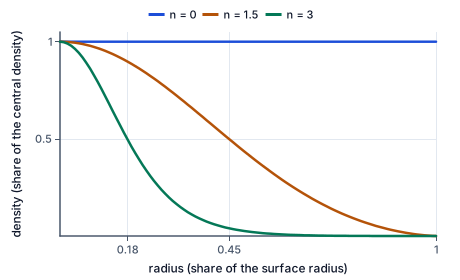
The figure shows density against radius for polytropes of index $0$, $1.5$ and $3$. Index $0$ is flat. Index $1.5$ falls to half its central density at about $0.45$ of the radius, and index $3$ at only $0.18$. The higher the index, the softer the relation between pressure and density, and the more the star's mass crowds toward its center while its outer layers become a tenuous envelope. The Sun's real profile lies close to the index-$3$ curve.
Central pressure must exceed the mean pressure, and central density the mean density; a polytrope's ratio $\rho_c/\bar\rho$ is $1$ for index $0$ and grows with $n$. Scaled central temperatures of main-sequence stars should come out between a few million and a few tens of millions of kelvins. A total energy from the virial theorem must be negative for a bound star, and must approach zero as the adiabatic index approaches $4/3$. And the Sun must come back out: $M = R = 1$ gives ratios of exactly $1$.
In 1862 William Thomson, later Lord Kelvin, asked how long the Sun could shine on its own gravitational energy. With the virial theorem's logic, the energy available from contracting to its present size is of order $GM^2/R \approx 4 \times 10^{41}$ joules, and at $3.8 \times 10^{26}$ watts that lasts about $30$ million years. Kelvin concluded the Sun, and so the Earth, could be no older than a few tens of millions of years.
Geologists and Charles Darwin, reading rock layers and evolution, needed hundreds of millions of years at least, and the dispute lasted half a century. Radioactive dating, and then the discovery of fusion in the 1930s, settled it: the Sun is $4.6$ billion years old, powered by a source Kelvin could not have known. His physics was right; his inventory of energy sources was incomplete.
The cold interiors of giant planets behave roughly like a polytrope of index $1$, for which a remarkable thing happens: the radius does not depend on the mass at all, only on the constant $K$ in $P = K\rho^2$. That is why Saturn, with less than a third of Jupiter's mass, is only about a sixth smaller, and why the many exoplanets from a fifth to several Jupiter masses all have radii close to Jupiter's.
NASA's Juno spacecraft, orbiting Jupiter since 2016, has mapped its gravity field precisely enough to test such models. Its measurements show a core that is not a compact rocky ball but dilute and spread out, a refinement that simple polytropes point toward and only detailed models can capture.
A uniform ball is the natural first picture, but real stars are strongly concentrated. The Sun's mean density is $1{,}410$ kg/m$^3$, while its center is about $150{,}000$ kg/m$^3$, more than a hundred times larger, and its mass-averaged temperature is a few million kelvins while its center is $15.7$ million. Gravity squeezes the inner layers hardest, and they in turn hold the heat that fusion needs.
A second slip is reading the virial theorem as saying a star cools as it loses energy. A star in equilibrium does the opposite: it contracts and heats, the reason stars can ignite fusion at all.
Take the Sun, $M = 1.989 \times 10^{30}$ kg and $R = 6.957 \times 10^{8}$ m. Write the scaling.
$P_c \sim \dfrac{G M^2}{R^4}$
From hydrostatic equilibrium.
Square the mass and multiply by G.
$6.674 \times 10^{-11} \times (1.989 \times 10^{30})^2 = 2.64 \times 10^{50}$
The numerator.
Raise the radius to the fourth power.
$(6.957 \times 10^{8})^4 = 2.34 \times 10^{35}\ \text{m}^4$
The denominator.
Divide the two.
$P_c \sim 2.64 \times 10^{50} \div 2.34 \times 10^{35} = 1.13 \times 10^{15}\ \text{Pa}$
The estimate.
Compare with the solar model.
$2.5 \times 10^{16} \div 1.13 \times 10^{15} \approx 22$
Central concentration makes the true value larger.
Take the Sun with $\mu = 0.6$. Write the gravitational energy of a uniform sphere.
$U = -\tfrac{3}{5}\dfrac{G M^2}{R}$
Binding energy.
Write the thermal energy of N particles.
$K = \tfrac{3}{2} N k \bar T, \quad N = \dfrac{M}{\mu m_H}$
An ideal monatomic gas.
Apply the virial theorem.
$2K = -U \Rightarrow 3Nk\bar T = \tfrac{3}{5}\dfrac{GM^2}{R}$
Twice the thermal energy balances the binding.
Solve for the mean temperature.
$\bar T = \dfrac{G M \mu m_H}{5kR}$
Divide both sides by 3Nk.
Evaluate the numerator and denominator.
$\dfrac{1.33 \times 10^{-7}}{5 \times 9.61 \times 10^{-15}}$
SI units.
Divide the two.
$\bar T = 2.78 \times 10^{6}\ \text{K}$
Below the central 15.7 million K, as a mean must be.
Model the Sun as an $n = 3$ polytrope. Write the central density.
$\rho_c = 54.2\,\bar\rho$
The index-3 concentration.
Multiply by the Sun's mean density.
$\rho_c = 54.2 \times 1{,}410 = 76{,}400\ \text{kg/m}^3$
About 76 times water.
Write the central pressure.
$P_c = 11.05\,\dfrac{G M^2}{R^4}$
The index-3 coefficient.
Multiply the coefficient by the scaling estimate.
$P_c = 11.05 \times 1.13 \times 10^{15} = 1.25 \times 10^{16}\ \text{Pa}$
Half the solar model's value.
Write the ideal gas law for the temperature.
$T_c = \dfrac{P_c\,\mu m_H}{\rho_c k}$
With mu = 0.62 at the center.
Substitute the values.
$T_c = \dfrac{1.25 \times 10^{16} \times 0.62 \times 1.674 \times 10^{-27}}{76{,}400 \times 1.381 \times 10^{-23}}$
SI units.
Evaluate and compare.
$T_c \approx 1.2 \times 10^{7}\ \text{K vs } 1.57 \times 10^{7}$
Within 25 percent of the solar model.
Square the mass.
$2^2 = 4$
Pressure goes as M squared.
Divide by the radius to the fourth power.
$4 \div 2^4 = 4 \div 16$
Pressure falls as R to the fourth.
State the ratio.
By a scaling argument, how would a star's central pressure change if its mass doubled while its radius stayed the same?
Complete the worked solution: the Sun's central pressure is $25 \times 10^{15}$ Pa and its central temperature $15.7$ million K. Assuming the same structure, find the central pressure and temperature of a star of $2$ suns and $1$ solar radii.
Divide the mass squared by the radius to the fourth power.
$M^2 \div R^4 = 4$
The pressure scaling.
Multiply the Sun's central pressure by that ratio.
$P_c =$ p $\times 10^{15}\ \text{Pa}$
Same structure, scaled.
Divide the mass by the radius.
$M \div R = 2$
The temperature scaling.
Multiply the Sun's central temperature by that ratio.
$T_c =$ t $\text{million K}$
Same structure, scaled.
Match each property of a star to how it scales with mass M and radius R.
| M squared over R to the fourth | M over R | M over R cubed | M squared over R | |
|---|---|---|---|---|
| central pressure | ||||
| central temperature | ||||
| mean density | ||||
| gravitational energy |
A star has $10$ solar masses and $5$ solar radii. Assuming it has the same internal structure as the Sun, fill in its central pressure and central temperature as multiples of the Sun's.
| value | |
|---|---|
| central pressure (Suns) | |
| central temperature (Suns) |
A star's gas has adiabatic index $\gamma = 1.6$. By the virial theorem its thermal energy is $K = -U/3(\gamma - 1)$, where $U$ is its gravitational energy. Write its total energy $E$ as a function of $U$.
Answer:
A star has $1$ solar masses and $1$ solar radii, and its ionized gas has $\mu = 0.6$. Using the virial theorem for a uniform-density star, $\bar T = G M \mu m_H/(5kR)$, find its mean temperature in millions of kelvins. For the Sun, $G M_\odot \mu m_H/(k R_\odot) = 13.88$ million K.
Answer: million kelvins
Vega has about $2.14$ solar masses and $2.36$ solar radii. Scaling from the Sun's central pressure, $2.5 \times 10^{16}$ Pa, and central temperature, $15.7$ million K, estimate its central pressure in units of $10^{16}$ Pa and its central temperature in millions of kelvins.
| value | |
|---|---|
| central pressure (10^16 Pa) | |
| central temperature (million K) |
Lesson test: one question per skill, one attempt each, no hints. Your answers are checked when you submit.
A star's gas has adiabatic index $\gamma = \tfrac{5}{3}$. By the virial theorem its thermal energy is $K = -U/3(\gamma - 1)$, where $U$ is its gravitational energy. Write its total energy $E$ as a function of $U$.
Answer:
You can estimate a star's center. Scale the Sun's central pressure to a star of 2 suns and 2 solar radii, and find the Sun's virial mean temperature.
20. Your turn: a star has $2$ solar masses and $2$ solar radii. Scale its central pressure from the Sun's., step 3
$P_c = 0.25\,P_{c\odot}$
A quarter of the Sun's.