Back to the on-screen lesson ·
The Boltzmann equation gives the share of atoms excited and the Saha equation the share ionized; their product makes each line rise and fade with temperature, so the spectral sequence O B A F G K M is a temperature sequence.
Paper packet. Every task here also exists on screen, where it is checked automatically; answers written on paper are not assessed by Nydus. When you are back at a device, enter your answers there.
By the end of this lesson you will be able to explain the spectral sequence from excitation and ionization using the Boltzmann and Saha equations.
You know from the Astronomy course that each element absorbs at its own wavelengths, that stars are sorted into the classes O, B, A, F, G, K and M, and that hotter stars are bluer. You can find a star's temperature from its spectrum's peak. This lesson explains the classes themselves: why each line appears in some stars and not others, using the physics of how atoms share out energy at a given temperature.
| Term | What it means |
|---|---|
| Excitation | An electron raised to a higher energy level within its atom. |
| Ionization | An electron removed from its atom altogether, leaving an ion. |
| Statistical weight (g) | The number of distinct quantum states at one energy level; 2n squared for hydrogen's level n. |
| Boltzmann equation | The ratio of atoms in two levels, (g_b / g_a) e to the minus (E_b - E_a) / kT. |
| Saha equation | The ratio of atoms in two ionization stages, rising with temperature and falling with electron density. |
| Spectral class | A star's place in the sequence O B A F G K M, set by which lines its spectrum shows. |
An absorption line appears only if atoms in the line's lower level are present. Two equations decide how many are. The Boltzmann equation gives the share excited:
$$\frac{N_b}{N_a} = \frac{g_b}{g_a}\,e^{-(E_b - E_a)/kT}.$$
The Saha equation gives the share ionized:
$$\frac{N_{\text{II}}}{N_{\text{I}}} = \frac{2Z_{\text{II}}}{n_e Z_{\text{I}}}\left(\frac{2\pi m_e kT}{h^2}\right)^{3/2} e^{-\chi/kT}.$$
As temperature rises, more atoms are excited but more are ionized, so each line rises and then fades. Hydrogen's Balmer lines peak near $9{,}900$ K: the spectral sequence is a temperature sequence.
Another way: picture
Picture a stadium with seats on several tiers. When the crowd is calm, almost everyone sits on the ground tier. As the excitement rises, people climb to the upper tiers, and some leave the stadium altogether. A camera aimed at the second tier sees a few people at first, then a crowd, then fewer again as people walk out. Hydrogen's second level is that tier, and temperature is the excitement.
Another way: steps
In the 1890s and 1900s, astronomers at the Harvard College Observatory sorted hundreds of thousands of stellar spectra on photographic plates. Annie Jump Cannon arranged the classes into the order O, B, A, F, G, K, M, a smooth progression of line patterns, and classified about $350{,}000$ stars by eye. The order was clearly meaningful, but what did it measure?
Hydrogen lines are strongest in A stars, weaker in B and F, and weak in the Sun, a G star. Lines of ionized helium appear only in O stars, and molecular bands only in M stars. If line strength simply reflected how much of each element a star contained, stars would differ wildly in composition. The answer came from atomic physics in the 1920s.
In gas at temperature $T$, collisions constantly knock electrons between energy levels. In equilibrium the number of atoms in level $b$ compared with level $a$ is
$$\frac{N_b}{N_a} = \frac{g_b}{g_a}\,e^{-(E_b - E_a)/kT},$$
where $g$ counts the quantum states at each level, $2n^2$ for hydrogen's level $n$, and $k = 8.617 \times 10^{-5}$ eV/K. The exponential is the cost: each level is penalized by how many thermal energies $kT$ it takes to reach.
At the Sun's $5{,}772$ K, $kT \approx 0.50$ eV, and hydrogen's second level lies $10.2$ eV up, about $20$ thermal energies. So $N_2/N_1 = 4e^{-20.5} \approx 5 \times 10^{-9}$: only about one hydrogen atom in two hundred million can absorb a Balmer line.
Collisions and photons also strip electrons off entirely. Meghnad Saha derived the equilibrium between stages in 1920. Its key features are visible in its form: a factor $T^{3/2}$, an exponential $e^{-\chi/kT}$ in the ionization energy $\chi$, $13.6$ eV for hydrogen, and a division by the electron density $n_e$, because free electrons recapture ions more often when there are more of them.
The exponential makes ionization switch on over a narrow range. At a typical stellar electron pressure, hydrogen is only about $3$ percent ionized at $8{,}000$ K, about $70$ percent at $10{,}000$ K, and over $99.9$ percent by $15{,}000$ K. The $Z$s in the equation are partition functions, sums over each stage's levels weighted by their Boltzmann factors; for hydrogen they are close to $2$ and $1$.
A Balmer line needs an atom that is neutral and in level 2. The share of all hydrogen able to absorb is the product
$$\frac{N_2}{N_{\text{total}}} = \frac{N_2}{N_{\text{I}}} \times \frac{N_{\text{I}}}{N_{\text{total}}}.$$
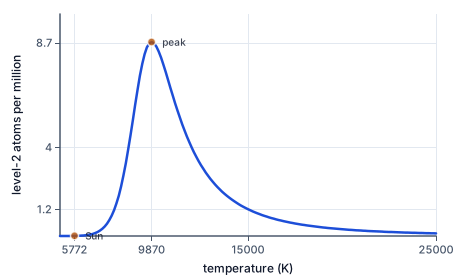
The first factor, from the Boltzmann equation, climbs steeply with temperature; the second, from the Saha equation, collapses once ionization switches on. Their product is the curve in the figure: negligible below about $7{,}000$ K, a peak near $9{,}900$ K, and a decline as the hydrogen is stripped. A stars sit at the peak, which is exactly where the Balmer lines are observed to be strongest.
Every line follows the same rise and fall, each at the temperature its atom's energies set. Helium holds its electrons tightly: removing one takes $24.6$ eV, and lifting the remaining electron to the levels that absorb visible light takes about $48$ eV more. So lines of ionized helium appear only in O stars above about $30{,}000$ K. Neutral helium marks the B stars. Hydrogen peaks in the A stars. In F and G stars, ionized calcium, with a low ionization energy and strong lines from its ground state, takes over: its H and K lines are the strongest in the Sun's visible spectrum. K stars show neutral metals, and in the M stars, below about $3{,}700$ K, molecules such as titanium oxide survive and carve broad bands. Each class marks a temperature range, from above $30{,}000$ K to below $3{,}700$ K.
In her 1925 doctoral thesis at Harvard, Cecilia Payne applied the Saha equation to the spectral classes and worked out, for the first time, the abundances of the elements in stellar atmospheres. Once the differences in temperature were accounted for, the stars turned out to have nearly the same composition, and that composition was overwhelmingly hydrogen and helium, about a million times more hydrogen than astronomers had assumed from Earth's makeup.
The result was so unexpected that she was persuaded to call it spurious. Within a few years Henry Norris Russell confirmed it by other means, and it is now the foundation of all stellar astrophysics: stars are about $74$ percent hydrogen and $24$ percent helium by mass.
The Saha equation's $1/n_e$ has a second consequence. A giant star's atmosphere is far less dense than a dwarf's at the same temperature, so its gas ionizes more easily, and its lines are narrower because collisions broaden them less. Careful classification therefore reads both temperature and density from a spectrum. The Morgan-Keenan system adds a luminosity class, from I for supergiants through III for giants to V for main-sequence dwarfs: the Sun is G2 V and Betelgeuse M1 Ia. Two stars of one spectral type but different classes differ in radius by factors of tens or hundreds.
The figure plots the hydrogen atoms in level 2 per million hydrogen atoms of every kind. At the Sun's temperature the curve sits at about $0.005$ per million, invisible on the scale. It rises by a factor of over a thousand by $10{,}000$ K, peaks at about $8.7$ per million near $9{,}900$ K, and falls to about $1.2$ at $15{,}000$ K and $0.1$ at $25{,}000$ K. Even at the peak only about one atom in a hundred thousand absorbs; hydrogen is so abundant that this is plenty to make the strongest lines in the spectrum.
A Boltzmann ratio must be smaller than the ratio of statistical weights, because the exponential is less than one, and it must grow with temperature. The thermal energy $kT$ at stellar temperatures is between about $0.2$ and $4$ eV; a value of thousands means $k$ was taken in joules per kelvin while the gap was in electron volts. A share of absorbing atoms can never exceed the neutral fraction or the excited share alone. And populations at two temperatures should differ by much more than the temperatures do, because the temperature sits in an exponent.
Cecilia Payne came to Harvard from England in 1923 and, in two years, produced what the astronomer Otto Struve later called the most brilliant doctoral thesis ever written in astronomy. Working from the Harvard plate collection and the new Saha equation, she matched the strengths of lines from eighteen elements across the spectral classes, correcting each for the share of atoms in the right state.
Her result: silicon, carbon and the common metals had roughly the same abundances as on Earth, but hydrogen and helium were enormously more abundant, hydrogen by a factor of about a million. Advised that this could not be right, she described it as almost certainly not real. Four years later Henry Norris Russell reached the same conclusion and credited her. Every model of a star's interior, including the ones in the coming lessons, starts from the composition her thesis found.
When infrared surveys began finding objects too cool to be ordinary stars, the spectral sequence had to grow. Brown dwarfs, too light to sustain hydrogen fusion, cool steadily for billions of years. Below about $2{,}200$ K the titanium oxide bands of M stars vanish as the molecules condense into dust clouds, defining class L. Below about $1{,}300$ K, methane appears, defining class T.
In 2011, data from NASA's Wide-field Infrared Survey Explorer revealed objects colder still, some near room temperature, now called class Y. The logic is exactly this lesson's: each new class is marked by which molecules can survive at a given temperature, the chemical version of the Boltzmann and Saha equations.
It is tempting to read a spectrum like an ingredients list: strong hydrogen lines, so lots of hydrogen. But the strength of a line depends on how many atoms are in the right state to absorb it, and that is set by temperature and pressure far more than by abundance. The Sun is about $74$ percent hydrogen by mass, yet its Balmer lines are weak because almost none of that hydrogen is excited.
Composition does vary a little: old stars have fewer metals, and a few peculiar stars show genuine excesses. Spotting those requires first modeling the temperature, which is exactly what the Boltzmann and Saha equations allow.
Take hydrogen at $10{,}000$ K. Multiply Boltzmann's constant by the temperature.
$kT = 8.617 \times 10^{-5} \times 10{,}000 = 0.8617\ \text{eV}$
The thermal energy.
Divide the energy gap by kT.
$10.2 \div 0.8617 = 11.84$
The jump costs about twelve thermal energies.
Find the ratio of statistical weights.
$g_2 \div g_1 = 8 \div 2 = 4$
Level 2 has four times as many states.
Multiply the weights by the Boltzmann factor.
$\dfrac{N_2}{N_1} = 4\,e^{-11.84} = 4 \times 7.23 \times 10^{-6}$
The Boltzmann equation.
Evaluate the product.
$\dfrac{N_2}{N_1} = 2.89 \times 10^{-5}$
About 29 per million neutral atoms.
At what temperature is one hydrogen atom in a hundred excited to level 2? Set the ratio.
$4\,e^{-10.2/kT} = 0.01$
The condition.
Divide both sides by 4.
$e^{-10.2/kT} = 0.0025$
Isolate the exponential.
Take the natural logarithm of both sides.
$-10.2/kT = \ln 0.0025 = -5.99$
Undo the exponential.
Solve for kT.
$kT = 10.2 \div 5.99 = 1.703\ \text{eV}$
Divide both sides.
Divide by Boltzmann's constant.
$T = 1.703 \div 8.617 \times 10^{-5} = 19{,}760\ \text{K}$
Kelvins.
Check what ionization does there.
$\text{nearly all hydrogen ionized at } 19{,}760\ \text{K}$
Excited atoms are common, but few atoms are left neutral.
Take hydrogen at $10{,}000$ K with electron pressure $20$ Pa. Find the electron density.
$n_e = P_e \div kT = 20 \div (1.381 \times 10^{-23} \times 10^4) = 1.45 \times 10^{20}\ \text{m}^{-3}$
The ideal gas law for electrons.
Evaluate the thermal factor.
$\left(\dfrac{2\pi m_e kT}{h^2}\right)^{3/2} = 2.41 \times 10^{27}\ \text{m}^{-3}$
Grows as T to the three halves.
Evaluate the exponential.
$e^{-13.6/0.8617} = e^{-15.78} = 1.40 \times 10^{-7}$
The ionization cost.
Take the partition-function factor as one.
$\dfrac{2Z_{\text{II}}}{Z_{\text{I}}} = \dfrac{2 \times 1}{2} = 1$
Hydrogen's ion is a bare proton.
Combine the factors in the Saha equation.
$\dfrac{N_{\text{II}}}{N_{\text{I}}} = \dfrac{2.41 \times 10^{27} \times 1.40 \times 10^{-7}}{1.45 \times 10^{20}} = 2.33$
More ions than neutral atoms.
Find the neutral fraction.
$\dfrac{N_{\text{I}}}{N_{\text{total}}} = \dfrac{1}{1 + 2.33} = 0.30$
Thirty percent neutral.
Combine with the excited share.
$0.30 \times 2.89 \times 10^{-5} = 8.7 \times 10^{-6}$
Close to the Balmer peak.
Write Boltzmann's constant in electron volts.
$k = 8.617 \times 10^{-5}\ \text{eV/K}$
Matching the energy gaps' units.
Multiply by the temperature.
$kT = 8.617 \times 10^{-5} \times 5{,}772$
The thermal energy.
State the result.
Hydrogen is by far the most common element in the Sun and in O stars, yet its Balmer lines are weak in both and strongest in A stars near 10,000 K. Why?
Complete the worked solution: in an atmosphere at $8000$ K, a fraction $0.03$ of the hydrogen is ionized, and $1.5$ of every million neutral atoms are in level 2. How many of every million hydrogen atoms can absorb a Balmer line?
Subtract the ionized fraction from one.
$\text{neutral fraction} =$ f
Ionized atoms have no electron to lift.
Multiply the neutral fraction by the excited share.
$\text{level-2 atoms per million} =$ n
Both conditions must hold at once.
Compare with the peak in words.
$\text{largest near } 9{,}900\ \text{K}$
Excitation and ionization pull in opposite directions.
Put these spectra in order from the hottest star to the coolest.
Number the steps in order (write the number in the box):
In a stellar atmosphere at $30000$ K, fill in $kT$ in electron volts and the ratio of hydrogen atoms in level 2 to level 1. Use $k = 8.617 \times 10^{-5}$ eV/K, statistical weights $g_1 = 2$ and $g_2 = 8$, and an energy gap of $10.2$ eV.
| value | |
|---|---|
| kT (eV) | |
| N2 over N1 |
In a stellar atmosphere at one fixed temperature, hydrogen has $2$ ions for every neutral atom when the electron density is $1.5$, in units of $10^{20}$ per cubic meter. Using the Saha equation, write the ratio of ions to neutral atoms as a function of the electron density $n$ in the same units.
Answer:
How many times larger is hydrogen's ratio of level-2 to level-1 atoms at $12000$ K than at $10000$ K? The gap is $10.2$ eV and $k = 8.617 \times 10^{-5}$ eV/K.
Answer: times larger
Deneb has an effective temperature of about $8525$ K. How many times larger is the ratio of hydrogen atoms in level 2 to level 1 in its atmosphere than in the Sun's, at $5{,}772$ K? Use a gap of $10.2$ eV and $k = 8.617 \times 10^{-5}$ eV/K.
Answer: times the Sun's
Lesson test: one question per skill, one attempt each, no hints. Your answers are checked when you submit.
In a stellar atmosphere at one fixed temperature, hydrogen has $25$ ions for every neutral atom when the electron density is $0.6$, in units of $10^{20}$ per cubic meter. Using the Saha equation, write the ratio of ions to neutral atoms as a function of the electron density $n$ in the same units.
Answer:
You can read a spectral class physically. Find hydrogen's level-2 to level-1 ratio at 10,000 K, and explain why Balmer lines are weak in both the Sun and O stars.
20. Your turn: find $kT$ in electron volts at the Sun's $5{,}772$ K., step 3
$kT = 0.497\ \text{eV}$
Half an electron volt.