Back to the on-screen lesson ·
Flux falls as L / 4 pi d^2; magnitudes measure it logarithmically, five magnitudes to a factor of 100; the distance modulus m - M = 5 log d - 5 + A gives distance, and a bolometric correction gives luminosity.
Paper packet. Every task here also exists on screen, where it is checked automatically; answers written on paper are not assessed by Nydus. When you are back at a device, enter your answers there.
By the end of this lesson you will be able to convert between flux, luminosity and magnitudes, correcting for extinction and for light outside the visual band.
You know from the last lesson that a star's luminosity is $L = 4\pi R^2 \sigma T^4$, and from the Astronomy course that brightness falls with the square of distance and that parallax gives the distances of nearby stars. You can work with base-10 logarithms. This lesson connects what a telescope measures, a flux, to what a star is, a luminosity, in the units astronomers actually use: magnitudes.
| Term | What it means |
|---|---|
| Flux | The power arriving on one square meter facing the star, in W per square meter. |
| Apparent magnitude (m) | A logarithmic measure of flux: five magnitudes is a factor of 100, and larger numbers are fainter. |
| Absolute magnitude (M) | The apparent magnitude a star would have at a distance of 10 parsecs. |
| Distance modulus | m minus M, which equals 5 log10 d minus 5 for d in parsecs. |
| Extinction (A) | The dimming, in magnitudes, caused by dust between the star and us. |
| Bolometric correction (BC) | The magnitudes added to a visual magnitude to count the light at every wavelength. |
A star of luminosity $L$ spreads its power over a sphere, so at distance $d$ the flux is $F = L/4\pi d^2$. Astronomers record flux as a magnitude, a logarithmic scale on which larger numbers are fainter:
$$m_1 - m_2 = -2.5\log_{10}\frac{F_1}{F_2}.$$
The absolute magnitude $M$ is the magnitude at $10$ pc, so the difference depends only on distance and dust:
$$m - M = 5\log_{10} d - 5 + A.$$
Adding a bolometric correction gives $M_{\text{bol}} = M_V + BC$, and then $L/L_\odot = 10^{-0.4\,(M_{\text{bol}} - 4.74)}$.
Another way: picture
Think of the magnitude scale as a staircase going down into the dark. Each step down makes a star about 2.5 times fainter, and five steps make it exactly 100 times fainter. Moving a star ten times farther away pushes it five steps down, because its flux falls by a factor of 100.
Another way: steps
A star radiates its luminosity in every direction. At distance $d$ that power is spread over a sphere of area $4\pi d^2$, so the flux through one square meter is
$$F = \frac{L}{4\pi d^2}.$$
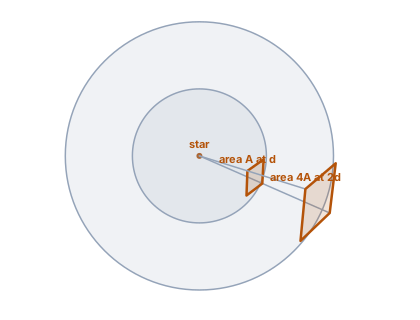
Double the distance and the flux falls to a quarter. The Sun's $3.83 \times 10^{26}$ watts give $1{,}361$ watts per square meter at Earth; seen from $10$ parsecs, $3.09 \times 10^{17}$ meters away, the same Sun would deliver only about $3 \times 10^{-10}$ watts per square meter. Fluxes span so many powers of ten that astronomers prefer a logarithm.
Hipparchus sorted the naked-eye stars into six classes about $2{,}000$ years ago, the brightest of the first magnitude and the faintest of the sixth. In 1856 Norman Pogson made the scale exact: five magnitudes is a factor of exactly $100$ in flux, so one magnitude is a factor of $100^{1/5} = 2.512$. In symbols,
$$m_1 - m_2 = -2.5\log_{10}\frac{F_1}{F_2}, \qquad \frac{F_1}{F_2} = 10^{-0.4\,(m_1 - m_2)}.$$
The minus sign keeps the old order: brighter stars have smaller, even negative, magnitudes. Sirius is $-1.46$, Vega about $0$, and the faintest galaxies the Webb telescope records are near $30$, a trillion times fainter than Vega.
To compare stars themselves, imagine each moved to $10$ parsecs. The magnitude it would have there is its absolute magnitude $M$. Moving a star from $10$ pc to $d$ multiplies its flux by $(10/d)^2$, so
$$m - M = -2.5\log_{10}\left(\frac{10}{d}\right)^2 = 5\log_{10} d - 5.$$
The distance modulus $m - M$ is zero at $10$ pc, $5$ at $100$ pc and $10$ at $1{,}000$ pc: each tenfold step in distance adds five magnitudes. Inside $10$ pc it is negative. Because it depends only on distance, astronomers often quote a distance as a modulus: the Large Magellanic Cloud's is about $18.5$, about $50$ kiloparsecs.
Interstellar dust absorbs and scatters starlight, more at blue wavelengths than red. The dimming in magnitudes is the extinction $A$, and it makes a star look farther away than it is unless it is subtracted:
$$m - M = 5\log_{10} d - 5 + A.$$
In the Milky Way's disk the visual extinction averages roughly $1.9$ magnitudes per kiloparsec, though it varies cloud by cloud. Because dust reddens as well as dims, astronomers measure the color excess $E(B - V)$, how much redder a star is than its spectral type says it should be, and use $A_V \approx 3.1\,E(B - V)$ for typical dust. Toward the Galactic center the visual extinction is about $30$ magnitudes, a factor of a trillion, which is why that region is studied in the infrared.
A visual magnitude counts only the light near $550$ nm. A hot star pours most of its energy out in the ultraviolet and a cool one in the infrared, so both are more luminous than their visual magnitudes suggest. The bolometric correction adds the missing light: $M_{\text{bol}} = M_V + BC$. It is near zero for stars like the Sun, about $-0.07$, and several magnitudes negative for the hottest and coolest stars.
The International Astronomical Union fixed the zero point in 2015, which gives the Sun $M_{\text{bol}} = 4.74$. Then
$$\frac{L}{L_\odot} = 10^{-0.4\,(M_{\text{bol}} - 4.74)}.$$
A star five bolometric magnitudes brighter than the Sun is $100$ times as luminous.
Measuring a star through two filters gives a second kind of information. The color index $B - V$ is the difference between its magnitudes through a blue filter centered near $440$ nm and a visual filter near $550$ nm. Because it is a difference of magnitudes, it is a ratio of fluxes, and it does not depend on distance: both filters dim by the same inverse square.
A hot star is brighter in blue than in visual light, so its $B$ magnitude is the smaller and $B - V$ is negative, about $-0.3$ for a $25{,}000$ K star. The Sun's is about $+0.65$, and a $3{,}500$ K red dwarf's is about $+1.5$. Vega defines zero in every filter. So a color index is a thermometer that needs no distance, the Planck curve's slope measured between two wavelengths. Dust spoils it a little, by reddening the star, and the color excess $E(B - V)$ is exactly that spoiling: the observed index minus the one the star's spectrum says it should have.
Most magnitude problems are one equation in logarithms. Keep three moves handy. To turn a magnitude difference into a ratio, multiply by $-0.4$ and raise $10$ to the result. To turn a distance into a modulus, take $\log_{10} d$, multiply by $5$, and subtract $5$. To turn a modulus back into a distance, add $5$, divide by $5$, and raise $10$ to the result. Subtract extinction before converting a modulus to a distance, never after, and add a bolometric correction before converting a magnitude to a luminosity.
The inverse-square law is geometry before it is physics. A star's light leaves in every direction, so at distance $d$ it is spread over a sphere of area $4\pi d^2$. The scene follows one bundle of rays: at twice the distance the same rays cover a patch twice as wide and twice as tall, four times the area, so each square meter receives a quarter of the light. Nothing is absorbed on the way; the light is only shared more thinly.
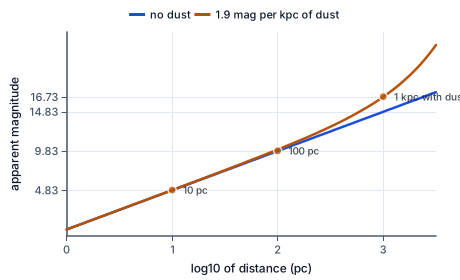
The figure follows a star like the Sun outward. Without dust its apparent magnitude climbs in a straight line against the logarithm of distance, five magnitudes per tenfold step: $4.83$ at $10$ pc, $9.83$ at $100$ pc, $14.83$ at $1{,}000$ pc. With the disk's average dust it falls behind the line, by $1.9$ magnitudes at $1{,}000$ pc, and the gap grows because extinction adds up with distance rather than with its logarithm. The naked eye reaches about magnitude $6$, so a Sun-like star fades from view beyond about $17$ pc.
A smaller magnitude must go with more flux; if your brighter star has the larger magnitude, a sign has flipped. A distance modulus must be positive beyond $10$ pc and negative inside it, and it grows by $5$ for each factor of $10$ in distance. Correcting for dust always brings a star closer, never farther. A bolometric correction always makes a star more luminous, since it adds light, so a negative $BC$ must make $M_{\text{bol}}$ smaller than $M_V$. Finally, the Sun is a check on every formula: $M_V = 4.83$, $BC \approx -0.07$ and $M_{\text{bol}} = 4.74$ must give one solar luminosity.
In 1997 the European Hipparcos satellite measured the parallax of the Pleiades star cluster and put it at about $120$ parsecs, closer than the $133$ to $135$ parsecs that astronomers had found by fitting the cluster's stars to models of how bright such stars should be. The difference is a distance modulus of $5\log_{10}(135/120) \approx 0.26$ magnitudes, and if the parallax were right, the Pleiades stars would be a quarter of a magnitude fainter than stellar models predicted.
The puzzle lasted more than fifteen years. In 2014 a team using a worldwide array of radio telescopes, including the Very Long Baseline Array run from New Mexico, measured radio parallaxes of Pleiades stars and found $136.2$ parsecs. The Gaia satellite later agreed. The models had been right; the satellite's first measurement had a small systematic error. A quarter of a magnitude is exactly the size of mistake that distance moduli make visible.
The center of our galaxy, about $8.2$ kiloparsecs away in Sagittarius, hides behind about $30$ magnitudes of visual extinction. A star there that would be magnitude $15$ without dust appears at magnitude $45$, far beyond any telescope.
Extinction is much smaller at longer wavelengths: in the near infrared at $2.2$ micrometers it is only about $3$ magnitudes toward the center. So the APOGEE survey, with spectrographs at Apache Point Observatory in New Mexico and at Las Campanas in Chile, observed hundreds of thousands of giant stars in the infrared, reading their compositions and motions through the dust. Choosing a wavelength where $A$ is small is often better than correcting for a large one.
The scale runs backward because it began with Hipparchus's classes, in which the brightest stars were of the first magnitude. So magnitude $1$ is brighter than magnitude $6$, and the brightest objects have negative magnitudes: the full Moon is about $-12.7$ and the Sun $-26.74$.
A second slip is treating magnitudes as a linear scale. Five magnitudes is a factor of $100$, not $5$, and ten magnitudes a factor of $10{,}000$. Differences of magnitudes correspond to ratios of fluxes, never to differences of fluxes.
Vega has $m = 0.03$ and Polaris $m = 1.98$. Find the magnitude difference.
$m_P - m_V = 1.98 - 0.03 = 1.95$
Polaris has the larger number.
Write the flux ratio in terms of the difference.
$\dfrac{F_V}{F_P} = 10^{0.4\,(m_P - m_V)}$
Pogson's definition, rearranged.
Multiply the difference by 0.4.
$0.4 \times 1.95 = 0.78$
The exponent of ten.
Raise ten to that power.
$10^{0.78} = 6.03$
The flux ratio.
State which is brighter.
$F_V \approx 6.0\,F_P$
The smaller magnitude is the brighter star.
A star has $m = 11.2$, $M = 1.2$ and extinction $A = 1.0$. Write the modulus with dust.
$m - M = 5\log_{10} d - 5 + A$
Dust adds to the dimming.
Substitute the magnitudes.
$11.2 - 1.2 = 5\log_{10} d - 5 + 1.0$
Ten magnitudes in all.
Subtract the extinction from both sides.
$9.0 = 5\log_{10} d - 5$
The true distance modulus.
Add 5 to both sides and divide by 5.
$\log_{10} d = \dfrac{9.0 + 5}{5} = 2.8$
Isolate the logarithm.
Raise ten to both sides.
$d = 10^{2.8} = 631\ \text{pc}$
Parsecs.
Compare with ignoring the dust.
$10^{(10 + 5)/5} = 1{,}000\ \text{pc}$
Forgetting dust overestimates the distance by 60 percent.
A star has $m_V = 9.6$ at $500$ pc with $A_V = 0.9$ and $BC = -0.4$. Write the modulus.
$5\log_{10} 500 - 5 = 8.49$
Distance first.
Subtract the modulus and the extinction from the apparent magnitude.
$M_V = 9.6 - 8.49 - 0.9 = 0.21$
Absolute visual magnitude.
Add the bolometric correction.
$M_{\text{bol}} = 0.21 + (-0.4) = -0.19$
All wavelengths.
Subtract the Sun's bolometric magnitude.
$-0.19 - 4.74 = -4.93$
Brighter than the Sun.
Multiply by minus 0.4.
$-0.4 \times (-4.93) = 1.972$
The exponent of ten.
Raise ten to that power.
$L = 10^{1.972} \approx 93.8\ L_\odot$
Solar luminosities.
Check against the five-magnitude rule.
$\text{about 5 mag brighter} \Rightarrow \text{about } 100\ L_\odot$
The answer is in the right range.
Find the distance modulus.
$5\log_{10} 100 - 5 = 5$
Ten times farther than 10 pc.
Subtract the modulus from the apparent magnitude.
$M = 7.3 - 5$
Brightness at 10 pc.
State the absolute magnitude.
Star A has apparent magnitude 2 and star B has apparent magnitude 7. How do the fluxes we receive from them compare?
Complete the worked solution: a star has absolute visual magnitude $-3.9$ and bolometric correction $-1.36$. Taking the Sun's bolometric magnitude as $4.74$, find its luminosity in suns.
Add the bolometric correction to the visual magnitude.
$M_{\text{bol}} =$ b
Count the light at every wavelength.
Subtract the Sun's bolometric magnitude.
$M_{\text{bol}} - 4.74 = -10$
A magnitude difference.
Multiply the difference by minus 0.4.
$\text{exponent} = 4$
Turn magnitudes into powers of ten.
Raise ten to the exponent.
$L =$ l $L_\odot$
Luminosity in suns.
Check the direction in words.
$\text{brighter than the Sun's magnitude means more luminous}$
Smaller magnitudes are brighter.
Match each quantity to what it measures.
| how bright the star looks from here | how bright the star would look from 10 parsecs | how far away the star is | the light the star gives off outside the visual band | |
|---|---|---|---|---|
| apparent magnitude | ||||
| absolute magnitude | ||||
| distance modulus | ||||
| bolometric correction |
A star $250$ pc away has apparent magnitude $9.5$. Ignoring dust, fill in its distance modulus and its absolute magnitude.
| value | |
|---|---|
| distance modulus (mag) | |
| absolute magnitude |
Star A is $1000$ times as luminous as star B, and both are measured in the same band. Write A's absolute magnitude as a function of B's absolute magnitude $x$.
Answer:
A star has apparent magnitude $14.3$ and absolute magnitude $4.3$, and dust dims it by $A = 2.0$ magnitudes. How far away is it, in parsecs?
Answer: parsecs
Vega has apparent visual magnitude about $0.03$ and lies about $7.68$ pc away, close enough that dust can be ignored. What is its absolute visual magnitude? Give two decimal places.
Answer: magnitudes
Lesson test: one question per skill, one attempt each, no hints. Your answers are checked when you submit.
Star A is $100000$ times as luminous as star B, and both are measured in the same band. Write A's absolute magnitude as a function of B's absolute magnitude $x$.
Answer:
You can work in magnitudes. Find the distance of a star with m = 11.2, M = 1.2 and A = 1.0, and the luminosity of a star whose bolometric magnitude is -0.26.
21. Your turn: a star at $100$ pc has $m = 7.3$. Ignoring dust, find its absolute magnitude., step 3
$M = 2.3$
Brighter than the Sun's 4.83.