Back to the on-screen lesson ·
A line's shift gives radial velocity and its rotational width v sin i; in a binary the velocity amplitudes give the mass ratio and, with the period, the total mass, which an eclipsing binary fixes outright.
Paper packet. Every task here also exists on screen, where it is checked automatically; answers written on paper are not assessed by Nydus. When you are back at a device, enter your answers there.
By the end of this lesson you will be able to use line widths and Doppler shifts to measure stellar rotation and the masses of binary stars.
You know the Doppler shift turns a line's change in wavelength into a speed along the line of sight, and from the last lesson which lines appear at which temperatures. You know Kepler's third law and that two bodies orbit their common center of mass. This lesson reads two more things from a line, its width and its motion over time, and uses them to measure how fast stars spin and how much they weigh.
| Term | What it means |
|---|---|
| Radial velocity | A star's speed toward or away from us, from the Doppler shift of its lines. |
| Line broadening | The widening of a spectral line by atomic motions, collisions or the star's rotation. |
| v sin i | A star's equatorial rotation speed times the sine of the tilt of its axis to our line of sight. |
| Spectroscopic binary | A pair of stars too close to separate in a telescope, revealed by periodic Doppler shifts. |
| Velocity amplitude (K) | Half the full swing of a star's radial velocity over its orbit. |
| Eclipsing binary | A binary whose orbit we see nearly edge-on, so the stars pass in front of each other. |
A spectral line carries three measurements. Its shift gives the radial velocity:
$$\frac{\Delta\lambda}{\lambda} = \frac{v_r}{c}.$$
Its width, when rotation dominates, gives $v\sin i = c\,\Delta\lambda/2\lambda$. And in a binary, its motion over time traces an orbit. The two stars balance about their center of mass, so
$$\frac{m_A}{m_B} = \frac{K_B}{K_A}, \qquad (m_A + m_B)\sin^3 i = 1.036 \times 10^{-7}\,(K_A + K_B)^3\,P$$
in suns, with $K$ in km/s and $P$ in days. An eclipsing binary has $\sin i \approx 1$, so it gives the masses outright.
Another way: picture
Picture an adult and a child on a seesaw that also spins like a merry-go-round. To balance, the child sits farther from the pivot, and as the seesaw turns, the child sweeps around a bigger circle, faster. Watching only how fast each one moves toward and away from you, you can tell who is heavier: the slower one.
Another way: steps
For speeds much less than light's, a line emitted at $\lambda$ is received at $\lambda + \Delta\lambda$ with $\Delta\lambda/\lambda = v_r/c$. A receding star's lines move red, an approaching star's blue, and motion across the sky produces no first-order shift at all. Because every line shifts by the same fraction, astronomers measure the whole spectrum at once against a template, which is far more precise than measuring one line.
The best spectrographs now reach about one meter per second, the speed of a slow walk, which corresponds to a shift of three parts in a billion. That precision is what lets them detect the wobble a planet induces in its star.
Even a perfectly still atom absorbs over a small range of wavelengths, its natural width. In a star, three effects widen it far more. Thermal broadening: atoms move randomly at typical speeds $\sqrt{2kT/m}$, about $13$ km/s for hydrogen at $10{,}000$ K, so each absorbs at its own Doppler-shifted wavelength. Pressure broadening: collisions interrupt the atoms' absorption, widening the line's wings, more so in dense dwarfs than in tenuous giants. Rotation: one limb of the star approaches and the other recedes, spreading every line.
Each leaves its own fingerprint on the line's shape, so a careful fit separates them. In rapidly rotating stars, rotation dominates and the line becomes a broad, shallow dish.
If a star's equator moves at $v_{\text{eq}}$ and its axis is tilted at angle $i$ to our line of sight, its limbs approach and recede at $\pm v_{\text{eq}}\sin i$. A line broadened only by rotation spans a full width
$$\Delta\lambda = \frac{2\lambda\,v\sin i}{c}, \qquad v\sin i = \frac{c\,\Delta\lambda}{2\lambda}.$$
Spectra give only $v\sin i$, a lower limit on the true speed. The Sun's equator moves at about $2$ km/s, and many hot stars spin at over $100$ km/s. Vega shows only about $20$ km/s, but its shape and brightness pattern reveal that we see it almost pole-on and that its equator actually moves at over $200$ km/s.
Two stars bound by gravity both orbit their center of mass, which lies on the line between them where $m_A a_A = m_B a_B$. They complete their orbits in the same period, so the speeds are in the same ratio as the orbit sizes: $m_A v_A = m_B v_B$. The total momentum stays zero.
So the heavier star moves more slowly, on a smaller orbit, and the ratio of the speeds gives the inverse ratio of the masses directly. Whatever the inclination, both measured amplitudes are reduced by the same factor $\sin i$, so the mass ratio is always secure.
Most binaries are too close to separate even in large telescopes. Their spectra reveal them: the lines shift back and forth with the orbital period. If both stars contribute light, two sets of lines swing in opposite directions, a double-lined binary; if one star is much fainter, only one set moves, a single-lined binary.
Plotting radial velocity against time gives a velocity curve: a sine wave for a circular orbit, a skewed curve for an eccentric one. The curve oscillates about the pair's own velocity $\gamma$, and half its full swing is the amplitude $K$. Reading $K_A$, $K_B$ and the period $P$ from the curves is the measurement every mass determination starts from.
For a circular orbit, the stars' separation is $a = (K_A + K_B)P/2\pi$ when the orbit is edge-on, and Kepler's third law, $G(m_A + m_B) = 4\pi^2 a^3/P^2$, then gives
$$m_A + m_B = \frac{P\,(K_A + K_B)^3}{2\pi G}.$$
For a tilted orbit both amplitudes are smaller by $\sin i$, so what the formula really yields is $(m_A + m_B)\sin^3 i$. Putting in $G$, a day of $86{,}400$ s and a km/s of $1{,}000$ m/s, and dividing by the Sun's mass, gives the working form $1.036 \times 10^{-7}\,(K_A + K_B)^3 P$ in suns. Split the total with the mass ratio and each star's mass follows.
If the two stars pass in front of each other, we must be looking almost along the orbital plane, so $i \approx 90°$ and $\sin^3 i \approx 1$. The light curve then fixes the inclination precisely, and the durations of the eclipses, combined with the orbital speeds, give each star's radius as well.
Double-lined eclipsing binaries are the only stars whose masses and radii are measured directly to a percent or better. Almost everything known about how a star's luminosity depends on its mass, which the coming lessons derive, was calibrated on a few hundred such pairs.
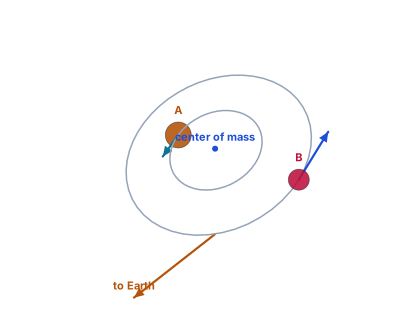
A spectrum measures only the part of each star's velocity along the line of sight. The scene shows why that hides the inclination. The two orbits share a plane tipped toward Earth; the heavier star circles closer to the center of mass and more slowly. Each velocity arrow tilts partly toward us and partly across the sky, and only the first part shifts the lines. That is why spectroscopy alone gives $m \sin^3 i$, and why an eclipse, which needs $i$ near 90 degrees, fixes the masses.
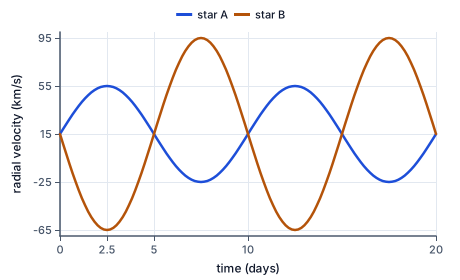
The figure shows the velocity curves of a double-lined binary with a $10$-day circular orbit. Both are sine waves about the pair's velocity of $+15$ km/s, always moving in opposite directions: when star A recedes fastest, star B approaches fastest. Star A swings $40$ km/s each way and star B $80$ km/s, so star A is twice as massive. The summed amplitude, $120$ km/s, and the period give the total mass, $1.036 \times 10^{-7} \times 120^3 \times 10 \approx 1.8$ suns if the orbit is edge-on: $1.2$ for star A and $0.6$ for star B.
A radial velocity from a redshift must be positive and from a blueshift negative, and stellar velocities are usually tens of km/s; thousands means the shift was not divided by the rest wavelength. In a binary, the star with the larger amplitude must come out lighter, and the two masses must add back to the total. A total mass from velocities is only a lower limit unless the stars eclipse. And a main-sequence pair of a few suns' total should have a period of days and amplitudes of tens to a hundred or so km/s; a mass of thousands of suns from such numbers means the cube was misplaced.
Algol, in Perseus, dims from magnitude $2.1$ to $3.4$ for about ten hours every $2.87$ days. In 1783 John Goodricke, a young deaf amateur astronomer in England, proposed that a darker companion was passing in front of it, and spectroscopy later confirmed Algol as an eclipsing binary.
Its spectrum revealed a puzzle. The brighter star is a $3.2$-solar-mass main-sequence star, while its companion, at only $0.7$ solar masses, is already a subgiant, more evolved. Since heavier stars evolve faster, the lighter star should be the less evolved one. The answer is mass transfer: the companion was once the heavier star, swelled first, and spilled much of its mass onto its partner. The velocity amplitudes and the eclipses, which give the masses, are what exposed the paradox.
In 1995 Michel Mayor and Didier Queloz, using a spectrograph at the Haute-Provence Observatory in France, found that the Sun-like star 51 Pegasi moves toward and away from us by about $56$ meters per second every $4.23$ days. Applying the same center-of-mass balance as for a binary, the companion had about half Jupiter's mass at a twentieth of Earth's distance from the Sun: the first planet found around a Sun-like star, which won them the 2019 Nobel Prize in Physics.
The NEID spectrograph on the WIYN telescope at Kitt Peak, Arizona, is built to measure stellar velocities to well under a meter per second, the precision needed to detect an Earth-mass planet's tug, which is about $9$ cm/s on the Sun. Its main obstacle is the stars themselves: convection and spots on a star's surface shift its lines by more than that.
It can seem that a star racing around must be the powerful one. But in a binary both stars feel the same gravitational force, equal and opposite, and the lighter star is accelerated more by it. It swings around a larger orbit, faster, while the heavier star makes small, slow loops near the center of mass. The Sun itself wobbles at about $12$ m/s because of Jupiter, while Jupiter moves at $13$ km/s.
A second slip is reading a radial velocity as a star's whole speed. The Doppler shift measures only motion along our line of sight; a star moving across the sky shows no shift at all.
Hydrogen's red line, at rest at $656.28$ nm, is seen at $656.50$ nm. Subtract.
$\Delta\lambda = 656.50 - 656.28 = 0.22\ \text{nm}$
A redshift.
Divide the shift by the rest wavelength.
$0.22 \div 656.28 = 3.352 \times 10^{-4}$
The fractional shift.
Multiply by the speed of light.
$v_r = 3.352 \times 10^{-4} \times 300{,}000 = 100.6\ \text{km/s}$
The Doppler formula.
Interpret the sign.
$v_r > 0$
The star is receding.
Check the size.
$100.6 \ll 300{,}000$
The non-relativistic formula is fine.
A line at $600$ nm in a hot star is $0.4$ nm wide, broadened by rotation. Write the rule.
$v\sin i = \dfrac{c\,\Delta\lambda}{2\lambda}$
The two limbs give the full width.
Double the wavelength.
$2\lambda = 1{,}200\ \text{nm}$
Half the width each way.
Divide the width by twice the wavelength.
$0.4 \div 1{,}200 = 3.333 \times 10^{-4}$
The fractional half-width.
Multiply by the speed of light.
$v\sin i = 3.333 \times 10^{-4} \times 300{,}000 = 100\ \text{km/s}$
The projected speed.
Compare with the Sun.
$100 \div 2 = 50$
Fifty times the Sun's equatorial speed.
State what is unknown.
$v_{\text{eq}} \ge 100\ \text{km/s}$
The tilt can only make the true speed larger.
An eclipsing pair has $K_A = 60$ km/s, $K_B = 90$ km/s and $P = 4$ days. Add the amplitudes.
$K_A + K_B = 150\ \text{km/s}$
Their relative speed.
Cube the sum.
$150^3 = 3.375 \times 10^{6}$
Kepler's law needs the cube.
Multiply by the period and the constant.
$1.036 \times 10^{-7} \times 3.375 \times 10^{6} \times 4 = 1.399$
Total mass in suns, since it eclipses.
Find the mass ratio.
$m_A \div m_B = 90 \div 60 = 1.5$
Star A is the slower, heavier one.
Divide the total by one plus the ratio.
$m_B = 1.399 \div 2.5 = 0.560\ M_\odot$
The lighter star.
Multiply by the ratio for star A.
$m_A = 1.5 \times 0.560 = 0.839\ M_\odot$
The heavier star.
Check momentum balance.
$0.839 \times 60 = 50.3 = 0.560 \times 90$
The masses are consistent.
Write the balance.
$m_A K_A = m_B K_B$
Momentum about the center of mass.
Divide star B's amplitude by star A's.
$m_A \div m_B = 45 \div 30$
The inverse of the velocity ratio.
State the ratio.
In a double-lined spectroscopic binary, star A's radial velocity swings 40 km/s either side of the pair's average and star B's swings 80 km/s. What can you say about their masses?
Complete the worked solution: in an eclipsing binary, star A's velocity amplitude is $30$ km/s, star B's is $90$ km/s, and the total mass is $8$ suns. Find each star's mass.
Divide star B's amplitude by star A's.
$m_A \div m_B = K_B \div K_A =$ q
Momentum balance.
Divide the total mass by one plus the ratio.
$m_B = 2\ M_\odot$
The total is star B's mass times one plus the ratio.
Multiply star B's mass by the ratio.
$m_A =$ x $M_\odot$
The heavier star.
Check the sum in words.
$\text{the two masses add back to the total}$
No mass is lost or double counted.
Match each feature of a star's spectral lines to what it measures.
| the star's speed toward or away from us | the star's equatorial speed times the sine of its tilt | an orbit around an unseen companion | the ratio of the two stars' masses | |
|---|---|---|---|---|
| the line moved from its rest wavelength | ||||
| the line widened by rotation | ||||
| the line moving back and forth with a fixed period | ||||
| two sets of lines swinging by different amounts |
A line with rest wavelength $486.1$ nm is observed at $485.98$ nm. Taking $c = 300{,}000$ km/s, fill in the shift and the star's radial velocity.
| value | |
|---|---|
| shift (nm) | |
| radial velocity (km/s) |
In a double-lined binary, star A's velocity amplitude is $40$ km/s and star B's is $80$ km/s. Write star B's mass as a function of star A's mass $m$.
Answer:
An eclipsing double-lined binary, seen edge-on, has a circular orbit with period $5$ days, and its two velocity amplitudes add to $150$ km/s. Using $m_A + m_B = 1.036 \times 10^{-7}\,(K_A + K_B)^3 P$, find its total mass in suns.
Answer: solar masses
A survey records an unfamiliar star whose spectrum is described this way: its strongest lines are ionized calcium's, with many neutral metal lines and weaker hydrogen. In it, hydrogen's red line, at rest at $656.28$ nm, appears at $656.17$ nm. Taking $c = 300{,}000$ km/s, give the star's spectral class and its radial velocity.
| spectral class | radial velocity (km/s) | |
|---|---|---|
| the star |
Lesson test: one question per skill, one attempt each, no hints. Your answers are checked when you submit.
In a double-lined binary, star A's velocity amplitude is $60$ km/s and star B's is $24$ km/s. Write star B's mass as a function of star A's mass $m$.
Answer:
You can weigh stars from their spectra. Find the radial velocity of a star whose 656.28 nm line appears at 656.50 nm, and the masses of an eclipsing pair with amplitudes of 60 and 90 km/s and a period of 4 days.
21. Your turn: star A swings $30$ km/s and star B $45$ km/s. Find the mass ratio., step 3
$m_A \div m_B = 1.5$
Star A is heavier.