Back to the on-screen lesson ·
Fusing four hydrogen nuclei into helium releases 26.7 MeV, 0.7 percent of their mass, by the proton-proton chain or the CNO cycle; burning a tenth of its mass gives the Sun 10 billion years, and lifetime falls as about M^-2.5.
Paper packet. Every task here also exists on screen, where it is checked automatically; answers written on paper are not assessed by Nydus. When you are back at a device, enter your answers there.
By the end of this lesson you will be able to compute the energy released by the proton-proton chain and the CNO cycle and derive how main-sequence lifetime depends on mass.
You know from the Astronomy course that the Sun fuses hydrogen into helium and that $E = mc^2$ turns lost mass into energy. From this course you know a star's central temperature, about $15$ million kelvins for the Sun, and how luminosity rises with mass. This lesson follows the nuclear reactions themselves: how much energy they release, how they overcome the repulsion between nuclei, and how long the fuel lasts.
| Term | What it means |
|---|---|
| Mass defect | The mass by which a reaction's products are lighter than its reactants, released as energy. |
| Proton-proton chain | The sequence of reactions that fuses hydrogen into helium in the Sun and smaller stars. |
| CNO cycle | A cycle that fuses hydrogen into helium using carbon, nitrogen and oxygen as catalysts. |
| Coulomb barrier | The electric repulsion between positively charged nuclei that fusion must overcome. |
| Quantum tunneling | The chance for a particle to pass through an energy barrier it lacks the energy to climb. |
| Main-sequence lifetime | How long a star fuses hydrogen in its core, about 10 billion years for the Sun. |
Four hydrogen-1 atoms have a mass of $4.0313$ u and one helium-4 atom $4.0026$ u. The mass defect, $0.0287$ u, is $0.7$ percent of the reactants and is released as
$$E = \Delta m\,c^2 = 0.028697 \times 931.5\ \text{MeV} = 26.7\ \text{MeV}.$$
Stars do it by the proton-proton chain or the CNO cycle, tunneling through the Coulomb barrier. Burning about a tenth of its mass gives a lifetime
$$t \approx 0.1 \times 0.007\,\frac{Mc^2}{L} \approx 10\ \text{Gyr}\,\frac{M}{L} \propto M^{-2.5}.$$
Another way: picture
Picture two cars on a long trip: a compact with a small tank and a high-powered truck with a tank ten times bigger. If the truck burns fuel three thousand times as fast, the compact is still driving long after the truck has run dry. Massive stars are the trucks: more fuel, but a ferocious burn rate.
Another way: steps
Nuclei are bound by the strong force, and the energy that binds them shows up as missing mass. Helium-4 is unusually tightly bound, so four free protons weigh more than the helium nucleus they can build. Using atomic masses, which include the electrons and so automatically account for the positrons they annihilate, the defect is $4 \times 1.007825 - 4.002603 = 0.028697$ u. One atomic mass unit is $931.5$ MeV, so each helium nucleus made releases $26.7$ MeV, about $4.3 \times 10^{-12}$ joules.
That is $0.7$ percent of the hydrogen's rest mass, roughly ten million times the energy per kilogram of burning gasoline. Fusing helium into carbon and oxygen releases far less, about a tenth as much per kilogram.
In the Sun about $99$ percent of the energy comes from the proton-proton chain. First, two protons fuse into a deuteron, $p + p \to d + e^+ + \nu_e$: one proton must turn into a neutron, a weak-force process so improbable that a typical proton in the Sun's core waits about ten billion years before it happens. Then the deuteron captures a proton within about a second, making helium-3, and two helium-3 nuclei fuse into helium-4, releasing two protons.
The slow first step is why the Sun is long-lived: if protons fused easily, the Sun would have burned out long ago. The neutrinos it produces carry away about $2$ percent of the energy, escaping the Sun directly.
In hotter cores, hydrogen fuses through a cycle in which carbon-12 captures four protons in turn, passing through nitrogen and oxygen, and finally splits off a helium-4 nucleus and returns to carbon-12. Carbon, nitrogen and oxygen act as catalysts: they are not used up, and the net result is the same as the proton-proton chain, four protons into one helium nucleus.
Because the protons must overcome the larger charge of carbon and nitrogen nuclei, the cycle's rate rises extremely steeply with temperature, roughly as $T^{16}$ to $T^{20}$, compared with about $T^4$ for the proton-proton chain. Above about $17$ million kelvins, in stars of more than about $1.3$ solar masses, the CNO cycle dominates.
Two protons repel electrically. To fuse, they must come within about $10^{-15}$ m, where the strong force takes over, and at that distance the electric potential energy is about $1$ MeV. At $15$ million kelvins the typical thermal energy $kT$ is only about $1.3$ keV, nearly a thousand times too small. Classically, fusion in the Sun would be impossible.
Quantum mechanics allows a proton to tunnel through the barrier with a probability that rises steeply with its energy. Combined with the few fast protons in the tail of the thermal distribution, which falls steeply with energy, the reactions occur in a narrow band of energies called the Gamow peak, a few times $kT$. That steep combination is why reaction rates depend so strongly on temperature.
The Sun radiates $3.83 \times 10^{26}$ watts, so it loses mass at $L/c^2 = 4.3 \times 10^{9}$ kg every second, the mass of a large lake converted to energy. Since only $0.7$ percent of the hydrogen fused becomes energy, it turns about $6 \times 10^{11}$ kg of hydrogen into helium each second. Even so, over its $4.6$-billion-year life it has used only a few percent of its hydrogen, and less than a tenth of a percent of its mass has become light.
A star leaves the main sequence when the hydrogen in its core is exhausted, roughly the inner tenth of its mass for a Sun-like star. Its main-sequence lifetime is the energy available divided by the rate it is spent:
$$t \approx \frac{0.1 \times 0.007 \times M c^2}{L}.$$
For the Sun this gives $3.3 \times 10^{17}$ s, about $10$ billion years. The Sun is $4.6$ billion years old, about halfway through. For any other star, in solar units, $t \approx 10\ \text{billion years} \times M/L$, provided it burns a similar fraction of its fuel.
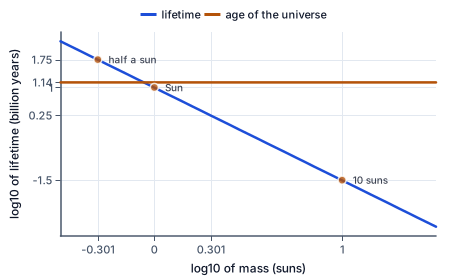
Since main-sequence luminosity rises roughly as $M^{3.5}$, the lifetime falls as $M/M^{3.5} = M^{-2.5}$. A star of $10$ solar masses lives about $10 \times 10^{-2.5}$ billion years, about $30$ million years; a star of half a solar mass about $57$ billion years, four times the present age of the universe. Every red dwarf that has ever formed is still on the main sequence, and the most massive stars, at fifty solar masses or more, live only a few million years. This steep dependence is what lets astronomers date star clusters, the subject of lesson 11.
The figure plots the logarithm of lifetime against the logarithm of mass, so the power law is a straight line with slope $-2.5$. The Sun sits at the origin: $\log 1 = 0$ and $\log 10 = 1$. A star of $10$ solar masses, one step right, is $2.5$ steps down, at about $30$ million years. The flat line marks the universe's age of $13.8$ billion years: every star to its left, below about $0.9$ solar masses, has a lifetime longer than the universe is old, so none has yet died of old age.
A mass defect must be positive for a reaction that releases energy, and small, a few hundredths of an atomic mass unit or less. A fusion energy should be some MeV; billions of MeV or a fraction of an electron volt means a unit was dropped. A lifetime must fall as mass rises; if your heavier star lives longer, the ratio was inverted. And lifetimes span from millions to trillions of years, with the Sun's $10$ billion near the middle; the Sun's numbers, $M = L = 1$, must give exactly $10$ billion years.
On December 5, 2022, the National Ignition Facility at Lawrence Livermore National Laboratory in California focused $192$ lasers delivering $2.05$ megajoules onto a peppercorn-sized capsule of deuterium and tritium, and the capsule released $3.15$ megajoules of fusion energy, the first time a fusion experiment produced more energy than the lasers delivered to the target.
The experiment used deuterium and tritium rather than ordinary hydrogen precisely because of this lesson's physics: the proton-proton chain's weak-force first step is far too slow for any laboratory, which has nanoseconds rather than billions of years. Deuterium-tritium fusion has no weak step and the largest reaction rate at achievable temperatures, about $100$ million kelvins, several times hotter than the Sun's core, to make up for a density and time the Sun has and a laboratory does not.
The CNO cycle supplies only about one percent of the Sun's energy, but it produces its own neutrinos, with energies distinct from the proton-proton chain's. In 2020 the Borexino experiment, a sphere of $300$ tonnes of ultrapure liquid scintillator deep under the Gran Sasso mountain in Italy, reported the first detection of solar CNO neutrinos, after years of reducing background radiation.
The detection confirmed that the cycle operates in the Sun at about the predicted rate, and it matters far beyond the Sun: in stars more massive than about $1.3$ suns, which dominate the light of young galaxies, the CNO cycle is the main source of energy. Borexino also measured the proton-proton chain's neutrinos directly in 2014, completing the picture of how the Sun shines.
It is natural to think a bigger tank lasts longer. But a massive star's core is hotter and denser, and its fusion rate climbs steeply, so its luminosity rises roughly as the $3.5$ power of its mass. Ten times the fuel burned three thousand times as fast lasts only about a three-hundredth as long. The most luminous stars in the sky are also the shortest-lived.
A second slip is treating the Sun as burning like a fire, consuming its fuel quickly. Fusion is so slow, because of the weak-force first step, that the Sun has fused only about six percent of its hydrogen in $4.6$ billion years.
Add the masses of four hydrogen-1 atoms.
$4 \times 1.007825 = 4.031300\ \text{u}$
The reactants.
Subtract the mass of one helium-4 atom.
$4.031300 - 4.002603 = 0.028697\ \text{u}$
The mass defect.
Multiply by the energy of one atomic mass unit.
$0.028697 \times 931.5 = 26.73\ \text{MeV}$
E = m c squared.
Divide the defect by the reactants' mass.
$0.028697 \div 4.031300 = 0.0071$
The efficiency.
State the efficiency as a percent.
$0.71\%$
Seven tenths of a percent of the mass becomes energy.
Take the Sun's luminosity, $3.83 \times 10^{26}$ W. Divide by the speed of light squared.
$\dfrac{3.83 \times 10^{26}}{(3.00 \times 10^{8})^2}$
Mass converted per second.
Evaluate the quotient.
$4.3 \times 10^{9}\ \text{kg/s}$
Mass turned into energy.
Divide by the efficiency.
$4.3 \times 10^{9} \div 0.0071 = 6.0 \times 10^{11}\ \text{kg/s}$
Hydrogen fused each second.
Multiply by the Sun's age in seconds.
$6.0 \times 10^{11} \times 1.45 \times 10^{17} = 8.7 \times 10^{28}\ \text{kg}$
Hydrogen fused so far.
Divide by the Sun's mass.
$8.7 \times 10^{28} \div 1.99 \times 10^{30} = 0.044$
About 4 percent of its mass.
Compare with the hydrogen it began with.
$0.044 \div 0.71 \approx 0.06$
Six percent of its hydrogen fused in 4.6 billion years.
Write the lifetime as energy available over power.
$t = \dfrac{f\,\varepsilon\,M c^2}{L}$
f is the fraction burned, epsilon the efficiency.
Take a tenth of the mass and the efficiency of hydrogen fusion.
$f = 0.1, \quad \varepsilon = 0.007$
The core's hydrogen.
Find the Sun's rest energy.
$M c^2 = 1.99 \times 10^{30} \times 9.0 \times 10^{16} = 1.79 \times 10^{47}\ \text{J}$
All its mass as energy.
Multiply by the two fractions.
$0.1 \times 0.007 \times 1.79 \times 10^{47} = 1.25 \times 10^{44}\ \text{J}$
The energy it will release.
Divide by the luminosity.
$1.25 \times 10^{44} \div 3.83 \times 10^{26} = 3.3 \times 10^{17}\ \text{s}$
Seconds.
Convert to years.
$3.3 \times 10^{17} \div 3.16 \times 10^{7} = 1.0 \times 10^{10}$
Ten billion years.
Compare with the Sun's age.
$4.6 \div 10 = 0.46$
The Sun is about halfway through.
Divide the mass by the luminosity.
$M \div L = 2 \div 16 = 0.125$
In solar units.
Multiply by the Sun's lifetime.
$t = 0.125 \times 10\ \text{billion years}$
Scaled.
State the lifetime.
A main-sequence star of 10 solar masses has ten times the Sun's fuel. How does its main-sequence lifetime compare with the Sun's?
Complete the worked solution: a main-sequence star has $1.5$ solar masses and $6$ solar luminosities. The Sun's main-sequence lifetime is 10 billion years. Find the star's.
Divide the mass by the luminosity.
$M \div L =$ q
Fuel over burning rate, in solar units.
Multiply the Sun's lifetime by that ratio.
$t =$ t $\text{billion years}$
The same fraction of fuel is burned.
Compare with the Sun in words.
$\text{more luminous per unit mass means a shorter life}$
Lifetime falls steeply with mass.
Match each step of hydrogen fusion to what it does.
| the slow weak-force step that sets the chain's pace | makes helium-3 and a gamma ray within seconds | completes helium-4 and returns two protons | turns hydrogen into helium with carbon as a catalyst | |
|---|---|---|---|---|
| two protons fuse into deuterium | ||||
| deuterium captures a proton | ||||
| two helium-3 nuclei fuse | ||||
| the CNO cycle |
When deuterium captures a proton to make helium-3, the reactants' atomic masses total $3.021927$ u and the products' total $3.016029$ u. Fill in the mass defect and the energy released, using $1$ u $= 931.5$ MeV.
| value | |
|---|---|
| mass defect (u) | |
| energy released (MeV) |
Suppose main-sequence luminosity follows $L = M^{4}$ in solar units and every star burns a fraction $0.05$ of its hydrogen before leaving the main sequence. The Sun, burning a fraction $0.1$, lasts $10$ billion years. Write the lifetime $t$ in billions of years as a function of mass $M$ in suns.
Answer:
A fusion rate near its operating temperature behaves as $\varepsilon \propto T^{18}$. If the core temperature rises by $5$ percent, by what factor does the energy generation rate grow?
Answer: times faster
Spica A has about $11.4$ solar masses and $20500$ solar luminosities. If it burns the same fraction of its hydrogen as the Sun, whose main-sequence life is $10{,}000$ million years, how long is its main-sequence life in millions of years?
Answer: million years
Lesson test: one question per skill, one attempt each, no hints. Your answers are checked when you submit.
Suppose main-sequence luminosity follows $L = M^{3}$ in solar units and every star burns a fraction $0.1$ of its hydrogen before leaving the main sequence. The Sun, burning a fraction $0.1$, lasts $10$ billion years. Write the lifetime $t$ in billions of years as a function of mass $M$ in suns.
Answer:
You can account for a star's fuel. Find the energy released when four hydrogen atoms become helium, and the lifetime of a star of 2 solar masses and 16 solar luminosities.
20. Your turn: a star has $2$ solar masses and $16$ solar luminosities. Find its main-sequence lifetime., step 3
$t = 1.25\ \text{billion years}$
An eighth of the Sun's.