Back to the on-screen lesson ·
Independent uncertainties add in quadrature, fractional ones for products and quotients, and a power multiplies a fractional uncertainty by its exponent; so a luminosity carries twice its distance's error and a radius twice its temperature's.
Paper packet. Every task here also exists on screen, where it is checked automatically; answers written on paper are not assessed by Nydus. When you are back at a device, enter your answers there.
By the end of this lesson you will be able to propagate measurement uncertainty through distance, luminosity and radius estimates and name the measurement that limits them.
You can find a star's radius from its luminosity and temperature and its luminosity from its flux and distance. You know a parallax gives a distance, $d = 1/p$, and that every measurement is a little uncertain. You can differentiate a logarithm. This lesson follows the uncertainty of each measurement through those calculations, so that every radius and luminosity comes with an honest error bar.
| Term | What it means |
|---|---|
| Uncertainty | The likely size of the difference between a measured value and the true one; one standard deviation. |
| Fractional uncertainty | The uncertainty divided by the value, often written as a percent. |
| Random error | Scatter that differs from one measurement to the next and averages down with repetition. |
| Systematic error | A bias that shifts every measurement the same way and does not average down. |
| Quadrature | Combining independent uncertainties as the square root of the sum of their squares. |
| Propagation | Working out the uncertainty of a calculated quantity from the uncertainties of its inputs. |
Every input carries its uncertainty into the result, and the way it combines depends on the operation. For independent errors:
So a luminosity $L = 4\pi d^2 F$ has
$$\frac{\sigma_L}{L} = \sqrt{\left(2\frac{\sigma_d}{d}\right)^2 + \left(\frac{\sigma_F}{F}\right)^2},$$
and the distance usually dominates.
Another way: picture
Picture two people pushing a stalled car, one hard to the left of straight ahead and one hard to the right. If both push at once, much of their sideways push cancels. Independent errors are like that: sometimes one is high while the other is low, so together they add less than their sum. The square root of the sum of squares is the length of the diagonal, not the two sides laid end to end.
Another way: steps
A measurement written $250 \pm 12$ pc says the best estimate is $250$ pc and that the true value is probably within about $12$ pc of it. In astronomy the number after the plus-or-minus is usually one standard deviation: if the errors are normally distributed, the true value lies within it about $68$ percent of the time and within twice it about $95$ percent of the time.
The fractional uncertainty, $12/250 = 4.8$ percent here, is often the more useful number, because it does not change when you convert units and because products, quotients and powers are built from fractions.
Random errors scatter repeated measurements around the true value: photon noise in a detector, the wobble of the atmosphere. Averaging $N$ independent measurements shrinks them by $\sqrt{N}$, so a hundred exposures are ten times as precise as one.
Systematic errors push every measurement the same way: a miscalibrated detector, a wrong extinction correction, a zero-point offset in a parallax catalog. Averaging does nothing to them. Gaia's third data release, for example, has parallaxes offset by a few hundredths of a milliarcsecond depending on a star's brightness, color and position, which the team measured from quasars, whose true parallax is zero. Always report the two kinds separately when you can.
Suppose $Q = a + b$ and the errors in $a$ and $b$ are independent. The variance of a sum of independent quantities is the sum of their variances, so $\sigma_Q^2 = \sigma_a^2 + \sigma_b^2$ and $\sigma_Q = \sqrt{\sigma_a^2 + \sigma_b^2}$. Two errors of $3$ and $4$ give $5$, not $7$.
For a product $Q = ab$, take logarithms: $\ln Q = \ln a + \ln b$, and a small change gives $dQ/Q = da/a + db/b$. That is a sum, so the fractional uncertainties add in quadrature. For a power, $\ln Q = n \ln y$ gives $dQ/Q = n\,dy/y$: the fractional uncertainty is multiplied by $|n|$. These three rules, all from one idea, cover almost every calculation in this course.
Quadrature assumes the errors are independent, and sometimes they are not. A star's temperature and its bolometric correction both come from the same spectrum, so if the temperature is overestimated the correction is misjudged in a related way. Two quantities computed from one miscalibrated detector share its error exactly.
For errors that move together, the general rule adds a cross term: $\sigma_Q^2 = \sigma_a^2 + \sigma_b^2 + 2\rho\,\sigma_a\sigma_b$, where the correlation $\rho$ runs from $-1$ to $1$. With $\rho = 0$ this is quadrature; with $\rho = 1$ it becomes straight addition, $\sigma_Q = \sigma_a + \sigma_b$, the worst case; with $\rho = -1$ the errors cancel. When you do not know the correlation, straight addition gives a safe upper bound and quadrature a lower one, and saying which you used is part of an honest result. Large surveys publish the correlations between their measured quantities for exactly this reason.
A parallax $p$ in arcseconds gives a distance $d = 1/p$ in parsecs, or $d = 1{,}000/p$ with $p$ in milliarcseconds. The exponent is $-1$, so the distance has exactly the parallax's fractional uncertainty: a parallax of $4.0 \pm 0.2$ mas, $5$ percent, gives $250 \pm 12.5$ pc.
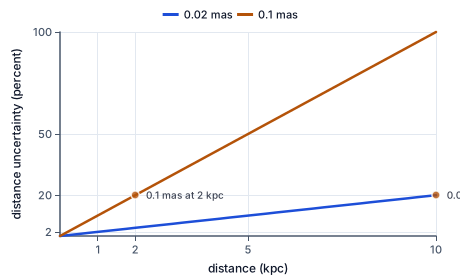
Because a fixed parallax error is a larger fraction of a smaller parallax, distance errors grow with distance, as the figure shows. When the fractional error passes about $20$ percent, $1/p$ itself becomes a biased estimate, because the error bar is lopsided once the distance is turned upside down; astronomers then use statistical methods that model the whole population of stars.
A luminosity from flux and distance, $L = 4\pi d^2 F$, carries twice the distance's fractional uncertainty and once the flux's. A radius from luminosity and temperature, $R \propto L^{1/2}T^{-2}$, carries half the luminosity's and twice the temperature's. Put the two together and $R \propto d\,F^{1/2}\,T^{-2}$:
$$\frac{\sigma_R}{R} = \sqrt{\left(\frac{\sigma_d}{d}\right)^2 + \left(\frac{1}{2}\frac{\sigma_F}{F}\right)^2 + \left(2\frac{\sigma_T}{T}\right)^2}.$$
A $2$ percent temperature error becomes $4$ percent in the radius, while a $4$ percent flux error becomes only $2$. Knowing which term dominates tells you which measurement to improve.
Because $m = -2.5\log_{10} F + \text{constant}$, a small flux error becomes a magnitude error $\sigma_m = 2.5\,\sigma_F/(F \ln 10) = 1.086\,\sigma_F/F$. So a magnitude uncertainty of $0.01$ is about a $1$ percent flux uncertainty, a handy rule.
Going the other way, a distance modulus known to $\sigma_\mu$ magnitudes gives a distance with fractional uncertainty $\sigma_d/d = (\ln 10/5)\,\sigma_\mu = 0.461\,\sigma_\mu$. A modulus good to $0.1$ magnitude is a distance good to about $5$ percent.
The figure plots the fractional distance error against distance for two parallax precisions. Each line is straight because $\sigma_d/d = \sigma_p/p$ and $p$ falls as $1/d$, so the fraction grows in proportion to the distance. At Gaia's best, $0.02$ mas, a star $1$ kiloparsec away has a $2$ percent distance and one at $10$ kpc a $20$ percent distance. At $0.1$ mas, typical of fainter stars, the same $20$ percent is reached at only $2$ kpc. Beyond that, parallaxes alone stop giving individual distances.
A combined uncertainty must be at least as large as its largest single term and no larger than the straight sum of the terms; anything outside that range is an arithmetic slip. A squared or fourth-power quantity must have a larger fractional uncertainty than its input, and a square root a smaller one. Fractional uncertainties do not depend on units, so converting parsecs to meters must leave the percentage unchanged. And a result whose uncertainty is larger than itself, such as a radius of $2 \pm 3$ solar radii, is telling you the measurement has not yet determined the quantity at all.
The Large Magellanic Cloud anchors the extragalactic distance scale: Cepheids calibrated there set the distances to galaxies far beyond. In 2019 a team led from the Polish Academy of Sciences used twenty eclipsing binary stars, pairs whose sizes come from their light curves and whose temperatures and fluxes come from their spectra, to measure its distance as $49.59$ kiloparsecs, with a random uncertainty of $0.09$ kpc and a systematic uncertainty of $0.54$ kpc.
Averaging twenty binaries shrank the random part to under $0.2$ percent; the systematic part, about $1.1$ percent, comes mostly from the calibration of the relation between a star's color and its angular size, and no number of binaries can average it away. Combined in quadrature, the total is about $1.1$ percent: the systematic term dominates completely, which tells astronomers that the next improvement must come from better calibration, not more stars.
Over its mission the European Space Agency's Gaia satellite scanned each of more than a billion stars roughly seventy times. A single scan measures a bright star's position to a few tenths of a milliarcsecond; combining many scans over years, and fitting the yearly parallax wobble, brings the parallax uncertainty for bright stars down to about $0.02$ milliarcseconds in the third data release, published in 2022.
That is the square-root-of-$N$ rule at work on the random errors. At $0.02$ mas, a star $1$ kiloparsec away, with a parallax of $1$ mas, has a $2$ percent distance, and its luminosity is good to about $4$ percent before the flux error is even added. The fourth data release, combining more years of scans, is expected to shrink the random errors further, while the team works separately on the systematic parallax offsets that repetition alone cannot remove.
Adding uncertainties straight assumes every error pushes the same way at the same time, the worst case. Independent errors are as likely to partly cancel as to reinforce, so they combine in quadrature: $3$ and $4$ percent make $5$, not $7$. Straight addition is right only for errors known to move together, such as two quantities computed from the same miscalibrated detector.
A second slip is forgetting the exponents. A squared distance doubles the distance's fractional error, and a fourth-power temperature quadruples the temperature's. The measurement with the smaller error can still dominate if it enters with the larger power.
A star's parallax is $4.0 \pm 0.2$ mas. Invert it.
$d = 1{,}000 \div 4.0 = 250\ \text{pc}$
Milliarcseconds give parsecs over 1,000.
Find the parallax's fractional uncertainty.
$0.2 \div 4.0 = 0.05$
Five percent.
Apply the power rule with exponent minus one.
$\sigma_d \div d = |-1| \times 0.05 = 0.05$
Inverting keeps the fraction.
Multiply the distance by the fraction.
$\sigma_d = 250 \times 0.05 = 12.5\ \text{pc}$
The absolute uncertainty.
Write the result and check its size.
$d = 250 \pm 12.5\ \text{pc}, \quad 5\% < 20\%$
Small enough for one over p.
A star's distance is known to $5$ percent and its flux to $3$ percent. Write the luminosity.
$L = 4\pi d^2 F$
Flux times the area of a sphere.
Apply the power rule to the distance.
$2 \times 5\% = 10\%$
The distance is squared.
Keep the flux's fractional uncertainty.
$3\%$
First power.
Square both terms.
$10^2 = 100, \quad 3^2 = 9$
Quadrature adds squares.
Add the squares and take the root.
$\sqrt{100 + 9} = \sqrt{109} = 10.44\%$
The combined uncertainty.
Check the bounds.
$10 \le 10.44 \le 13$
Between the largest term and the sum.
A luminosity is known to $10$ percent and a temperature to $2$ percent. Write how the radius scales.
$R \propto L^{1/2}\,T^{-2}$
From L = R squared T to the fourth.
Multiply the luminosity's fraction by one half.
$\tfrac{1}{2} \times 10\% = 5\%$
The square root halves it.
Multiply the temperature's fraction by two.
$2 \times 2\% = 4\%$
The temperature is squared.
Square both terms.
$5^2 = 25, \quad 4^2 = 16$
Quadrature adds squares.
Add the squares and take the root.
$\sqrt{25 + 16} = \sqrt{41} = 6.40\%$
The radius's uncertainty.
Halve the temperature error and recompute.
$\sqrt{25 + 4} = 5.39\%$
A better temperature helps a little.
Halve the luminosity error instead.
$\sqrt{6.25 + 16} = 4.72\%$
Here improving the luminosity helps more.
Write the rule for magnitudes.
$\sigma_m = 1.086\,\sigma_F \div F$
From the derivative of minus 2.5 log10 F.
Substitute the fractional uncertainty.
$\sigma_m = 1.086 \times 0.02$
Two percent as a fraction.
State the result.
A star's luminosity is found from $L = 4\pi d^2 F$. The distance is known to 10 percent and the flux to 1 percent. About how uncertain is the luminosity?
Complete the worked solution: a star's luminosity is known to $20$ percent and its temperature to $1.5$ percent. Its radius goes as the square root of the luminosity over the temperature squared. To what percentage is the radius known?
Halve the luminosity's percentage.
$\text{luminosity term} = 10\%$
A square root has exponent one half.
Double the temperature's percentage.
$\text{temperature term} =$ b $\%$
The temperature is squared in the denominator.
Combine the two terms in quadrature.
$\sigma_R \div R =$ c $\%$
Independent errors.
Name the dominant term in words.
$\text{the larger of the two terms}$
That measurement is the one to improve.
Match each way of combining measurements to the rule for its uncertainty.
| add the absolute uncertainties in quadrature | add the fractional uncertainties in quadrature | multiply the fractional uncertainty by the exponent | divide the scatter by the square root of N | |
|---|---|---|---|---|
| a sum or a difference | ||||
| a product or a quotient | ||||
| a quantity raised to a power | ||||
| the mean of N repeated measurements |
A star's parallax is $12.5 \pm 0.25$ milliarcseconds. Fill in its distance in parsecs and the uncertainty of that distance.
| value | |
|---|---|
| distance (pc) | |
| distance uncertainty (pc) |
In a calculation, a star's flux, found from its distance, goes as that measured quantity to the power $-2$. Write the fractional uncertainty of the result as a function of the fractional uncertainty $x$ of the measured quantity.
Answer:
A star's distance is known to $5$ percent and its flux to $3$ percent, independently. To what percentage is its luminosity, $L = 4\pi d^2 F$, known?
Answer: percent
A survey measures a hot subdwarf at $400 \pm 8\%$ pc, with a bolometric flux of $4.4 \pm 3\%$ picowatts per square meter and an effective temperature of $28000 \pm 2\%$ K. Taking a parsec as $3.086 \times 10^{16}$ m, the Sun's luminosity as $3.828 \times 10^{26}$ W and its temperature as $5{,}772$ K, fill in the star's luminosity, its radius, and the percentage uncertainty of the radius.
| value | |
|---|---|
| luminosity (suns) | |
| radius (solar radii) | |
| radius uncertainty (percent) |
Lesson test: one question per skill, one attempt each, no hints. Your answers are checked when you submit.
In a calculation, a star's surface flux, found from its temperature, goes as that measured quantity to the power $4$. Write the fractional uncertainty of the result as a function of the fractional uncertainty $x$ of the measured quantity.
Answer:
You can carry an error bar through a calculation. Find the distance and its uncertainty from a parallax of 4.0 plus or minus 0.2 mas, and the luminosity's uncertainty when the distance is known to 5 percent and the flux to 3 percent.
20. Your turn: a flux is measured to $2$ percent. Find the magnitude's uncertainty., step 3
$\sigma_m = 0.022\ \text{mag}$
About two hundredths of a magnitude.