Back to the on-screen lesson ·
Conserving angular momentum spins collapsing cores up into pulsars, which shine on their rotational energy; gas falling onto compact objects releases G M / R per kilogram through hot disks, up to the Eddington luminosity.
Paper packet. Every task here also exists on screen, where it is checked automatically; answers written on paper are not assessed by Nydus. When you are back at a device, enter your answers there.
By the end of this lesson you will be able to explain pulsars, accretion disks and X-ray binaries from energy and angular-momentum arguments and estimate their luminosities.
You know neutron stars are about $12$ km across with masses above the Sun's, that white dwarfs are Earth-sized, and that a binary's stars can be close enough to exchange mass. From mechanics you know angular momentum and gravitational potential energy. This lesson uses just those two conservation laws to explain pulsars, the disks of gas that spiral onto compact objects, and the X-ray sources they light up.
| Term | What it means |
|---|---|
| Pulsar | A rotating, magnetized neutron star whose beams sweep past Earth once per turn. |
| Spin-down power | The rate a pulsar loses rotational energy as it slows, 4 pi^2 I Pdot / P^3. |
| Accretion | Gas falling onto a star or compact object, releasing gravitational energy. |
| Accretion disk | A flat, rotating disk of gas spiraling inward as it sheds angular momentum. |
| Eddington luminosity | The luminosity at which radiation pressure on the gas balances gravity, 1.26 x 10^31 W per solar mass. |
| X-ray binary | A neutron star or black hole drawing gas from a companion star, glowing in X-rays. |
A collapsing core keeps its angular momentum, so its period shrinks with its radius squared, $P_1 = P_0(R_1/R_0)^2$, and neutron stars spin in milliseconds to seconds. A magnetized one is a pulsar, slowing as it radiates its rotational energy:
$$\dot E = \frac{4\pi^2 I \dot P}{P^3}, \qquad \tau = \frac{P}{2\dot P}.$$
Gas falling onto a compact object releases $GM/R$ per kilogram, giving $L = GM\dot M/R$: about $17$ percent of the rest energy for a neutron star. It spirals in through an accretion disk, up to the Eddington luminosity $L_{\text{Edd}} = 1.26 \times 10^{31}(M/M_\odot)$ W.
Another way: picture
Picture a figure skater spinning with arms out, then pulling them in tight: she spins far faster, though nothing pushed her. A collapsing stellar core pulls its mass in from hundreds of thousands of kilometers to about twelve, and spins up the same way, but by a factor of hundreds of millions.
Another way: steps
A spinning sphere's angular momentum is $J = I\omega$, with moment of inertia $I \propto MR^2$ and spin rate $\omega = 2\pi/P$. With no outside torque, $J$ stays the same as the core collapses, so $R^2/P$ is constant and
$$P_1 = P_0\left(\frac{R_1}{R_0}\right)^2.$$
A core the size of the Sun rotating once a month, collapsed to $12$ km, would spin in under a millisecond. Real newborn neutron stars spin more slowly, tens of milliseconds, because massive stars' cores lose angular momentum before they collapse, but the conservation law explains why neutron stars spin at all as fast as they do. The same logic squeezes the magnetic field: magnetic flux, $BR^2$, is also conserved, so fields grow a billionfold, to about $10^{8}$ tesla.
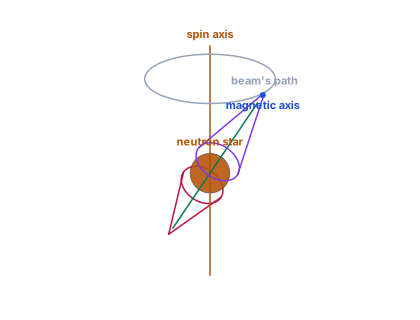
In 1967 Jocelyn Bell, a graduate student at Cambridge in England, found a radio source pulsing every $1.337$ seconds with clocklike regularity. Within a year the explanation was clear: a rotating neutron star whose magnetic axis is tilted from its spin axis, beaming radiation along the magnetic poles. Each time a beam sweeps across Earth we see a pulse, like a lighthouse.
Only a neutron star could do it. A rotating body cannot spin faster than about once per its free-fall time without flying apart, and a pulse period of a second or less needs a density of at least about $10^{11}$ kg/m$^3$, beyond even a white dwarf. The fastest known pulsar turns $716$ times a second.
A pulsar's spinning magnetic field drives a wind of particles and radiation that drains its rotational energy, $E = \tfrac{1}{2}I\omega^2$, so it slows down and its period lengthens at a rate $\dot P$. Differentiating $E$ gives the power lost,
$$\dot E = I\omega\dot\omega = \frac{4\pi^2 I \dot P}{P^3},$$
with $I \approx 10^{38}$ kg m$^2$ for a neutron star. The Crab pulsar, with $P = 0.0337$ s and $\dot P = 4.21 \times 10^{-13}$, loses about $4 \times 10^{31}$ W, about a hundred thousand Suns, which is just what lights the surrounding Crab Nebula. If the pulsar was born spinning much faster than now, its age is about $P/2\dot P$, the characteristic age: about $1{,}270$ years for the Crab, whose supernova was recorded in 1054.
A mass $m$ falling from far away onto the surface of an object of mass $M$ and radius $R$ gains kinetic energy $GMm/R$, which becomes heat and radiation when it hits. Gas arriving at a rate $\dot M$ therefore produces
$$L_{\text{acc}} = \frac{G M \dot M}{R}.$$
The yield per kilogram, as a fraction of rest energy, is $GM/(Rc^2)$: about $0.0002$ percent for the Sun, $0.01$ percent for a white dwarf, and about $17$ percent for a neutron star, twenty-five times the efficiency of hydrogen fusion. Disks around black holes release between about $6$ and $42$ percent, depending on the hole's spin. Compactness is what makes accretion powerful.
Gas flowing from a companion star carries angular momentum and cannot fall straight in. It settles into a flat, rotating accretion disk, each ring orbiting at nearly the Kepler speed for its radius. To move inward, gas must hand its angular momentum outward to neighboring rings, which friction-like turbulence, driven by magnetic fields, accomplishes. That friction heats the disk.
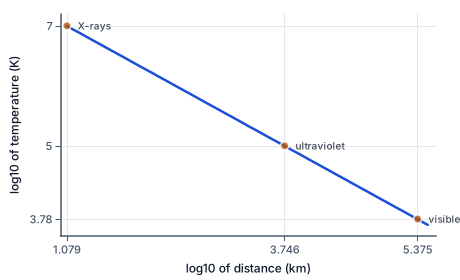
Half the energy released as gas spirals in is radiated by the disk itself, and the inner disk, deepest in the well, gets hottest: the temperature rises inward roughly as $r^{-3/4}$. Around a neutron star or stellar black hole the inner disk reaches about $10^{7}$ K and glows in X-rays, as the figure shows.
Radiation pushes on matter. Photons streaming out scatter off electrons, pushing them outward with a force proportional to the luminosity, while gravity pulls on the protons, which hold the electrons by electric attraction. The two balance at the Eddington luminosity,
$$L_{\text{Edd}} = \frac{4\pi G M m_p c}{\sigma_T} = 1.26 \times 10^{31}\,\frac{M}{M_\odot}\ \text{W},$$
about $33{,}000$ Suns per solar mass. Brighter than that, radiation blows the infalling gas away and steady accretion stops. It caps the luminosity of accreting objects and also of the most massive stars.
In an X-ray binary, a neutron star or black hole draws gas from a companion. In low-mass X-ray binaries, the companion is a small star overflowing its gravitational boundary, feeding a disk; Scorpius X-1, the first X-ray source found beyond the Sun, is one, shining near its Eddington limit. In high-mass X-ray binaries, the compact object sits in the wind of a massive star, as in Cygnus X-1, a black hole of about $21$ suns.
Accretion also delivers angular momentum. Over hundreds of millions of years it can spin an old neutron star up to millisecond periods, making a millisecond pulsar, a recycled pulsar of extreme regularity. On white dwarfs, accreted hydrogen can ignite in a runaway, a nova.
A pulsar does not switch on and off; its beams are steady and the star turns. The scene shows the geometry: radio beams stream along the magnetic axis, which is tipped from the spin axis, so each rotation sweeps the beams in a cone around the sky. We see a pulse only if our line of sight lies on that cone, which is why many neutron stars that are spinning and beaming are never seen as pulsars.
The figure shows the temperature of a disk around a neutron star against distance, both on logarithmic scales, falling as distance to the minus three quarters. At the inner edge, $12$ km out, the gas is at about $10$ million kelvins and radiates X-rays. By about $5{,}600$ km it has cooled to $100{,}000$ K, in the ultraviolet, and only beyond about $230{,}000$ km is it cool enough to shine mainly in visible light. A single disk spans the spectrum, which is why X-ray binaries are studied with X-ray, ultraviolet and optical telescopes together.
A spun-up period must be shorter than the original by the square of the radius ratio; if it came out longer, the ratio was inverted. A pulsar's characteristic age should be hundreds to millions of years, and its spin-down power must fall as the period grows. An accretion efficiency must be below about $42$ percent, the most any disk can reach, and above the white dwarf's hundredth of a percent for a neutron star. And an Eddington luminosity must grow in proportion to mass, about $33{,}000$ Suns per solar mass.
In June 1962 a rocket launched from the White Sands Missile Range in New Mexico carried X-ray detectors above the atmosphere for about six minutes, looking for X-rays from the Moon. Instead Riccardo Giacconi's team found a brilliant X-ray source in Scorpius, far brighter than anyone expected, and a glow from the whole sky.
Scorpius X-1 turned out to be a neutron star accreting from a small companion, radiating a thousand times more in X-rays than in visible light. Its discovery founded X-ray astronomy, and Giacconi later led the Uhuru satellite, launched in 1970 from Kenya, and the Einstein observatory. He shared the 2002 Nobel Prize in Physics. NASA's Chandra X-ray Observatory, launched in 1999, continues his work.
Millisecond pulsars, spun up by accretion, keep time almost as well as atomic clocks. The North American Nanohertz Observatory for Gravitational Waves, NANOGrav, has timed dozens of them for over fifteen years with the Green Bank Telescope in West Virginia, the Very Large Array in New Mexico and, until its collapse in 2020, the Arecibo telescope in Puerto Rico.
A passing gravitational wave would make pulses from different directions arrive slightly early or late in a correlated pattern. In June 2023 NANOGrav reported evidence for exactly that pattern, a background of gravitational waves with periods of years, probably from pairs of supermassive black holes orbiting each other in distant galaxies: recycled pulsars as a detector the size of the galaxy.
The pulses look like flashes, so it is natural to imagine the star brightening and dimming. In fact a pulsar shines steadily in its beams; we see a pulse only when a beam sweeps across Earth as the star rotates, exactly as a lighthouse seems to flash. Pulsars whose beams never cross our line of sight are invisible to us as pulsars.
A second slip is thinking accretion is a minor energy source compared with fusion. For a neutron star or black hole it is the opposite: a kilogram falling in releases tens of times more energy than fusing a kilogram of hydrogen.
A core of $700{,}000$ km rotating every $30$ days collapses to $12$ km. Write the rule.
$P_1 = P_0\,(R_1 \div R_0)^2$
Angular momentum is conserved.
Divide the radii.
$12 \div 700{,}000 = 1.71 \times 10^{-5}$
The radius ratio.
Square the ratio.
$(1.71 \times 10^{-5})^2 = 2.94 \times 10^{-10}$
Spin-up factor.
Convert the old period to seconds.
$30 \times 86{,}400 = 2.59 \times 10^{6}\ \text{s}$
SI units.
Multiply the old period by the square.
$P_1 = 2.59 \times 10^{6} \times 2.94 \times 10^{-10} = 7.6 \times 10^{-4}\ \text{s}$
Under a millisecond.
The Crab pulsar has $P = 0.0337$ s and $\dot P = 4.21 \times 10^{-13}$. Write the spin-down power.
$\dot E = \dfrac{4\pi^2 I \dot P}{P^3}$
Rotational energy lost per second.
Multiply the numerator.
$4\pi^2 \times 10^{38} \times 4.21 \times 10^{-13} = 1.66 \times 10^{27}$
With I = 10^38 kg m^2.
Cube the period.
$0.0337^3 = 3.83 \times 10^{-5}$
The denominator.
Divide the two.
$\dot E = 1.66 \times 10^{27} \div 3.83 \times 10^{-5} = 4.3 \times 10^{31}\ \text{W}$
About a hundred thousand Suns.
Find the characteristic age.
$\tau = \dfrac{0.0337}{2 \times 4.21 \times 10^{-13}} = 4.0 \times 10^{10}\ \text{s}$
Seconds.
Convert to years and compare.
$4.0 \times 10^{10} \div 3.156 \times 10^{7} = 1{,}270\ \text{years vs } 970$
Close to the true age since 1054.
Scorpius X-1 shines at about $2.3 \times 10^{31}$ W from a neutron star of $1.4$ suns and $12$ km. Write the luminosity.
$L = \dfrac{G M \dot M}{R}$
Accretion power.
Solve for the accretion rate.
$\dot M = \dfrac{L R}{G M}$
Multiply by R, divide by G M.
Find G M over R.
$\dfrac{6.674 \times 10^{-11} \times 2.785 \times 10^{30}}{1.2 \times 10^{4}} = 1.55 \times 10^{16}\ \text{J/kg}$
Energy per kilogram.
Divide the luminosity by it.
$\dot M = 2.3 \times 10^{31} \div 1.55 \times 10^{16} = 1.5 \times 10^{15}\ \text{kg/s}$
Kilograms per second.
Convert to solar masses per year.
$1.5 \times 10^{15} \times 3.156 \times 10^{7} \div 1.989 \times 10^{30} = 2.4 \times 10^{-8}$
Suns per year.
Compare with the Eddington luminosity.
$L_{\text{Edd}} = 1.26 \times 1.4 = 1.76 \times 10^{31}\ \text{W}$
For 1.4 suns.
Draw the conclusion.
$2.3 \div 1.76 \approx 1.3$
Near the limit, within the uncertainty of its distance.
Write the limit.
$L_{\text{Edd}} = 1.26 \times 10^{31}\,(M/M_\odot)\ \text{W}$
Proportional to mass.
Multiply by the mass in suns.
$L_{\text{Edd}} = 1.26 \times 10^{31} \times 10$
Ten suns.
State the result.
Stars rotate in days or weeks, yet the neutron stars their cores collapse into rotate in milliseconds to seconds. Why?
Complete the worked solution: a stellar core rotating once every $1500$ s with a radius of $1200$ km collapses to a neutron star of $12$ km, keeping its angular momentum. Find the neutron star's period.
Divide the new radius by the old.
$R_1 \div R_0 = 0.01$
How much it shrinks.
Square the radius ratio.
$(R_1 \div R_0)^2 =$ s
Angular momentum goes as R squared over P.
Multiply the old period by the square.
$P_1 =$ n $\text{s}$
The new spin period.
Say what the fast spin means in words.
$\text{a newborn pulsar spinning many times a second}$
Like the Crab pulsar.
Match each phenomenon to the energy that powers it.
| the rotational energy of a magnetized neutron star | the gravitational energy of gas falling onto a compact object | spin delivered by gas from a companion long ago | fusion of hydrogen piled up on the surface | |
|---|---|---|---|---|
| a young pulsar's beams and wind | ||||
| an X-ray binary's glow | ||||
| a millisecond pulsar's fast spin | ||||
| a nova outburst on a white dwarf |
Gas falls onto Sirius B, of $1.02$ solar masses and radius $5844$ km. Fill in the energy released per kilogram in units of $10^{12}$ J/kg, and that energy as a percentage of the kilogram's rest energy. Use $G = 6.674 \times 10^{-11}$, $M_\odot = 1.989 \times 10^{30}$ kg and $c = 2.998 \times 10^{8}$ m/s.
| value | |
|---|---|
| energy per kilogram (10^12 J/kg) | |
| efficiency (percent) |
Accretion onto a nonrotating black hole's disk turns a fraction $\eta = 0.06$ of the infalling mass's rest energy into radiation. Taking $c^2 = 9 \times 10^{16}$ J/kg, write the luminosity in units of $10^{30}$ W as a function of the accretion rate $x$ in units of $10^{14}$ kg/s.
Answer:
The Eddington luminosity for ionized hydrogen is $L_{\text{Edd}} = 1.26 \times 10^{31}\,(M/M_\odot)$ W. Find it for a compact object of $21$ solar masses, in units of $10^{31}$ W.
Answer: times 10^31 watts
Timing gives the Crab pulsar a period $P = 0.0337$ s that lengthens at $\dot P = 4.21 \times 10^{-13}$ seconds per second. Taking its moment of inertia as $10^{38}$ kg m$^2$ and a year as $3.156 \times 10^{7}$ s, fill in its characteristic age in years and its spin-down power in units of $10^{28}$ W.
| value | |
|---|---|
| characteristic age (years) | |
| spin-down power (10^28 W) |
Lesson test: one question per skill, one attempt each, no hints. Your answers are checked when you submit.
Accretion onto a nonrotating black hole's disk turns a fraction $\eta = 0.06$ of the infalling mass's rest energy into radiation. Taking $c^2 = 9 \times 10^{16}$ J/kg, write the luminosity in units of $10^{30}$ W as a function of the accretion rate $x$ in units of $10^{14}$ kg/s.
Answer:
You can account for a compact object's power. Find the period of a core that collapses from 700,000 km to 12 km, and the Crab pulsar's spin-down power.
21. Your turn: find the Eddington luminosity of a $10$-solar-mass black hole., step 3
$L_{\text{Edd}} = 1.26 \times 10^{32}\ \text{W}$
About 330,000 Suns.