Back to the on-screen lesson ·
Energy leaves a star by radiative diffusion or by convection, decided by the Schwarzschild criterion; massive stars convect in their cores and small ones in their envelopes, and scaling radiative transport gives L ~ M^3 / kappa.
Paper packet. Every task here also exists on screen, where it is checked automatically; answers written on paper are not assessed by Nydus. When you are back at a device, enter your answers there.
By the end of this lesson you will be able to compare radiative and convective energy transport, decide where each dominates, and use scaling relations to predict how a star's luminosity and central temperature change with mass.
You have the radiative transport equation from lesson 6 and the scalings $T_c \propto M/R$ and $\rho \propto M/R^3$ from lesson 7. You know that a gas cools when it expands without exchanging heat. This lesson asks how energy actually gets out of a star, when radiation can carry it and when the gas must boil, and what that means for how luminous a star of a given mass must be.
| Term | What it means |
|---|---|
| Radiative diffusion | Energy carried outward by photons that are absorbed and re-emitted again and again in a random walk. |
| Mean free path | The average distance a photon travels between absorptions, 1 / (kappa rho). |
| Convection | Energy carried by hot gas rising and cool gas sinking. |
| Adiabatic gradient | How steeply temperature falls with pressure in gas that rises without exchanging heat, 1 - 1/gamma. |
| Schwarzschild criterion | Gas convects where the radiative temperature gradient would be steeper than the adiabatic gradient. |
| Mass-luminosity relation | The steep rise of main-sequence luminosity with mass, roughly as the third to fourth power. |
Energy leaves a star's core by radiative diffusion or by convection. Radiation diffuses through gas of opacity $\kappa$, needing a gradient $\nabla_{\text{rad}} = d\ln T/d\ln P$ that grows with $\kappa L(r)/r^2$. A rising blob of gas cools along the adiabatic gradient, $\nabla_{\text{ad}} = 1 - 1/\gamma$, $0.4$ for an ideal monatomic gas. The Schwarzschild criterion:
$$\nabla_{\text{rad}} > \nabla_{\text{ad}} \quad\Longrightarrow\quad \text{convection}.$$
Scaling the radiative case gives a luminosity set by mass alone,
$$L \propto \frac{R\,T^4}{\kappa\rho} \propto \frac{M^3}{\kappa}.$$
Another way: picture
Picture a pot of soup on a low flame. Heat creeps up through the still liquid by conduction, and the top stays calm. Turn the flame up and the bottom gets too hot for that slow creep to carry the heat away: the soup starts to churn, hot soup rising and cooler soup sinking. A star switches from radiation to convection in the same way, wherever radiation cannot carry the heat fast enough at a gentle gradient.
Another way: steps
A photon made in the Sun's core does not fly straight out. It travels on average one mean free path, $\ell = 1/(\kappa\rho)$, before an atom or electron absorbs or scatters it in a random new direction. In the dense core that is well under a centimeter. After $N$ random steps the photon is typically only $\sqrt{N}\,\ell$ from where it began, so reaching the surface takes $N = (R/\ell)^2$ steps and a time
$$t \approx \frac{R^2}{\ell\,c}.$$
With $\ell = 1$ mm throughout, that is about $50{,}000$ years; detailed models, with the mean free path varying layer by layer, give tens of thousands to a few hundred thousand years. Light crossing the Sun in a straight line would take $2.3$ seconds.
Opacity measures how strongly gas blocks radiation, per kilogram. In the hottest, fully ionized gas the main source is electron scattering, about $0.034$ m$^2$/kg for the Sun's composition and independent of temperature. In cooler gas, electrons bound to atoms absorb photons, and the opacity follows roughly Kramers's law, $\kappa \propto \rho T^{-3.5}$, rising steeply as the gas cools. In the outer layers of the Sun and cooler stars, the negative hydrogen ion, a hydrogen atom holding a second electron, dominates and makes the gas very opaque. Where opacity is high, radiation needs a steep gradient to push energy through.
Imagine nudging a blob of gas upward. It expands into the lower pressure and, exchanging no heat on the way, cools along the adiabatic gradient, $\nabla_{\text{ad}} = d\ln T/d\ln P = 1 - 1/\gamma$. If the surrounding gas cools with height even faster than that, the blob ends up hotter and lighter than its surroundings and keeps rising: the layer is unstable and convects. If the surroundings cool more slowly, the blob sinks back and the layer is stable.
So the test is the Schwarzschild criterion: compare the gradient radiation would need, $\nabla_{\text{rad}}$, with $\nabla_{\text{ad}}$. For an ideal monatomic gas, $\gamma = 5/3$ and $\nabla_{\text{ad}} = 0.4$.
Two things make $\nabla_{\text{rad}}$ large: high opacity and a large flux, $L(r)/r^2$. In stars above about $1.3$ solar masses, the CNO cycle releases energy in a tiny central region, so $L(r)/r^2$ is enormous there and the core convects, while the envelope is radiative. In the Sun and smaller stars, the core is radiative but the cool outer layers, opaque with the negative hydrogen ion, convect.
Below about $0.35$ solar masses the opacity is high throughout and the whole star convects, which mixes all its hydrogen into the core and lets it burn almost all of it. Where hydrogen or helium is partly ionized, $\gamma$ drops toward $1$, so $\nabla_{\text{ad}}$ falls and convection sets in more easily.
Convection in the Sun begins at $0.71$ of its radius and carries the energy the rest of the way out. At the surface it shows as granulation: bright cells of rising hot gas, each about $1{,}000$ km across, outlined by dark lanes of sinking cooler gas, each cell lasting about eight minutes. Larger patterns, supergranules about $30{,}000$ km across, sit beneath.
Convection is turbulent and has no simple formula. Stellar models describe it with mixing-length theory, in which a blob travels a fixed multiple of the pressure scale height before dissolving; the multiple is tuned so that a model of the Sun has the Sun's radius.
Write the radiative transport equation as $L \approx 4\pi r^2\,(16\sigma T^3/3\kappa\rho)\,|dT/dr|$ and replace $dT/dr$ by $T/R$:
$$L \propto \frac{R^2\,T^4}{\kappa\rho R} = \frac{R\,T^4}{\kappa\rho}.$$
Substitute $T \propto M/R$ and $\rho \propto M/R^3$. The radius cancels:
$$L \propto \frac{R\,(M/R)^4}{\kappa\,(M/R^3)} = \frac{M^3}{\kappa}.$$
A radiative star's luminosity is set by its mass and opacity, not by how big it is, a striking result. With constant electron-scattering opacity, $L \propto M^3$. With Kramers opacity, $\kappa \propto \rho T^{-3.5}$, it becomes $L \propto M^{5.5}R^{-0.5}$. Real main-sequence stars between about one and twenty solar masses follow roughly $L \propto M^{3.5}$.
The scaling explains why a star twice the Sun's mass is about ten to sixteen times as luminous, and why the most massive stars outshine the Sun a million times. It fails at the ends of the main sequence. In red dwarfs, which convect throughout, radiative transport does not set the luminosity, and the relation is shallower. In the most massive stars, radiation pressure and electron scattering take over and the relation flattens toward $L \propto M$. Testing a scaling against measured stars, as the last item asks, is how such limits are found.
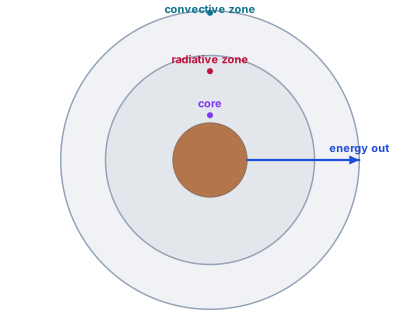
In the Sun, energy changes how it travels partway out. The scene cuts the Sun open: fusion in the core, out to a quarter of the radius; a radiative zone to about 70 percent, where the temperature gradient stays below the adiabatic one and light diffuses outward; and a convective zone above, where the gradient would be too steep and the gas turns over instead. Stars much heavier than the Sun reverse the arrangement, with a convective core and a radiative envelope.
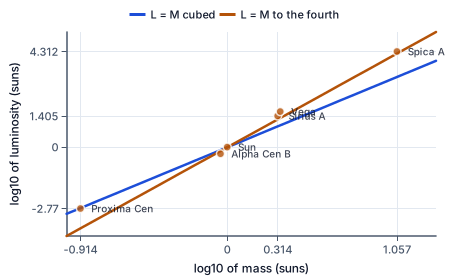
The figure plots the logarithm of luminosity against the logarithm of mass, so a power law is a straight line with slope equal to the power. The lines $L = M^3$ and $L = M^4$ pass through the Sun at the origin. Sirius A, Vega and Spica A lie between them, nearer the fourth power: Sirius A, at $2.06$ solar masses, has $25$ times the Sun's luminosity, about three times what $M^3$ predicts. Alpha Centauri B lies a little below both lines, and Proxima Centauri sits near the cube.
An adiabatic gradient for a real gas must be between $0$ and $0.4$, the monatomic value; anything above $0.4$ means $1/\gamma$ was used instead of $1 - 1/\gamma$. A photon diffusion time must be thousands of years or more for a star; seconds means the path was treated as straight. A luminosity scaling must give one solar luminosity for one solar mass when the opacity is the Sun's, and must rise with mass. And when a prediction and a measurement disagree by a steady factor across many stars, suspect the scaling's assumptions, not the data.
In January 2020 the National Science Foundation's Daniel K. Inouye Solar Telescope, with a $4$-meter mirror on Haleakala on Maui, Hawaii, released the most detailed images of the Sun's surface ever taken. They show the granulation as a pattern of bright cells, each about the size of Texas, separated by dark lanes where cooled gas plunges back down.
Each granule is the top of a convection cell, hot gas rising at about a kilometer per second, spreading, cooling and sinking within about eight minutes. Bright points in the lanes mark concentrated magnetic fields. These images are a direct look at the convection zone's top layer, the final stage of the energy's long trip from the core.
Fusion in the Sun's core releases not only energy that random-walks out over millennia but also neutrinos, which barely interact with matter and escape in about two seconds, reaching Earth eight minutes later. Starting in 1968, Ray Davis detected them with a tank of $380{,}000$ liters of cleaning fluid nearly a mile underground in the Homestake Mine in Lead, South Dakota, catching about one solar neutrino every few days.
Neutrinos report what the core is doing today, while sunlight reports what it did long ago. That they agree, once the neutrinos' own changes of type in flight are accounted for, confirms both the solar model and the long diffusion time. Davis shared the 2002 Nobel Prize in Physics.
Sunlight takes about eight minutes to reach Earth, so it is tempting to think the light we see left the core a few seconds before. In fact the energy wanders outward in a random walk lasting tens of thousands of years or more, then is carried the last third of the way by convection. The light we see now was emitted by the photosphere; the energy it carries was released in the core long before.
A second slip is assuming hotter or bigger stars always convect. Convection is decided by comparing two gradients, and it is the concentration of energy release, not the star's size, that gives massive stars their convective cores.
A layer has $\gamma = 5/3$ and needs $\nabla_{\text{rad}} = 0.55$. Write the adiabatic gradient.
$\nabla_{\text{ad}} = 1 - \dfrac{1}{\gamma}$
How a rising blob cools.
Substitute the adiabatic index.
$\nabla_{\text{ad}} = 1 - \dfrac{3}{5} = 0.4$
An ideal monatomic gas.
Subtract it from the radiative gradient.
$0.55 - 0.4 = 0.15$
The Schwarzschild test.
Read the sign.
$0.15 > 0$
The radiative gradient is steeper.
State the mode.
$\text{the layer convects}$
A rising blob stays hotter than its surroundings.
Take a mean free path of $1$ mm throughout the Sun. Convert it to meters.
$\ell = 1 \times 10^{-3}\ \text{m}$
SI units.
Count the random-walk steps.
$N = \left(\dfrac{6.957 \times 10^{8}}{10^{-3}}\right)^2 = 4.84 \times 10^{23}$
Distance grows as the root of the steps.
Multiply the steps by the time per step.
$t = N\,\dfrac{\ell}{c} = 4.84 \times 10^{23} \times \dfrac{10^{-3}}{3 \times 10^{8}}$
Each step at light speed.
Evaluate the time in seconds.
$t = 1.61 \times 10^{12}\ \text{s}$
Seconds.
Convert to years.
$1.61 \times 10^{12} \div 3.156 \times 10^{7} = 51{,}100\ \text{years}$
Tens of thousands of years.
Compare with a straight path.
$6.957 \times 10^{8} \div 3 \times 10^{8} = 2.3\ \text{s}$
The random walk is trillions of times slower.
A main-sequence star has $2$ solar masses and $1.7$ solar radii. Write the luminosity scaling.
$L \propto \dfrac{M^3}{\kappa}$
Constant opacity.
Cube the mass ratio.
$L = 2^3 = 8\ L_\odot$
The prediction.
Write the central temperature scaling.
$T_c \propto \dfrac{M}{R}$
From lesson 7.
Scale the Sun's central temperature.
$T_c = 15.7 \times 2 \div 1.7 = 18.5\ \text{million K}$
Only 18 percent hotter.
Compare with Sirius A's measured luminosity.
$25.4 \div 8.74 = 2.9$
Sirius A, at 2.06 suns, is about three times brighter than the cube predicts.
Find the power that would fit.
$\log 25.4 \div \log 2.06 = 4.5$
Steeper than 3 for this star.
Explain the difference.
$\text{lower opacity in hotter stars}$
Less opacity lets more energy out.
Write the scaling normalized to the Sun.
$L = M^3$
Constant opacity.
Cube the mass.
$L = 3^3$
Mass in suns.
State the luminosity.
Stars of more than about 1.3 solar masses have convective cores, while the Sun's core is radiative. Why?
Complete the worked solution: a layer's gas has $\gamma = \tfrac{5}{3}$ and a radiative gradient $\nabla_{\text{rad}} = 0.55$. Decide whether it convects.
Subtract one over gamma from one.
$\nabla_{\text{ad}} =$ a
The adiabatic gradient.
Subtract the adiabatic gradient from the radiative gradient.
$\nabla_{\text{rad}} - \nabla_{\text{ad}} =$ d
The Schwarzschild test.
Read the sign in words.
$\text{positive means convection, negative means radiation}$
A steeper radiative gradient is unstable.
Match each star to how its energy is carried outward.
| a radiative core under a convective envelope | convection from the center to the surface | a convective core under a radiative envelope | a convective envelope reaching deep toward a small core | |
|---|---|---|---|---|
| the Sun | ||||
| a red dwarf of a fifth of a solar mass | ||||
| a main-sequence star of 10 solar masses | ||||
| a red giant |
In a layer of a star the gas has adiabatic index $\gamma = \tfrac{4}{3}$, and radiation alone would need a temperature gradient $\nabla_{\text{rad}} = d\ln T/d\ln P = 0.2$. Fill in the adiabatic gradient and how the energy is carried.
| adiabatic gradient | energy carried by | |
|---|---|---|
| the layer |
A family of radiative main-sequence stars has twice the Sun's opacity throughout. Scaling the radiative transport equation, and taking a star with the Sun's mass, structure and opacity to have one solar luminosity, write a star's luminosity in suns as a function of its mass $M$ in suns.
Answer:
Suppose a photon's mean free path were $1$ cm everywhere in a star of the Sun's radius, $6.957 \times 10^{8}$ m. How long, in years, would it take to random-walk from the center to the surface? Use $c = 3 \times 10^{8}$ m/s and a year of $3.156 \times 10^{7}$ s.
Answer: years
Sirius A has about $2.06$ solar masses and $1.71$ solar radii, and its measured luminosity is about $25.4$ suns. Using the scaling laws $L \propto M^3$ and $T_c \propto M/R$, normalized to the Sun's $1$ sun and $15.7$ million K, fill in the predicted luminosity, the predicted central temperature, and the measured luminosity divided by the prediction.
| value | |
|---|---|
| predicted luminosity (suns) | |
| predicted central temperature (million K) | |
| measured over predicted |
Lesson test: one question per skill, one attempt each, no hints. Your answers are checked when you submit.
A family of radiative main-sequence stars has half the Sun's opacity throughout. Scaling the radiative transport equation, and taking a star with the Sun's mass, structure and opacity to have one solar luminosity, write a star's luminosity in suns as a function of its mass $M$ in suns.
Answer:
You can tell how a star carries its energy. Decide whether a layer with gamma = 5/3 and a radiative gradient of 0.55 convects, and predict the luminosity of a 3-solar-mass star.
21. Your turn: with $L \propto M^3$, how luminous is a $3$-solar-mass star?, step 3
$L = 27\ L_\odot$
Twenty-seven suns.