Back to the on-screen lesson ·
Orbital speeds weigh the mass inside an orbit, M = v^2 r / G; flat rotation curves, cluster velocity dispersions, hot X-ray gas and lensing all show five to six times more mass than the stars and gas, the dark matter.
Paper packet. Every task here also exists on screen, where it is checked automatically; answers written on paper are not assessed by Nydus. When you are back at a device, enter your answers there.
By the end of this lesson you will be able to use rotation curves and the virial theorem to weigh galaxies and clusters and infer how much of their mass is dark.
You know from the Astronomy course that the Milky Way's rotation stays flat out past the Sun, a first hint of dark matter, and from lesson 7 that the virial theorem balances a system's kinetic and gravitational energy. You can find a central mass from an orbit with Kepler's third law. This lesson turns those ideas into quantitative weighings of galaxies and clusters, and follows the evidence that most of their mass is something we cannot see.
| Term | What it means |
|---|---|
| Rotation curve | A galaxy's orbital speed plotted against distance from its center. |
| Dynamical mass | The mass inferred from motions under gravity, such as v^2 r / G inside an orbit. |
| Mass-to-light ratio | Mass in suns divided by luminosity in suns; about 1 to 3 for a population of stars. |
| Velocity dispersion | The spread of random speeds along the line of sight among stars or galaxies in a system. |
| Dark matter | Matter that exerts gravity but emits and absorbs no light, five to six times as much as ordinary matter. |
| Gravitational lensing | The bending of light from distant sources by the gravity of mass along the way. |
Anything on a circular orbit of radius $r$ moves at $v = \sqrt{GM(r)/r}$, so its speed weighs all the mass inside its orbit:
$$M(r) = \frac{v^2 r}{G} = 2.325 \times 10^{5}\,M_\odot \times \left(\frac{v}{\text{km/s}}\right)^2 \left(\frac{r}{\text{kpc}}\right).$$
Spiral galaxies' rotation curves stay flat far beyond their light, so $M(r)$ keeps growing as $r$ where the stars have run out. Clusters agree, by the virial theorem $M \approx 5\sigma^2 R/G$, by their X-ray gas and by lensing. Most of the mass is dark.
Another way: picture
Picture a merry-go-round seen from far away at night, with only the lights near the center visible. If the riders at the dark outer edge are swinging around just as fast as those near the lights, something heavy must be holding them in, even though you cannot see it. The outer gas of a galaxy is those riders, and the unseen hold is dark matter.
Another way: steps
For a body on a circular orbit, gravity provides the centripetal force: $GM(r)m/r^2 = mv^2/r$, so $M(r) = v^2 r/G$. By the shell theorem, only the mass inside the orbit counts if the distribution is spherical; for a flattened disk the factor changes slightly but the idea holds. In astronomers' units, with $v$ in km/s and $r$ in kiloparsecs, $1/G = 2.325 \times 10^{5}$ suns.
For the Sun, orbiting at about $230$ km/s at $8.2$ kpc, that gives about $10^{11}$ suns inside its orbit. Measuring orbital speeds at many radii, a rotation curve, weighs a galaxy shell by shell.
If a galaxy's mass were concentrated where its light is, orbital speeds beyond the bright disk should fall as $r^{-1/2}$, as the planets' do around the Sun. In the 1970s Vera Rubin and Kent Ford, measuring Doppler shifts of gas in spiral galaxies with a spectrograph built at the Carnegie Institution in Washington, found instead that the speeds stay flat as far out as they could measure. Radio observations of the 21-centimeter line, which reach gas far beyond the stars, confirmed it.
A flat curve, $v$ constant, means $M(r) = v^2 r/G$ grows in proportion to $r$: the density of whatever supplies the mass falls only as $r^{-2}$, far more slowly than the starlight. Galaxies sit inside large halos of unseen mass.
Comparing a galaxy's dynamical mass with its luminosity gives its mass-to-light ratio. A population of stars like those near the Sun has about one to three suns of mass per sun of light. In the inner parts of spiral galaxies, measured ratios are similar, so the stars account for the mass there. Far out, the ratios climb to ten, twenty or more: the outer regions have mass with little light. In small dwarf galaxies the ratio can reach hundreds, and in galaxy clusters it is a few hundred.
In 1933 Fritz Zwicky measured the speeds of galaxies in the Coma cluster and applied the virial theorem. For a bound, settled system, twice the kinetic energy balances the gravitational energy, and with the measured line-of-sight velocity dispersion $\sigma$ and the cluster's size $R$, a common estimate is
$$M \approx \frac{5\sigma^2 R}{G}.$$
Coma's galaxies move at about $1{,}000$ km/s, which requires a mass of about $10^{15}$ suns, hundreds of times the mass of its visible stars. Zwicky called the missing component dark matter. For decades the claim was set aside; flat rotation curves revived it.
Clusters are filled with gas at $10$ to $100$ million kelvins, glowing in X-rays. Gas that hot stays in place only if gravity holds it in hydrostatic equilibrium, so its temperature profile measures the cluster's mass, and the hot gas itself turns out to outweigh the galaxies' stars several times over, yet still fall far short of the total.
Gravitational lensing needs no assumption about equilibrium at all: the cluster's gravity bends light from galaxies behind it into arcs and distorted shapes, and the amount of bending measures all the mass along the line of sight. All three methods agree: about five to six times as much dark matter as ordinary matter.
Dark matter is not ordinary matter in a hidden form. Cold gas would absorb or emit radio waves, hot gas X-rays, and dim stars or black holes would show up by microlensing; searches have ruled out most of these. Big Bang nucleosynthesis and the cosmic background, taken up in the Cosmology course, also limit ordinary matter to about a sixth of the total. Dark matter seems to be a new kind of particle that interacts by gravity and very weakly or not at all otherwise. Experiments deep underground, such as LUX-ZEPLIN in South Dakota, search for its rare collisions with ordinary nuclei; none has yet been seen.
In the Bullet Cluster, two clusters of galaxies have collided. Their hot gas, which holds most of the ordinary matter, slowed and piled up in the middle, glowing in X-rays. The galaxies passed through each other almost untouched. Lensing maps show that most of the mass went with the galaxies, not with the gas. If gravity simply worked differently on large scales, the mass would follow the ordinary matter, the gas; instead it follows something that passed through without colliding. Many astronomers regard this, measured in 2006, as direct evidence for dark matter.
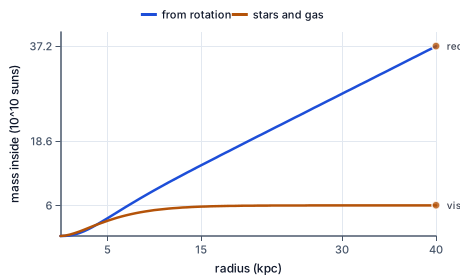
The figure plots the mass inside each radius for a galaxy with a rotation curve flat at $200$ km/s. The mass the rotation requires climbs in a straight line, $M \propto r$, reaching about $37 \times 10^{10}$ suns at $40$ kpc. The visible mass, from an exponential disk of stars and gas, grows quickly near the center and levels off near $6 \times 10^{10}$ suns beyond about $15$ kpc. Inside a few kiloparsecs the two agree; at $40$ kpc the required mass is about six times the visible. The widening gap is the dark halo.
An enclosed mass must grow with both speed and radius, and as the square of the speed; doubling the speed must quadruple it. For a large spiral galaxy, the mass inside tens of kiloparsecs should be $10^{11}$ to $10^{12}$ suns, and for a rich cluster $10^{14}$ to $10^{15}$. A dark-matter fraction must be between $0$ and $1$, and a mass-to-light ratio near $1$ to $3$ means the stars are enough. And remember that visible masses rest on an assumed mass-to-light ratio for the stars, so verdicts near the threshold are uncertain.
Vera Rubin, working at the Carnegie Institution's Department of Terrestrial Magnetism in Washington, D.C., with the instrument builder Kent Ford, set out in the late 1960s to measure how stars and gas move in nearby spiral galaxies, starting with Andromeda. Ford's image-tube spectrograph let them record Doppler shifts at many points across each galaxy, using telescopes such as Kitt Peak's in Arizona.
Galaxy after galaxy, the rotation curves stayed flat far beyond the bright disks. By 1980 their results for dozens of spirals had convinced most astronomers that galaxies are embedded in massive dark halos. The Vera C. Rubin Observatory on Cerro Pachón in Chile, which began its survey in 2025, is named for her and will map dark matter through the lensing of billions of galaxies.
If dark matter is a particle, Earth is moving through a wind of it as the Sun orbits the galaxy, and very rarely one should strike an atomic nucleus. The LUX-ZEPLIN experiment, nearly a mile underground in the Sanford Underground Research Facility in Lead, South Dakota, watches about $7$ tonnes of liquid xenon for the faint flash and charge such a collision would make, shielded from cosmic rays by the rock above.
So far it has seen nothing beyond background, which rules out a wide range of proposed particles and sets the strongest limits yet on how often dark matter can collide with ordinary matter. Its gravitational effects on galaxies are certain; its identity remains one of the largest open questions in physics.
A galaxy's light comes from its stars and glowing gas, so it is natural to assume its mass does too. But orbital speeds, cluster motions, hot gas and lensing all weigh far more than the light accounts for: in galaxies and clusters, dark matter outweighs ordinary matter roughly five to one, and it extends far beyond the visible disk.
A second slip is thinking dark matter is just faint ordinary matter, such as dim stars or cold gas. Searches for those have come up short, and independent limits on the amount of ordinary matter in the universe leave most of the dark matter to be something else.
The Sun orbits at about $230$ km/s at $8.2$ kpc. Write the enclosed mass.
$M = 2.325 \times 10^{5}\,v^2 r$
Suns, km/s and kpc.
Square the speed.
$230^2 = 52{,}900$
Speed squared.
Multiply by the radius.
$52{,}900 \times 8.2 = 433{,}780$
v squared r.
Multiply by the constant.
$M = 2.325 \times 10^{5} \times 433{,}780 = 1.01 \times 10^{11}\ M_\odot$
A hundred billion suns.
Compare with the visible mass.
$\text{stars and gas inside: several times } 10^{10}$
Dark matter already matters at the Sun's radius.
Gas orbits at $200$ km/s at $20$ kpc, where the luminosity inside is $3 \times 10^{10}$ suns. Write the mass.
$M = 2.325 \times 10^{5} \times 200^2 \times 20$
The enclosed mass.
Evaluate the mass.
$M = 1.86 \times 10^{11}\ M_\odot$
Nearly two hundred billion suns.
Divide by the luminosity.
$M \div L = 18.6 \div 3.0 = 6.2$
Suns of mass per sun of light.
Compare with stars.
$6.2 > 3$
More mass than the stars can supply.
Estimate the dark share if stars have a ratio of 2.
$(6.2 - 2) \div 6.2 = 0.68$
About two thirds dark.
Note the dependence.
$\text{a heavier stellar ratio lowers the dark share}$
The stars' mass is itself estimated.
Coma's galaxies have a dispersion of about $1{,}000$ km/s within about $2{,}000$ kpc. Write the virial estimate.
$M \approx \dfrac{5\sigma^2 R}{G}$
Kinetic and gravitational energy balanced.
Square the dispersion.
$1{,}000^2 = 10^{6}\ (\text{km/s})^2$
Speeds squared.
Multiply by 5 and the radius.
$5 \times 10^{6} \times 2{,}000 = 10^{10}$
In (km/s)^2 kpc.
Multiply by the constant.
$M \approx 10^{10} \times 2.325 \times 10^{5} = 2.3 \times 10^{15}\ M_\odot$
Two quadrillion suns.
Compare with the stars.
$\text{stars: about } 10^{13}\ M_\odot$
Hundreds of times too little.
Add the hot gas.
$\text{gas: about } 10^{14}\ M_\odot$
Still a fraction of the total.
Draw the conclusion.
$\text{most of the cluster's mass is dark}$
Zwicky's result, confirmed by X-rays and lensing.
Write the enclosed mass.
$M = 2.325 \times 10^{5}\,v^2 r$
Suns.
Substitute the values.
$M = 2.325 \times 10^{5} \times 10{,}000 \times 10$
Speed squared times radius.
State the mass.
A spiral galaxy's stars and gas orbit at nearly the same speed, about 200 km/s, from 5 kpc out to 40 kpc, far beyond where its starlight fades. What does that imply?
Complete the worked solution: a galaxy's rotation shows $50 \times 10^{10}$ suns inside an orbit, where its stars and gas add up to $5 \times 10^{10}$ suns. Find the dark mass and the fraction of the mass that is dark.
Subtract the visible mass from the dynamical mass.
$M_{\text{dark}} =$ d $\times 10^{10}\ M_\odot$
What the rotation needs but the light does not show.
Divide the dark mass by the dynamical mass.
$f_{\text{dark}} =$ f
The dark share.
Interpret the share in words.
$\text{most of the mass inside the orbit is dark}$
Typical of the outer parts of galaxies.
Match each measurement to what it weighs.
| the mass inside each radius of the galaxy | the cluster's mass, by the virial theorem | the cluster's mass, by hydrostatic balance | all the mass along the line of sight, by bending light | |
|---|---|---|---|---|
| a spiral galaxy's rotation curve | ||||
| the speeds of galaxies in a cluster | ||||
| the temperature of a cluster's X-ray gas | ||||
| distorted images of more distant galaxies |
Gas orbits a galaxy at $150$ km/s at a radius of $15$ kpc, where the galaxy's luminosity inside that radius is $1.0 \times 10^{10}$ suns. Taking $1/G = 2.325 \times 10^{5}$ suns per (km/s)$^2$ per kpc, fill in the mass inside the orbit and the mass-to-light ratio.
| value | |
|---|---|
| mass inside (10^10 suns) | |
| mass-to-light ratio |
A galaxy's rotation curve is flat at $220$ km/s. Taking $1/G = 2.325 \times 10^{5}$ suns per (km/s)$^2$ per kpc, write the mass inside radius $r$, in units of $10^{10}$ suns, as a function of $r$ in kiloparsecs.
Answer:
A galaxy cluster has a line-of-sight velocity dispersion of $600$ km/s and a radius of $1000$ kpc. Using the virial estimate $M \approx 5\sigma^2 R/G$ with $1/G = 2.325 \times 10^{5}$ suns per (km/s)$^2$ per kpc, find its mass in units of $10^{14}$ suns.
Answer: times 10^14 solar masses
Radio observations of an unfamiliar galaxy show hydrogen orbiting at $90$ km/s at $15$ kpc, and its starlight and gas add up to $0.6 \times 10^{10}$ suns inside that radius. Taking $1/G = 2.325 \times 10^{5}$ suns per (km/s)$^2$ per kpc, and calling dark matter needed when the dynamical mass is more than 1.5 times the visible mass, fill in the dynamical mass, the ratio and the verdict.
| dynamical mass (10^10 suns) | dynamical over visible | verdict | |
|---|---|---|---|
| the galaxy |
Lesson test: one question per skill, one attempt each, no hints. Your answers are checked when you submit.
A galaxy's rotation curve is flat at $100$ km/s. Taking $1/G = 2.325 \times 10^{5}$ suns per (km/s)$^2$ per kpc, write the mass inside radius $r$, in units of $10^{10}$ suns, as a function of $r$ in kiloparsecs.
Answer:
You can weigh a galaxy. Find the mass inside the Sun's orbit at 230 km/s and 8.2 kpc, and the virial mass of a cluster with a dispersion of 1,000 km/s within 2,000 kpc.
20. Your turn: gas orbits at $100$ km/s at $10$ kpc. Find the mass inside., step 3
$M = 2.325 \times 10^{10}\ M_\odot$
About 23 billion suns.