Back to the on-screen lesson ·
A cluster's stars share an age, so its main-sequence turnoff marks the stars whose lifetime equals that age; main-sequence fitting gives the distance and the turnoff's luminosity, and t is about 10 billion years times L^-0.714.
Paper packet. Every task here also exists on screen, where it is checked automatically; answers written on paper are not assessed by Nydus. When you are back at a device, enter your answers there.
By the end of this lesson you will be able to use a star cluster's H-R diagram to estimate its age and state the assumptions the estimate depends on.
You know how a star's main-sequence lifetime falls with its mass, how distance moduli turn apparent magnitudes into absolute ones, and how a star leaves the main sequence when its core hydrogen runs out. This lesson puts them together on a whole cluster of stars at once, which turns the H-R diagram into a clock: the most direct way astronomers have of measuring the ages of stars.
| Term | What it means |
|---|---|
| Star cluster | A group of stars born together from one cloud, sharing an age, a distance and a composition. |
| Turnoff | The point where a cluster's main sequence bends away, marking stars just exhausting their core hydrogen. |
| Turnoff mass | The mass of the stars at the turnoff, whose main-sequence lifetime equals the cluster's age. |
| Main-sequence fitting | Finding a cluster's distance modulus by sliding its main sequence to match nearby stars of known luminosity. |
| Open cluster | A loose cluster of tens to thousands of stars in the galaxy's disk, usually young. |
| Globular cluster | A dense ball of hundreds of thousands of old stars orbiting in the galaxy's halo. |
Stars born together share an age, so the heaviest, shortest-lived ones leave the main sequence first. The turnoff, where the main sequence bends away, marks the stars whose main-sequence lifetime equals the cluster's age:
$$t_{\text{cluster}} \approx 10\ \text{Gyr}\,\left(\frac{M_{\text{to}}}{M_\odot}\right)^{-2.5} \approx 10\ \text{Gyr}\,\left(\frac{L_{\text{to}}}{L_\odot}\right)^{-0.714}.$$
Main-sequence fitting gives the distance modulus, which turns the turnoff's apparent magnitude into a luminosity. The brighter and bluer the turnoff, the younger the cluster.
Another way: picture
Picture a box of candles of different thicknesses, all lit at the same moment. The thinnest burn out first. Come back later and see which candles are still burning: the thickest one that has just gone out tells you how long ago they were lit. In a cluster the most massive stars are the fast-burning candles, and the turnoff is the one just guttering out.
Another way: steps
A single field star's age is hard to measure: a Sun-like star changes little in billions of years. A cluster is different. Its stars condensed from one cloud within a few million years, so they share an age, a distance and a starting composition; they differ only in mass. Their H-R diagram is therefore a snapshot of how stars of every mass look at one age.
At first every star is on the main sequence. As time passes, stars leave it in order of mass, the heaviest first. The upper main sequence erodes from the top down, and the point where it ends, the turnoff, slides to fainter, cooler, lighter stars as the cluster ages.
The stars at the turnoff are those whose main-sequence lifetime equals the cluster's age. With the scaling from lesson 9, $t \approx 10$ billion years $\times\,M^{-2.5}$, a turnoff at $2$ solar masses means about $1.8$ billion years, and one at $5$ solar masses about $180$ million.
A turnoff's mass is not measured directly; its luminosity is. Since $L \propto M^{3.5}$, $M \propto L^{1/3.5}$, and so
$$t \propto \frac{M}{L} \propto L^{1/3.5 - 1} = L^{-0.714}.$$
A turnoff ten times brighter than another means a cluster about $10^{0.714} \approx 5$ times younger.
An old cluster's diagram shows the whole of the last lesson at once. The main sequence runs up to the turnoff; just above it, a short subgiant branch crosses to the right; the red giant branch climbs steeply to the upper right; and in old, metal-poor clusters a horizontal branch of helium-burning stars runs across the middle. Each feature is populated in proportion to how long stars spend there, which is why the main sequence is crowded and the subgiant branch sparse.
A few stars sit on the main sequence above the turnoff, where no single star of the cluster's age should be. These blue stragglers are rejuvenated stars, made when two stars merge or one strips mass from a companion, and they are excluded when the turnoff is read.
To turn the turnoff's apparent magnitude into a luminosity, the cluster's distance is needed. Because every cluster star is at the same distance, the whole main sequence is shifted in magnitude by the same distance modulus $m - M$. Plotting the cluster and nearby stars with parallax distances on one diagram and sliding the cluster's main sequence vertically until it lies on top of theirs gives the modulus.
The method uses hundreds of cluster stars at once, so it is precise; its main uncertainties are composition, which shifts the main sequence slightly, and dust, which dims and reddens the cluster. Gaia's parallaxes now give many nearby clusters' distances directly, and the two methods check each other.
Open clusters in the galaxy's disk span a wide range. The Pleiades, about $125$ million years old, still has blue B stars on its main sequence. The Hyades, about $625$ million years old, turns off among white A stars and already has a few red giants. M67, about four billion years old, turns off near stars a little heavier than the Sun.
Globular clusters, dense balls of hundreds of thousands of stars in the halo, turn off below a solar mass, at about $0.8$ suns. Their ages, about $11$ to $13$ billion years, make them among the oldest objects known, and for decades they set a lower limit on the age of the universe: the universe must be older than its oldest stars.
A turnoff age is a model age. It rests on how luminosity depends on mass, which depends on composition: metal-poor stars, like those in globular clusters, are bluer and more luminous at a given mass, so assuming solar composition for them would give the wrong age. It rests on how much fuel the turnoff stars burn, which convective overshooting in their cores can raise. And it rests on the distance and dust corrections.
Detailed models handle all of these by fitting isochrones, the predicted H-R diagram of stars of one age and composition, to the whole cluster sequence, not just the turnoff. The simple scaling used here gives ages to within a factor of two; careful isochrone fits reach about ten percent.
White dwarfs cool steadily for billions of years without any fuel, growing fainter in a way that depends mainly on physics that is well understood. In an old cluster the faintest white dwarfs are those that formed first, and their luminosity gives an independent age. For the globular cluster M4, Hubble Space Telescope observations of its faintest white dwarfs gave an age of about twelve billion years, consistent with the turnoff age. When two independent clocks agree, both are more believable.
Because clusters can be dated, they record when and where the galaxy made stars. The open clusters of the disk span from a few million years, still wrapped in their birth clouds, to about ten billion years. The globular clusters of the halo are nearly all old and metal-poor, the survivors of the galaxy's earliest era. Lining up cluster ages against their compositions shows how heavy elements built up as generations of stars lived and died.
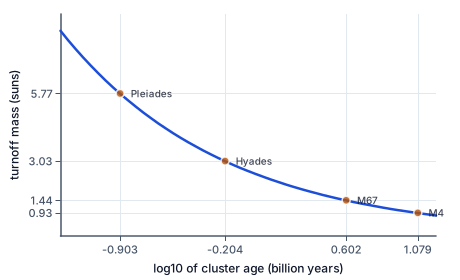
The figure plots the turnoff mass against the logarithm of a cluster's age from the simple scaling. Moving right, toward older clusters, the turnoff mass falls: about $5.8$ suns at the Pleiades' $125$ million years, $3.0$ at the Hyades' $625$ million, $1.4$ at M67's four billion, and $0.9$ at M4's twelve billion. The curve flattens toward old ages because lifetime depends so steeply on mass: halving the turnoff mass from one sun takes nearly fifty billion years more.
A cluster's age must fall as its turnoff mass or luminosity rises. A turnoff brighter than the Sun means a cluster younger than ten billion years, and a turnoff below a solar mass an old one. No cluster can be older than the universe, about $13.8$ billion years; an age well past that means the composition or the luminosity relation assumed does not fit the cluster. And a distance from main-sequence fitting should agree with any parallax distance to the cluster within the uncertainties.
In the 1990s, ages of globular clusters from their turnoffs came out at fourteen to sixteen billion years, while the expansion of the universe, measured by the Hubble constant, seemed to imply an age of only ten to twelve billion. The universe cannot be younger than its stars, so one of the measurements had to be wrong.
Two developments resolved the conflict. Hipparcos parallaxes in 1997 revised the distances to the nearby stars used for main-sequence fitting, making globular clusters farther, their turnoffs brighter and their ages younger, about twelve to thirteen billion years. And the discovery of accelerating expansion in 1998 made the universe older, $13.8$ billion years. Cluster ages remain one of the checks every cosmological model must pass.
The Gaia satellite's measurements of positions, motions and colors for over a billion stars have transformed the study of clusters. Stars moving together through space can be picked out even when they are spread across the sky, and studies of Gaia data have catalogued thousands of open clusters within a few kiloparsecs, many previously unknown, and fitted isochrones to most of them.
Those ages map the recent history of the galaxy's disk, showing where star formation happened along the spiral arms over the last few hundred million years. Each age rests on exactly the steps of this lesson: a distance, a turnoff, and the physics of how long a star of each mass lives.
Brilliant blue stars look impressive and long-established, but they are the opposite: massive stars live only tens of millions of years, so a cluster that still has them must be young. An old cluster has lost all its bright blue stars, and its brightest members are red giants and stars like the Sun.
A second slip is thinking a cluster's age can be read from its overall color or brightness without finding the turnoff. A young, distant cluster and an old, nearby one can look equally bright; only the turnoff's position, corrected for distance, dates it.
A cluster turns off at $2$ solar masses. Write the lifetime scaling.
$t = 10\ \text{Gyr} \times M^{-2.5}$
From lesson 9.
Raise the mass to the 2.5.
$2^{2.5} = 5.657$
Two to the 2.5.
Divide the Sun's lifetime by it.
$t = 10 \div 5.657 = 1.77\ \text{Gyr}$
The cluster's age.
Find the turnoff luminosity.
$L = 2^{3.5} = 11.3\ L_\odot$
Mass to the 3.5.
Check with the luminosity form.
$10 \times 11.3^{-0.714} = 1.77\ \text{Gyr}$
The two forms agree.
A cluster's main sequence lies $9.6$ magnitudes below nearby stars of the same color. State the modulus.
$m - M = 9.6$
Main-sequence fitting.
Subtract it from the turnoff's apparent magnitude, $12.4$.
$M_{\text{to}} = 12.4 - 9.6 = 2.8$
Absolute magnitude.
Subtract the Sun's absolute magnitude.
$2.8 - 4.83 = -2.03$
Brighter than the Sun.
Multiply by minus 0.4.
$-0.4 \times (-2.03) = 0.812$
The exponent of ten.
Raise ten to that power.
$L = 10^{0.812} = 6.49\ L_\odot$
The turnoff luminosity.
Convert to an age.
$10 \times 6.49^{-0.714} = 2.63\ \text{Gyr}$
A middle-aged open cluster.
A cluster $800$ pc away turns off at $m = 13.6$. Find the distance modulus.
$5\log_{10} 800 - 5 = 9.515$
From the distance.
Subtract it from the turnoff magnitude.
$M_{\text{to}} = 13.6 - 9.515 = 4.085$
Absolute magnitude.
Subtract the Sun's and multiply by minus 0.4.
$-0.4 \times (4.085 - 4.83) = 0.298$
The exponent.
Raise ten to that power.
$L = 10^{0.298} = 1.99\ L_\odot$
About twice the Sun.
Convert to an age.
$t = 10 \times 1.99^{-0.714} = 6.12\ \text{Gyr}$
An old open cluster.
Test a dust correction of half a magnitude.
$L \times 10^{0.2} = 3.15, \quad t = 4.4\ \text{Gyr}$
Dust would make it younger.
List the assumptions.
$\text{composition, fuel fraction, dust, distance}$
Each shifts the age if wrong.
Write the scaling.
$t = 10 \times M^{-2.5}$
Billions of years.
Raise the mass to the minus 2.5.
$t = 10 \times 3^{-2.5}$
Three to the minus 2.5 is 0.0642.
State the age.
The main sequence of cluster A turns off among B5 stars, and that of cluster B among G0 stars. The clusters lie at different, unknown distances. Which is older?
Complete the worked solution: at one color, a cluster's main sequence lies at apparent magnitude $13.2$, and nearby stars of that color have absolute magnitude $3.2$. Find the cluster's distance modulus and distance.
Subtract the absolute magnitude from the apparent magnitude.
$m - M =$ u
The distance modulus, from the whole main sequence.
Raise ten to the power of the modulus plus five, divided by five.
$d =$ d $\text{pc}$
Undo the distance modulus.
Say why the whole sequence is used in words.
$\text{many stars fitted at once average out the scatter}$
One star alone would be less certain.
Match each cluster's turnoff to the age it implies.
| tens of millions of years old | hundreds of millions of years old | around ten billion years old | about twelve billion years old | |
|---|---|---|---|---|
| turns off among blue B stars | ||||
| turns off among white A stars | ||||
| turns off at stars like the Sun | ||||
| turns off below the Sun's mass, a globular cluster |
A cluster's main-sequence turnoff is at $1.25$ solar masses. Using $t = 10\ \text{billion years} \times M^{-2.5}$ and $L = M^{3.5}$, fill in the cluster's age and the turnoff stars' luminosity.
| value | |
|---|---|
| cluster age (billion years) | |
| turnoff luminosity (suns) |
Suppose main-sequence luminosity follows $L \propto M^{2}$, and the turnoff stars of cluster A burn $1$ times the fraction of their fuel that cluster B's do. Write the ratio of A's age to B's as a function of $x = M_A/M_B$, the ratio of their turnoff masses.
Answer:
Main-sequence fitting gives a cluster a distance modulus of $13.0$. Its turnoff is at apparent visual magnitude $17.7$. Taking the bolometric correction as zero and the Sun's absolute magnitude as $4.83$, find the turnoff luminosity in suns.
Answer: solar luminosities
Astronomers find an unfamiliar open cluster $800$ pc away, with negligible dust. Its main-sequence turnoff is at apparent visual magnitude $13.6$. Taking the bolometric correction as zero, the Sun's absolute magnitude as $4.83$ and $t = 10\ \text{billion years} \times L^{-0.714}$, fill in the turnoff luminosity and the cluster's age.
| value | |
|---|---|
| turnoff luminosity (suns) | |
| cluster age (billion years) |
Lesson test: one question per skill, one attempt each, no hints. Your answers are checked when you submit.
Suppose main-sequence luminosity follows $L \propto M^{4}$, and the turnoff stars of cluster A burn $1$ times the fraction of their fuel that cluster B's do. Write the ratio of A's age to B's as a function of $x = M_A/M_B$, the ratio of their turnoff masses.
Answer:
You can date a cluster. Find the age of a cluster that turns off at 2 solar masses, and the turnoff luminosity of a cluster with a distance modulus of 9.6 and a turnoff at magnitude 12.4.
21. Your turn: a cluster turns off at $3$ solar masses. Find its age., step 3
$t = 0.642\ \text{billion years}$
About 640 million years.