Back to the on-screen lesson ·
Interstellar gas comes in phases from 10 K molecular clouds to million-kelvin bubbles in rough pressure balance, each seen by its own signal; dust dims starlight more at short wavelengths, so A_V = 3.1 E(B - V), and the gas column follows the extinction.
Paper packet. Every task here also exists on screen, where it is checked automatically; answers written on paper are not assessed by Nydus. When you are back at a device, enter your answers there.
By the end of this lesson you will be able to characterize the phases of the interstellar medium and correct starlight for the dimming and reddening of dust.
You know from lesson 2 that dust adds an extinction $A$ to a star's distance modulus and that a color excess measures reddening, and from lesson 4 how temperature sets which atoms absorb or emit. You know the ideal gas law. This lesson surveys the gas and dust between the stars, the raw material of the next lesson's star formation, and the dust that every distant measurement must see through.
| Term | What it means |
|---|---|
| Interstellar medium | The gas and dust between the stars, about 99 percent gas and 1 percent dust by mass. |
| Phase | A distinct state of the interstellar gas, set by its temperature, density and ionization. |
| 21-centimeter line | Radio emission from neutral hydrogen atoms as their electron's spin flips. |
| Extinction | The dimming of starlight by dust, in magnitudes. |
| Reddening | The change in a star's color because dust blocks blue light more than red. |
| Column density | The number of atoms in a column of one square centimeter cross section along a line of sight. |
The interstellar gas has phases: molecular clouds near $10$ K, cold neutral gas near $100$ K, warm neutral and ionized gas near $8{,}000$ K, and hot gas near $10^6$ K. Outside self-gravitating clouds they share roughly one pressure,
$$nT \approx 3{,}000\ \text{K cm}^{-3},$$
so hotter phases are thinner. Dust blocks short wavelengths more than long ones, so it reddens as it dims:
$$A_V = R_V\,E(B - V), \quad R_V \approx 3.1, \qquad N_H \approx 1.9 \times 10^{21}\,A_V\ \text{cm}^{-2}.$$
Another way: picture
Picture a sunset. Sunlight crossing a long path through the air loses much of its blue to scattering, so the setting Sun looks orange-red, even though the Sun has not changed. Interstellar dust does the same to starlight over thousands of light-years, scattering and absorbing blue more than red.
Another way: steps
The space between the stars is not empty. In the Milky Way's disk, gas and dust add up to about a tenth of the mass of the stars, roughly one atom per cubic centimeter on average, a vacuum far better than any laboratory makes. By mass it is about $70$ percent hydrogen, $28$ percent helium and two percent heavier elements, half of them locked in dust grains.
This thin material matters out of all proportion to its density: stars form from it, dying stars return enriched gas to it, and its dust dims and reddens the light of everything beyond it.
The gas is not uniform. Starlight heats it, supernovae blast it, and it cools by radiating, and these processes settle into distinct phases. Molecular clouds, at $10$ to $20$ K and $10^{2}$ to $10^{6}$ particles per cubic centimeter, hold much of the mass in little volume. The cold neutral medium, near $100$ K and about $30$ per cubic centimeter, and the warm neutral and warm ionized media, near $8{,}000$ K and about $0.3$ per cubic centimeter, fill much of the disk. The hot ionized medium, about a million kelvins and $0.003$ per cubic centimeter, fills bubbles blown by supernovae.
Outside the self-gravitating clouds, neighboring phases push on each other until their pressures match: $P = nkT$, so $nT$ is roughly the same, about $3{,}000$ K per cubic centimeter. A phase a hundred times hotter is a hundred times thinner.
Each phase's temperature is a balance. Ultraviolet starlight knocks electrons off small dust grains, and those fast electrons heat the gas; cosmic rays and supernova shock waves add more. The gas cools by radiating: in cold neutral gas, mainly through a far-infrared line of ionized carbon at $158$ micrometers, and in molecular clouds through carbon monoxide lines.
Over a wide range of pressures, the balance between heating and cooling has two stable solutions, one near $100$ K and one near $8{,}000$ K, with intermediate temperatures unstable: gas there either cools and condenses or heats and expands. That thermal instability, worked out by George Field in 1965, is why the neutral gas splits into distinct cold and warm phases rather than forming a smooth mixture.
Each phase announces itself differently. Neutral hydrogen emits the 21-centimeter line when the spins of its electron and proton flip from parallel to opposite, a transition so rare for one atom, about once in ten million years, that only the vast numbers of atoms in space make it visible. Molecular hydrogen is almost invisible at low temperature, so molecular clouds are mapped by the radio lines of carbon monoxide, its common companion. Ionized hydrogen glows red in hydrogen-alpha as electrons recombine with protons around hot stars. The hot gas emits X-rays. Dust, warmed by starlight to about $20$ K, glows in the far infrared.
The coldest, densest phase is where stars are born. Giant molecular clouds hold $10^{5}$ to $10^{6}$ suns of gas across tens of parsecs, threaded by filaments and dense cores. Dust shields their interiors from ultraviolet starlight, which would otherwise break molecules apart, so molecules survive and radiate away heat, keeping the gas cold. Cold, dense gas is exactly what gravity can pull together: the next lesson finds the condition for a cloud to collapse.
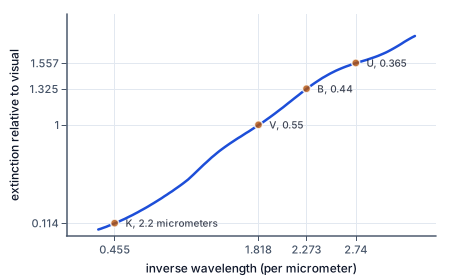
Dust grains, mostly silicates and carbon compounds, are about a tenth of a micrometer across, comparable to visible wavelengths. They absorb and scatter light most effectively at wavelengths near or shorter than their size, so extinction rises toward the blue and ultraviolet and falls in the infrared, as the figure shows. In the near infrared at $2.2$ micrometers, the extinction is only about a tenth of its visual value.
So dust does two things to a star's light: it dims it, by the extinction $A_V$, and it reddens it, by removing more blue than red. Both must be corrected before a star's luminosity or distance can be found.
A star's spectral type fixes its intrinsic color $(B - V)_0$. Behind dust its observed color is redder, and the difference is the color excess,
$$E(B - V) = (B - V)_{\text{obs}} - (B - V)_0 = A_B - A_V.$$
For ordinary interstellar dust the total extinction is a fixed multiple of it,
$$A_V = R_V\,E(B - V), \qquad R_V \approx 3.1.$$
In dense clouds, where grains grow larger, $R_V$ can reach $5$ or more, because larger grains block colors more evenly. Measuring a color excess thus lets astronomers correct for dust they cannot see directly.
Gas and dust are thoroughly mixed, so the extinction toward a star measures the gas in front of it too. Ultraviolet absorption lines of hydrogen toward reddened stars give
$$N_H \approx 1.9 \times 10^{21}\,A_V\ \text{cm}^{-2},$$
a dust-to-gas mass ratio of about one percent. Dust is made in the cool winds of giant stars and in supernova remnants, and it absorbs about a third of all the starlight in a galaxy like ours, re-radiating it in the infrared. Toward the Galactic center, about $30$ magnitudes of visual extinction correspond to a column of nearly $6 \times 10^{22}$ atoms per square centimeter.
The figure shows extinction relative to its visual value against inverse wavelength, so blue lies to the right. The curve climbs steadily: $0.11$ in the infrared K band, $1$ in the visual, about $1.32$ in the blue and $1.56$ in the ultraviolet near $0.37$ micrometers. The difference between the blue and visual values is $0.32$ of $A_V$, which is just $1/R_V$: that is where $A_V = 3.1\,E(B - V)$ comes from. The low infrared value is why infrared telescopes can see into dusty star-forming regions and the Galactic center.
In pressure balance, a hotter phase must be thinner: a density that rises with temperature means the division was inverted. A color excess must be positive, since dust only reddens. A visual extinction should be about three times the color excess for ordinary dust, and removing it must make a star brighter and nearer, never fainter or farther. A hydrogen column of about $2 \times 10^{21}$ per square centimeter goes with each magnitude of extinction; columns of $10^{30}$ or $10^{10}$ mean a power of ten slipped.
In 1944 the Dutch astronomer Hendrik van de Hulst predicted that cold hydrogen atoms should emit a radio line at $21$ centimeters. On Easter Sunday 1951, Harold Ewen, a Harvard graduate student, and his adviser Edward Purcell detected it, using a horn antenna built of plywood and copper sheet stuck out of a window of the physics laboratory in Cambridge, Massachusetts.
Because radio waves pass through dust, the 21-centimeter line revealed hydrogen across the whole galaxy, and its Doppler shifts mapped the Milky Way's spiral arms and rotation, which visible light, blocked by dust in the disk, could never show. Today the Green Bank Telescope in West Virginia and radio arrays across the world use the same line to weigh the gas in other galaxies.
In 1995 the Hubble Space Telescope photographed the Pillars of Creation in the Eagle Nebula, about $6{,}500$ light-years away: towering columns of dark, dusty gas lit by hot young stars. In visible light the pillars are opaque, their interiors hidden by extinction of many magnitudes.
In 2022 the James Webb Space Telescope imaged the same pillars in the near infrared, where dust blocks only a small fraction as much light. The pillars became translucent, and dozens of newborn stars, still wrapped in their dusty cocoons, appeared inside them. The two images side by side are the extinction curve made visible: the same dust, nearly opaque at short wavelengths and nearly transparent at long ones.
It is natural to think of reddening like looking through red glass. But interstellar dust does not add red light or glow red in the visible; it removes light, more at short wavelengths than at long. What remains is redder only because more of the blue has been taken away, as at sunset.
A second slip is confusing reddening with redshift. A redshift moves every spectral line to longer wavelengths because of motion or expansion; reddening leaves the lines where they are and changes only the balance of colors in the continuum.
Cold neutral gas has $n = 40$ per cubic centimeter at $T = 75$ K. Find n T.
$nT = 40 \times 75 = 3{,}000\ \text{K cm}^{-3}$
Its pressure over k.
Write pressure balance with warm gas at $8{,}000$ K.
$n_w \times 8{,}000 = 3{,}000$
Equal pressures.
Divide both sides by the warm temperature.
$n_w = 3{,}000 \div 8{,}000 = 0.375\ \text{cm}^{-3}$
A hundred times thinner.
Compare the densities.
$40 \div 0.375 \approx 107$
The inverse of the temperature ratio.
Find the warm gas mass in a cubic parsec.
$0.375 \times 0.03462 = 0.013\ M_\odot$
Little mass in a big volume.
A star of intrinsic color $-0.20$ is observed at $B - V = 0.30$ and $m_V = 11.0$. Find the color excess.
$E(B - V) = 0.30 - (-0.20) = 0.50$
The reddening.
Multiply by R_V for the extinction.
$A_V = 3.1 \times 0.50 = 1.55$
Ordinary dust.
Subtract it from the observed magnitude.
$m_0 = 11.0 - 1.55 = 9.45$
The dust-free magnitude.
Turn the extinction into a flux factor.
$10^{0.4 \times 1.55} = 4.17$
The dust removed three quarters of the light.
Find the hydrogen column.
$N_H = 1.9 \times 10^{21} \times 1.55 = 2.9 \times 10^{21}\ \text{cm}^{-2}$
Gas in front of the star.
Check the blue extinction.
$A_B = A_V + E = 2.05$
Blue is dimmed more, as it must be.
A B0 star has $m_V = 9.8$, $M_V = -4.1$, observed $B - V = 0.45$ and intrinsic $-0.30$. Find the color excess.
$E(B - V) = 0.45 - (-0.30) = 0.75$
Reddening.
Multiply by 3.1.
$A_V = 3.1 \times 0.75 = 2.325$
Extinction.
Write the distance modulus with dust.
$m - M = 5\log_{10} d - 5 + A_V$
From lesson 2.
Subtract the extinction from the modulus.
$5\log_{10} d - 5 = 9.8 + 4.1 - 2.325 = 11.575$
The true modulus.
Add 5 and divide by 5.
$\log_{10} d = 16.575 \div 5 = 3.315$
Isolate the logarithm.
Raise ten to that power.
$d = 10^{3.315} = 2{,}065\ \text{pc}$
About 2 kiloparsecs.
Compare with ignoring the dust.
$10^{(13.9 + 5)/5} = 6{,}026\ \text{pc}$
Three times too far without the correction.
Write the gas-to-dust relation.
$N_H = 1.9 \times 10^{21}\,A_V$
Per square centimeter.
Multiply by the extinction.
$N_H = 1.9 \times 10^{21} \times 2$
Two magnitudes.
State the column.
A hot blue star seen through a dusty cloud looks both fainter and redder than an identical star seen through clear space. Why redder?
Complete the worked solution: a cold cloud has $60$ particles per cubic centimeter at $50$ K and sits in pressure balance with surrounding gas at $1000000$ K. Find the surrounding gas's density.
Multiply the cloud's density by its temperature.
$n T =$ p $\text{K cm}^{-3}$
The shared pressure over k.
Divide that by the surrounding temperature.
$n_{\text{other}} =$ d $\text{cm}^{-3}$
The hotter gas must be thinner.
Compare the two densities in words.
$\text{the hot gas is far thinner than the cold cloud}$
Same pressure, very different temperatures.
Match each phase of the interstellar medium to how astronomers see it.
| radio lines of carbon monoxide | the 21-centimeter radio line | red hydrogen-alpha light | X-rays | |
|---|---|---|---|---|
| molecular clouds | ||||
| cold neutral hydrogen | ||||
| warm ionized hydrogen | ||||
| hot gas heated by supernovae |
Gas in the warm ionized medium is at about $7500$ K. If it is in pressure balance with $nT = 3{,}000$ K per cubic centimeter, fill in its density in particles per cubic centimeter and the gas mass in one cubic parsec, in suns, taking $0.03462$ suns per cubic parsec for each particle per cubic centimeter.
| value | |
|---|---|
| density (per cm^3) | |
| mass per cubic parsec (suns) |
Stars behind a cloud of ordinary diffuse interstellar dust, with $R_V = 3.1$, all show a color excess $E(B - V) = 0.5$. Write a star's dust-free visual magnitude as a function of its observed visual magnitude $m$.
Answer:
Gas and dust are well mixed, with about $1.9 \times 10^{21}$ hydrogen atoms per square centimeter of column for each magnitude of visual extinction. A star is dimmed by $A_V = 0.5$ magnitudes. What hydrogen column lies in front of it, in units of $10^{21}$ per square centimeter?
Answer: times 10^21 per square centimeter
A hot star in the Milky Way's disk has apparent visual magnitude $9.8$ and, from its spectral type, absolute magnitude $-4.1$ and intrinsic color $(B - V)_0 = -0.30$. Its observed color is $B - V = 0.45$. Taking $R_V = 3.1$, fill in its visual extinction and its distance in parsecs.
| value | |
|---|---|
| visual extinction (mag) | |
| distance (pc) |
Lesson test: one question per skill, one attempt each, no hints. Your answers are checked when you submit.
Stars behind a cloud of dust in a dense molecular cloud, with large grains, with $R_V = 5$, all show a color excess $E(B - V) = 0.4$. Write a star's dust-free visual magnitude as a function of its observed visual magnitude $m$.
Answer:
You can read the space between the stars. Find the density of 8,000 K gas in pressure balance with 75 K gas at 40 per cubic centimeter, and the extinction of a star with a color excess of 0.5.
21. Your turn: a star is dimmed by $A_V = 2$. Find the hydrogen column in front of it., step 3
$N_H = 3.8 \times 10^{21}\ \text{cm}^{-2}$
Atoms per square centimeter.