Back to the on-screen lesson ·
Planck's law gives a blackbody's spectrum; its peak is Wien's law and its area the Stefan-Boltzmann law, so L = 4 pi R^2 sigma T^4 and any two of luminosity, radius and temperature give the third.
Paper packet. Every task here also exists on screen, where it is checked automatically; answers written on paper are not assessed by Nydus. When you are back at a device, enter your answers there.
By the end of this lesson you will be able to derive Wien's and the Stefan-Boltzmann laws from Planck's law and use them to find a star's temperature and radius.
You know from the Astronomy course that hotter bodies glow bluer and give off more light per square meter, that Wien's law turns a peak wavelength into a temperature, and that a star's luminosity grows with its size. You can differentiate and integrate. This lesson derives those rules from Planck's law and uses them together to find what a telescope cannot see directly: the size of a star that is only a point of light.
| Term | What it means |
|---|---|
| Blackbody | An ideal body that absorbs all light falling on it and gives off a spectrum set by its temperature alone. |
| Spectral radiance | The power given off per unit area, per unit solid angle and per unit wavelength; the height of the Planck curve. |
| Flux | Power passing through one square meter, in watts per square meter. |
| Luminosity | A star's total power output in every direction, in watts or in solar luminosities. |
| Effective temperature | The temperature of the blackbody that would give off the same flux as the star's surface. |
| Stefan-Boltzmann constant | sigma, 5.670 x 10^-8 W per square meter per kelvin to the fourth. |
A star's surface glows nearly like a blackbody, whose spectrum is fixed by its temperature alone. Planck's law gives that spectrum:
$$B_\lambda(T) = \frac{2hc^2}{\lambda^5}\,\frac{1}{e^{hc/\lambda k T} - 1}.$$
Two rules follow from it. Where the curve peaks is Wien's law, $\lambda_{\max} T = 2.898 \times 10^{-3}$ m K. The area under it, the power from each square meter, is the Stefan-Boltzmann law, $F = \sigma T^4$. Multiply by the area of a sphere and you have the star's luminosity:
$$L = 4\pi R^2 \sigma T^4 \quad\Longrightarrow\quad \frac{L}{L_\odot} = \left(\frac{R}{R_\odot}\right)^2 \left(\frac{T}{T_\odot}\right)^4.$$
With $T_\odot = 5{,}772$ K, any two of luminosity, radius and temperature give the third.
Another way: picture
Picture two stoves set to the same heat, one with a burner the size of a coin and one the size of a dinner plate. Every square centimeter of each glows alike, so the plate gives off far more heat in total only because it has more surface. A star's temperature sets how hard each square meter shines; its radius sets how many square meters there are.
Another way: steps
Max Planck found the blackbody formula in 1900 by assuming that light is given off in packets of energy $hc/\lambda$. Read it in two parts. The factor $2hc^2/\lambda^5$ rises steeply toward short wavelengths: there are many more ways to fit short waves into a box than long ones. The factor $1/(e^{hc/\lambda kT} - 1)$ falls steeply there, because a packet of short-wavelength light costs more energy than the thermal energy $kT$ can usually supply. Their product rises, peaks, and falls, and the temperature sets where.
At long wavelengths, where $hc/\lambda kT$ is small, $e^x - 1 \approx x$ and the law becomes $B_\lambda \approx 2ckT/\lambda^4$, the classical Rayleigh-Jeans law that radio astronomers use. At short wavelengths the exponential dominates and the curve dies away, which classical physics failed to predict.
The peak is where $dB_\lambda/d\lambda = 0$. Write $x = hc/\lambda kT$, so that $B_\lambda \propto x^5/(e^x - 1)$ at fixed temperature. Differentiating and setting the result to zero gives
$$5\left(1 - e^{-x}\right) = x,$$
which has no algebraic solution. Try $x = 5$: the left side is $4.966$, a little short. A few rounds of putting the left side's value back in settle on $x = 4.965$. Then
$$\lambda_{\max} T = \frac{hc}{4.965\,k} = 2.898 \times 10^{-3}\ \text{m K}.$$
In nanometers the constant is $2{,}898{,}000$ nm K, so a star peaking at $500$ nm is at about $5{,}800$ K. The peak moves to shorter wavelength in exact inverse proportion to the temperature.
The power leaving one square meter of surface, summed over every wavelength and every outward direction, is $F = \pi \int_0^\infty B_\lambda\, d\lambda$. The factor $\pi$ comes from adding up the directions over a hemisphere, weighted by how obliquely each leaves the surface. Substituting $x = hc/\lambda kT$ turns the integral into $T^4$ times a pure number, because every $\lambda$ can be traded for $T/x$:
$$F = \sigma T^4, \qquad \sigma = \frac{2\pi^5 k^4}{15 c^2 h^3} = 5.670 \times 10^{-8}\ \text{W m}^{-2}\ \text{K}^{-4}.$$
The fourth power is steep. Doubling the temperature multiplies the flux by $16$; a $10{,}000$ K surface gives off $5.67 \times 10^{8}$ watts from every square meter, about nine times the Sun's.
A spherical star of radius $R$ has surface area $4\pi R^2$, so its luminosity is $L = 4\pi R^2 \sigma T^4$. A real star's surface is not one temperature, so astronomers define its effective temperature as the temperature that makes this equation true. The Sun's is $5{,}772$ K, the value the International Astronomical Union adopted in 2015 as its nominal solar effective temperature.
Dividing by the same equation for the Sun cancels $4\pi$ and $\sigma$:
$$\frac{L}{L_\odot} = \left(\frac{R}{R_\odot}\right)^2 \left(\frac{T}{T_\odot}\right)^4.$$
Working in solar units keeps the numbers small and the constants out of the way.
Almost every star is too far away to show a disk, even in the largest telescopes. Its radius is inferred instead. The spectrum gives the temperature; the distance and the measured flux give the luminosity, which is the next lesson's work. Solving for the radius,
$$\frac{R}{R_\odot} = \sqrt{\frac{L}{L_\odot}}\,\left(\frac{T_\odot}{T}\right)^2.$$
The temperature enters squared, so it matters most. A star twice as hot as the Sun with $144$ times its luminosity has a radius of $\sqrt{144}/4 = 3$ solar radii. A cool red star at half the Sun's temperature with the same luminosity as the Sun is four times its size.
Real stellar spectra carry absorption lines and broad dips where the gas above the glowing layer absorbs, and the light comes from a range of depths at different temperatures. So the temperature from Wien's peak, the temperature from the color, and the effective temperature can differ by a few hundred kelvins, most for the coolest stars, whose molecules carve away much of the visible light.
The effective temperature is the one the radius equation needs, because it is defined by the total flux. Astronomers find it by fitting model atmospheres to the whole spectrum. Treat a Wien temperature as a first estimate and an effective temperature as the quantity to use in $L = 4\pi R^2\sigma T^4$.
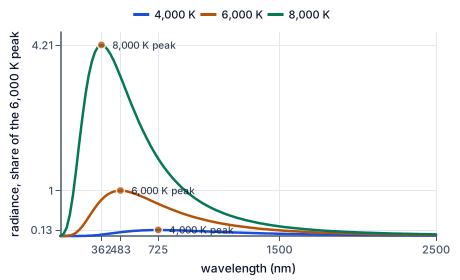
The figure puts three blackbodies on one scale. The hotter body is brighter at every wavelength, so the curves never cross: an $8{,}000$ K star outshines a $6{,}000$ K star even in the infrared. The peak height grows as $T^5$ and the area, the flux, as $T^4$. Comparing the $8{,}000$ K and $4{,}000$ K curves, the area grows $2^4 = 16$ times and the peak shifts from about $725$ nm to about $362$ nm, half the wavelength at twice the temperature.
A temperature from Wien's law should be between about $2{,}500$ K and $50{,}000$ K for a star; a value near $5$ or $5$ million means the nanometers were not converted. A flux ratio must be above $1$ for a star hotter than the Sun and below $1$ for a cooler one, and it should change much faster than the temperature: a $20$ percent hotter star has about twice the flux. A radius must grow with luminosity and shrink with temperature. And whenever you can, compare with a star measured directly: the Sun's own numbers, $1$, $1$ and $5{,}772$ K, must come back out of any formula you write.
NASA's Total and Spectral Solar Irradiance Sensor, mounted on the International Space Station since 2017, measures the Sun's flux above the atmosphere: about $1{,}361$ watts per square meter at Earth's average distance of $1.496 \times 10^{11}$ meters. That is a whole radiation-laws calculation in reverse.
Multiply the flux by the area of a sphere of radius one astronomical unit and the Sun's luminosity comes out: $1{,}361 \times 4\pi (1.496 \times 10^{11})^2 \approx 3.83 \times 10^{26}$ W. Divide by the Sun's surface area, with radius $6.957 \times 10^{8}$ m, to get the surface flux, $6.29 \times 10^{7}$ W per square meter. Divide by sigma and take the fourth root: $5{,}772$ K. That is exactly the nominal value astronomers adopted, and a change of a tenth of a percent in the measured flux would move it by only one or two kelvins, because of the fourth root.
The CHARA Array, run by Georgia State University on Mount Wilson in California, links six telescopes spread across $330$ meters so that they act, for measuring angles, like one telescope of that size. It can resolve disks a fraction of a thousandth of an arcsecond across.
Measuring a star's angular diameter and its distance gives its radius directly, with no radiation law at all. For Sirius A, interferometers find about $1.71$ solar radii; the radiation laws, from a luminosity of $25.4$ suns and a temperature of $9{,}940$ K, give $1.70$. Agreement like this, for the few dozen stars close and large enough to measure, is why astronomers trust the inferred radii of the billions that remain points of light.
Luminosity is power per square meter times the number of square meters. A red supergiant like Betelgeuse has a surface near $3{,}600$ K, much cooler than the Sun, yet it is over $100{,}000$ times as luminous because its radius is hundreds of times larger. A white dwarf can be three times hotter than the Sun and a thousand times fainter, because it is the size of Earth.
A second slip is treating the fourth power as a square. Flux goes as $T^4$; radius at fixed luminosity goes as $1/T^2$. Halving the temperature at the same luminosity makes the star four times larger, not twice.
A star's spectrum peaks at $580$ nm. Write Wien's law.
$\lambda_{\max} T = 2.898 \times 10^{-3}\ \text{m K}$
The peak sets the temperature.
Convert the constant to nanometer kelvins.
$2.898 \times 10^{-3} \times 10^{9} = 2{,}898{,}000\ \text{nm K}$
A meter is a billion nanometers.
Divide both sides by the peak wavelength.
$T = \dfrac{2{,}898{,}000}{580}$
Isolate the temperature.
Evaluate the quotient.
$T \approx 4{,}997\ \text{K}$
Kelvins.
Compare with the Sun.
$4{,}997 < 5{,}772$
A peak redder than 500 nm is cooler than the Sun.
A star's surface is at $10{,}000$ K. Write the Stefan-Boltzmann law.
$F = \sigma T^4$
Power per square meter.
Raise the temperature to the fourth power.
$(10^4)^4 = 10^{16}\ \text{K}^4$
Powers of ten multiply.
Multiply by the constant.
$F = 5.670 \times 10^{-8} \times 10^{16} = 5.67 \times 10^{8}\ \text{W/m}^2$
Watts per square meter.
Divide the temperature by the Sun's.
$10{,}000 \div 5{,}772 = 1.733$
Compare with a known star.
Raise the ratio to the fourth power.
$1.733^4 \approx 9.01$
The flux ratio.
Check against the Sun's own flux.
$5.67 \times 10^{8} \div 9.01 \approx 6.29 \times 10^{7}\ \text{W/m}^2$
That is sigma times 5,772 to the fourth, as it should be.
Sirius A has $L = 25.4\ L_\odot$ and $T = 9{,}940$ K. Write the radius in solar units.
$\dfrac{R}{R_\odot} = \sqrt{\dfrac{L}{L_\odot}}\left(\dfrac{T_\odot}{T}\right)^2$
Rearranged from L = R squared T to the fourth.
Take the square root of the luminosity.
$\sqrt{25.4} = 5.040$
Luminosity grows with area.
Divide the Sun's temperature by the star's.
$5{,}772 \div 9{,}940 = 0.5807$
The ratio, upside down.
Square the ratio.
$0.5807^2 = 0.3372$
Temperature enters as its square.
Multiply the two factors.
$5.040 \times 0.3372 = 1.70$
Solar radii.
Convert to kilometers.
$1.70 \times 696{,}000 \approx 1.18 \times 10^{6}\ \text{km}$
The Sun's radius is about 696,000 km.
Compare with interferometry.
$\text{measured: about } 1.71\ R_\odot$
The inferred radius matches a direct measurement.
Write Wien's constant in nanometer kelvins.
$2{,}898{,}000\ \text{nm K}$
Convert first.
Divide the constant by the peak wavelength.
$T = 2{,}898{,}000 \div 414$
Isolate the temperature.
State the temperature.
Two stars have the same surface temperature, but one is 100 times as luminous as the other. What must be true of the more luminous star?
Complete the worked solution: a star has luminosity $144$ $L_\odot$ and surface temperature $11544$ K. Taking the Sun's surface as $5{,}772$ K, find its radius in solar radii.
Divide the star's temperature by the Sun's.
$T \div T_\odot =$ k
Work in solar units.
Multiply the temperature ratio by itself.
$\text{ratio squared} = 4$
The radius goes as the luminosity's root over this.
Take the square root of the luminosity.
$\sqrt{L} = 12$
Luminosity grows as radius squared.
Divide the root of the luminosity by the squared ratio.
$R =$ r $R_\odot$
Radius from luminosity and temperature.
Check the sense of the answer in words.
$\text{hotter at the same luminosity means smaller}$
Each square meter gives off more.
Match each radiation law to what it gives you.
| how bright a blackbody is at each wavelength | the temperature from the wavelength of the peak | the power given off by each square meter | a star's total output from its radius and temperature | |
|---|---|---|---|---|
| Planck's law | ||||
| Wien's law | ||||
| the Stefan-Boltzmann law | ||||
| the luminosity of a sphere |
A star's surface is at $9600$ K. Taking the Sun's surface as $5{,}772$ K, fill in its peak wavelength and its surface flux as a multiple of the Sun's.
| value | |
|---|---|
| peak wavelength (nm) | |
| surface flux (Suns) |
A star's surface is $2$ times as hot as the Sun's. Write its luminosity $L$, in solar luminosities, as a function of its radius $R$, in solar radii.
Answer:
A star's spectrum peaks at $350$ nm. Using Wien's law, $\lambda_{\max} T = 2.898 \times 10^{-3}$ m K, find its surface temperature in kelvins.
Answer: kelvins
Aldebaran has a luminosity of about $439$ $L_\odot$ and an effective temperature of about $3910$ K. Taking the Sun's as $5{,}772$ K, what is its radius in solar radii? Give three significant figures.
Answer: solar radii
Lesson test: one question per skill, one attempt each, no hints. Your answers are checked when you submit.
A star's surface is $3$ times as hot as the Sun's. Write its luminosity $L$, in solar luminosities, as a function of its radius $R$, in solar radii.
Answer:
You can use the radiation laws. Find the temperature of a star peaking at 580 nm, and the radius of a star with 25.4 times the Sun's luminosity at 9,940 K.
19. Your turn: a star peaks at $414$ nm. Find its temperature., step 3
$T = 7{,}000\ \text{K}$
Hotter than the Sun.