Back to the on-screen lesson ·
Dark energy, 69 percent of critical, dilutes as a^(-3(1 + w)) and accelerates the expansion if w < -1/3; data put w near -1, a cosmological constant, but do not establish what it is, why it is so small, or that it never changes.
Paper packet. Every task here also exists on screen, where it is checked automatically; answers written on paper are not assessed by Nydus. When you are back at a device, enter your answers there.
By the end of this lesson you will be able to evaluate the evidence for cosmic acceleration and the cosmological constant, including what it does not establish.
You know how matter, radiation and vacuum energy dilute, the deceleration parameter $q_0 = \Omega_m/2 - \Omega_\Lambda$, and that supernovae near $z = 0.5$ are fainter than any decelerating model allows. This lesson asks what drives the acceleration, how its properties are described and measured, and, just as important, what the evidence does not yet tell us.
| Term | What it means |
|---|---|
| Dark energy | A smooth component, about 69 percent of the critical density, that makes the expansion accelerate. |
| Equation of state (w) | Pressure over energy density, w = p / (rho c^2); 0 for matter, 1/3 for radiation, -1 for a cosmological constant. |
| Cosmological constant | Dark energy with w = -1 exactly, a constant energy density of empty space. |
| Negative pressure | A tension; for w < -1/3 its gravity is repulsive and the expansion accelerates. |
| Cosmological constant problem | Quantum estimates of vacuum energy exceed the measured value by some 120 powers of ten. |
| Coincidence problem | The puzzle that matter and dark energy have similar densities just now. |
A component with equation of state $w = p/(\rho c^2)$ dilutes as
$$\rho \propto a^{-3(1+w)},$$
and because pressure gravitates, it accelerates the expansion when $w < -1/3$; a flat universe dominated by it has $q = (1 + 3w)/2$. The data require about $69$ percent of the critical density in such a component, dark energy, with $w$ within a few percent of $-1$, the value for Einstein's cosmological constant. They establish acceleration and $w \approx -1$; they do not establish what dark energy is, why it is so small, or that it never changes.
Another way: picture
Picture a stretched rubber sheet that, unlike ordinary rubber, keeps the same tension however far you stretch it, and pulls the frame outward rather than in. More sheet, more energy, but the same energy per square meter. A cosmological constant is like that: every new cubic meter of space comes with the same energy, and its tension drives the expansion faster.
Another way: steps
Supernovae show distances to $z \approx 0.5$ some $12$ percent larger than a decelerating universe allows. The baryon acoustic scale, a standard ruler in galaxy clustering, gives the same expansion history independently. The cosmic background shows space is flat, $\Omega_{\text{total}} = 1$, while all matter adds to only $0.31$, leaving $0.69$ for something smooth that does not clump. And the ages of the oldest stars need the extra age that acceleration supplies. Any one could be doubted; together, with different systematics, they make acceleration one of the best-established facts in cosmology.
In general relativity, pressure as well as energy density is a source of gravity. The acceleration equation reads $\ddot a/a = -\tfrac{4\pi G}{3}(\rho + 3p/c^2)$. For matter, $p = 0$ and gravity decelerates. For radiation, $p = \rho c^2/3$, and it decelerates more. A component with $p = w\rho c^2$ contributes $\rho(1 + 3w)$, which is negative when $w < -1/3$: a large enough negative pressure, a tension, makes gravity repel on cosmic scales. The same equation with energy conservation gives the dilution law $\rho \propto a^{-3(1+w)}$.
Einstein added a constant $\Lambda$ to his equations in 1917 to hold the universe static, and dropped it after the expansion was found. It behaves as an energy density of empty space with $w = -1$ exactly: as space grows, each new cubic meter carries the same energy, and the tension pushes outward. Its density today is $\Omega_\Lambda \rho_c c^2 \approx 5 \times 10^{-10}$ J/m³, equivalent to about four protons' mass per cubic meter. It is the simplest explanation, with a single number, and it fits all current data well.
The measurements constrain how the expansion rate changed, and so the density and $w$ of whatever drives it. They do not say whether it is a true constant, a slowly changing field, sometimes called quintessence, or a sign that general relativity needs modifying on the largest scales; all can mimic $w \approx -1$. Measurements combine $w$ with other parameters, so a reported departure from $-1$ depends on the assumptions in the fit. Claims that go beyond what the expansion history shows, about the nature of dark energy, are hypotheses, not results.
Quantum field theory predicts that empty space should carry energy from virtual particles. Estimated naively, cut off at the scale where gravity becomes quantum, that energy exceeds the measured value by roughly $120$ powers of ten, the worst prediction in physics. Either something cancels it almost exactly, or the estimate is wrong in a way not understood. The second puzzle is timing: matter's density falls as $a^{-3}$ while a constant's does not, so they are comparable only briefly, and that brief window happens to be now.
The Dark Energy Spectroscopic Instrument's first three years of data, released in 2024 and 2025 and combined with supernovae and the background, prefer a dark energy whose $w$ drifts with time, near $-0.75$ today and more negative in the past, over a constant, at a significance of roughly three to four standard deviations depending on which supernova sample is used. That is suggestive, not decisive: it depends on combining data sets, each with its own systematics. Future data from DESI, Euclid and the Rubin Observatory should settle it.
Nobody measures $w$ directly. Surveys measure distances and the expansion rate at many redshifts and fit them with a model in which dark energy has some $w$. Because a different $w$ changes when dark energy took over and how strongly it accelerated the expansion since, it changes the luminosity distance to every supernova and the angle of the baryon acoustic scale at every redshift. A constant $w$ is the simplest test; a common extension lets it drift linearly with the scale factor, $w = w_0 + w_a(1 - a)$, adding a second number. The more freedom the model has, the larger the uncertainty on each number, which is why the same data can look consistent with a constant under one model and inconsistent under another.
Measurements also trade $w$ against the matter density and the Hubble constant: a slightly larger matter density can mimic a less negative $w$. Combining probes that respond differently, such as supernovae, the acoustic scale and the background, is what breaks these trade-offs and makes a sharp statement possible.
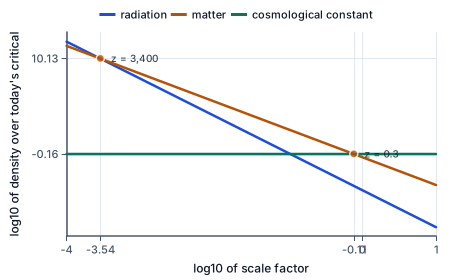
The figure plots each component's density against the scale factor, both as base-10 logarithms, so each dilution law is a straight line whose slope is $-3(1 + w)$. Radiation, slope $-4$, starts on top; matter, slope $-3$, overtakes it near $a = 0.0003$; the cosmological constant, slope $0$, overtakes matter near $a = 0.77$, redshift $0.3$. Far in the past and far in the future one component always dominates, and the crossings, where two are comparable, are brief. We live just after the second crossing.
A component accelerates the expansion only if $w < -1/3$; check the sign of $1 + 3w$. The density power $3(1 + w)$ is zero for a cosmological constant and positive for anything with $w > -1$. Dark energy with a less negative $w$ took over from matter earlier than a constant would. And when judging a claimed departure from $-1$, count uncertainties: a value one uncertainty away is entirely consistent with a constant.
Read reports with the same care. A headline that dark energy is changing should come with a measured departure from $-1$ and its uncertainty; if the departure is under two uncertainties, the data do not require it. Ask also which data sets were combined, since a result that appears only with one supernova sample, or only when a particular model is fitted, is weaker than one that survives every reasonable choice. A data-supported conclusion follows from the measurements; an underdetermined claim needs assumptions the measurements do not test, and it should be reported as a possibility rather than a finding.
The Dark Energy Spectroscopic Instrument, run by Lawrence Berkeley National Laboratory on the Mayall Telescope at Kitt Peak National Observatory near Tucson, Arizona, uses 5,000 robotically positioned optical fibers to take spectra of thousands of galaxies an hour. Its maps measure the baryon acoustic scale from $z = 0.3$ to $2.3$.
Combined with supernovae and Planck, its results fit best with $w_0 \approx -0.75$ today, evolving to more negative values in the past, rather than $w = -1$ throughout. A departure of $0.25$ from $-1$ with an uncertainty near $0.07$ would be about $3.5$ standard deviations, suggestive but short of the five that physicists usually demand.
The European Space Agency's Euclid telescope, launched in 2023, and NASA's Nancy Grace Roman Space Telescope, built and managed at Goddard Space Flight Center in Greenbelt, Maryland, will measure dark energy two ways at once: by the baryon acoustic scale in millions of galaxies and by weak gravitational lensing, which traces how fast structure grew.
The second test matters because a modification of gravity could imitate dark energy's effect on the expansion yet change how fast clusters grow. If the expansion and the growth of structure disagree with one value of $w$, that would favor modified gravity. Only measuring both can tell the explanations apart.
The data show the expansion is accelerating and that the cause behaves very nearly like a cosmological constant, $w \approx -1$. They do not prove it is one: a slowly changing field, or a modification of gravity, could look the same within today's uncertainties, and recent data hint at slow change. What dark energy is remains an open question.
A second slip is confusing dark energy with dark matter. Dark matter clumps around galaxies and pulls; dark energy is spread smoothly through space and pushes the expansion faster. They are different things that share an adjective.
A component has $w = -0.8$. Apply the density rule.
$n = 3(1 - 0.8) = 0.6$
It dilutes slowly.
Write its density law.
$\rho \propto a^{-0.6}$
Falls by a factor 1.5 as a doubles.
Find the deceleration parameter if it dominates.
$q = (1 + 3 \times (-0.8)) \div 2 = -0.7$
Negative.
Interpret the sign.
$q < 0$
Accelerating.
Compare with a cosmological constant.
$q = -1$
A constant accelerates harder.
Take $H_0 = 70$ and $\Omega_\Lambda = 0.7$. Find the critical density.
$\rho_c = 18.78 \times 10^{-27} \times 0.49 = 9.20 \times 10^{-27}\ \text{kg/m}^3$
Five protons per cubic meter.
Multiply by the vacuum share.
$\rho_\Lambda = 0.7 \times 9.20 \times 10^{-27} = 6.44 \times 10^{-27}\ \text{kg/m}^3$
Its mass equivalent.
Multiply by c squared.
$u_\Lambda = 6.44 \times 10^{-27} \times 8.988 \times 10^{16} = 5.79 \times 10^{-10}\ \text{J/m}^3$
Energy density.
Convert to electron volts per cubic centimeter.
$5.79 \times 10^{-10} \div (1.602 \times 10^{-19}) \div 10^6 = 3{,}600$
eV per cubic centimeter.
Compare with Earth's volume.
$1.08 \times 10^{21}\ \text{m}^3 \times 5.79 \times 10^{-10} = 6 \times 10^{11}\ \text{J}$
Comparable to a few hundred lightning strikes.
Take a flat universe, $\Omega_m = 0.3$, $\Omega_{DE} = 0.7$, $w = -2/3$. Write both densities.
$0.3(1+z)^3 \text{ and } 0.7(1+z)^{1}$
Dark energy power 3(1 + w) = 1.
Set the two densities equal.
$0.3(1+z)^2 = 0.7$
Divide through.
Solve for the square.
$(1+z)^2 = 2.333$
The ratio of shares.
Take the square root.
$1 + z = 1.5275$
Root of power -3w = 2.
Subtract one from it.
$z = 0.5275$
The takeover redshift.
Compare with a cosmological constant.
$z = 0.326 \text{ for } w = -1$
Less negative w takes over earlier.
Write the deceleration parameter.
$q = (1 + 3w) \div 2$
For a single component.
Substitute the value of w.
$q = (1 - 1.5) \div 2$
Evaluate.
State the result.
Supernovae, galaxy clustering, the cosmic background and stellar ages all point to dark energy. Which conclusion do these data actually establish?
Complete the worked solution: a flat universe has matter share $0.28$ and dark energy share $0.72$ with $w = -2/3$. Find the redshift at which their densities were equal.
Divide the dark-energy share by the matter share.
$\Omega_{DE} \div \Omega_m =$ r
Their ratio today.
Take the root of power minus three w and subtract one.
$z =$ z
Where the ratio was one.
Compare with a cosmological constant.
$\text{less negative } w \Rightarrow \text{earlier takeover}$
Its density grew into the past.
Match each equation of state to how the component's density changes as the universe grows.
| falls as the scale factor cubed | falls as the scale factor to the fourth | falls as the scale factor squared | stays the same | |
|---|---|---|---|---|
| w = 0, pressureless matter | ||||
| w = 1/3, radiation | ||||
| w = -1/3 | ||||
| w = -1, a cosmological constant |
A component has equation of state $w = -0.5$. Fill in the power $n$ in its density law $\rho \propto a^{-n}$, and the deceleration parameter $q$ of a flat universe dominated by it.
| value | |
|---|---|
| power n in the density law | |
| deceleration parameter q |
A flat universe holds matter, share $0.4$, and dark energy with constant $w = -1$, share $0.6$. Write $H^2/H_0^2$ as a function of redshift $z$.
Answer:
A universe has $H_0 = 100$ km/s per Mpc and $\Omega_\Lambda = 0.7$. The critical density is $18.78 \times 10^{-27}\,(H_0/100)^2$ kg/m³. What is the vacuum energy density, in units of $10^{-10}$ J/m³?
Answer: x 10^-10 J/m^3
A survey report headlines that dark energy is not a cosmological constant. Its measurement is $w = -0.70 \pm 0.10$. Find how many uncertainties the value lies from $-1$, and judge what the data support, treating two uncertainties as the threshold.
| uncertainties from -1 | what the data support | |
|---|---|---|
| the report |
Lesson test: one question per skill, one attempt each, no hints. Your answers are checked when you submit.
A flat universe holds matter, share $0.3$, and dark energy with constant $w = -2/3$, share $0.7$. Write $H^2/H_0^2$ as a function of redshift $z$.
Answer:
You can weigh the dark-energy evidence. Find the dilution power and deceleration for w = -0.8, and say whether w = -0.95 +/- 0.05 is evidence against a cosmological constant.
20. Your turn: a component has $w = -0.5$. Does a universe dominated by it accelerate?, step 3
$q = -0.25$
Negative: it accelerates.