Back to the on-screen lesson ·
Neutrons froze out at n/p near 1/6, decayed to about 1/7 by the time deuterium survived, and nearly all went into helium, Y = 2 (n/p) / (1 + n/p) near 0.25; leftover deuterium pins ordinary matter at about 5 percent of critical, far below all matter.
Paper packet. Every task here also exists on screen, where it is checked automatically; answers written on paper are not assessed by Nydus. When you are back at a device, enter your answers there.
By the end of this lesson you will be able to use Big Bang nucleosynthesis to predict the helium and deuterium abundances and compare them with observation.
You know the background's temperature history, $T \propto 1/a$ and $T \propto t^{-1/2}$ in the radiation era, the Boltzmann factor $e^{-E/kT}$, and from Astrophysics how stars fuse hydrogen into helium. This lesson follows the first three minutes, when the whole universe was hot enough for fusion, and shows how the lightest elements record its density.
| Term | What it means |
|---|---|
| Big Bang nucleosynthesis | The fusion of light nuclei in the first few minutes, making helium, deuterium and traces of lithium. |
| Freeze-out | The moment, near kT = 0.8 MeV, when weak reactions stopped converting neutrons and protons into each other. |
| Neutron-to-proton ratio (n/p) | About one sixth at freeze-out and one seventh when fusion began. |
| Helium mass fraction (Y) | The share of ordinary matter's mass in helium-4, about 0.25. |
| Deuterium bottleneck | The delay until about three minutes, when deuterium could first survive the photon bath. |
| Baryon-to-photon ratio (eta) | Baryons per photon, about 6.1 x 10^-10, which sets the abundances. |
Above about $10^{10}$ K, weak reactions kept neutrons and protons in balance, $n/p = e^{-1.293\,\text{MeV}/kT}$. They froze out at $kT \approx 0.8$ MeV, leaving $n/p \approx 1/6$. Free neutrons decayed, lifetime $879$ s, until the deuterium bottleneck broke at about three minutes; then nearly every surviving neutron, now $n/p \approx 1/7$, went into helium-4:
$$Y = \frac{2(n/p)}{1 + n/p} \approx 0.25.$$
The leftover deuterium falls steeply with the density of ordinary matter, giving $\Omega_b h^2 = 0.0224$, about $5$ percent of the critical density.
Another way: picture
Picture a dance where partners must pair up before the music stops. Neutrons are the scarce dancers, and some of them leave early, because free neutrons decay. When the pairing finally starts, nearly every neutron left finds a place in a helium foursome. Count the foursomes and you know how many neutrons there were.
Another way: steps
At temperatures above about $10^{10}$ K, reactions such as $n + \nu_e \leftrightarrow p + e^-$ turned neutrons into protons and back many times a second. In equilibrium, their ratio follows the Boltzmann factor for the mass difference: $n/p = e^{-\Delta m c^2/kT}$, with $\Delta m c^2 = 1.293$ MeV. At very high temperature the ratio is nearly one; as the universe cools, protons, being lighter, are favored. Because these reactions go through the weak force, their rate falls steeply with temperature, as $T^5$, much faster than the expansion rate, which falls as $T^2$.
When the weak reaction rate drops below the expansion rate, neutrons and protons stop converting: the ratio freezes. This happens at $kT \approx 0.8$ MeV, about one second after the beginning, giving $n/p = e^{-1.293/0.8} \approx 0.2$, or about one in six after a gradual finish. The freeze-out temperature depends on the strength of the weak force and on the expansion rate, which depends on how many kinds of light particles fill the universe. That is how nucleosynthesis counted the neutrino species, three, before particle accelerators did.
Building helium starts with deuterium, $n + p \to d + \gamma$, which is bound by only $2.22$ MeV. As long as the photon bath holds enough photons above $2.22$ MeV, every deuteron formed is broken apart. With $1.6$ billion photons per baryon, that remains true until $kT \approx 0.07$ MeV, about $10^9$ K, roughly three minutes after the beginning, the same photon-to-baryon logic that delays recombination. Meanwhile free neutrons decay, and $n/p$ drifts from about one sixth to about one seventh.
Once deuterium survives, fusion runs quickly through tritium and helium-3 to helium-4, the most tightly bound light nucleus, and nearly every neutron ends up there. Since each helium-4 has two neutrons and two protons, its mass fraction is $Y = 2(n/p)/(1 + n/p)$, $0.25$ for $n/p = 1/7$. Going further is blocked: no stable nucleus has mass $5$ or $8$, and the universe was cooling and thinning too fast for the triple collisions that stars use to make carbon. A little lithium-7 forms, about one atom per ten billion hydrogen atoms.
Not all deuterium is burned. The denser the ordinary matter, the more completely deuterium is fused into helium, so the leftover deuterium falls steeply with the baryon-to-photon ratio $\eta$, roughly as $\eta^{-1.6}$. Helium is insensitive, because nearly all neutrons end up in it regardless. The measured primordial ratio, $\text{D/H} = (2.53 \pm 0.03) \times 10^{-5}$, gives $\eta = 6.1 \times 10^{-10}$ and $\Omega_b h^2 = 0.0224$. With $h = 0.674$, $\Omega_b = 0.049$: ordinary matter is about five percent of the critical density.
Galaxy clusters, lensing and the cosmic background all put the total matter at $\Omega_m \approx 0.31$. Nucleosynthesis allows only about $0.05$ in baryons, the protons and neutrons that make atoms. The rest, about $0.26$, or $84$ percent of all matter, must be something that did not take part in nuclear reactions in the first minutes: dark matter that is not made of atoms at all. This is among the strongest arguments that dark matter is a new kind of particle rather than dim stars or gas.
Primordial abundances must be measured where few stars have altered the gas. Helium comes from ionized gas in small, metal-poor galaxies, extrapolated to zero heavy elements: $Y = 0.245$. Deuterium, destroyed but never made in stars, comes from absorption lines in pristine gas clouds seen against quasars at $z \approx 3$. Lithium comes from the atmospheres of old, metal-poor stars in the Milky Way's halo, where it is about three times scarcer than predicted, the lithium problem, perhaps because the stars have slowly destroyed some of their own.
Nucleosynthesis is the earliest era of cosmic history that we test with data. The predicted helium fraction depends on the expansion rate at one second, and so on everything that contributed to the density then. Each extra kind of light neutrino would speed the expansion, freeze the neutrons out earlier and raise $Y$ by about $0.013$. The measured $Y = 0.245$ allows about three neutrino species, matching the count from the decay of the $Z$ boson at CERN, and it rules out many proposed new light particles.
The same argument limits how much the constants of nature, such as the strength of the weak force or of gravity, could have differed in the first minutes; they appear to have been the same to within a few percent. That three light-element abundances, spanning nine powers of ten, agree with one baryon density, using only laboratory nuclear physics, is one of the strongest pillars of the hot Big Bang model, alongside the expansion and the microwave background.
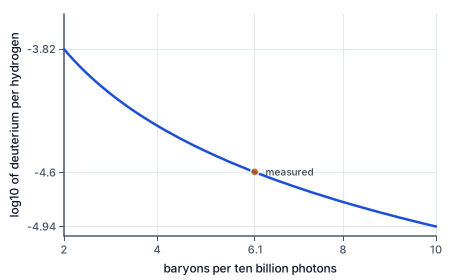
The figure plots the logarithm of the deuterium-to-hydrogen ratio against the number of baryons per ten billion photons. The curve falls steadily: at two baryons per ten billion photons, $\text{D/H} \approx 1.5 \times 10^{-4}$; at ten, about $1.1 \times 10^{-5}$. Because the slope is steep, a measurement of D/H to a few percent pins the baryon density to about two percent. The measured value lands at $6.1$, matching, independently, the baryon density read from the cosmic background's ripples.
A helium mass fraction should come out near $0.25$; a value near $0.13$ means the factor of two was forgotten. Neutron-to-proton ratios at freeze-out are between about a fifth and a seventh, never above a half. Less deuterium always means more baryons. And $\Omega_b$ requires dividing $\Omega_b h^2$ by $h^2$, not by $h$: for $h = 0.7$, $0.0224$ becomes $0.046$, not $0.032$.
When following neutron decay, apply the surviving share to the neutrons only: the protons gain what the neutrons lose, so the neutron fraction falls while the total number of nucleons stays the same. A longer wait before fusion always means less helium, and a helium fraction that rises with the delay signals a slip in the sign of the exponential, so recheck that step before going on to the helium fraction.
Ryan Cooke, Max Pettini and Charles Steidel, using the Keck telescopes on Mauna Kea, Hawaii, and the Very Large Telescope in Chile, measured deuterium in a handful of pristine gas clouds at $z \approx 3$, seen as absorption lines against background quasars. The deuterium line sits just $82$ km/s blueward of hydrogen's, so only clouds with simple velocity structure work.
Their 2018 result, $\text{D/H} = (2.527 \pm 0.030) \times 10^{-5}$, gives $\Omega_b h^2$ near $0.022$, the exact value depending on laboratory nuclear reaction rates. Planck's analysis of the background's ripples, an entirely separate physics at $380{,}000$ years, gives $0.0224 \pm 0.0001$. Two eras, two methods, one baryon density.
Nucleosynthesis depends on how fast free neutrons decay. Experiments disagree: neutrons trapped in magnetic or material bottles, as in the UCNtau experiment at Los Alamos National Laboratory in New Mexico, last about $877.8$ s, while beam experiments at the National Institute of Standards and Technology in Gaithersburg, Maryland, count decay protons and find about $887.7$ s.
The nine-second gap changes the predicted helium fraction by only about $0.002$, below the uncertainty in measured $Y$, so cosmology is not yet troubled. But the discrepancy itself is unexplained, an example of a small laboratory number that the whole universe depends on.
The first minutes made hydrogen, helium, a little deuterium and helium-3 and a trace of lithium, and essentially nothing else. Every atom of carbon, oxygen, iron and the rest was made later in stars and stellar explosions. The gaps at mass 5 and 8, and a universe that cooled and thinned within minutes, stopped Big Bang fusion at the lightest nuclei.
A second slip is thinking deuterium is a waste product of no interest. Its small leftover abundance is the most precise measure of how much ordinary matter the universe holds.
Freeze-out occurs at $kT = 0.8$ MeV. Divide the mass difference by kT.
$1.293 \div 0.8 = 1.616$
The exponent.
Take e to minus that.
$n/p = e^{-1.616} = 0.199$
About one in five.
Let decay bring it to one seventh by the time fusion starts.
$n/p = 0.143$
After about three minutes.
Find the helium mass fraction.
$Y = 2 \times 0.143 \div 1.143 = 0.25$
A quarter of the mass.
Count helium atoms per hydrogen atom.
$(0.25 \div 4) \div 0.75 = 0.083$
About one in twelve.
Neutrons make up $0.15$ of the nucleons at freeze-out and fusion begins $180$ s later. Find the exponent.
$180 \div 879 = 0.205$
Time over lifetime.
Find the surviving share.
$e^{-0.205} = 0.815$
Most survive.
Multiply by the starting fraction.
$X_n = 0.15 \times 0.815 = 0.122$
Neutrons left.
Double for helium.
$Y = 2 \times 0.122 = 0.244$
Close to the observed 0.245.
Note what a longer bottleneck would do.
$\text{more decay, less helium}$
Y is sensitive to timing.
Take the measured $\text{D/H} = 2.53 \times 10^{-5}$. Read the baryon density.
$\Omega_b h^2 = 0.0224$
From nucleosynthesis.
Take $h = 0.674$ and square it.
$h^2 = 0.454$
The dimensionless Hubble constant.
Divide by h squared.
$\Omega_b = 0.0224 \div 0.454 = 0.0493$
Five percent of critical.
Compare with the total matter.
$0.0493 \div 0.315 = 0.157$
About a sixth.
Find the dark matter share.
$0.315 - 0.049 = 0.266$
Not made of atoms.
State the conclusion.
$\text{most matter is non-baryonic}$
Independent of galaxy dynamics.
Write the formula.
$Y = 2r \div (1 + r)$
With r = 1/8.
Substitute the ratio.
$Y = 0.25 \div 1.125$
Twice one eighth, over nine eighths.
State the fraction.
Big Bang nucleosynthesis made hydrogen, helium and a trace of lithium, but almost no carbon or anything heavier. Why did it stop so early?
Complete the worked solution: at freeze-out neutrons make up a mass fraction $0.145$ of all nucleons. Free neutrons decay with a mean lifetime of $879$ s, and fusion begins $100$ s later. Find the helium mass fraction.
Find the share of neutrons that survive.
$e^{-t/879} =$ s
Exponential decay.
Multiply by the starting neutron fraction.
$X_n =$ n
The neutrons left when fusion begins.
Double it for helium's mass fraction.
$Y =$ y
Each neutron brings a proton into helium.
Match each fact about the first minutes to what it tells cosmologists.
| how many neutrons there were for each proton | the density of ordinary matter | a puzzle still unresolved | how many neutrons survived until fusion began | |
|---|---|---|---|---|
| a primordial helium mass fraction near 0.25 | ||||
| about 2.5 deuterium atoms per 100,000 hydrogen atoms | ||||
| old stars with about a third of the predicted lithium | ||||
| a free neutron's lifetime of about 15 minutes |
When fusion begins there are $1/6$ neutrons for every proton, and nearly all the neutrons end up in helium-4. Fill in the helium mass fraction $Y$ and the number of helium atoms per hydrogen atom.
| value | |
|---|---|
| helium mass fraction Y | |
| helium atoms per hydrogen atom |
When fusion begins there are $r$ neutrons for every proton, and a share $f = 0.9$ of the neutrons ends up in helium-4, the rest in traces of other nuclei. Write the helium mass fraction $Y$ as a function of $r$.
Answer:
The neutron is $1.293$ MeV heavier than the proton. If the weak reactions froze out at $kT = 0.9$ MeV, what was the neutron-to-proton ratio, $e^{-\Delta m c^2/kT}$, then?
Answer:
Gas clouds seen against distant quasars give a primordial deuterium-to-hydrogen ratio of $0.08 \times 10^{-5}$. Nucleosynthesis predicts $\Omega_b h^2 = 0.0224\,(\text{D/H} \div 2.53 \times 10^{-5})^{-0.625}$. Taking $h = 0.7$ and a total matter density $\Omega_m = 0.35$, find the baryon density parameter $\Omega_b$ and how it compares with all matter.
| baryon density parameter | baryons are | |
|---|---|---|
| the measurement |
Lesson test: one question per skill, one attempt each, no hints. Your answers are checked when you submit.
When fusion begins there are $r$ neutrons for every proton, and a share $f = 0.8$ of the neutrons ends up in helium-4, the rest in traces of other nuclei. Write the helium mass fraction $Y$ as a function of $r$.
Answer:
You can read the first three minutes. Find the helium mass fraction if n/p = 1/7 when fusion begins, and Omega_b from Omega_b h^2 = 0.0224 with h = 0.674.
21. Your turn: if there were $1/8$ as many neutrons as protons when fusion began, what would the helium mass fraction be?, step 3
$Y = 0.222$
Less helium than observed.