Back to the on-screen lesson ·
The comoving distance is c times the integral of dz / H; in flat space D_L = (1 + z) D_C and D_A = D_C / (1 + z); supernovae near z = 0.5 lie about 12 percent farther than a matter-only universe allows, the evidence for acceleration.
Paper packet. Every task here also exists on screen, where it is checked automatically; answers written on paper are not assessed by Nydus. When you are back at a device, enter your answers there.
By the end of this lesson you will be able to compare proper, comoving, luminosity and angular-diameter distances and use them with supernova data.
You know the distance modulus $\mu = m - M = 5\log_{10}(d/10\ \text{pc})$ from Astrophysics, type Ia supernovae as standard candles from the first lesson of this course, and the expansion history $H(z)$ from the last unit. This lesson defines the distances that an expanding universe makes necessary and uses them to read the evidence that the expansion is accelerating.
| Term | What it means |
|---|---|
| Comoving distance (D_C) | The proper distance to a galaxy now, c times the integral of dz / H(z). |
| Luminosity distance (D_L) | The distance that makes F = L / (4 pi D_L^2) true; (1 + z) D_C in flat space. |
| Angular-diameter distance (D_A) | The distance that makes angle = size / D_A true; D_C / (1 + z) in flat space. |
| Light-travel distance | The speed of light times the lookback time; not a separation at any single moment. |
| Standard candle | An object of known luminosity, such as a type Ia supernova. |
| Standard ruler | An object of known size, such as the sound horizon imprinted in galaxy clustering. |
Light from a galaxy at redshift $z$ left when the universe was smaller, and has traveled through expanding space ever since, so no single number is its distance. The comoving distance, where the galaxy is now, adds up the light's path:
$$D_C = c\int_0^z \frac{dz'}{H(z')}.$$
In flat space a standard candle's flux gives the luminosity distance $D_L = (1+z)D_C$, and a standard ruler's angle gives the angular-diameter distance $D_A = D_C/(1+z)$. Magnitudes use $\mu = 5\log_{10}D_L + 25$ with $D_L$ in Mpc. Distant supernovae lie at larger $D_L$ than any decelerating model allows.
Another way: picture
Picture a lighthouse on a ship sailing away while the sea itself stretches. Its flashes reach you redder and spaced further apart than they left, so it looks dimmer than its present distance suggests. Its lamp also looks larger than you would expect, because the light you see left when the ship was closer. One ship, two different apparent distances, and neither is where the ship is now.
Another way: steps
Light moving through the Robertson-Walker metric covers comoving distance $c\,dt/a$ in each moment. Adding up from emission to now, and using $dz = -(1+z)H\,dt$ to change variables, gives $D_C = c\int_0^z dz'/H(z')$. The expansion history $H(z)$ from the last unit goes straight in. A universe that expanded more slowly in the past, with a smaller $H$ at each redshift, has a larger $D_C$ to the same redshift: light took longer to get here and so came from farther away. That is the whole logic of the supernova evidence.
A supernova's light spreads over a sphere whose present area is $4\pi D_C^2$ in flat space. Two more effects dim it. Each photon arrives with its energy reduced by $1 + z$, and the photons arrive at a rate slowed by $1 + z$, the same time dilation that stretches light curves. The flux is therefore $L/[4\pi D_C^2(1+z)^2]$, and the distance that would give that flux in a static universe is $D_L = (1+z)D_C$. At $z = 1$ a supernova is twice as far by its brightness as it is now.
An object of size $\ell$ subtends an angle set by where it was when its light left, at proper distance $a\,D_C = D_C/(1+z)$. So $\theta = \ell/D_A$ with $D_A = D_C/(1+z)$. Strangely, $D_A$ stops growing near $z \approx 1.6$ and then shrinks: very distant galaxies look larger on the sky than somewhat nearer ones of the same size, because the universe was so much smaller when their light set out. The cosmic background, at $z = 1{,}100$, has $D_A$ of only about $13$ Mpc.
For a few models the integral can be done exactly. A flat vacuum universe has constant $H$, so $D_C = cz/H_0$ and $D_L = (c/H_0)z(1+z)$. An empty coasting universe gives $D_L = (c/H_0)z(1 + z/2)$. A flat matter universe gives $D_C = (2c/H_0)(1 - 1/\sqrt{1+z})$. At small redshift all of them reduce to Hubble's law, $D \approx cz/H_0$; they part ways only beyond $z \approx 0.2$, which is why the supernova test needs supernovae at redshifts of a half and more.
Type Ia supernovae peak near absolute magnitude $M = -19.3$, after a correction for the shape of the light curve that brings their scatter down to about $0.15$ magnitudes. Measure the peak apparent magnitude $m$, and $\mu = m - M$ gives $D_L = 10^{(\mu - 25)/5}$ Mpc. In 1998 two teams found supernovae near $z = 0.5$ some $0.25$ magnitudes fainter than a flat matter universe predicts, about $12$ percent farther. Only a slower past expansion, and so an accelerating present, could put them there.
Supernovae measure distances relative to one another, so they constrain the shape of the expansion history, not $H_0$ by themselves, which needs the distance ladder. Within a flat model they measure roughly $\Omega_\Lambda - \Omega_m$; combined with the cosmic background, which measures roughly the sum, they pin both. They do not, alone, tell whether the cause is a cosmological constant or a slowly changing dark energy, and they depend on the assumption that distant supernovae are the same candles as nearby ones, tested by comparing their spectra and colors.
News reports often say a galaxy is twelve billion light-years away when its light has traveled for twelve billion years. That light-travel distance is the speed of light times the lookback time, and it is not a distance between the galaxy and us at any single moment. When the light left, the galaxy was much closer; today it is much farther. For a galaxy at $z = 1$ the light-travel distance is about $2.4$ Gpc, between its angular-diameter distance of $1.7$ Gpc and its comoving distance of $3.4$ Gpc. Because it mixes two epochs, cosmologists rarely use it in calculations; quote a redshift, or say which distance is meant.
In a curved universe the comoving distance along the line of sight is still the integral of $c\,dz/H$, but the area of the sphere the light spreads over is not $4\pi D_C^2$. In a closed space spheres are smaller than that and in an open space larger, by the circle rules of the last lesson. The luminosity distance becomes $(1+z)R\sin(D_C/R)$ for a closed universe and $(1+z)R\sinh(D_C/R)$ for an open one, with $R$ the curvature radius. Because measured curvature radii exceed about $96$ Gpc, the corrections are a fraction of a percent even at the largest supernova distances, and the flat formulas are used throughout.
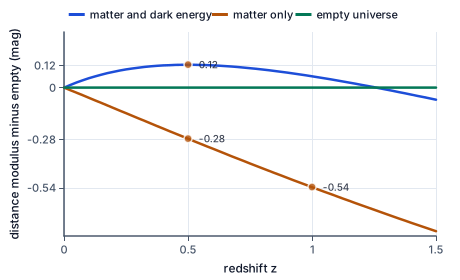
The figure plots each model's distance modulus minus that of an empty, coasting universe. The accelerating model rises above zero, meaning fainter supernovae, by about $0.12$ magnitudes at $z = 0.5$, then turns down beyond $z \approx 1$, where the universe was still decelerating. The matter-only model falls steadily below, $0.28$ magnitudes at $z = 0.5$ and $0.54$ at $z = 1$. A quarter-magnitude gap between the two at $z = 0.5$ is easy to see with a few dozen supernovae.
At any redshift above zero, $D_A < D_C < D_L$; a luminosity distance smaller than the comoving distance means the factor of $1 + z$ was applied the wrong way. Distance moduli for cosmological supernovae lie between about $35$ and $46$; a value near $15$ means the $25$ was left out. And when judging two models from one supernova, remember that a single object scatters by $0.15$ magnitudes, about $7$ percent in distance: real conclusions come from many.
When inverting a modulus, check the size of the answer against the redshift: at small redshift $D_L$ should be close to $cz/H_0$, about $4{,}300z$ Mpc for $H_0 = 70$. A supernova at $z = 0.1$ should come out near $450$ Mpc; if it comes out near half a megaparsec, the absolute magnitude was forgotten and the result is the distance modulus of the apparent magnitude alone.
Two teams raced to measure deceleration in the 1990s: the Supernova Cosmology Project, led by Saul Perlmutter at Lawrence Berkeley National Laboratory in California, and the High-z Supernova Search Team, led by Brian Schmidt with Adam Riess as lead author of its 1998 paper. Each found supernovae near $z = 0.5$ about $0.25$ magnitudes too faint for any decelerating universe.
A quarter magnitude is a factor of $1.26$ in flux and $1.12$ in distance. The Berkeley team's $42$ high-redshift supernovae favored $\Omega_\Lambda \approx 0.7$ with $\Omega_m \approx 0.3$ at high confidence, and the result earned the 2011 Nobel Prize in Physics.
The Sloan Digital Sky Survey and the Dark Energy Spectroscopic Instrument, at Apache Point Observatory in New Mexico and Kitt Peak in Arizona, measure a standard ruler instead. Sound waves in the early universe left a preferred separation of about $147$ Mpc between galaxies, called the baryon acoustic scale.
Measured as an angle on the sky it gives $D_A$, and along the line of sight it gives $H(z)$ directly. At $z = 0.5$, where $D_A$ is about $1{,}250$ Mpc, the comoving scale of $147$ Mpc, or $98$ Mpc at that time, appears about $4.5$ degrees across. These measurements agree with the supernovae, by a completely different route.
For nearby galaxies every way of measuring distance agrees. For distant ones they do not: the galaxy's brightness, its apparent size, where it is now and how long its light traveled give four different numbers, differing by factors of $1 + z$. None is wrong; each answers a different question, and a cosmologist must say which one is meant.
A second slip is thinking that fainter supernovae mean dimmer supernovae. The faintness of distant type Ia supernovae is a distance effect, tested against dust and evolution, and it is what revealed acceleration.
A galaxy at $z = 1$ has comoving distance $3{,}400$ Mpc. Find the stretch factor.
$1 + z = 2$
Both conversions use it.
Multiply for the luminosity distance.
$D_L = 2 \times 3{,}400 = 6{,}800\ \text{Mpc}$
As its brightness suggests.
Divide for the angular-diameter distance.
$D_A = 3{,}400 \div 2 = 1{,}700\ \text{Mpc}$
As its size suggests.
Find the distance modulus.
$\mu = 5\log_{10}6{,}800 + 25 = 44.16$
From the luminosity distance.
Find the angle of a galaxy 30 kpc across.
$\theta = 0.030 \div 1{,}700 = 1.8 \times 10^{-5}\ \text{rad}$
About 3.6 arcseconds.
Take $z = 3$ and $c/H_0 = 4{,}283$ Mpc. Take one over the square root of one plus z.
$1 \div \sqrt{4} = 0.5$
The redshift-dependent piece.
Subtract from one.
$1 - 0.5 = 0.5$
Inside the bracket.
Multiply by twice the Hubble distance.
$D_C = 2 \times 4{,}283 \times 0.5 = 4{,}283\ \text{Mpc}$
The comoving distance.
Multiply by one plus z.
$D_L = 4 \times 4{,}283 = 17{,}132\ \text{Mpc}$
The luminosity distance.
Note the limit as z grows.
$D_C \to 2c \div H_0 = 8{,}566\ \text{Mpc}$
The horizon of this model.
A supernova at $z = 0.5$ peaks at $m = 22.94$. Subtract its absolute magnitude.
$\mu = 22.94 + 19.3 = 42.24$
The distance modulus.
Subtract 25 and divide by 5.
$(42.24 - 25) \div 5 = 3.448$
The exponent.
Raise ten to that power.
$D_L = 10^{3.448} = 2{,}805\ \text{Mpc}$
Its luminosity distance.
Compare with an accelerating model's prediction.
$2{,}830\ \text{Mpc}$
Within 1 percent.
Compare with a decelerating model's prediction.
$2{,}360\ \text{Mpc}$
Off by 19 percent.
Weigh one object's scatter.
$0.15\ \text{mag} \approx 7\%$
Many supernovae needed for a verdict.
Find the stretch factor.
$1 + z = 3$
One plus the redshift.
Multiply the comoving distance by it.
$D_L = 3 \times 5{,}300$
The luminosity distance.
State the distance.
In 1998, type Ia supernovae near $z = 0.5$ were found to be about a quarter of a magnitude fainter than a matter-only universe predicts. What did that imply?
Complete the worked solution: in a flat universe of matter alone with $c/H_0 = 4{,}283$ Mpc, the comoving distance is $D_C = (2c/H_0)(1 - 1/\sqrt{1+z})$. Find the comoving and luminosity distances to $z = 0.44$.
Take one over the square root of one plus z.
$1 \div \sqrt{1 + 0.44} = 0.8333$
The only redshift-dependent piece.
Multiply twice the Hubble distance by one minus that.
$D_C =$ c $\text{Mpc}$
The comoving distance.
Multiply by one plus z.
$D_L =$ l $\text{Mpc}$
The luminosity distance.
For a galaxy at $z = 1$ in our universe, order these distances from smallest to largest.
Number the steps in order (write the number in the box):
In a flat universe, a galaxy at $z = 3$ has comoving distance $6400$ Mpc. Fill in its luminosity distance and its angular-diameter distance.
| value | |
|---|---|
| luminosity distance (Mpc) | |
| angular-diameter distance (Mpc) |
In a flat universe of vacuum energy alone with $H_0 = 67.4$ km/s per Mpc, the comoving distance to redshift $z$ is $4448\,z$ Mpc. Write the luminosity distance, in Mpc, as a function of $z$.
Answer:
A supernova has luminosity distance $100$ Mpc. What is its distance modulus $\mu = 5\log_{10}(D_L / 10\ \text{pc})$?
Answer: mag
A type Ia supernova at $z = 0.5$ peaks at apparent magnitude $m = 22.94$, and such supernovae peak at absolute magnitude $M = -19.3$. An accelerating model predicts a luminosity distance of $2830$ Mpc and a decelerating model $2360$ Mpc. Find the supernova's luminosity distance, and say which model it supports.
| luminosity distance (Mpc) | model supported | |
|---|---|---|
| the supernova |
Lesson test: one question per skill, one attempt each, no hints. Your answers are checked when you submit.
In a flat universe of vacuum energy alone with $H_0 = 100$ km/s per Mpc, the comoving distance to redshift $z$ is $2998\,z$ Mpc. Write the luminosity distance, in Mpc, as a function of $z$.
Answer:
You can read a supernova's distance. Find the luminosity and angular-diameter distances of a galaxy at z = 1 and D_C = 3,400 Mpc, and which model a supernova at m = 22.94 supports.
21. Your turn: a flat universe puts a galaxy at $z = 2$ at comoving distance $5{,}300$ Mpc. What is its luminosity distance?, step 3
$D_L = 15{,}900\ \text{Mpc}$
Three times where it is now.