Back to the on-screen lesson ·
Light stretches with space while it travels, so 1 + z = 1/a; this is not a Doppler shift, though it gives v = cz at small z, and galaxies beyond c/H0 recede faster than light without breaking relativity.
Paper packet. Every task here also exists on screen, where it is checked automatically; answers written on paper are not assessed by Nydus. When you are back at a device, enter your answers there.
By the end of this lesson you will be able to distinguish cosmological redshift from the Doppler shift of motion through space and relate redshift to the scale factor.
You know the Doppler shift from motion along the line of sight, $\Delta\lambda/\lambda = v_r/c$, from the Astrophysics course's binaries lesson, and Hubble's law $v = H_0 d$ from the last lesson. This lesson replaces the picture of galaxies flying apart through space with the picture cosmology actually uses: space itself growing, described by a single number, the scale factor.
| Term | What it means |
|---|---|
| Scale factor (a) | The size of the universe at some time relative to today; a = 1 now and was smaller in the past. |
| Redshift (z) | The fractional increase in wavelength, z = (observed - rest) / rest. |
| Cosmological redshift | The stretching of light's wavelength by the growth of space while it travels: 1 + z = 1 / a. |
| Comoving distance | A distance measured with the expansion divided out: it stays fixed for galaxies that only follow the Hubble flow. |
| Hubble distance | c / H0, about 4,300 Mpc: the distance at which the recession speed equals c. |
| Time dilation | The stretching of every time interval from a distant source by the same factor 1 + z. |
In a homogeneous expanding universe every distance between unbound galaxies grows in proportion to one function of time, the scale factor $a(t)$, with $a = 1$ today. A light wave traveling between them is stretched in the same proportion, so light emitted when the scale factor was $a$ arrives with
$$1 + z = \frac{\lambda_{\text{obs}}}{\lambda_{\text{emit}}} = \frac{1}{a}.$$
This cosmological redshift measures how much the universe grew during the journey, not how fast the source was moving. At small $z$ it reduces to $v = cz$ and Hubble's law; at large $z$ it has no speed limit.
Another way: picture
Picture ants on the surface of a balloon being inflated. The ants stay where they are, but the rubber between them stretches, so every ant sees every other ant receding, faster the farther away it is. Draw a wave on the rubber, and the wave stretches too. The balloon's rubber is the whole of space; there is no inside or outside for the universe to expand into.
Another way: steps
Think of two wave crests leaving a galaxy one wavelength apart. Each crest travels toward us through space that keeps growing, and the space between the two crests grows with everything else. By the time they arrive, the gap between them has grown by the same factor as every other cosmic distance. A wavelength is just a distance between crests, so $\lambda_{\text{obs}}/\lambda_{\text{emit}} = a_{\text{now}}/a_{\text{then}}$. The redshift tells you nothing about how fast the galaxy was moving when it emitted, or how far away it is now, until a model of how $a$ changed with time is added.
For nearby galaxies the light's journey is short, and the growth during it is small. Over a travel time $\Delta t = d/c$ the scale factor grows by $\Delta a \approx \dot a\, \Delta t$, and with $H_0 = \dot a / a$ this gives $z \approx H_0 d / c$, or $cz \approx H_0 d$. That is exactly Hubble's law written with a Doppler speed $v = cz$. This is why treating small redshifts as speeds works perfectly well, and why it fails at large redshift, where the naive $v = cz$ would exceed the speed of light at $z > 1$.
Hubble's law $v = H_0 D$ applied to proper distances has no ceiling: at the Hubble distance $c/H_0 \approx 4{,}300$ Mpc the recession speed equals $c$, and beyond it galaxies recede faster than light. Relativity is not violated. Special relativity forbids anything from passing a nearby observer faster than light; it says nothing about how fast the distance between two remote galaxies can grow. Every galaxy is nearly at rest in its own neighborhood, and we routinely see galaxies whose recession speed exceeds $c$ today.
The expansion is not an explosion into empty surroundings. The universe, as far as we can tell, is uniform on large scales and has no edge or center; every galaxy sees the same Hubble law around it. What grows is the distance between every pair of unbound objects. Bound systems do not grow: atoms, people, the solar system and the Milky Way hold together by their own forces, and the expansion between them is only between clusters and beyond.
Because every unbound distance scales with $a$, it is convenient to divide the expansion out. A comoving distance $\chi$ is defined so that the proper distance is $D(t) = a(t)\,\chi$. Two galaxies following the Hubble flow keep the same comoving distance forever; only the scale factor changes. Two clusters $300$ Mpc apart today were $300/(1+z)$ Mpc apart when light we now see at redshift $z$ left: $150$ Mpc at $z = 1$, $75$ Mpc at $z = 3$. The comoving grid lets cosmologists draw the universe as a fixed map whose overall scale changes.
Any interval at the source is stretched by $1 + z$: the time between two wave crests is just the shortest example. A type Ia supernova that takes $20$ days to fade nearby takes $40$ days at $z = 1$. Surveys in the 1990s and 2000s measured exactly this stretching in hundreds of supernovae, with the light-curve stretch matching the spectral redshift. It rules out tired-light ideas, in which photons simply lose energy on the way, because a photon losing energy cannot slow down the clock of the source.
Astronomers rarely quote the age of the universe when a distant galaxy's light left it, or the galaxy's distance; they quote its redshift. The reason is that redshift is measured directly from a spectrum, with no model at all, while turning it into a time or a distance needs the whole history of the scale factor, which depends on how much matter, radiation and dark energy the universe holds. A galaxy at $z = 2$ is at $z = 2$ whatever the cosmological parameters turn out to be; its distance and the time its light has traveled shift whenever they are revised.
Redshift also orders events. Light from $z = 6$ left before light from $z = 2$, when the universe was smaller, so larger redshift always means earlier. A cosmologist who says the first stars formed near $z = 20$ and reionization ended near $z = 6$ is giving a timeline that is independent of any fitted model, and the scale factor at each moment follows at once: a twenty-first and a seventh of today's size.
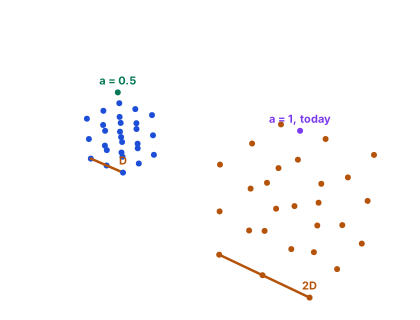
The scene shows one cube of galaxies at two moments. Each galaxy keeps its comoving place on the grid; what changes is the scale factor, from one half to one, and with it every separation, which doubles. A pair that was $D$ apart is now $2D$ apart, and a pair twice as far apart has moved twice as far, which is Hubble's law. No galaxy is at a center: from any of them, all the others recede in the same pattern.
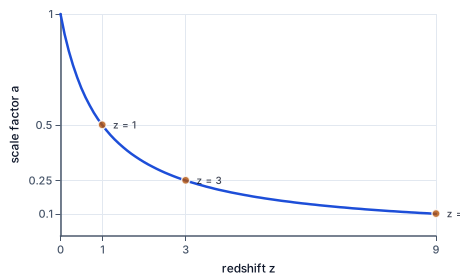
The figure plots the scale factor $a = 1/(1+z)$. Near $z = 0$ it falls steeply, which is why nearby redshifts look like small speeds; by $z = 1$ the universe was half its present size, by $z = 3$ a quarter, and by $z = 9$, when some of the first galaxies Webb has found emitted their light, a tenth. The curve flattens because each further step in redshift means a smaller change in size. The cosmic microwave background, at $z \approx 1{,}100$, left when the universe was about a thousandth of its present size.
A redshift found from a line should be the same for every line in the same spectrum: hydrogen-alpha and calcium K must give one $z$. The scale factor must lie between $0$ and $1$ for anything we see in the past. Dividing the shift by the observed wavelength instead of the rest wavelength is a common slip that gives too small a redshift. And $v = cz$ is safe only for $z$ below about $0.1$; at larger redshift give $z$ or $a$, not a speed.
Since 2022 the James Webb Space Telescope has found galaxies at redshifts above $10$, seen when the universe was less than a tenth of its present size and a few hundred million years old. Their ultraviolet light is stretched into Webb's infrared detectors, which is why the telescope was built to see infrared at all. Teams at the Space Telescope Science Institute in Baltimore, Maryland, and the University of Arizona in Tucson confirm such redshifts spectroscopically, by finding the sharp drop in a galaxy's light at Lyman-alpha, $121.6$ nm at rest, near $1{,}400$ nm or beyond.
A galaxy at $z = 13$ shows that drop at $121.6 \times 14 = 1{,}702$ nm, and its light left when the universe was one fourteenth of its present size. Photometric redshifts from colors alone are sometimes wrong, because a dusty galaxy nearby can mimic the drop, so spectra remain the final word.
The Sloan Digital Sky Survey, run from Apache Point Observatory in New Mexico, and the Dark Energy Spectroscopic Instrument on the Mayall Telescope at Kitt Peak in Arizona have measured redshifts for tens of millions of galaxies and quasars. Each redshift becomes a position in a three-dimensional map once a model of the scale factor turns it into a distance. The maps reveal walls, filaments and voids hundreds of megaparsecs across, and the faint imprint of sound waves from the early universe used to measure how the expansion has changed over time, the subject of the dark energy lesson later in this course.
The expanding universe is not galaxies hurtling outward from a central explosion into empty space. Galaxies are nearly at rest in their own regions; the distances between them grow because space grows, and there is no outside for it to grow into. The redshift measures how much the universe expanded while the light traveled, which is why it can exceed any Doppler limit.
A second slip is thinking that a galaxy receding faster than light breaks relativity. No galaxy moves past anything near it faster than light; it is the space between distant galaxies that grows, and that growth has no speed limit.
A galaxy's hydrogen-beta line, at $486.1$ nm at rest, is seen at $729.2$ nm. Divide.
$1 + z = 729.2 \div 486.1 = 1.5$
The stretch factor.
Subtract one from it.
$z = 0.5$
The redshift.
Take the reciprocal of the stretch.
$a = 1 \div 1.5 = 0.667$
Two-thirds of today's size.
Predict hydrogen-alpha, at $656.3$ nm at rest.
$656.3 \times 1.5 = 984.5\ \text{nm}$
In the near infrared.
Check the redshift is the same for both lines.
$984.5 \div 656.3 = 1.5$
One redshift per galaxy.
Two clusters are $300$ Mpc apart today. Write the separation through a.
$D = a \times 300$
Unbound distances scale with a.
Write a from the redshift.
$a = 1 \div (1 + z)$
The redshift's meaning.
Combine them into one function.
$D = \dfrac{300}{1+z}$
Separation then.
Evaluate at a redshift of one.
$D = 300 \div 2 = 150\ \text{Mpc}$
Half the size.
Evaluate at a redshift of three.
$D = 300 \div 4 = 75\ \text{Mpc}$
A quarter of the size.
A galaxy has $z = 0.02$. Convert it to a speed.
$v = 300{,}000 \times 0.02 = 6{,}000\ \text{km/s}$
Small z: a fine approximation.
Divide by H0 for the distance.
$d = 6{,}000 \div 70 = 85.7\ \text{Mpc}$
Hubble's law.
Try the same formula for a quasar at a redshift of two.
$v = 300{,}000 \times 2 = 600{,}000\ \text{km/s}$
Twice the speed of light.
Recognize the breakdown.
$cz > c$
The formula's assumption, small z, fails.
Report the quasar by its scale factor instead.
$a = 1 \div 3 = 0.333$
A third of today's size.
Note what is still needed for a distance.
$\text{a model of } a(t)$
The subject of later lessons.
Divide the observed by the rest wavelength.
$1 + z = 486.4 \div 121.6 = 4$
The stretch factor.
Find the redshift.
$z = 3$
Subtract one.
Take the reciprocal.
A quasar's light shows a redshift of $z = 3$. What, according to the expanding-universe model, produced the shift?
Complete the worked solution: a quasar has redshift $z = 3$. Find how much space has stretched since its light left, the scale factor then, and where its Lyman-alpha line, at $121.6$ nm in the laboratory, is observed.
Add one to the redshift for the stretch factor.
$1 + z =$ s
Wavelengths and distances grow by this factor.
Take the reciprocal for the scale factor.
$a =$ a
The universe's size then relative to now.
Stretch the rest wavelength.
$\lambda_{\text{obs}} =$ l $\text{nm}$
The rest wavelength times the stretch factor.
Match each observed shift to its cause.
| orbital motion through space | light escaping a strong gravitational field | the growth of space during the light's journey | a peculiar velocity toward us | |
|---|---|---|---|---|
| a line in a binary star that shifts back and forth | ||||
| a small redshift of a white dwarf's lines | ||||
| a redshift of 2 in a galaxy billions of light-years away | ||||
| the blueshift of the Andromeda galaxy |
A galaxy's hydrogen-beta line, at $486.1$ nm in the laboratory, is observed at $729.2$ nm. Fill in the redshift and the scale factor of the universe when the light left.
| value | |
|---|---|
| redshift z | |
| scale factor a |
Two galaxy clusters are $300$ Mpc apart today and are not bound to each other. Write their separation, in Mpc, at the time when light now reaching us with redshift $z$ was emitted, as a function of $z$.
Answer:
A galaxy has redshift $z = 0.012$. Using $v = cz$ with $c = 300{,}000$ km/s, valid at small redshift, and $H_0 = 70$ km/s per Mpc, how far away is it, in Mpc?
Answer: Mpc
Nearby type Ia supernovae take about $20$ days to fade by a set amount. A distant one takes $30$ days, as measured on Earth. If expansion stretches time intervals by the same factor as wavelengths, what is its redshift, and where should its silicon absorption line, at $635.5$ nm at rest, appear?
| redshift z | silicon line (nm) | |
|---|---|---|
| the supernova |
Lesson test: one question per skill, one attempt each, no hints. Your answers are checked when you submit.
Two galaxy clusters are $200$ Mpc apart today and are not bound to each other. Write their separation, in Mpc, at the time when light now reaching us with redshift $z$ was emitted, as a function of $z$.
Answer:
You can read a redshift as growth. Find the redshift and scale factor for a line at 486.1 nm seen at 729.2 nm, and how far apart two clusters 300 Mpc apart today were then.
21. Your turn: a quasar's Lyman-alpha line, at $121.6$ nm at rest, is observed at $486.4$ nm. Find the scale factor when the light left., step 3
$a = 1 \div 4 = 0.25$
A quarter of today's size.