Back to the on-screen lesson ·
A homogeneous, isotropic space is positively curved, flat or negatively curved, detectable from inside by large triangles whose angles sum to 180 degrees plus or minus 57.3 A / R^2; the Robertson-Walker metric combines a(t) and k, and today R exceeds about 96 Gpc.
Paper packet. Every task here also exists on screen, where it is checked automatically; answers written on paper are not assessed by Nydus. When you are back at a device, enter your answers there.
By the end of this lesson you will be able to describe homogeneous, isotropic spaces of positive, zero and negative curvature and the Robertson-Walker metric at an introductory level.
You know from the Friedmann equation that the universe's energy appears as a curvature constant $k$, whose sign is that of $\Omega - 1$. You know Euclid's geometry, in which a triangle's angles add to $180$ degrees and a circle's circumference is $2\pi r$. This lesson asks what curved space actually means, how it could be measured from inside, and how the Robertson-Walker metric packages expansion and curvature together.
| Term | What it means | ||
|---|---|---|---|
| Homogeneous | The same at every place, on large enough scales. | ||
| Isotropic | The same in every direction. | ||
| Curvature radius | The length scale R over which a curved space departs from flatness; today c / (H0 sqrt | Omega_k | ). |
| Geodesic | The straightest possible path in a space, followed by light. | ||
| Metric | The rule that gives the distance between two nearby points or events. | ||
| Robertson-Walker metric | The metric of a homogeneous, isotropic expanding universe, set by a(t) and k. |
A space that is homogeneous and isotropic can be curved in only three ways: positively, like a sphere's surface, with triangles adding to more than $180$ degrees; not at all, flat; or negatively, like a saddle, with triangles adding to less. On a space of curvature radius $R$ a triangle of area $A$ has angle sum
$$\Sigma = 180^\circ \pm 57.3^\circ \times \frac{A}{R^2}.$$
The Robertson-Walker metric gives distances in such a universe,
$$ds^2 = -c^2dt^2 + a(t)^2\left[\frac{dr^2}{1 - kr^2} + r^2 d\Omega^2\right],$$
with all the expansion in $a(t)$ and all the geometry in $k$.
Another way: picture
Picture walking from the North Pole straight down to the equator, turning ninety degrees, walking a quarter of the way around the equator, and turning ninety degrees again to walk straight back to the pole. You have drawn a triangle with three right angles, adding to $270$ degrees, without ever leaving the surface. That is how curvature reveals itself from inside.
Another way: steps
Carl Friedrich Gauss showed in 1827 that the curvature of a surface can be measured without ever leaving it. Draw the straightest possible lines, called geodesics, and measure triangles and circles. On a flat plane a triangle's angles add to $180$ degrees and a circle of radius $r$ has circumference $2\pi r$. On a sphere of radius $R$ the angles add to more, by $A/R^2$ radians, and circles are smaller than $2\pi r$. On a saddle-shaped surface the angles add to less and circles are larger. The same tests work in three dimensions: cosmologists use light rays as their straight lines.
If space is the same at every point and in every direction, its curvature must be the same everywhere too. That leaves only three possibilities, distinguished by the sign of the curvature: the three-dimensional analog of a sphere, called a three-sphere, which is finite in volume but has no edge; flat Euclidean space; and hyperbolic space, which is infinite and whose volume grows faster than $r^3$. These correspond to $k > 0$, $k = 0$ and $k < 0$ in the Friedmann equation, and so to $\Omega > 1$, $\Omega = 1$ and $\Omega < 1$.
A closed universe is finite but has no boundary, just as a sphere's surface has a definite area but no edge to walk off. Travel far enough in one direction and you return to your starting point. Its total volume is $2\pi^2 R^3$, and a great circle has circumference $2\pi R$. The universe does not expand into anything outside: the three-sphere is the whole of space, and expansion means $R$ itself grows with $a$. The balloon picture is useful only if you remember that the universe is the rubber, not the air inside or the room around it.
A metric tells how to compute the separation $ds$ between two nearby events. In the Robertson-Walker metric, the time part is just $-c^2dt^2$, with $t$ the time kept by every observer moving with the Hubble flow. The space part is $a(t)^2$ times a fixed comoving geometry: $dr^2/(1 - kr^2) + r^2 d\Omega^2$, where $r$ is a comoving radial coordinate and $d\Omega$ an angle. With $k = 0$ the bracket is ordinary flat space in spherical coordinates; with $k \ne 0$ the factor $1/(1 - kr^2)$ makes radial distances differ from what the circumference suggests. Light travels along $ds = 0$.
The curvature share today is $\Omega_k = -kc^2/(a_0^2 H_0^2)$, so the curvature radius is $R = (c/H_0)/\sqrt{|\Omega_k|}$. The Hubble distance $c/H_0$ is about $4.3$ Gpc for $H_0 = 70$. Planck's measurements, combined with galaxy clustering, give $|\Omega_k| < 0.002$, so $R > 96$ Gpc, more than six times the radius of the observable universe. If space is curved at all, the curvature is too gentle to show within the region we can see, just as a field looks flat though Earth is round.
The angle excess grows with the area: a triangle much smaller than $R^2$ has an excess far too small to measure. On Earth a triangle with $10$-km sides has an excess of less than a ten-thousandth of a degree; surveyors in the nineteenth century had to correct for it only over the largest triangulations. The universe is the same: to detect a curvature radius of a hundred gigaparsecs, a triangle must span billions of light-years. The cosmic microwave background provides one, as the next unit shows.
Triangles are not the only test. On a sphere of radius $R$, a circle drawn at distance $r$ from its center, measured along the surface, has circumference $2\pi R\sin(r/R)$, less than $2\pi r$. For small circles $\sin(r/R) \approx r/R - (r/R)^3/6$, so the shortfall is a fraction $r^2/(6R^2)$, again tiny unless $r$ approaches $R$. On a saddle the sine becomes a hyperbolic sine and circles come out larger than $2\pi r$.
In three dimensions the same holds for spheres and volumes. Count galaxies in shells at increasing distance: in flat space the number grows as $r^2$, in closed space more slowly and in open space faster. Edwin Hubble tried exactly this count in the 1930s; the method failed because galaxies evolve, so distant ones are not the same population as nearby ones. Geometry tests need objects whose true size or brightness is known.
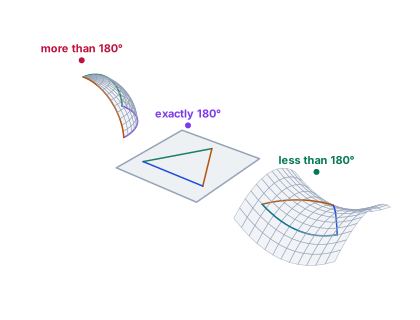
The scene draws two-dimensional versions of the three geometries, each with a triangle on it. On the sphere, three arcs that meet at right angles enclose an eighth of the surface and their angles add to $270$ degrees; on the plane they add to $180$; on the saddle, to less. The surfaces are drawn from outside only so the eye can see them; the triangles' angle sums are what an inhabitant measures from within, and that is the test cosmologists apply to our three-dimensional space.
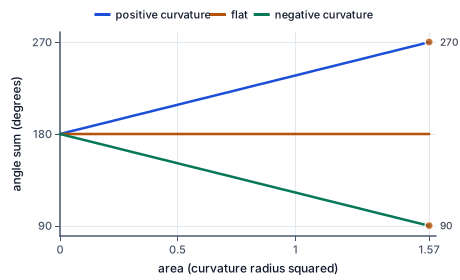
The figure plots the angle sum of a triangle against its area, measured in units of the curvature radius squared. All three lines start at $180$ degrees: tiny triangles look Euclidean everywhere. On a positively curved space the sum climbs by $57.3$ degrees per unit of area, reaching $270$ at an area of $\pi/2$, the three-right-angle triangle that covers an eighth of the sphere. On a negatively curved space it falls by the same amount. Flat space stays at $180$ forever.
An angle excess must be quoted in degrees when a sum is wanted; a value under $2$ is probably still in radians. Curvature radii from modern constraints come out in tens to hundreds of gigaparsecs; a value in thousands means $\Omega_k$ was used without its square root. A closed universe's volume is $2\pi^2R^3$, about $19.7R^3$, not the $4.19R^3$ of a ball. And a verdict of flat is a statement about the data's precision, not a proof that $k$ is exactly zero.
Signs need care. In the Friedmann equation a positive $k$ means positive curvature, but $\Omega_k$ is defined with a minus sign, so a negative $\Omega_k$ means a closed universe. When a result is quoted, check which convention it uses before reading off the geometry, and remember that the total density above critical means closed.
In the 1820s Carl Friedrich Gauss led a survey of the Kingdom of Hanover and is said to have measured the triangle formed by three mountain peaks, the Brocken, the Hohenhagen and the Inselsberg, with sides up to about $107$ km, to test whether space itself might be curved. Whatever his motive, the measurement could not have detected it: on Earth's scale, the sphere's own curvature adds an excess of about $15$ seconds of arc to such a triangle, and space's curvature would add far less.
Modern geodesy, run in the United States by the National Geodetic Survey in Silver Spring, Maryland, routinely corrects for the excess on Earth's surface. Its lesson for cosmology is that a triangle must be comparable in size to the curvature radius before curvature shows, so measuring the universe's geometry needs triangles billions of light-years across.
The cosmic microwave background gives the largest triangle available. Its hot and cold spots have a known physical size, set by how far sound traveled before the universe became transparent, and they are about $13.8$ billion light-years away. Their measured angular size, about one degree, is just what flat space predicts; in a closed universe they would look larger and in an open one smaller.
The BOOMERanG balloon, flown around Antarctica from McMurdo Station in 1998, gave the first precise measurement, $\Omega_{\text{total}} \approx 1$. NASA's WMAP and ESA's Planck satellites have since tightened it, combined with galaxy surveys, to $|\Omega_k| < 0.002$: if space is curved, its curvature radius is more than about $96$ Gpc.
A closed universe is finite in volume, but like a sphere's surface it has no boundary: there is no edge and no outside. Expansion means every distance within space grows, including the curvature radius, not that space spreads into a surrounding void. The same is true of flat and open universes, which are infinite and simply grow in scale.
A second slip is thinking curvature could be seen only from a higher dimension. Curvature is intrinsic: triangles and circles drawn within a space reveal it, which is why cosmologists can measure it at all.
A triangle on Earth encloses $10$ million km². Square Earth's radius.
$6{,}371^2 = 40.59 \text{ million km}^2$
The natural unit of area.
Divide the area by it.
$10 \div 40.59 = 0.2464$
The excess in radians.
Convert to degrees.
$0.2464 \times 57.3 = 14.12^\circ$
A large excess.
Add the flat value.
$\Sigma = 194.12^\circ$
The angle sum.
Check with the three-right-angle triangle.
$63.76 \div 40.59 \times 57.3 = 90^\circ$
An eighth of the sphere.
Take $H_0 = 70$ and $|\Omega_k| = 0.01$. Find the Hubble distance.
$299{,}792 \div 70 = 4{,}283\ \text{Mpc}$
c over H0.
Take the square root of the curvature share.
$\sqrt{0.01} = 0.1$
A small number.
Divide the Hubble distance by it.
$R = 4{,}283 \div 0.1 = 42{,}830\ \text{Mpc}$
The curvature radius.
Convert to gigaparsecs.
$R = 42.83\ \text{Gpc}$
Three times the observable radius.
Repeat for the Planck limit of 0.002.
$4{,}283 \div 0.0447 = 95{,}800\ \text{Mpc}$
At least 96 Gpc.
A closed universe has a curvature radius of $20$ Gpc. Multiply by two pi.
$C = 2\pi \times 20 = 125.7\ \text{Gpc}$
Around a great circle.
Cube the radius.
$20^3 = 8{,}000\ \text{Gpc}^3$
For the volume.
Multiply by two pi squared.
$V = 19.74 \times 8{,}000 = 157{,}914\ \text{Gpc}^3$
The three-sphere's volume.
Find the observable universe's volume.
$\tfrac{4}{3}\pi \times 14.3^3 = 12{,}250\ \text{Gpc}^3$
A ball of radius 14.3 Gpc.
Divide the two volumes.
$157{,}914 \div 12{,}250 = 12.9$
Most of space lies beyond view.
Note what a beam would find.
$\text{expansion outpaces it}$
Light never completes the circuit.
Find the excess in radians.
$0.5 \div 1^2 = 0.5$
Area over radius squared.
Convert the excess to degrees.
$0.5 \times 57.3 = 28.65^\circ$
The excess.
Add the flat value.
Beings confined to a curved two-dimensional surface cannot step off it into a third dimension. How could they find out that their space is curved?
Complete the worked solution: a closed universe has curvature radius $10$ Gpc today. Find how far a beam of light would travel to circle it, its total volume, and that volume in units of today's observable universe, a ball $14.3$ Gpc in radius.
Multiply the radius by two pi.
$C =$ c $\text{Gpc}$
A great circle, ignoring further expansion.
Find two pi squared times the radius cubed.
$V =$ v $\text{Gpc}^3$
The volume of a three-sphere.
Divide by the observable volume, about 12,250 cubic gigaparsecs.
$V \div V_{\text{obs}} =$ n
How much lies beyond our view.
Match each measurement made inside a space to what it reveals about that space.
| positively curved, like a sphere's surface | flat, like a plane | negatively curved, like a saddle | not homogeneous | |
|---|---|---|---|---|
| every large triangle's angles add to more than 180 degrees | ||||
| every triangle's angles add to exactly 180 degrees | ||||
| every large triangle's angles add to less than 180 degrees | ||||
| equal triangles have different angle sums in different places |
A triangle drawn on Earth's surface, a sphere of radius $6{,}371$ km, encloses $63.76$ million km². Fill in its angle excess and its angle sum, in degrees.
| value | |
|---|---|
| angle excess (degrees) | |
| angle sum (degrees) |
On a sphere of radius $10$, a triangle's angle excess in radians is its area divided by the radius squared. Write the triangle's angle sum, in degrees, as a function of its area $A$, taking $180/\pi = 57.3$.
Answer:
A universe has $H_0 = 70$ km/s per Mpc and a curvature share of magnitude $|\Omega_k| = 0.002$. Its curvature radius today is $R = c/(H_0\sqrt{|\Omega_k|})$, with $c = 299{,}792$ km/s. What is $R$, in gigaparsecs?
Answer: Gpc
An analysis reports $\Omega_k = -0.004 \pm 0.005$ with $H_0 = 67.4$ km/s per Mpc, where negative $\Omega_k$ means positive curvature. Find the curvature radius from the central value, in Gpc, and give the verdict on the geometry, treating anything within two uncertainties of zero as consistent with flat.
| curvature radius (Gpc) | geometry | |
|---|---|---|
| the analysis |
Lesson test: one question per skill, one attempt each, no hints. Your answers are checked when you submit.
On a sphere of radius $2$, a triangle's angle excess in radians is its area divided by the radius squared. Write the triangle's angle sum, in degrees, as a function of its area $A$, taking $180/\pi = 57.3$.
Answer:
You can measure curvature from inside. Find the angle sum of a triangle of area 0.5 on a sphere of radius 1, and the curvature radius for H0 = 70 and |Omega_k| = 0.01.
21. Your turn: on a sphere of radius $1$, a triangle has area $0.5$. What is its angle sum?, step 3
$\Sigma = 208.65^\circ$
The angle sum.