Back to the on-screen lesson ·
Matter and a cosmological constant give H^2 / H0^2 = Omega_m (1 + z)^3 + Omega_k (1 + z)^2 + Omega_Lambda and q0 = Omega_m / 2 - Omega_Lambda; a flat 30 percent matter universe is 0.964 Hubble times old, and a positive constant decides the fate.
Paper packet. Every task here also exists on screen, where it is checked automatically; answers written on paper are not assessed by Nydus. When you are back at a device, enter your answers there.
By the end of this lesson you will be able to relate the density parameters to the age and fate of the universe.
You know the Friedmann equation, the critical density and $\Omega$, how matter, radiation and vacuum energy dilute, and the pure power-law and exponential solutions. This lesson puts matter and a cosmological constant together, the two components that matter today, and finds how their shares decide the universe's expansion history, its age and its future.
| Term | What it means |
|---|---|
| Omega_m | Matter's share of the critical density today, about 0.31. |
| Omega_Lambda | The cosmological constant's share of the critical density today, about 0.69. |
| Omega_k | The curvature share, 1 - Omega_m - Omega_Lambda; zero for a flat universe. |
| Deceleration parameter (q0) | Omega_m / 2 - Omega_Lambda: positive if the expansion is slowing, negative if speeding up. |
| Cosmological constant | A vacuum energy of constant density, Einstein's Lambda. |
| Big Crunch | A recollapse to infinite density, the fate of a closed universe of matter alone. |
With matter and a cosmological constant, the Friedmann equation divided by $H_0^2$ is
$$\frac{H^2}{H_0^2} = \Omega_m(1+z)^3 + \Omega_k(1+z)^2 + \Omega_\Lambda,\qquad \Omega_k = 1 - \Omega_m - \Omega_\Lambda.$$
The deceleration parameter today is $q_0 = \Omega_m/2 - \Omega_\Lambda$: matter brakes, the cosmological constant pushes. For a flat universe the age is
$$t_0 = \frac{2}{3H_0\sqrt{\Omega_\Lambda}}\sinh^{-1}\sqrt{\frac{\Omega_\Lambda}{\Omega_m}},$$
$0.964/H_0$ for $\Omega_m = 0.3$. Once a positive constant is present, it decides the fate.
Another way: picture
Picture a rocket climbing away from a planet while a small engine gives it a constant push. Close to the planet, gravity wins and the rocket slows. Far away, gravity has weakened and the constant push wins, and the rocket speeds up forever. Matter is the planet's weakening pull and the cosmological constant is the engine that never shuts off.
Another way: steps
Divide the Friedmann equation $H^2 = \tfrac{8\pi G}{3}(\rho_m + \rho_\Lambda) - kc^2/a^2$ by $H^2$. Each density over the critical density is its share $\Omega$, and the curvature term becomes $\Omega_k = -kc^2/(a^2H^2)$. The left side is $1$, so $\Omega_m + \Omega_\Lambda + \Omega_k = 1$ at every moment. Given today's values, each term's history follows from its dilution law: matter as $(1+z)^3$, curvature as $(1+z)^2$, the constant not at all. That gives the expansion rate at any redshift, which every distance and age calculation in the rest of the course is built on.
The second Friedmann equation, from general relativity, says $\ddot a / a = -\tfrac{4\pi G}{3}(\rho + 3p/c^2)$. Matter has no pressure, so it always brakes. A cosmological constant has negative pressure $p = -\rho c^2$, so $\rho + 3p/c^2 = -2\rho$ and it pushes. Dividing by $H^2$ gives $q_0 = \Omega_m/2 - \Omega_\Lambda$. The expansion accelerates when $\Omega_\Lambda > \Omega_m/2$. For $\Omega_m = 0.3$ and $\Omega_\Lambda = 0.7$, $q_0 = -0.55$: the universe is speeding up.
Matter's density grows into the past as $(1+z)^3$ while the constant's stays fixed. They were equal when $(1+z)^3 = \Omega_\Lambda/\Omega_m$, at $z = 0.33$ for $\Omega_m = 0.3$. Acceleration began earlier, when the vacuum share first exceeded half the matter share, $(1+z)^3 = 2\Omega_\Lambda/\Omega_m$, at $z = 0.67$, a little over six billion years ago. Before that, for most of cosmic history, the expansion slowed; since then it has sped up. The supernovae that revealed acceleration span exactly this range of redshifts.
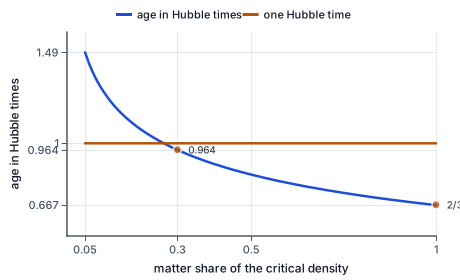
For a flat universe of matter and a constant, the Friedmann equation can be integrated exactly, giving the age formula above. It reduces to $2/(3H_0)$ as $\Omega_\Lambda \to 0$. More dark energy means a slower expansion in the past and an older universe: $0.831$ Hubble times at half matter, $0.964$ at thirty percent and $1.28$ at ten percent. Our universe, at $\Omega_m \approx 0.31$, is about $0.95$ Hubble times old, which with $H_0 = 67.4$ is $13.8$ billion years.
For matter alone, geometry decides everything: closed universes recollapse, open and flat ones expand forever. A cosmological constant breaks the link. Because its density never falls while matter's does, it eventually dominates unless matter halts the expansion first, and then the universe expands exponentially forever, even if its space is closed. Conversely, a negative constant would make even an open universe recollapse. Only a very large matter share, with a small constant, can still produce a Big Crunch.
Planck's analysis of the cosmic background, combined with supernova and galaxy clustering data, gives $\Omega_m = 0.315 \pm 0.007$ and $\Omega_\Lambda = 0.685$, with $|\Omega_k| < 0.002$: flat to within a fraction of a percent. Each data set alone allows a line of combinations in the plane of $\Omega_m$ and $\Omega_\Lambda$; supernovae measure roughly their difference, the background roughly their sum. Where the lines cross is the measured universe, which is how such a precise answer comes from data that are each individually loose.
The expansion history turns the shares into numbers at any epoch. For $\Omega_m = 0.3$ and $\Omega_\Lambda = 0.7$, at $z = 1$ the matter term is $0.3 \times 8 = 2.4$ and the vacuum term $0.7$, so $H^2/H_0^2 = 3.1$ and $H = 1.76\,H_0$: the universe was expanding about $76$ percent faster, per megaparsec, when it was half its present size. The matter share then was $2.4/3.1 = 0.77$, so dark energy was a minor player. At $z = 3$, $H^2/H_0^2 = 19.9$, and matter made up $96$ percent of the total. Running forward instead, as $z \to -1$ and the universe grows without limit, $H$ settles at $H_0\sqrt{0.7} = 0.84\,H_0$, the steady rate of the coming de Sitter era.
Every distance, age and lookback time in cosmology is an integral of $1/H$ over this history, which is why measuring the two shares precisely matters so much.
Cosmologists draw every matter-and-constant universe as a point in a plane, with $\Omega_m$ along one axis and $\Omega_\Lambda$ along the other. The line $\Omega_m + \Omega_\Lambda = 1$ separates closed universes above from open ones below. The line $\Omega_\Lambda = \Omega_m/2$ separates universes accelerating today from those decelerating. A curve near the $\Omega_m$ axis separates those that expand forever from those that recollapse, and in one corner, with a large constant and little matter, lie universes that never had a big bang at all, because the constant would have halted their contraction in the past. Our universe sits on the flat line, just above the acceleration line, far from both exotic corners.
The figure plots a flat universe's age in Hubble times against its matter share. The curve falls from $1.49$ at five percent matter to two thirds for matter alone. It crosses one Hubble time near twenty-six percent, so a universe like ours is a little younger than $1/H_0$. Read off an age by finding the matter share on the horizontal axis, reading the curve's height, and multiplying by $977.8/H_0$; at thirty percent and $H_0 = 70$, $0.964 \times 13.97 = 13.47$ billion years.
The shares, including curvature, must add to one, and the history must equal one at $z = 0$. A deceleration parameter for matter alone is $0.5$, not $1$: the matter term carries a half. Acceleration must begin at a higher redshift than matter-vacuum equality. A flat age must lie between two thirds of the Hubble time and a little more than one for any reasonable matter share, and adding dark energy must make it older.
When predicting a fate, ask two questions in order. First, is there any positive vacuum energy? If not, the old rule applies and the geometry decides. If there is, ask whether matter is plentiful enough to halt the expansion before the vacuum term grows to dominate; for any matter share below about one, it is not, and the universe ends in exponential expansion. Finally, a deceleration parameter tells you about today only: a universe decelerating now may still accelerate later, once matter has thinned out, and that is the most common surprise in these problems, so always check the future as well as the present.
By the early 2000s three independent measurements had converged. Supernovae, from the teams based at Lawrence Berkeley National Laboratory and Harvard and Australian observatories, measured roughly $\Omega_\Lambda - \Omega_m$; the cosmic background, from the BOOMERanG balloon flown from McMurdo Station and then NASA's WMAP satellite, measured the sum near $1$; and galaxy clusters measured $\Omega_m \approx 0.3$.
Only one point satisfied all three: $\Omega_m \approx 0.3$, $\Omega_\Lambda \approx 0.7$, flat. With $H_0 = 70$ that means $q_0 = -0.55$, acceleration since $z \approx 0.67$, and an age of $13.5$ billion years, safely older than the oldest stars. The agreement among methods with completely different systematics is why the model is called concordance cosmology.
The Dark Energy Spectroscopic Instrument, run by Lawrence Berkeley National Laboratory on the Mayall Telescope at Kitt Peak, Arizona, measures the expansion history from the imprint of early-universe sound waves in millions of galaxies. Its 2024 and 2025 results, combined with supernovae and the cosmic background, hinted that dark energy's density may be slowly changing rather than strictly constant.
If so, the formulas of this lesson, which assume a constant $\Omega_\Lambda$, would need an extra term, and the far future could differ. The evidence so far is suggestive, not decisive, a good example of separating what data establish from what they only allow.
Textbooks once taught that a closed universe recollapses and an open one expands forever. That is true only for a universe of matter alone. With a cosmological constant, whose density never falls, the constant eventually dominates and drives exponential expansion unless matter halts everything first; a closed universe can expand forever, and a negative constant could make an open one recollapse.
A second slip is thinking the expansion has always been accelerating. For most of cosmic history it slowed, while matter dominated; acceleration began only about six billion years ago.
Take a flat universe with $\Omega_m = 0.3$ and $\Omega_\Lambda = 0.7$. Set the densities equal.
$0.3(1+z)^3 = 0.7$
Matter grows into the past.
Solve for the cube.
$(1+z)^3 = 2.333$
Their ratio.
Take the cube root and subtract one.
$z = 1.326 - 1 = 0.326$
Equality.
Double the ratio for the onset of acceleration.
$(1+z)^3 = 4.667$
Vacuum equals half the matter.
Take the cube root and subtract one.
$z = 1.671 - 1 = 0.671$
Acceleration began earlier.
Take $\Omega_m = 0.3$ and $\Omega_\Lambda = 0.7$. Halve the matter share.
$0.3 \div 2 = 0.15$
Matter's braking.
Subtract the vacuum share.
$q_0 = 0.15 - 0.7 = -0.55$
Negative.
Read the sign.
$q_0 < 0$
Accelerating today.
Compare with matter alone.
$q_0 = 1 \div 2 = 0.5$
Decelerating.
Find the vacuum share that would just stop the acceleration.
$\Omega_\Lambda = 0.15$
Half the matter share.
Take $\Omega_m = 0.3$, $\Omega_\Lambda = 0.7$ and $H_0 = 70$. Find the square root of the vacuum share.
$\sqrt{0.7} = 0.8367$
In the denominator.
Find the square root of the ratio.
$\sqrt{0.7 \div 0.3} = 1.5275$
Inside the inverse sine.
Take the inverse hyperbolic sine.
$\sinh^{-1} 1.5275 = 1.2099$
A calculator function.
Combine the two ingredients.
$H_0 t_0 = \tfrac{2}{3} \times 1.2099 \div 0.8367 = 0.964$
In Hubble times.
Multiply by the Hubble time.
$t_0 = 0.964 \times 977.8 \div 70 = 13.47$
Billion years.
Compare with matter alone.
$\tfrac{2}{3} \times 13.97 = 9.31$
Dark energy adds four billion years.
Halve the matter share.
$0.5 \div 2 = 0.25$
Matter's braking.
Subtract the vacuum share.
$q_0 = 0.25 - 0.5$
The deceleration parameter.
State the result.
A universe has slightly more than the critical density, so its space is closed, but most of that density is a cosmological constant. What decides whether it expands forever?
Complete the worked solution: a flat universe has matter share $0.2$, the rest in a cosmological constant, and $H_0 = 65$ km/s per Mpc. Its age is $t_0 = \dfrac{2}{3H_0\sqrt{\Omega_\Lambda}} \sinh^{-1}\sqrt{\Omega_\Lambda / \Omega_m}$. Find it.
Find the square root of the vacuum share and the inverse hyperbolic sine.
$\sqrt{\Omega_\Lambda} = 0.8944,\ \sinh^{-1} = 1.4436$
The two ingredients.
Combine them into the age in Hubble times.
$H_0 t_0 =$ f
Two thirds times their ratio.
Multiply by 977.8 over the Hubble constant.
$t_0 =$ t $\text{billion years}$
The Hubble time in billions of years.
These flat universes all have the same Hubble constant, with the rest of the critical density in dark energy. Order them from youngest to oldest.
Number the steps in order (write the number in the box):
A flat universe has $\Omega_m = 0.3$ and $\Omega_\Lambda = 0.7$. Fill in the redshift at which matter and vacuum densities were equal, and the redshift at which the expansion began to accelerate.
| redshift | |
|---|---|
| redshift of matter-vacuum equality | |
| redshift when acceleration began |
A universe has matter share $\Omega_m = 0.3$, vacuum share $\Omega_\Lambda = 0.6$ and curvature share $\Omega_k = 0.1$ today. Write $H^2/H_0^2$ as a function of $z$.
Answer:
A universe of matter and a cosmological constant has $\Omega_m = 0.3$ and $\Omega_\Lambda = 0.7$ today. What is its deceleration parameter $q_0 = \Omega_m/2 - \Omega_\Lambda$?
Answer:
A model proposes a flat universe with $\Omega_m = 1$, $\Omega_\Lambda = 0$ and $H_0 = 60$ km/s per Mpc. Using the figure's age factor or the formula, find its age, and say how its expansion behaves now and in the future.
| age (billion years) | expansion | |
|---|---|---|
| the model |
Lesson test: one question per skill, one attempt each, no hints. Your answers are checked when you submit.
A universe has matter share $\Omega_m = 0.3$, vacuum share $\Omega_\Lambda = 0.5$ and curvature share $\Omega_k = 0.2$ today. Write $H^2/H_0^2$ as a function of $z$.
Answer:
You can read a universe's future from two numbers. For Omega_m = 0.3 and Omega_Lambda = 0.7, find q0, when acceleration began, and the age for H0 = 70.
21. Your turn: a universe has $\Omega_m = 0.5$ and $\Omega_\Lambda = 0.5$. Is its expansion speeding up?, step 3
$q_0 = -0.25$
Negative: accelerating.