Back to the on-screen lesson ·
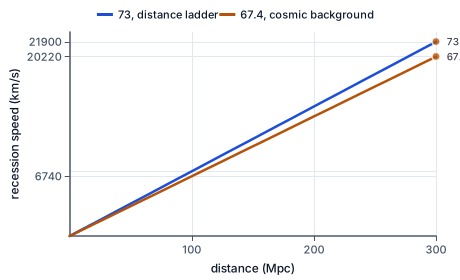
H0 is fitted as sum(v d) / sum(d^2) to galaxies far enough that peculiar velocities are small; every distance rests on a ladder of parallax, Cepheids and supernovae, whose calibration sets H0, now 73 from the ladder and 67.4 from the cosmic background.
Paper packet. Every task here also exists on screen, where it is checked automatically; answers written on paper are not assessed by Nydus. When you are back at a device, enter your answers there.
By the end of this lesson you will be able to interpret Hubble's law from redshift-distance data, fit the Hubble constant, and explain how it depends on the distance ladder's calibration.
You know from the Astronomy course that galaxies recede as $v = H_0 d$ and that Cepheids and supernovae give galaxy distances, and from Astrophysics how distance moduli and their uncertainties work. This lesson looks at how the Hubble constant is actually measured: fitting it to data, what spoils the fit nearby, how every distance rests on a ladder of calibrations, and why two precise measurements now disagree.
| Term | What it means |
|---|---|
| Hubble constant (H0) | Today's expansion rate, recession speed per unit distance, in km/s per Mpc. |
| Hubble flow | The motion of galaxies due to expansion alone, v = H0 d. |
| Peculiar velocity | A galaxy's own motion through space, superposed on the Hubble flow, typically a few hundred km/s. |
| Distance ladder | A chain of distance methods, each calibrated on the nearer one below it. |
| Least-squares fit | The line that minimizes the sum of squared deviations of the data from it. |
| Hubble tension | The 8 percent disagreement between H0 from the distance ladder and from the cosmic background. |
Galaxies recede as $v = H_0 d + v_{\text{pec}}$: the Hubble flow plus a peculiar velocity of a few hundred km/s. Fitting many galaxies with a line through the origin gives
$$H_0 = \frac{\sum v_i d_i}{\sum d_i^2}.$$
Speeds come from redshifts and are precise; distances come from a distance ladder of parallax, Cepheids and type Ia supernovae, each calibrated on the one below. If every distance is off by a factor $x$, $H_0$ is off by $1/x$. Today the ladder gives $H_0 \approx 73$ km/s per Mpc and the cosmic background $67.4$: the Hubble tension.
Another way: picture
Picture timing cars on a highway from a bridge, to find their average speed. Cars a short way off are hard to judge: a little weaving changes their apparent speed a lot. Cars far down the road give cleaner numbers, but only if you know how far away they are, and that depends on the markers you measured the road with. Cosmologists face both problems at once.
Another way: steps
A galaxy's redshift is measured from its spectrum to a precision of a few km/s, at any distance. Its distance is another matter: there is no ruler that reaches other galaxies, only methods that compare something whose true brightness or size we think we know with how it appears. Every measurement of $H_0$ is really a measurement of distances, and its accuracy is set by the weakest link in the chain that produced them.
Galaxies are pulled by their neighbors, so each has its own motion, its peculiar velocity, typically a few hundred km/s. The Milky Way and Andromeda are approaching each other at about $110$ km/s, and the whole Local Group falls toward the Virgo cluster. For a galaxy $4$ Mpc away, the Hubble flow is only about $280$ km/s, no larger than the noise, and some nearby galaxies even show blueshifts. At $100$ Mpc the flow is $7{,}000$ km/s and a few hundred is a small correction. That is why $H_0$ is measured in the Hubble flow, beyond about $50$ Mpc, and why nearby galaxies scatter about the line.
With many galaxies, each with distance $d_i$ and speed $v_i$, the best line through the origin minimizes $\sum (v_i - H_0 d_i)^2$. Setting the derivative with respect to $H_0$ to zero gives
$$H_0 = \frac{\sum v_i d_i}{\sum d_i^2}.$$
This weights distant galaxies most, which is right when peculiar velocities are the main scatter, since they matter least far away. Peculiar velocities are random and average down as more galaxies are added. Errors in the distances' calibration are not random: they shift every distance together, and no number of galaxies can remove them.
Parallax measures distances by geometry, from the shift of a star as Earth orbits; Gaia gives precise parallaxes out to a few kiloparsecs. Cepheid variables, pulsating supergiants whose periods reveal their luminosities, are calibrated on parallax in the Milky Way and can be seen in galaxies out to about $40$ Mpc. Type Ia supernovae, exploding white dwarfs of nearly standard peak luminosity, are calibrated in galaxies that host both Cepheids and a supernova, and are visible across billions of light-years. The tip of the red giant branch, the brightest red giants just before the helium flash, offers an alternative middle rung.
If the Cepheid zero point is off by $0.1$ magnitude, every distance on the rungs above is off by about $5$ percent, and so is $H_0$. Write the true distances as $x$ times the assumed ones: every $v/d$ shrinks by $x$, so $H_0^{\text{true}} = H_0^{\text{assumed}}/x$. Edwin Hubble's own 1929 value was about $500$ km/s per Mpc, seven times too large, because his Cepheid calibration confused two kinds of pulsating star; correcting it in the 1950s roughly doubled every distance, and later corrections did the rest.
The SH0ES team, using Hubble and Webb observations of Cepheids and supernovae, finds $H_0 \approx 73$ km/s per Mpc with about a one percent uncertainty. The Planck satellite's map of the cosmic background, interpreted with the standard cosmological model, gives $67.4$, also to about one percent. The two differ by about $8$ percent, several times their combined uncertainty.
Either an unrecognized systematic error lurks in one method, or the standard model is missing something about the early universe that changes how the background's pattern maps onto today's expansion rate. Independent ladders, using the red giant branch tip or gravitational-wave sirens, are now being built to decide.
Once $H_0$ is known, Hubble's law runs backward: a galaxy's redshift gives its distance, $d = v/H_0$, for galaxies near enough that the simple law holds and far enough that peculiar motions are small. A galaxy receding at $7{,}000$ km/s is about $100$ Mpc away, about $326$ million light-years, for $H_0 = 70$. This is how astronomers map the large-scale structure of the universe from redshift surveys of millions of galaxies, remembering that every such distance inherits the uncertainty in $H_0$ itself.
The figure draws Hubble's law for the two disputed values. Both lines start at the origin; at $100$ Mpc they predict speeds of $7{,}300$ and $6{,}740$ km/s, a difference of $560$ km/s, larger than a typical peculiar velocity, and at $300$ Mpc they differ by about $1{,}700$ km/s. Equivalently, a galaxy at a given speed is $8$ percent farther for the smaller constant. With thousands of supernovae in the Hubble flow, a gap that size is easy to see, which is what makes the tension so hard to dismiss.
Two kinds of error limit any measurement of $H_0$. Random errors, such as peculiar velocities and the scatter of individual supernova brightnesses, differ from galaxy to galaxy and shrink as the square root of the number of galaxies: a hundred supernovae beat one by a factor of ten. Systematic errors, such as the zero point of the Cepheid period-luminosity relation, dust corrections that are wrong in the same direction, or crowded images that make every Cepheid look slightly too bright, act on all galaxies alike. They do not shrink at all. Modern measurements have so many supernovae that the random errors are tiny, and the whole argument over the tension is about systematics.
A Hubble constant from modern data should lie between about $60$ and $80$ km/s per Mpc; values in the hundreds mean distances were taken in kiloparsecs or a calibration from the 1930s was used. A peculiar velocity should be a few hundred km/s, positive or negative. A least-squares fit must lie between the smallest and largest individual $v/d$ values. And if every distance grows, $H_0$ must shrink by the same factor: a calibration change never affects the speeds, which come from spectra alone and need no distances at all.
Measuring $H_0$ to ten percent was a founding goal of the Hubble Space Telescope. In the 1990s, Wendy Freedman's Key Project team, working from the Carnegie Observatories in Pasadena, California, found Cepheids in about two dozen galaxies and calibrated five secondary distance methods, publishing $H_0 = 72 \pm 8$ km/s per Mpc in 2001, ending a decades-old argument between camps favoring values near $50$ and near $100$.
Since then, Adam Riess's SH0ES team at Johns Hopkins University and the Space Telescope Science Institute in Baltimore has pushed the ladder to about one percent precision, now using Webb to check Hubble's Cepheid photometry in crowded fields. Webb's sharper infrared images confirmed the Hubble measurements, deepening rather than resolving the tension.
When two neutron stars merge, their gravitational waves encode the distance to the collision directly, with no distance ladder at all: the waves' amplitude and how fast their frequency rises give the true luminosity of the source. Such an event is called a standard siren.
On August 17, 2017, LIGO and Virgo detected the merger GW170817, and telescopes found its host galaxy, NGC 4993, about $40$ Mpc away, giving its redshift. Together they gave $H_0 \approx 70$ km/s per Mpc, with an uncertainty of about fifteen percent from one event. With dozens more such events, sirens could weigh in on the tension independently of both Cepheids and the cosmic background.
Hubble's law describes the average flow, but each galaxy also moves through space at a few hundred km/s, pulled by its neighbors. Nearby, this peculiar motion rivals the expansion: Andromeda, less than a megaparsec away, is approaching us. Treating every velocity as pure expansion gives wrong distances and a wrong Hubble constant from nearby galaxies.
A second slip is thinking more galaxies always mean a better $H_0$. More galaxies beat down the random peculiar motions, but a systematic error in the distance ladder's calibration shifts every distance together and survives any amount of averaging.
A galaxy $50$ Mpc away recedes at $3{,}200$ km/s. Divide.
$H = 3{,}200 \div 50 = 64$
km/s per Mpc from this galaxy alone.
Take the Hubble flow as $70$ km/s per Mpc and find its speed there.
$70 \times 50 = 3{,}500\ \text{km/s}$
Expansion alone.
Subtract it from the observed speed.
$v_{\text{pec}} = 3{,}200 - 3{,}500 = -300\ \text{km/s}$
The galaxy moves toward us through space.
Express the error in H.
$(64 - 70) \div 70 = -9\%$
One galaxy's bias.
Repeat at $200$ Mpc with the same peculiar speed.
$-300 \div (70 \times 200) = -2\%$
Distant galaxies are far less affected.
Galaxies at $40$, $80$ and $120$ Mpc recede at $2{,}950$, $5{,}700$ and $8{,}650$ km/s. Multiply each pair.
$118{,}000 + 456{,}000 + 1{,}038{,}000$
Each v times d.
Add the products.
$\sum v d = 1{,}612{,}000$
The numerator.
Square the distances.
$1{,}600 + 6{,}400 + 14{,}400$
Each d squared.
Add the squares.
$\sum d^2 = 22{,}400$
The denominator.
Divide the two sums.
$H_0 = 1{,}612{,}000 \div 22{,}400 = 71.96$
km/s per Mpc.
Compare with each galaxy alone.
$73.75,\ 71.25,\ 72.08$
The fit lies within their range, weighted to the farthest.
A survey finds $H_0 = 73$. Suppose the Cepheid zero point is $0.1$ magnitude too bright. Write the distance shift.
$\Delta \mu = 0.1\ \text{mag}$
Every modulus too large by 0.1.
Turn the magnitude shift into a distance factor.
$x = 10^{0.1/5} = 10^{0.02}$
Five magnitudes per factor of ten.
Evaluate the factor.
$x = 1.047$
Distances 4.7 percent larger.
Write the true constant.
$H_0 = \dfrac{73}{x}$
Velocities unchanged.
Divide by the factor.
$H_0 = 73 \div 1.047 = 69.7$
km/s per Mpc.
Compare with the cosmic background value.
$69.7 \text{ vs } 67.4$
Half the tension, from a tenth of a magnitude.
Note why it matters.
$\text{no number of supernovae removes it}$
A systematic error, not a random one.
Write Hubble's law for distance.
$d = v \div H_0$
Inverted.
Divide the velocity by the constant.
$d = 7{,}000 \div 70$
Megaparsecs.
State the distance.
Why do astronomers measure the Hubble constant with galaxies more than about 50 Mpc away, rather than with the nearest galaxies, whose distances are best known?
Complete the worked solution: a galaxy recedes at $2190$ km/s. Taking $H_0 = 73$ km/s per Mpc and $3.26$ million light-years per megaparsec, find its distance.
Divide the velocity by the Hubble constant.
$d =$ d $\text{Mpc}$
Hubble's law, inverted.
Multiply by 3.26 for millions of light-years.
$d =$ l $\text{million light-years}$
A more familiar unit.
State the assumption in words.
$\text{its own motion is small compared with the expansion}$
Otherwise the distance is uncertain.
Put the steps of the distance ladder in order, starting from the nearest.
Number the steps in order (write the number in the box):
A galaxy $200$ Mpc away recedes at $14200$ km/s. Fill in the Hubble constant it alone would give, and its peculiar velocity relative to a Hubble flow of $70$ km/s per Mpc.
| value | |
|---|---|
| H from this galaxy (km/s per Mpc) | |
| peculiar velocity (km/s) |
Using the distance scale they assumed, astronomers found $H_0 = 73$ km/s per Mpc. Suppose every true distance is $x$ times the assumed one, while the measured velocities are right. Write the true $H_0$ as a function of $x$.
Answer:
Three galaxies have distances and speeds of $60$ Mpc and $4300$ km/s, $150$ Mpc and $10800$ km/s, and $250$ Mpc and $18000$ km/s. Fit a line through the origin by least squares, $H_0 = \sum v d / \sum d^2$. What is $H_0$ in km/s per Mpc?
Answer: km/s per Mpc
A survey reports three galaxies: $60$ Mpc at $4400$ km/s, $140$ Mpc at $10200$ km/s, and $260$ Mpc at $18900$ km/s. Fit $H_0$ by least squares through the origin, and name the systematic error that would most change it.
| H0 (km/s per Mpc) | largest systematic | |
|---|---|---|
| the data set |
Lesson test: one question per skill, one attempt each, no hints. Your answers are checked when you submit.
Using the distance scale they assumed, astronomers found $H_0 = 500$ km/s per Mpc. Suppose every true distance is $x$ times the assumed one, while the measured velocities are right. Write the true $H_0$ as a function of $x$.
Answer:
You can measure the expansion rate. Fit H0 to galaxies at 40, 80 and 120 Mpc receding at 2,950, 5,700 and 8,650 km/s, and find how a 0.1-magnitude Cepheid error would shift it.
21. Your turn: a galaxy recedes at $7{,}000$ km/s. With $H_0 = 70$, how far away is it?, step 3
$d = 100\ \text{Mpc}$
About 326 million light-years.