Back to the on-screen lesson ·
Matter dilutes as a^-3, radiation as a^-4 and vacuum energy not at all, so a flat universe grows as t^(2/3), t^(1/2) or exp(H t); generally a component with rho as a^-n gives t^(2/n), and radiation gave way to matter near z = 3,400.
Paper packet. Every task here also exists on screen, where it is checked automatically; answers written on paper are not assessed by Nydus. When you are back at a device, enter your answers there.
By the end of this lesson you will be able to solve for the scale factor in matter-, radiation- and vacuum-dominated universes.
You know the Friedmann equation $H^2 = \tfrac{8\pi G}{3}\rho - kc^2/a^2$ and that $H = \dot a / a$, and from calculus how to solve separable differential equations such as $\dot y = y^n$. This lesson solves the Friedmann equation for a flat universe filled with one thing at a time, matter, radiation or vacuum energy, and finds out when each dominated our own universe's history.
| Term | What it means |
|---|---|
| Matter | Anything moving much slower than light, ordinary or dark; its density falls as a^-3. |
| Radiation | Photons and other particles moving near light speed; its density falls as a^-4. |
| Vacuum energy | Energy of empty space itself, the cosmological constant; its density does not change. |
| Matter-radiation equality | The moment, near z = 3,400, when matter and radiation had equal densities. |
| Power-law expansion | Growth a proportional to t^p, which decelerates if p < 1 and accelerates if p > 1. |
| Era | A stretch of cosmic history when one component dominates the Friedmann equation. |
In a flat universe $H^2 = (\dot a/a)^2 = \tfrac{8\pi G}{3}\rho$, so the growth of $a$ depends only on how $\rho$ falls as $a$ grows. Matter dilutes with volume, $\rho \propto a^{-3}$; radiation also loses energy to redshift, $\rho \propto a^{-4}$; vacuum energy stays constant. Solving each:
$$a \propto t^{2/3}\ (\text{matter}),\quad a \propto t^{1/2}\ (\text{radiation}),\quad a \propto e^{Ht}\ (\text{vacuum}).$$
In general, a component with $\rho \propto a^{-n}$ gives $a \propto t^{2/n}$. Our universe was radiation-dominated until $z \approx 3{,}400$, then matter-dominated, and is now entering a vacuum-dominated era.
Another way: picture
Picture three cars leaving the same town. One brakes hard and steadily, one brakes gently, and one has its foot on the accelerator. All three are moving forward, but their distances from town grow in completely different ways. Radiation, matter and vacuum are the hard brake, the gentle brake and the accelerator of cosmic expansion.
Another way: steps
Take a box that grows with the universe. Its volume grows as $a^3$. The number of particles inside stays fixed, so the number density of anything falls as $a^{-3}$. For matter, each particle's mass is fixed, so $\rho_m \propto a^{-3}$. For radiation, each photon's wavelength also stretches by $a$, so its energy falls by $a$, and $\rho_r \propto a^{-4}$. Vacuum energy is a property of space itself: a bigger box simply holds more of it, and its density stays fixed. These three laws are all that the Friedmann equation needs.
With $\rho \propto a^{-3}$ the flat Friedmann equation reads $\dot a^2 \propto a^{-1}$, or $\dot a \propto a^{-1/2}$. Separating, $a^{1/2}\,da \propto dt$, and integrating from the beginning, $\tfrac{2}{3} a^{3/2} \propto t$, so $a \propto t^{2/3}$. Then $H = \dot a/a = 2/(3t)$, which is where the matter-only age $t_0 = 2/(3H_0)$ of the earlier lesson comes from. The expansion decelerates because $\dot a \propto t^{-1/3}$ falls with time.
With $\rho \propto a^{-4}$, $\dot a \propto a^{-1}$, so $a\,da \propto dt$ and $a^2 \propto t$, or $a \propto t^{1/2}$. Then $H = 1/(2t)$ and the age is $1/(2H)$. Radiation brakes harder than matter because its density, and so its gravity, falls faster as the universe grows, leaving the early expansion running fastest of all. In the radiation era the temperature, which falls as $1/a$, falls as $t^{-1/2}$: ten billion kelvins at one second, one billion at a hundred seconds.
With constant density, $H$ itself is constant, and $\dot a = Ha$ gives exponential growth, $a \propto e^{Ht}$. The universe doubles in size every $\ln 2 / H$, forever. There is no beginning: run backward, $a$ shrinks but never reaches zero. This is the de Sitter universe, and it is where our own is headed as matter thins out and vacuum energy takes over. Inflation, in the first instant, was a brief vacuum era of the same kind.
For any component with $\rho \propto a^{-n}$, $\dot a \propto a^{1 - n/2}$ and a power law $a \propto t^p$ works with $p = 2/n$. Matter has $n = 3$ and $p = 2/3$; radiation has $n = 4$ and $p = 1/2$. Whenever $n > 2$, $p < 1$ and the expansion decelerates; at $n = 2$ it coasts; for $n < 2$ it accelerates. Only something whose density falls slower than $a^{-2}$ can speed up the expansion, which is why dark energy must be unlike any ordinary matter or radiation.
Today radiation, mostly the microwave background plus neutrinos, has $\Omega_r \approx 9 \times 10^{-5}$, and matter $\Omega_m \approx 0.31$. Their ratio grows as $1 + z$ into the past, so they were equal when $1 + z = \Omega_m/\Omega_r \approx 3{,}400$, about fifty thousand years after the beginning. Before that, radiation dominated; afterward, matter. Matter and vacuum energy were equal at $z \approx 0.3$, a little over three billion years ago, when the cubic fall of matter brought it below the constant vacuum density. The acceleration had begun a few billion years earlier, near $z \approx 0.6$.
Whether the expansion speeds up or slows down is a question about the second derivative $\ddot a$. For a power law $a \propto t^p$, $\dot a \propto p\,t^{p-1}$ and $\ddot a \propto p(p-1)\,t^{p-2}$, which is negative when $p < 1$ and positive when $p > 1$. Cosmologists summarize this with the deceleration parameter $q = -\ddot a\, a / \dot a^2$, which for a power law is $q = (1 - p)/p$: $q = 1/2$ for matter, $q = 1$ for radiation, $q = -1$ for a vacuum. A positive $q$ means braking.
The name dates from the 1960s, when everyone expected braking and the great observational program was to measure how much. The answer, from supernovae in 1998, was a negative $q$ today, about $-0.55$, which is what the mixture of matter and vacuum energy in the next lesson predicts.
A real universe holds all three components at once, and then the Friedmann equation has no simple power-law solution. Its right side is a sum, $H^2 = H_0^2[\Omega_r a^{-4} + \Omega_m a^{-3} + \Omega_\Lambda]$ for a flat universe, and it is solved numerically. But because the terms fall at such different rates, one of them nearly always dominates, and the pure solutions describe each era well. The transitions, near equality and near the onset of acceleration, are brief compared with the eras themselves. A cosmologist estimating a temperature at one second uses the radiation solution; one estimating the growth of galaxies at redshift $5$ uses the matter solution; and both are accurate to a few percent.
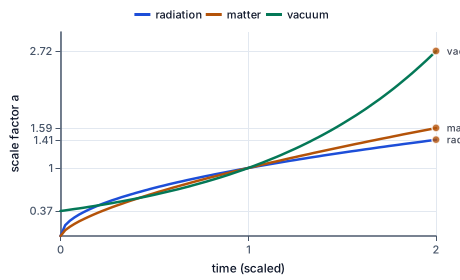
The figure scales all three solutions to pass through $a = 1$ at time $1$. The radiation and matter curves start at zero, rise steeply and bend over, the signature of deceleration; radiation bends more. By time $2$, radiation has reached $1.41$ and matter $1.59$. The vacuum curve bends upward instead, reaching $2.72$, and stays above zero into the past. A real universe follows the radiation curve early, the matter curve in the middle and the vacuum curve late.
Growth in a matter era is the age factor to the two-thirds power, so it must be less than the age factor itself, and growth in a radiation era is smaller still. The redshift of matter-radiation equality should come out in the thousands; a value near fifty means a square root crept in. And for a new component, check the power against the known cases: $n = 3$ must give two thirds and $n = 4$ one half.
Temperatures in the radiation era should fall as the square root of time grows: a time a hundred times longer means a temperature ten times lower, never a hundred times lower. If an answer divides the temperature by the time itself, the growth law has been skipped. Finally, a vacuum-dominated answer should never contain a beginning, however far back it is run.
The radiation share today, $\Omega_r \approx 9 \times 10^{-5}$, is fixed by measurement. The microwave background's temperature, $2.7255$ K, measured by NASA's COBE satellite at Goddard Space Flight Center in Greenbelt, Maryland, gives its photon density through the blackbody law. Neutrinos, never directly seen in the background, add about $68$ percent more, as nucleosynthesis and the background's pattern both confirm.
With Planck's $\Omega_m = 0.31$, equality falls at $z \approx 3{,}400$, when the universe was about $50{,}000$ years old and at about $9{,}300$ K. The timing matters: dark matter can only begin clumping strongly once matter dominates, so the redshift of equality sets the size of the largest structures that later grow.
Because vacuum energy does not thin out, it now makes up about $69$ percent of the critical density and its share keeps rising. In tens of billions of years the expansion will be nearly exponential, with $H$ settling at $H_0\sqrt{\Omega_\Lambda} \approx 56$ km/s per Mpc, doubling the distances between unbound galaxies about every $12$ billion years.
Galaxies beyond our Local Group will eventually recede past the point where their light can ever reach us; astronomers in the far future, as Lawrence Krauss and Robert Scherrer pointed out from Case Western Reserve University in Cleveland, Ohio, would see only their own merged galaxy, with no expansion to measure.
It is tempting to think that everything in the universe simply thins out with the volume. Matter does, as $a^{-3}$. Radiation thins faster, as $a^{-4}$, because each photon is redshifted as well as spread out. Vacuum energy does not thin at all. These different laws are why the universe passes through eras, each dominated by one component, and why the order is always radiation, then matter, then vacuum.
A second slip is thinking a vacuum universe must have begun somewhere. Its scale factor never reaches zero in the past; it has no big bang of its own.
A matter-dominated universe ages by a factor of $27$. Write the growth law.
$a \propto t^{2/3}$
From H^2 proportional to a^-3.
Take the cube root of the age factor.
$27^{1/3} = 3$
First step of two thirds.
Square the result.
$3^2 = 9$
The scale factor grows ninefold.
Compare with the radiation era.
$\sqrt{27} = 5.196$
Less growth.
Find the density change in the matter case.
$9^{-3} = 1 \div 729$
Density falls as a^-3.
Take $\Omega_m = 0.31$ and $\Omega_r = 0.000091$. Write both densities at redshift z.
$0.31(1+z)^3 \text{ and } 0.000091(1+z)^4$
Scaled from today.
Set them equal.
$0.31 = 0.000091(1+z)$
Three powers cancel.
Solve for one plus z.
$1 + z = 0.31 \div 0.000091 = 3{,}406.6$
The ratio of parameters.
Subtract one for the redshift.
$z = 3{,}405.6$
Equality.
Find the scale factor then.
$a = 1 \div 3{,}406.6 = 0.000294$
Under a three-thousandth of today's size.
At one second the universe was at ten billion kelvins. Find the growth by $100$ seconds.
$a \div a_1 = \sqrt{100} = 10$
Radiation era.
Divide the temperature by the growth.
$T = 10 \div 10 = 1$
Billion kelvins.
Find the growth by $400$ seconds.
$\sqrt{400} = 20$
Twice as much as at 100 s.
Find that temperature.
$T = 10 \div 20 = 0.5$
Billion kelvins.
Write the general rule.
$T \propto 1 \div \sqrt{t}$
Halving T takes four times as long.
Connect it to the next unit.
$\text{deuterium survives below about a billion kelvins}$
Nucleosynthesis begins.
Write the radiation growth law.
$a \propto \sqrt{t}$
From H^2 proportional to a^-4.
Take the square root of the age factor.
$\sqrt{64}$
The growth.
State the growth.
As the universe doubles in size, matter's density falls by a factor of $8$ but radiation's falls by $16$. Why does radiation thin out faster?
Complete the worked solution: one second after the beginning, the radiation-dominated universe was at ten billion kelvins. Find how much it had grown, and its temperature, $2500$ seconds after the beginning.
Take the square root of the ratio of times.
$a \div a_1 =$ a
The radiation-era growth law.
Divide ten billion kelvins by that growth.
$T =$ c $\text{billion kelvins}$
Temperature falls as one over a.
Note what cooling allows next.
$\text{nuclei can survive below about a billion kelvins}$
The start of nucleosynthesis.
Match each flat or empty universe to how its scale factor grows with time.
| grows as the square root of time | grows as time to the two-thirds power | grows exponentially, doubling at fixed intervals | grows in proportion to time | |
|---|---|---|---|---|
| a flat universe of radiation | ||||
| a flat universe of matter | ||||
| a universe of vacuum energy | ||||
| an empty universe |
A flat universe's age grows by a factor of $8$. Fill in how much its scale factor grows if matter dominates, and if radiation dominates.
| factor | |
|---|---|
| growth if matter dominates | |
| growth if radiation dominates |
In a model universe, matter and radiation had equal densities when $1 + z = 3000$. Matter density scales as $(1+z)^3$ and radiation density as $(1+z)^4$. Write the ratio of radiation density to matter density as a function of $z$.
Answer:
Today matter has density parameter $\Omega_m = 0.31$ and radiation $\Omega_r = 0.000091$. At what redshift were their densities equal?
Answer:
A theorist proposes a new component whose density falls as $a^{-6}$. In a flat universe dominated by it, the scale factor grows as $t^p$. Find $p$, and say how the expansion behaves.
| power p | expansion | |
|---|---|---|
| the new component |
Lesson test: one question per skill, one attempt each, no hints. Your answers are checked when you submit.
In a model universe, matter and radiation had equal densities when $1 + z = 4000$. Matter density scales as $(1+z)^3$ and radiation density as $(1+z)^4$. Write the ratio of radiation density to matter density as a function of $z$.
Answer:
You can solve the Friedmann equation era by era. Find how much a matter universe grows while its age grows 27-fold, and the redshift at which matter and radiation were equal.
21. Your turn: a radiation-dominated universe ages by a factor of $64$. How much does its scale factor grow?, step 3
$8$
Its scale factor grows eightfold.