Back to the on-screen lesson ·
With 1.6 billion photons per baryon, hydrogen stays ionized until kT is about 13.6/40 eV; as electrons bind, the mean free path 1 / (n_e sigma_T) outgrows the Hubble distance and light decouples at z of about 1,090, leaving the last-scattering surface.
Paper packet. Every task here also exists on screen, where it is checked automatically; answers written on paper are not assessed by Nydus. When you are back at a device, enter your answers there.
By the end of this lesson you will be able to trace recombination and the decoupling of matter and radiation.
You know the Saha equation from the Astrophysics lesson on excitation and ionization, that the background's temperature is $2.7255(1+z)$ K, and that there are about $1.6$ billion photons per baryon. This lesson follows the universe through the moment its hydrogen formed atoms and its light broke free, the event whose afterglow is the microwave background.
| Term | What it means |
|---|---|
| Recombination | The capture of free electrons by protons to make neutral hydrogen, near z = 1,100 to 1,400. |
| Decoupling | The moment photons stopped scattering off electrons and began to travel freely, near z = 1,090. |
| Last-scattering surface | The shell of the early universe from which background photons last scattered, seen as the microwave background. |
| Thomson scattering | The scattering of photons by free electrons, with cross section 6.652 x 10^-29 m^2. |
| Mean free path | The average distance a photon travels between scatterings, 1 / (n_e sigma_T). |
| Reionization | The re-ionizing of intergalactic hydrogen by the first stars and galaxies, completed near z = 6. |
In the early universe hydrogen was ionized and photons scattered off free electrons constantly, with mean free path $\lambda = 1/(n_e\sigma_T)$. As the universe cooled, electrons and protons combined, recombination, but not at $kT = 13.6$ eV: with $1.6$ billion photons per baryon, the blackbody's high-energy tail kept re-ionizing atoms until $kT \approx 13.6/40$ eV, about $3{,}000$ to $4{,}000$ K. With free electrons gone, $\lambda$ outgrew the Hubble distance and the photons decoupled at $z \approx 1{,}090$, about $380{,}000$ years after the beginning. We see that moment as the last-scattering surface.
Another way: picture
Picture a crowded room where everyone keeps bumping into you; you can never walk more than a step in a straight line. Then, within a few minutes, almost everyone pairs up and sits down, and suddenly you can walk straight across the room. Photons in the early universe were in the crowd of free electrons; when the electrons paired up with protons, the light walked free.
Another way: steps
Before recombination the universe was a plasma of protons, helium nuclei, electrons and photons, much like the interior of a star. Free electrons scatter photons by Thomson scattering, with a cross section of $6.652 \times 10^{-29}$ m². With $0.22$ electrons per cubic meter today, there were $0.22 \times 1{,}101^3 \approx 3 \times 10^8$ per cubic meter at $z = 1{,}100$, and a photon traveled only about $1.7$ kpc between scatterings, far less than the $200$ kpc that light could cross in an expansion time. Photons and matter moved together as a single fluid.
Hydrogen's ionization energy, $13.6$ eV, corresponds to $kT$ at $158{,}000$ K. But a blackbody has photons far above its typical energy, in a tail falling as $e^{-E/kT}$. With $1.6 \times 10^9$ photons per baryon, the number of photons above $13.6$ eV per atom is roughly $1.6 \times 10^9\, e^{-13.6/kT}$ times a modest factor, and this stays above one until $13.6/kT$ reaches about $40$. That puts recombination at $kT \approx 0.3$ eV, a few thousand kelvins. The Saha equation makes this precise: hydrogen is half ionized near $z = 1{,}370$, at about $3{,}700$ K.
The Saha equation assumes equilibrium, which the real universe could not quite keep up. An electron captured directly into the ground state emits a photon above $13.6$ eV that promptly ionizes another atom, so direct capture achieves nothing. Recombination must go through excited states, and each Lyman-alpha photon emitted on the way down is reabsorbed nearby. Only the slow two-photon decay of the $2s$ level and the redshifting of Lyman-alpha photons out of resonance let atoms settle. The ionized fraction therefore falls more slowly than Saha predicts, to about ten percent near $z = 1{,}100$ rather than a fraction of a percent, and a residual of a few parts in $10{,}000$ never recombines.
Photons decouple when they are no longer likely to scatter before the universe expands significantly, when the mean free path exceeds the Hubble distance. With the ionized fraction falling steeply, this happens quickly, at $z \approx 1{,}090$. The photons we receive last scattered on a thin shell centered on us, the last-scattering surface, now about $46$ billion light-years away. Its thickness corresponds to a spread in redshift of about $80$, so the background is a snapshot of the universe at an age of about $380{,}000$ years, give or take a few tens of thousands.
Decoupling freed matter as much as light. Before it, any clump of ordinary matter was pushed apart by photon pressure, so only dark matter, which ignores photons, could begin to cluster. Afterward, ordinary matter fell into the dark matter's gravitational wells, and the growth of galaxies could begin. The universe then entered the dark ages: neutral gas, the background glow fading into the infrared, and no stars yet, a period lasting a hundred million years or more.
The first stars and galaxies, forming from $z \approx 20$ to $30$, emitted ultraviolet light that ionized the gas around them. Bubbles of ionized gas grew and merged, and by $z \approx 6$, about a billion years after the beginning, intergalactic hydrogen was ionized again. Because the universe was then far less dense, the free electrons scatter only about $5$ percent of background photons, measured by Planck as the optical depth $\tau = 0.054$. Spectra of quasars beyond $z \approx 6$ show nearly total absorption blueward of Lyman-alpha, the sign of neutral gas just before reionization finished.
Helium holds its electrons more tightly than hydrogen, so it recombined earlier. Its second electron, bound by $54.4$ eV, was captured near $z \approx 6{,}000$; its first, bound by $24.6$ eV, near $z \approx 2{,}000$ to $2{,}500$. The same photon-to-baryon argument applies, with each event waiting until $kT$ was a few percent of the binding energy. Helium makes up a quarter of the ordinary matter by mass, so its recombination removed about one free electron in seven, slightly lengthening the photons' mean free path before hydrogen's turn. Precise models of the background include all three steps, and the predicted pattern of hot and cold spots depends on getting them right to a fraction of a percent.
The physics of recombination is ordinary atomic physics, understood since the 1960s, when Yakov Zeldovich in Moscow and Jim Peebles at Princeton independently worked out the slow, trapped-photon route. That is one reason cosmologists trust the background so much: the one step between the early universe and the map involves nothing exotic.
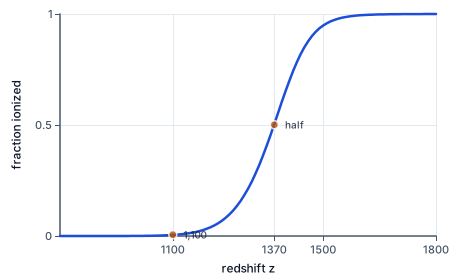
The figure plots hydrogen's ionized fraction from the Saha equation, against redshift from $800$ to $1{,}800$. Time runs from right to left. The fraction holds near one until about $z = 1{,}600$, then plunges, passing one half at $z \approx 1{,}370$ and falling below one percent by $z = 1{,}100$. The plunge spans a factor of only $1.5$ in temperature. The true recombination, slowed by trapped Lyman-alpha photons, follows a somewhat gentler curve shifted to lower redshift, but the narrowness of the transition is real.
Recombination temperatures are a few thousand kelvins, never the $158{,}000$ K that $kT = 13.6$ eV would suggest. Redshifts of recombination lie between about $1{,}000$ and $1{,}500$; an answer that equals the temperature means the division by $2.7255$ was skipped. Electron densities scale as $(1+z)^3$; mean free paths as $(1+z)^{-3}$, shrinking dramatically into the past. And photons are coupled when the mean free path is less than the Hubble distance, free when it is more.
When an ionized fraction is given, apply it to the electrons, not to the photons: the number of photons never changes during recombination, only the number of free electrons they can scatter from. A fraction of a thousandth multiplies the mean free path by a thousand, which is why decoupling follows so quickly once recombination is under way.
Because the last-scattering surface has a thickness, photons scattered there by moving plasma became slightly polarized. NASA's WMAP satellite, run from Goddard Space Flight Center in Greenbelt, Maryland, and later Planck and the South Pole Telescope and BICEP experiments at the Amundsen-Scott South Pole Station measured this polarization pattern.
Its fluctuations, a few microkelvins, line up with the temperature pattern exactly as decoupling at $z \approx 1{,}090$ predicts. A second, large-angle polarization signal comes from reionization: its strength gives Planck's optical depth $\tau = 0.054$, about $5$ percent of photons rescattered, placing the midpoint of reionization near $z \approx 7.7$.
In 1965 James Gunn and Bruce Peterson, at Caltech in Pasadena, California, predicted that even a little neutral hydrogen between galaxies would absorb all light just blueward of a quasar's Lyman-alpha line. Quasars at modest redshift showed no such trough: intergalactic hydrogen was ionized.
In 2001 the Sloan Digital Sky Survey found a quasar at $z = 6.28$ whose spectrum went black blueward of $121.6 \times 7.28 = 885$ nm. A neutral fraction of only one part in ten thousand suffices to do it. Quasars just past $z \approx 6$ thus mark the end of reionization, about a billion years after the beginning.
It is natural to expect atoms to form as soon as typical photons are too weak to break them. But with over a billion photons for every atom, even the tiny fraction in the blackbody's high-energy tail is enough to re-ionize every atom that forms, until the temperature is about a fortieth of $158{,}000$ K. The huge photon-to-baryon ratio, not the binding energy alone, sets the time of recombination.
A second slip is thinking the universe became transparent instantly everywhere at a single moment and then stayed so. Decoupling took tens of thousands of years, and the first stars later reionized the gas, which is now ionized but too thin to block the light.
Take $z = 1{,}090$. Multiply today's temperature by one plus z.
$T = 2.7255 \times 1{,}091 = 2{,}973.5\ \text{K}$
The temperature at decoupling.
Multiply by Boltzmann's constant in electron volts.
$kT = 8.617 \times 10^{-5} \times 2{,}973.5 = 0.2562\ \text{eV}$
A typical photon energy.
Divide 13.6 eV by kT.
$13.6 \div 0.2562 = 53.1$
Far below ionization.
Estimate the Boltzmann factor.
$e^{-53.1} \approx 9 \times 10^{-24}$
The tail fraction.
Multiply by photons per baryon.
$1.6 \times 10^9 \times 9 \times 10^{-24} \approx 10^{-14}$
Too few to ionize the atoms.
Take $z = 1{,}100$ and full ionization. Scale the electron density.
$n_e = 0.22 \times 1{,}101^3 = 2.94 \times 10^8\ \text{m}^{-3}$
Per cubic meter.
Multiply by the Thomson cross section.
$n_e \sigma_T = 2.94 \times 10^8 \times 6.652 \times 10^{-29} = 1.95 \times 10^{-20}\ \text{m}^{-1}$
Scatterings per meter.
Invert for the mean free path.
$\lambda = 5.12 \times 10^{19}\ \text{m}$
In meters.
Convert to kiloparsecs.
$\lambda = 5.12 \times 10^{19} \div (3.086 \times 10^{19}) = 1.66\ \text{kpc}$
About the size of a small galaxy.
Compare with the Hubble distance then.
$7{,}925 \div 1{,}101^{1.5} = 0.217\ \text{Mpc}$
130 times longer: still coupled.
At $z = 1{,}000$ the ionized fraction is $0.001$. Find the electron density.
$n_e = 0.22 \times 0.001 \times 1{,}001^3 = 2.2 \times 10^5\ \text{m}^{-3}$
A thousand times fewer.
Find the mean free path.
$\lambda = 2.213 \times 10^6 \div (0.001 \times 1{,}001^3) = 2.21\ \text{Mpc}$
Long.
Find the Hubble distance then.
$7{,}925 \div 1{,}001^{1.5} = 0.250\ \text{Mpc}$
Shorter.
Divide the two distances.
$2.21 \div 0.250 = 8.8$
Above one.
State the verdict.
$\text{traveling freely}$
The photons have decoupled.
Note how fast the change was.
$\text{a 1,000-fold fall in } x$
Within a factor of about 1.3 in redshift.
Divide by Boltzmann's constant.
$T = 0.25 \div (8.617 \times 10^{-5}) = 2{,}901\ \text{K}$
The temperature.
Divide by today's temperature.
$1 + z = 2{,}901 \div 2.7255$
The stretch factor.
State the redshift.
Hydrogen's ionization energy, $13.6$ eV, corresponds to $kT$ at about $158{,}000$ K. Why did hydrogen in the early universe stay ionized until it had cooled to a few thousand kelvins?
Complete the worked solution: at redshift $z = 1090$, find the background's temperature, its characteristic photon energy $kT$, and how many times $kT$ fits into hydrogen's ionization energy of $13.6$ eV.
Multiply today's temperature by one plus z.
$T =$ t $\text{K}$
Hotter in the past.
Multiply by Boltzmann's constant in electron volts.
$kT =$ k $\text{eV}$
A typical photon energy.
Divide 13.6 eV by that energy.
$13.6 \div kT =$ r
Near 40 or above, hydrogen recombines.
Put these stages of cosmic history in order, earliest first.
Number the steps in order (write the number in the box):
At redshift $z = 900$ a fraction $x = 0.01$ of hydrogen is ionized. With $0.22$ electrons per cubic meter today if all were free, and the Thomson cross section $6.652 \times 10^{-29}$ m², fill in the free-electron density and the photons' mean free path in kiloparsecs, using $\lambda = 2.213 \times 10^9 / (x(1+z)^3)$ kpc.
| value | |
|---|---|
| free electrons per cubic meter | |
| mean free path (kpc) |
If every electron were free, there would be $0.22$ free electrons per cubic meter today. During recombination a fraction $x = 0.9$ of them remain free. Write the free-electron density, per cubic meter, as a function of redshift $z$.
Answer:
At what redshift did the $2.7255$ K background have a characteristic photon energy $kT = 0.2$ eV? Take $k = 8.617 \times 10^{-5}$ eV per kelvin.
Answer:
A model gives hydrogen's ionized fraction as $x = 1$ at $z = 1100$. The photons' mean free path is $2.213 \times 10^6 / (x(1+z)^3)$ Mpc and the Hubble distance then is $7{,}925/(1+z)^{1.5}$ Mpc. Find the ratio of the two, and say whether the photons are still coupled to matter or traveling freely.
| mean free path over Hubble distance | the photons | |
|---|---|---|
| the model |
Lesson test: one question per skill, one attempt each, no hints. Your answers are checked when you submit.
If every electron were free, there would be $0.22$ free electrons per cubic meter today. During recombination a fraction $x = 0.1$ of them remain free. Write the free-electron density, per cubic meter, as a function of redshift $z$.
Answer:
You can follow the universe becoming transparent. Find how far below 13.6 eV the photons were at z = 1,090, and whether photons at z = 1,000 with x = 0.001 travel freely.
20. Your turn: at what redshift did the background have $kT = 0.25$ eV?, step 3
$z = 1{,}063.5$
Just after decoupling.