Back to the on-screen lesson ·
Small contrasts grow as delta proportional to a in the matter era; ordinary matter alone could grow from 10^-5 only to 10^-2, so dark matter's head start was needed; the 147-Mpc sound horizon subtends 0.6 degrees, showing space is flat.
Paper packet. Every task here also exists on screen, where it is checked automatically; answers written on paper are not assessed by Nydus. When you are back at a device, enter your answers there.
By the end of this lesson you will be able to explain how small density fluctuations grow into galaxies and clusters, and what the CMB's anisotropies reveal.
You know the eras of radiation, matter and dark energy, that ordinary matter was coupled to photons until $z \approx 1{,}090$, and that dark matter outweighs ordinary matter about five to one. This lesson explains how galaxies and clusters grew out of tiny density variations, and how the background's ripples record those variations and the geometry of space.
| Term | What it means |
|---|---|
| Density contrast (delta) | The fractional excess density of a region, (rho - mean) / mean. |
| Linear growth | Growth of a small contrast, delta proportional to a in the matter era. |
| Gravitational instability | The tendency of a slightly denser region to pull in more matter and grow denser. |
| Sound horizon | How far sound traveled in the early plasma before decoupling, 147 Mpc comoving. |
| Acoustic peaks | Peaks in the background's spot sizes, set by sound waves at decoupling. |
| Hierarchical formation | Small structures forming first and merging into larger ones. |
A region slightly denser than average pulls in matter and grows denser still. In the matter era a small density contrast grows as
$$\delta \propto a = \frac{1}{1+z},$$
but hardly at all during the radiation era, and it stalls once dark energy dominates. Ordinary matter, smoothed by photon pressure until decoupling at $\delta \sim 10^{-5}$, could reach only $\sim 10^{-2}$ by now; dark matter, growing since equality, supplied the deeper wells. The background's spots record the variations at decoupling, and the sound horizon, $147$ Mpc seen from $13{,}900$ Mpc, subtends $0.6$ degrees, the size flat space predicts.
Another way: picture
Picture a slightly uneven field after rain. Water runs toward the low spots, which get deeper as they collect it, and the ridges dry out. Gravity does the same with matter: the slightly denser places collect more and more, while the emptier places empty further, until the field is a pattern of deep pools and dry voids.
Another way: steps
A region with density slightly above average has a slightly stronger pull, so the matter around it falls in and its contrast grows. Solving the equations for a small contrast in a matter-dominated universe gives $\delta \propto a$: as the universe doubles in size, every small contrast doubles. The expansion fights the collapse, which is why growth is a power law rather than the exponential growth one would find in a static universe. Once a region's contrast nears one, linear theory fails, the region stops expanding with the universe, and it collapses into a bound halo.
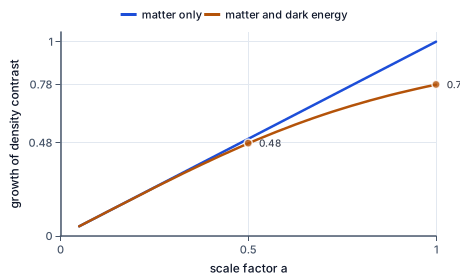
During the radiation era, the rapid expansion driven by radiation outpaces the weak pull of the small matter contrasts, and they grow only logarithmically, an effect worked out by Peter Meszaros in 1974. Growth begins in earnest at matter-radiation equality. In the dark energy era the accelerating expansion again outpaces gravity, and growth stalls: today's contrasts are about $78$ percent of what a matter-only universe would have produced, as the figure shows. The window for building structure is the long matter era in between.
Before decoupling, ordinary matter was locked to photons, whose pressure prevented its contrasts from growing; it could only oscillate. The background shows those contrasts at about $10^{-5}$. Growing as $a$ from $z = 1{,}090$, they would reach only about $10^{-2}$ today, nowhere near the contrasts of a million or more inside galaxies. Dark matter, which ignores photons, began growing at equality, $z \approx 3{,}400$, three times longer, and its clumps were deeper by decoupling. Ordinary matter then fell into these ready-made wells within a short time, catching up.
In a universe of cold dark matter, small regions reach a contrast of one first, because the initial variations are slightly larger on small scales. The first halos, of about a million solar masses, collapsed at $z \approx 20$ to $30$ and hosted the first stars. Galaxies grew by merging and by accreting gas, and the largest structures, clusters of $10^{15}$ solar masses, are still assembling today. Computer simulations such as Millennium and IllustrisTNG, following billions of particles, reproduce the cosmic web of filaments, walls and voids seen in redshift surveys.
Before decoupling, the photon-baryon plasma behaved as a fluid with a sound speed near $c/\sqrt 3$. Every initial overdensity launched a spherical sound wave that spread out until decoupling froze it, at a comoving radius of $147$ Mpc, the sound horizon. Gravity of the dark matter pulled the plasma in while photon pressure pushed it out, so the plasma oscillated. Regions caught at maximum compression or rarefaction at decoupling appear as the strongest spots, at a series of angular scales: the acoustic peaks.
The sound horizon is a standard ruler of known comoving length, $147$ Mpc, at a known comoving distance, $13{,}900$ Mpc. In flat space it subtends $147/13{,}900 = 0.0106$ radians, about $0.6$ degrees, corresponding to a first acoustic peak at multipole $\ell \approx 220$. In a closed universe light rays from its edges converge, making it look larger; in an open one, smaller. The measured angle matches flat space to a fraction of a percent, the main reason cosmologists conclude $\Omega_{\text{total}} = 1$.
The relative heights of the peaks weigh the components. Ordinary matter adds inertia to the oscillating plasma, deepening compressions relative to rarefactions, so odd-numbered peaks rise above even-numbered ones by an amount that gives $\Omega_b h^2$. Dark matter sets the depth of the wells and the timing of the oscillations, fixing $\Omega_c h^2$. Planck's measurement of the first seven peaks gives both to about one percent, agreeing with nucleosynthesis on the baryons, and showing dark matter at decoupling, long before galaxies existed.
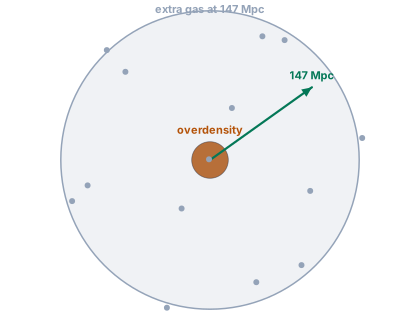
The sound waves left a mark in matter as well as in light. Each initial overdensity ended up with a shell of extra ordinary matter at a radius of $147$ Mpc, frozen in at decoupling, and galaxies later formed slightly more often at that separation. Measuring the clustering of millions of galaxies reveals a small bump in the number of galaxy pairs $147$ Mpc apart, the baryon acoustic scale, first detected in 2005 by the Sloan Digital Sky Survey and the 2dF survey in Australia.
Because the same ruler appears in the background at $z = 1{,}090$ and in galaxies at $z = 0.1$ to $2.3$, it maps the expansion history across cosmic time: its angle on the sky gives the angular-diameter distance at each redshift, and its length along the line of sight gives the expansion rate. That is how DESI tests whether dark energy is constant, and why the background and galaxy surveys together pin the universe's contents so tightly.
The scene follows one early overdensity. A sound wave in the plasma carried ordinary matter outward from it until decoupling froze the wave at a comoving radius of $147$ Mpc, leaving a shell of extra gas there while the dark matter stayed at the center. Galaxies later formed a little more often at the center and on the shell. Summed over every overdensity in the universe, the shells show up as a small excess of galaxy pairs $147$ Mpc apart.
The figure compares the linear growth of a small contrast in two flat universes, both normalized to grow as the scale factor early on. With matter only, growth follows the straight line, reaching $1$ today. With $70$ percent dark energy the curves agree until about $a = 0.3$, then the dark-energy curve lags, reaching $0.48$ at $a = 0.5$ and $0.78$ today. Measuring how fast clusters have grown over the last few billion years is therefore a test of dark energy independent of distances.
In the matter era a contrast's growth equals the growth of the scale factor: from $z = 1{,}100$ to today, a factor of $1{,}101$, not its square. A contrast must reach one at a positive redshift for a structure to have formed by now. Sound-horizon angles are fractions of a degree; an answer near $0.01$ is still in radians. And a measured angle larger than predicted means closed space, smaller means open, a direction easy to reverse.
Remember too that linear growth is only a guide once a contrast passes one: after that, the region has stopped expanding and collapsed, and its true density is far higher than the linear value suggests.
In 1998 the BOOMERanG balloon, launched from McMurdo Station in Antarctica and carried around the continent by polar winds for ten days, mapped a patch of the background at high resolution. Teams led from Caltech and the University of Rome found hot and cold spots mostly about one degree across, a first peak near $\ell \approx 200$.
A closed universe with $\Omega = 2$ would have put the peak near $\ell \approx 155$ and an open one with $\Omega = 0.3$ near $\ell \approx 400$. The measurement gave $\Omega_{\text{total}} \approx 1.0$ within about ten percent, the first direct evidence for flat space, and, combined with $\Omega_m \approx 0.3$, strong support for the newly discovered dark energy.
The Millennium Simulation, run in 2005 at the Max Planck Society's supercomputing center in Garching, Germany, followed ten billion dark-matter particles in a cube about $700$ Mpc across from $z = 127$ to today. Its cosmic web of filaments and voids matched the patterns of galaxies in the Sloan Digital Sky Survey from Apache Point Observatory in New Mexico.
Starting contrasts of a few times $10^{-3}$ at $z = 127$ grew roughly as $a$, by about a factor of $100$ after allowing for dark energy, to reach one and collapse in the dense regions. The same physics, with no further adjustment, explains structure from galaxy halos to superclusters.
Galaxies and clusters did not start as large lumps: the early universe was smooth to one part in $100{,}000$, and gravity amplified those tiny variations over billions of years. Ordinary matter alone could not have done it, because photon pressure held it smooth until decoupling, leaving too little time; dark matter, unaffected by photons, had already formed the wells that ordinary matter fell into.
A second slip is thinking the largest structures formed first. In our universe small halos collapse first and larger ones are built by merging.
At decoupling the contrast is $10^{-5}$. Find the growth of the scale factor since.
$1 + z = 1{,}091$
From z = 1,090 to today.
Multiply the contrast.
$\delta_0 = 10^{-5} \times 1{,}091 = 0.011$
Linear theory.
Compare with what a galaxy needs.
$\delta \approx 1 \text{ to collapse}$
A hundred times short.
Allow for dark energy's slowing.
$0.011 \times 0.78 = 0.0086$
Even shorter.
Conclude what is needed.
$\text{dark matter with a head start}$
Deeper wells by decoupling.
A region has $\delta = 0.002$ at $z = 1{,}100$. Find the constant.
$\delta(1+z) = 0.002 \times 1{,}101 = 2.202$
Constant in the matter era.
Write the contrast as a function of redshift.
$\delta = 2.202 \div (1+z)$
Linear growth.
Set it equal to one.
$1 + z = 2.202$
Collapse threshold.
Solve for the redshift.
$z = 1.202$
About five billion years after the beginning.
Find its linear contrast today.
$\delta_0 = 2.202$
Well past collapse: a bound object.
Take $r_s = 147$ Mpc and $D = 13{,}900$ Mpc. Divide.
$\theta = 147 \div 13{,}900 = 0.01058\ \text{rad}$
Both comoving.
Convert to degrees.
$\theta = 0.01058 \times 57.3 = 0.606^\circ$
About the Moon's size.
Find the size at decoupling itself.
$147 \div 1{,}091 = 0.135\ \text{Mpc}$
135 kpc then.
Suppose a closed universe brought the distance down to $10{,}000$ Mpc.
$147 \div 10{,}000 \times 57.3 = 0.842^\circ$
Spots look larger.
Compare with the measurement.
$\text{measured } \approx 0.6^\circ$
Flat space fits.
Note the multipole.
$\ell \approx 220$
The first peak's position.
Find the growth of the scale factor.
$1 + 1{,}100 = 1{,}101$
From then to now.
Multiply the contrast by it.
$\delta_0 = 0.001 \times 1{,}101$
Linear growth.
State the contrast.
At decoupling, ordinary matter varied in density by about one part in $100{,}000$. In the matter era a small contrast grows in proportion to the scale factor. Why could ordinary matter alone not have formed today's galaxies?
Complete the worked solution: dark matter has contrast $0.0002$ at matter-radiation equality, $z = 3400$, and grows in proportion to the scale factor afterward. Find its growth to decoupling at $z = 1{,}090$, its contrast then, and its linear contrast today.
Divide one plus z at equality by one plus z at decoupling.
$\text{growth} =$ g
The dark matter's head start.
Multiply the starting contrast by that growth.
$\delta_{\text{dec}} =$ c
While ordinary matter was held smooth.
Multiply by 1,091 for the growth since.
$\delta_0 =$ t
Linear theory, ignoring dark energy.
Put the stages of structure formation in order, earliest first.
Number the steps in order (write the number in the box):
In a matter-dominated universe a region has density contrast $\delta = 0.002$ at $z = 1100$. Assuming linear growth $\delta \propto a$ throughout, fill in its contrast today and the redshift at which it reached $1$.
| value | |
|---|---|
| contrast today | |
| redshift when it reached 1 |
In a matter-dominated universe a region has contrast $\delta = 0.003$ at $z = 900$, and in linear theory $\delta$ grows in proportion to the scale factor. Write its contrast as a function of redshift $z$.
Answer:
Sound waves in the early plasma traveled a comoving distance of $147$ Mpc before decoupling. The last-scattering surface lies at a comoving distance of $13900$ Mpc. In flat space, what angle does the sound horizon subtend on the sky, in degrees?
Answer: degrees
In flat space the background's sound horizon should subtend $0.60$ degrees. A balloon experiment measures $0.45$ degrees. Find the ratio of measured to predicted angle, and the geometry it implies, treating anything within $5$ percent of $1$ as flat.
| measured over predicted | geometry | |
|---|---|---|
| the measurement |
Lesson test: one question per skill, one attempt each, no hints. Your answers are checked when you submit.
In a matter-dominated universe a region has contrast $\delta = 0.003$ at $z = 900$, and in linear theory $\delta$ grows in proportion to the scale factor. Write its contrast as a function of redshift $z$.
Answer:
You can follow structure from ripples to galaxies. Find when a region with delta = 0.002 at z = 1,100 collapses, and the angle of a 147-Mpc sound horizon at 13,900 Mpc.
22. Your turn: a region has contrast $0.001$ at $z = 1{,}100$. What is its linear contrast today?, step 3
$\delta_0 = 1.101$
Just past collapse.