Back to the on-screen lesson ·
Space is filled with a 2.7255 K blackbody, 411 photons per cubic centimeter, cooling as T0 (1 + z) and staying thermal because every wavelength stretches alike; it is uniform to parts in 100,000 apart from a 3.36 mK dipole from our 370 km/s motion.
Paper packet. Every task here also exists on screen, where it is checked automatically; answers written on paper are not assessed by Nydus. When you are back at a device, enter your answers there.
By the end of this lesson you will be able to explain the cosmic microwave background's blackbody spectrum and why its temperature falls as the universe expands.
You know Planck's law and Wien's law from Astrophysics, that radiation density falls as $a^{-4}$, and that redshift stretches every wavelength by $1 + z$. This lesson meets the most important single observation in cosmology, the microwave background that fills all of space, and reads what its spectrum, its temperature and its tiny variations tell us.
| Term | What it means |
|---|---|
| Cosmic microwave background (CMB) | Blackbody radiation at 2.7255 K filling all of space, released about 380,000 years after the beginning. |
| Blackbody | Radiation in thermal equilibrium, whose spectrum depends only on temperature. |
| Dipole | A pattern warmer in one direction and cooler in the opposite one, caused by our motion. |
| Anisotropy | A variation with direction; the background's are a few parts in 100,000. |
| FIRAS | The instrument on NASA's COBE satellite that measured the background's spectrum. |
| Photon-to-baryon ratio | About 1.6 billion photons for every proton or neutron. |
In every direction the sky glows with microwaves whose spectrum is a blackbody at $T_0 = 2.7255$ K. It is relic radiation from when the universe was hot and dense, and as space expands it cools as
$$T = T_0(1 + z),$$
staying a perfect blackbody because every wavelength stretches by the same factor. It holds $n = 20.29\,T^3$ photons per cubic centimeter, $411$ today. Its temperature is the same in all directions to a few parts in $100{,}000$, apart from a dipole of $3.36$ mK from our motion, $\Delta T/T = v/c$.
Another way: picture
Picture standing in a fog that glows faintly and evenly in every direction. You are not seeing the fog from outside; you are inside it, and so is everyone else, wherever they stand. The microwave background is like that glow: it is not coming from one place where something exploded, but from everywhere at once.
Another way: steps
In 1964 Arno Penzias and Robert Wilson, at Bell Telephone Laboratories in Holmdel, New Jersey, found an unexplained hiss in a horn antenna built for satellite communication, the same in every direction and at every time of day. A few miles away at Princeton, Robert Dicke's group was building a radiometer to look for exactly such radiation, predicted from a hot early universe. The two groups published side by side in 1965. The discovery ended the steady-state theory, which had no way to produce a universe-filling blackbody, and Penzias and Wilson shared the 1978 Nobel Prize in Physics.
A blackbody's spectrum depends only on its temperature: Planck's law gives the number of photons per unit volume in each wavelength interval. Expansion stretches every wavelength by the same factor $a$, so the interval $[\lambda, \lambda + d\lambda]$ moves to $[a\lambda, a\lambda + a\,d\lambda]$, and the volume grows by $a^3$. Put both into Planck's law and the result is exactly a Planck spectrum at temperature $T/a$. No collisions are needed: once in equilibrium, the radiation stays thermal forever, simply cooling. This is why $T = T_0(1+z)$ holds precisely.
In 1990 the FIRAS instrument on NASA's Cosmic Background Explorer, COBE, compared the sky with an onboard blackbody and found no difference to within $50$ parts per million across the peak of the spectrum. The data points sat so exactly on the curve that the error bars were smaller than the line's width when John Mather first showed them. Any large release of energy after the first few months, from decaying particles or early stars, would have distorted it. Mather shared the 2006 Nobel Prize in Physics for the measurement.
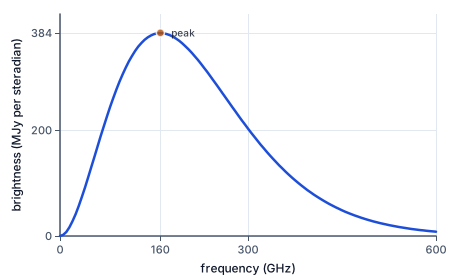
Wien's law, $\lambda_{\max} = 2{,}898\ \mu\text{m K}/T$, puts the peak of the brightness per unit wavelength at $1.06$ mm for $2.7255$ K. The figure plots brightness per unit frequency instead, which peaks at $160$ GHz, a wavelength of $1.87$ mm. Both describe the same spectrum: the peak depends on whether one counts per wavelength or per frequency interval. Either way, the peaks scale as $1/T$, so at $z = 1{,}100$ the background peaked near one micrometer, in the near infrared, close to visible light.
A blackbody at temperature $T$ holds $20.29\,T^3$ photons per cubic centimeter, $411$ at $2.7255$ K. Ordinary matter averages about $0.25$ protons and neutrons per cubic meter, so there are about $1.6$ billion photons for every baryon. Both numbers fall as $a^{-3}$, so the ratio has stayed fixed since the first minutes. That huge ratio controls the thermal history: it is why recombination waited until $3{,}000$ K, and why nucleosynthesis waited until well below the binding energy of deuterium.
The background's temperature is the same in every direction to about one part in $100{,}000$ once one pattern is removed: a dipole, $3.36$ mK warmer toward the constellation Leo and as much cooler in the opposite direction. It is the Doppler shift of our own motion, $v = c\,\Delta T/T = 370$ km/s, the Sun's orbit around the Milky Way combined with the Local Group's fall toward neighboring superclusters. The background defines a natural rest frame for the universe, the frame in which it looks uniform.
The background does not come from a place; it fills space. At $z = 1{,}100$ the whole universe was a hot, opaque plasma, and the light released then, from every point, has been crossing space ever since. The photons reaching us today left a shell of that plasma about $13.8$ billion years ago that is now about $46$ billion light-years away. Observers in any other galaxy see their own shell, at the same temperature. There is no center and no outside from which the background is seen.
The background's energy density follows the Stefan-Boltzmann law for radiation, $u = aT^4$ with $a = 7.566 \times 10^{-16}$ J m⁻³ K⁻⁴, about $4.2 \times 10^{-14}$ J/m³ today, or $0.26$ electron volts per cubic centimeter. Dividing by $c^2$ and by the critical density gives its share, $\Omega_\gamma \approx 5.4 \times 10^{-5}$: a tiny fraction of the universe's energy today. Because $u$ grows as $(1+z)^4$ while matter grows only as $(1+z)^3$, the background's share was once far larger, and before matter-radiation equality near $z = 3{,}400$ radiation, with its accompanying neutrinos, governed the expansion. The same background that is now a faint hiss once ruled the universe.
Remove the dipole and the emission of the Milky Way, and the background shows hot and cold spots differing by about $\pm 100$ microkelvins, a few parts in $100{,}000$. They map the density variations in the plasma at release: slightly denser regions, slightly hotter or cooler depending on scale. Their typical size, about one degree, encodes the geometry of space, and their detailed pattern the amounts of ordinary matter, dark matter and dark energy. The unit on structure returns to them; for now, note that a universe uniform to this precision is what lets a single temperature describe it.
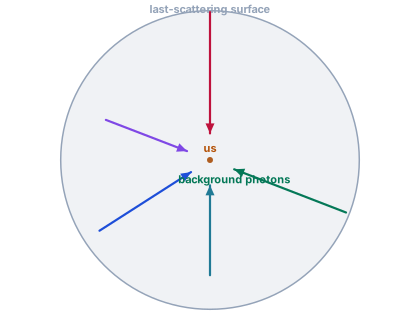
The scene puts us at the center of the last-scattering surface, the sphere from which the background photons now arriving last scattered. They come in from every direction at once with the same temperature, which is why the sky glows evenly. The sphere is not a wall around the universe. It is simply the set of places whose light, released when the universe became transparent, is reaching us now; an observer in another galaxy sees a sphere of its own.
The figure plots the background's brightness against frequency as a blackbody at $2.7255$ K. It rises from zero at low frequency, where it follows the long-wavelength form brightness $\propto \nu^2 T$, peaks at about $384$ megajanskys per steradian near $160$ GHz, and falls off exponentially above $300$ GHz. The COBE data, if plotted, would sit on the line with error bars invisible at this scale. Ground-based radio measurements extend the agreement to wavelengths of tens of centimeters.
A temperature in the past must be larger than $2.7$ K, never smaller: dividing by $1 + z$ is the common slip. Photon number density goes as $(1+z)^3$, not the fourth power that applies to energy density. A dipole speed for an observer in a galaxy should be a few hundred km/s; a value near a thousand means the amplitude was not divided by the temperature. And Wien's law in micrometers uses $2{,}898$, in millimeters $2.898$.
When testing a measured temperature at high redshift, compare the difference from the prediction with the measurement's uncertainty, not with the temperature itself: a one-kelvin miss is small at $10$ K only if the uncertainty is near a kelvin too.
NASA's Cosmic Background Explorer was built and run from Goddard Space Flight Center in Greenbelt, Maryland, and launched in 1989. Its FIRAS instrument, led by John Mather, measured the spectrum; its DMR instrument, led by George Smoot at Lawrence Berkeley National Laboratory, found the first anisotropies, about $30$ microkelvins.
FIRAS fixed the temperature at $2.725$ K, later refined to $2.7255 \pm 0.0006$ K, and limited any departure from a blackbody to $50$ parts per million. Mather and Smoot shared the 2006 Nobel Prize in Physics. The perfect spectrum rules out every alternative in which the background was produced gradually, by starlight scattered by dust or by anything else.
If $T = T_0(1+z)$, molecules in a distant gas cloud are bathed in a warmer background than molecules here. Carbon monoxide and ionized carbon in clouds seen against quasars have levels excited by it, and their populations give the temperature there.
Measurements with the Very Large Telescope in Chile and other observatories find temperatures of roughly $7$ to $11$ K for clouds between $z = 1.7$ and $z = 3$, in line with predictions of $7.4$ to $10.9$ K. Nearer clusters, through the Sunyaev-Zeldovich effect, and a water cloud at $z = 6.3$, seen in absorption against the background, extend the agreement. These checks test the expansion directly: a static universe would show $2.7$ K everywhere, at every redshift.
The Big Bang was not an explosion at a point, and the background is not its flash seen from a distance. The early universe was hot and dense everywhere at once, and the background was released everywhere at once; it fills all of space, and observers in every galaxy see it coming equally from all directions. There is no outside to view it from.
A second slip is thinking the background must have been reheated to stay a blackbody. Expansion alone keeps its spectrum exactly thermal, only cooler.
Take $z = 1{,}100$. Multiply today's temperature by one plus z.
$T = 2.7255 \times 1{,}101 = 3{,}000.8\ \text{K}$
The temperature at release.
Apply Wien's law in micrometers.
$\lambda_{\max} = 2{,}898 \div 3{,}000.8 = 0.966\ \mu\text{m}$
Near infrared.
Compare with today's peak.
$0.966 \times 1{,}101 = 1{,}063\ \mu\text{m}$
Stretched to a millimeter.
Find the photon density then.
$411 \times 1{,}101^3 = 5.5 \times 10^{11}\ \text{per cm}^3$
A billion times denser.
Note why it was opaque.
$\text{enough energetic photons to ionize hydrogen}$
The subject of the next lesson.
The dipole is $3.36$ mK. Convert to kelvins.
$\Delta T = 0.00336\ \text{K}$
The amplitude.
Divide by the mean temperature.
$0.00336 \div 2.7255 = 0.001233$
The fractional shift.
Multiply by the speed of light.
$v = 0.001233 \times 299{,}792 = 369.6\ \text{km/s}$
Our speed.
Subtract the Sun's orbital speed around the galaxy, roughly.
$\text{about 230 km/s, in another direction}$
Not a simple subtraction: vectors.
Conclude about the Local Group.
$\text{about 600 km/s toward Hydra-Centaurus}$
The galaxy's own motion.
Find the photon density from the temperature.
$n_\gamma = 20.29 \times 2.7255^3$
The blackbody formula.
Evaluate the photon density.
$n_\gamma = 410.7\ \text{per cm}^3$
Today.
Convert to per cubic meter.
$4.107 \times 10^8\ \text{per m}^3$
A million cubic centimeters per cubic meter.
Take the baryon density.
$n_b = 0.25\ \text{per m}^3$
From nucleosynthesis and the background.
Divide the two densities.
$4.107 \times 10^8 \div 0.25 = 1.6 \times 10^9$
Photons per baryon.
Note that it never changes.
$\text{both fall as } a^{-3}$
Fixed since the first minutes.
Find one plus z.
$1 + 9 = 10$
The stretch factor.
Multiply today's temperature by it.
$T = 2.7255 \times 10$
Hotter in the past.
State the temperature.
The background radiation was a blackbody at about $3{,}000$ K when it was released, and has scarcely interacted with matter since. Why is it still a blackbody today, at $2.7$ K?
Complete the worked solution: the background today is at $2.725$ K with $411$ photons per cubic centimeter. Find its temperature and photon density at redshift $z = 1$.
Multiply today's temperature by one plus z.
$T =$ t $\text{K}$
Wavelengths were shorter.
Multiply today's density by one plus z, cubed.
$n =$ n $\text{per cm}^3$
The same photons in a smaller volume.
Check the two together.
$n \propto T^3$
As for any blackbody.
Match each feature of the microwave background to what it reveals.
| the early universe was hot, dense and in equilibrium | the universe is the same everywhere on large scales | the Milky Way moves relative to the background | small density variations that grew into galaxies | |
|---|---|---|---|---|
| its blackbody spectrum | ||||
| the same temperature in every direction | ||||
| one hemisphere 3.36 mK warmer than the other | ||||
| spots warmer and cooler by tens of microkelvins |
The background is at $2.7255$ K today. Fill in its temperature, and the wavelength at which its spectrum peaked, at redshift $z = 1$.
| value | |
|---|---|
| temperature (K) | |
| peak wavelength (micrometers) |
A blackbody at temperature $T$ holds $20.29\,T^3$ photons per cubic centimeter. A universe's background is at $3$ K today. Write its photon number density, per cubic centimeter, as a function of redshift $z$.
Answer:
An observer finds the $2.7255$ K background warmer by $2$ mK in one direction and cooler by the same amount in the opposite direction. How fast is the observer moving relative to the background, in km/s?
Answer: km/s
Molecules in a gas cloud at $z = 3.03$, seen against a quasar, are excited by the background there; their populations give a background temperature of $11.2 \pm 0.9$ K. Find the temperature $T_0(1+z)$ predicts with $T_0 = 2.7255$ K, and judge the measurement, treating anything within two uncertainties as consistent.
| predicted temperature (K) | verdict | |
|---|---|---|
| the cloud |
Lesson test: one question per skill, one attempt each, no hints. Your answers are checked when you submit.
A blackbody at temperature $T$ holds $20.29\,T^3$ photons per cubic centimeter. A universe's background is at $5$ K today. Write its photon number density, per cubic centimeter, as a function of redshift $z$.
Answer:
You can read the background's thermometer. Find its temperature and peak wavelength at z = 1,100, and our speed from a 3.36 mK dipole.
23. Your turn: what was the background's temperature at $z = 9$?, step 3
$T = 27.26\ \text{K}$
Ten times warmer.