Back to the on-screen lesson ·
Flat rotation curves (M = v^2 r / G), cluster speeds (M = 3 sigma^2 R / G), lensing and the background's ripples all weigh more matter than shines; Omega_m = 0.315 against Omega_b = 0.049 means about 84 percent of matter is not made of atoms.
Paper packet. Every task here also exists on screen, where it is checked automatically; answers written on paper are not assessed by Nydus. When you are back at a device, enter your answers there.
By the end of this lesson you will be able to weigh the evidence for dark matter from rotation curves, cluster dynamics, gravitational lensing and the CMB.
You met rotation curves and the virial theorem in the Astrophysics course's galaxy unit, and from the last lesson you know nucleosynthesis fixes ordinary matter at $\Omega_b \approx 0.049$. This lesson gathers the cosmological case for dark matter: four kinds of evidence, on scales from single galaxies to the whole observable universe, that all point to the same unseen, non-atomic mass.
| Term | What it means |
|---|---|
| Dark matter | Matter that gravitates but neither emits nor absorbs light, about 84 percent of all matter. |
| Rotation curve | Orbital speed against distance from a galaxy's center. |
| Mass-to-light ratio | Mass divided by luminosity in solar units; about 1 to 10 for stars, hundreds for clusters. |
| Virial mass | A system's mass from the speeds of its members, M = 3 sigma^2 R / G. |
| Gravitational lensing | The bending of light by mass, which weighs matter whether it shines or not. |
| Einstein radius | The angular radius of the ring a lens makes of a source directly behind it. |
Every gravity-based measurement of mass finds more than is seen:
The last comparison says about $84$ percent of matter is not made of atoms at all.
Another way: picture
Picture watching dancers spin on a dark stage where only some of them wear lights. The lit dancers whirl as though held by partners you cannot see, and when two groups pass through each other, the lit costumes snag and slow while the invisible partners glide straight on. You never see the partners, but you can weigh them by how they pull.
Another way: steps
In 1933 Fritz Zwicky, at Caltech in Pasadena, measured the speeds of galaxies in the Coma cluster. Their spread, about $1{,}000$ km/s, needs far more mass to hold the cluster together than its galaxies' light implies. The virial theorem gives $M \approx 3\sigma^2 R/G$ for a line-of-sight dispersion $\sigma$: with $\sigma = 1{,}000$ km/s and $R = 2$ Mpc, $1.4 \times 10^{15}$ solar masses. Clusters shine with a few trillion suns, so their mass-to-light ratios are in the hundreds, while stars have ratios of one to ten.
In the 1970s Vera Rubin and Kent Ford, at the Carnegie Institution in Washington, D.C., measured how fast gas orbits in spiral galaxies. Far beyond the visible disk, where the enclosed mass should stop growing and speeds should fall as $1/\sqrt{r}$, the speeds stayed flat. A flat curve means $M(r) = v^2 r/G$ keeps rising in proportion to $r$. Radio observations of neutral hydrogen extend the curves to several times the stars' radius. Each galaxy sits in a roughly spherical halo of dark matter many times its visible mass.
Mass bends light whether or not the mass shines. A cluster in front of more distant galaxies distorts them into arcs, and their positions give the mass inside. For a source directly behind a compact mass, the image is a ring of angular radius $\theta_E = \sqrt{(4GM/c^2)D_{LS}/(D_LD_S)}$, the Einstein radius; giant arcs around clusters sit tens of arcseconds out, implying $10^{14}$ to $10^{15}$ solar masses. Lensing masses agree with the virial masses and with masses from the hot gas, three independent methods all exceeding the visible matter many times.
Clusters contain more ordinary matter in hot gas, at tens of millions of kelvins and glowing in X-rays, than in stars, typically six to ten times as much. Adding it all up, ordinary matter in clusters is about one sixth of the total mass, matching the cosmic ratio $\Omega_b/\Omega_m \approx 0.16$. The gas's temperature itself weighs the cluster: hot gas would escape unless held by a deep gravitational well, and the well's depth matches the lensing mass.
In the cluster 1E 0657-56, two clusters collided about $150$ million years ago at some $4{,}500$ km/s. Their hot gas, which collides like any fluid, slowed and piled up in the middle, glowing in X-rays. Their galaxies, small and widely spaced, passed through. Lensing maps, published in 2006, show the mass concentrated around the galaxies, not the gas. Since the gas holds most of the ordinary matter, most of the mass must be something else, and something that passes through itself with little or no collision, as dark matter particles would.
The cosmic background's pattern of hot and cold spots depends on how ordinary matter, which feels photon pressure, and dark matter, which does not, behaved before decoupling. The relative heights of its acoustic peaks give $\Omega_b h^2 = 0.0224$ and $\Omega_c h^2 = 0.120$ for cold dark matter. The baryon value matches nucleosynthesis, from an entirely different era. Together they say dark matter outweighs ordinary matter by about $5.4$ to $1$, and that it existed, not made of atoms, $380{,}000$ years after the beginning.
Dark matter cannot be ordinary matter in dim form: faint stars, planets and black holes made from stars all formed from baryons, which nucleosynthesis caps at $\Omega_b \approx 0.05$. Microlensing surveys have also ruled out compact objects of planetary to stellar mass as most of the halo. Neutrinos have mass but move too fast to clump into galaxies. Leading candidates are new particles: weakly interacting massive particles, axions and others, sought in underground detectors and at colliders, so far without a detection. Dark matter is also not dark energy: it clumps and pulls, while dark energy is smooth and pushes the expansion.
Every piece of evidence infers mass from gravity, so an alternative is that gravity itself behaves differently at very low accelerations. Mordehai Milgrom's Modified Newtonian Dynamics, proposed in 1983, fits individual galaxy rotation curves remarkably well with no dark matter, using one new constant acceleration. It struggles elsewhere: clusters still need extra unseen mass, the Bullet Cluster's lensing peaks sit away from the ordinary matter that modified gravity would follow, and the background's acoustic peaks need a component that does not feel photon pressure before decoupling.
Separating what the data establish from what they leave open matters here. The data establish that gravity, as we understand it, requires about five times more matter than the atoms provide, on every scale tested. They do not yet establish what that matter is, and a modified gravity that also explains clusters and the background has not been ruled out by logic, only by the failure so far of any version to fit everything at once.
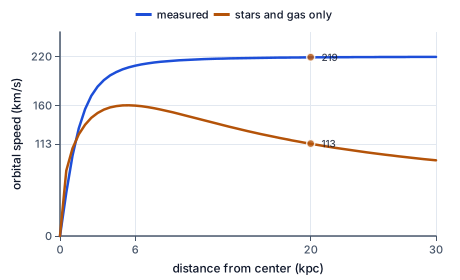
The figure compares a spiral galaxy's measured rotation curve with the curve its stars and gas alone would produce. Both rise near the center, where visible matter dominates. Beyond about $6$ kpc the visible curve falls, to $113$ km/s at $20$ kpc and $93$ at $30$, as Kepler predicts once the light runs out, while the measured curve stays near $220$. At $20$ kpc the enclosed mass is $(220/113)^2 \approx 3.8$ times the visible mass: about three quarters of it is dark, and the share grows outward.
Enclosed mass grows linearly with radius for a flat rotation curve: doubling $r$ doubles $M$, never quadruples it. Cluster masses come out near $10^{14}$ to $10^{15}$ solar masses; a value three times smaller means the factor of three for the line of sight was dropped. Einstein radii of massive clusters are tens of arcseconds. A dark fraction must lie between zero and one, and should grow with radius. When judging a claim that dark matter is ordinary, compare it with the nucleosynthesis limit on atoms, not with how bright the matter is.
Vera Rubin and Kent Ford, at the Carnegie Institution's Department of Terrestrial Magnetism in Washington, D.C., used an image-tube spectrograph to measure gas speeds across the Andromeda galaxy and then dozens of spirals through the 1970s. The curves stayed flat at $200$ to $300$ km/s as far out as they could measure.
For a flat curve at $250$ km/s out to $30$ kpc, $M = 250^2 \times 30 / (4.301 \times 10^{-6}) = 4.4 \times 10^{11}$ solar masses, several times the stars. The Vera C. Rubin Observatory in Chile, named for her, began its survey in 2025 and will map dark matter through the weak lensing of billions of galaxies.
If dark matter is a particle, the Milky Way's halo sends billions of them through every square meter each second. The LUX-ZEPLIN experiment, a tank of seven tonnes of liquid xenon nearly a mile underground at the Sanford Underground Research Facility in Lead, South Dakota, watches for the rare recoil of a xenon nucleus struck by one.
None has been seen, which rules out many once-favored weakly interacting particles. The ADMX experiment at the University of Washington in Seattle searches instead for axions, much lighter particles that would turn into microwave photons in a strong magnetic field. The astronomical evidence is secure; the particle physics is still open.
It is tempting to suppose the missing mass is faint stars, planets or cold gas that simply do not shine much. But every such object is made of atoms, and nucleosynthesis and the background together cap ordinary matter at about one sixth of the total. Most of the matter must be something not made of atoms, and the Bullet Cluster shows it does not collide like gas.
Dark matter is also not dark energy. Dark matter clumps around galaxies and pulls, slowing the expansion; dark energy is smooth and drives the expansion to speed up. They share only the word dark.
A cluster has $\sigma = 1{,}000$ km/s and $R = 2$ Mpc. Square the dispersion.
$\sigma^2 = 10^6\ (\text{km/s})^2$
In km/s squared.
Multiply by three and the radius.
$3 \times 10^6 \times 2 = 6 \times 10^6$
Mpc (km/s)^2.
Divide by G.
$M = 6 \times 10^6 \div (4.301 \times 10^{-9}) = 1.395 \times 10^{15}\ M_\odot$
The virial mass.
Divide by its luminosity of five trillion suns.
$M/L = 1.395 \times 10^{15} \div (5 \times 10^{12}) = 279$
In solar units.
Compare with a stellar population.
$279 \div 5 \approx 56$
Dozens of times more mass than stars supply.
A galaxy is flat at $220$ km/s to $20$ kpc. Square the speed.
$v^2 = 48{,}400\ (\text{km/s})^2$
Needed for the mass.
Multiply by the radius.
$48{,}400 \times 20 = 968{,}000$
kpc (km/s)^2.
Divide by G.
$M = 968{,}000 \div (4.301 \times 10^{-6}) = 2.25 \times 10^{11}\ M_\odot$
Enclosed mass.
Compare with $6 \times 10^{10}$ solar masses of stars and gas.
$6 \div 22.5 = 0.267$
The visible share.
Subtract from one.
$f_{\text{dark}} = 0.733$
Three quarters dark.
A cluster of $10^{15}$ solar masses lenses a galaxy, with distances of $1{,}000$, $2{,}000$ and $1{,}000$ Mpc. Find four G M over c squared.
$1.914 \times 10^{-19} \times 10^{15} = 1.914 \times 10^{-4}\ \text{Mpc}$
About 40 au.
Multiply by the distance ratio.
$1.914 \times 10^{-4} \times 1{,}000 \div (1{,}000 \times 2{,}000)$
The geometry.
Evaluate the product.
$9.57 \times 10^{-8}\ \text{rad}^2$
Theta squared.
Take the square root.
$\theta_E = 3.09 \times 10^{-4}\ \text{rad}$
In radians.
Convert to arcseconds.
$3.09 \times 10^{-4} \times 206{,}265 = 63.8''$
About a minute of arc.
Compare with the visible mass.
$\text{stars supply only a few percent}$
Lensing sees the dark matter.
Find the coefficient.
$200^2 \div 43{,}010 = 0.93$
In 10^10 solar masses per kpc.
Multiply by the radius.
$M = 0.93 \times 30$
Enclosed mass.
State the mass.
In the Bullet Cluster, two galaxy clusters have passed through each other. X-ray images show the hot gas, most of the ordinary matter, piled up between them, while lensing shows most of the mass in two clumps around the galaxies. What does this show?
Complete the worked solution: a galaxy's rotation curve is flat at $150$ km/s out to $10$ kpc, and its stars and gas inside that radius total $2 \times 10^{10}$ solar masses. Find the total mass inside $10$ kpc and the share that is dark.
Multiply the speed squared by the radius and divide by G.
$M =$ m $\times 10^{10}\ M_\odot$
The total enclosed mass.
Subtract the visible share from one.
$f_{\text{dark}} =$ f
One minus visible over total.
Note how the share changes outward.
$\text{it grows with radius}$
Light levels off; mass does not.
Match each measurement to what it weighs.
| the mass of a single galaxy's halo | the total mass of a cluster from its galaxies' motions | mass along the line of sight, whether it shines or not | the ratio of dark to ordinary matter in the early universe | |
|---|---|---|---|---|
| orbital speeds of gas far out in a spiral galaxy | ||||
| the spread of galaxy speeds in a cluster | ||||
| arcs of background galaxies around a cluster | ||||
| the relative heights of the background's ripple peaks |
A galaxy cluster has line-of-sight velocity dispersion $900$ km/s, radius $1.8$ Mpc and luminosity $4 \times 10^{12}$ solar luminosities. Using $M = 3\sigma^2 R/G$ with $G = 4.301 \times 10^{-9}$ Mpc (km/s)² per solar mass, fill in its mass in units of $10^{14}$ solar masses and its mass-to-light ratio.
| value | |
|---|---|
| mass (10^14 solar masses) | |
| mass-to-light ratio |
A galaxy's rotation curve is flat at $250$ km/s. Taking $G = 4.301 \times 10^{-6}$ kpc (km/s)² per solar mass, write the mass enclosed within radius $r$, in units of $10^{10}$ solar masses with $r$ in kpc, as a function of $r$.
Answer:
A cluster of $1 \times 10^{14}$ solar masses lies at angular-diameter distance $D_L = 1000$ Mpc, in front of a galaxy at $D_S = 2000$ Mpc, with $D_{LS} = 1000$ Mpc. Using $\theta_E = \sqrt{(4GM/c^2)\,D_{LS}/(D_L D_S)}$ and $4GM_\odot/c^2 = 1.914 \times 10^{-19}$ Mpc, what is its Einstein radius, in arcseconds?
Answer: arcsec
A report argues that the universe's missing mass could all be dim ordinary matter, such as faint stars, planets and cold gas. Its data give a total matter density $\Omega_m = 0.3$ from lensing and the background, and nucleosynthesis gives ordinary matter $\Omega_b = 0.046$. Find the share of matter that cannot be made of atoms, and judge the claim.
| share not made of atoms | the claim | |
|---|---|---|
| the report |
Lesson test: one question per skill, one attempt each, no hints. Your answers are checked when you submit.
A galaxy's rotation curve is flat at $250$ km/s. Taking $G = 4.301 \times 10^{-6}$ kpc (km/s)² per solar mass, write the mass enclosed within radius $r$, in units of $10^{10}$ solar masses with $r$ in kpc, as a function of $r$.
Answer:
You can weigh what does not shine. Find the mass of a cluster with sigma = 1,000 km/s and R = 2 Mpc, and the share of matter that nucleosynthesis says cannot be atoms.
21. Your turn: a galaxy is flat at $200$ km/s. What mass lies within $30$ kpc?, step 3
$M = 27.9 \times 10^{10}\ M_\odot$
About 280 billion suns.