Back to the on-screen lesson ·
A Newtonian expanding sphere gives H^2 = (8 pi G / 3) rho - k c^2 / a^2; the critical density 3 H^2 / (8 pi G), about five hydrogen atoms per cubic meter, makes space flat, and Omega - 1 has the sign of the curvature.
Paper packet. Every task here also exists on screen, where it is checked automatically; answers written on paper are not assessed by Nydus. When you are back at a device, enter your answers there.
By the end of this lesson you will be able to derive the Friedmann equation from a Newtonian expanding sphere and interpret the critical density.
You know Newtonian gravity and energy conservation, escape speed $v^2 = 2GM/r$, and from this course the scale factor $a(t)$ and the Hubble rate $H = \dot a / a$. This lesson derives the equation that governs how the scale factor changes, the Friedmann equation, from nothing more than a sphere of matter obeying Newton's law, and finds the density that separates the possible fates.
| Term | What it means |
|---|---|
| Friedmann equation | H^2 = (8 pi G / 3) rho - k c^2 / a^2, the rule for how fast the universe expands given what it contains. |
| Critical density | rho_c = 3 H^2 / (8 pi G), the density that makes space flat; about 9.2 x 10^-27 kg/m^3 for H0 = 70. |
| Density parameter | Omega = rho / rho_c, a density as a fraction of the critical density. |
| Curvature constant (k) | A constant whose sign gives the geometry of space: positive closed, zero flat, negative open. |
| Shell theorem | Newton's result that matter outside a spherical shell exerts no net force inside it. |
| Homogeneous | The same everywhere on large scales, the assumption that lets one sphere stand for the whole universe. |
Pick any sphere of radius $r = a(t)\,x$ in a uniform universe. By the shell theorem only the mass inside pulls on its surface, so energy per unit mass is conserved:
$$\tfrac{1}{2}\dot r^2 - \frac{GM}{r} = E.$$
With $M = \tfrac{4}{3}\pi r^3 \rho$ and $\dot r / r = H$, this becomes the Friedmann equation
$$H^2 = \frac{8\pi G}{3}\rho - \frac{kc^2}{a^2},$$
where general relativity reinterprets the energy as the curvature $k$ of space. The critical density $\rho_c = 3H^2/(8\pi G)$ makes $k = 0$, and $\Omega = \rho/\rho_c$ tells which side a universe is on.
Another way: picture
Picture throwing a ball straight up from an airless planet. Throw it slower than escape speed and it stops and falls back; faster and it leaves forever, never stopping; at exactly escape speed it slows forever toward zero. The expanding universe is the same contest between outward motion and gravity, with density in place of the planet's mass.
Another way: steps
Newton's shell theorem says that a uniform spherical shell exerts no net force on anything inside it. In a universe that is the same everywhere, choose any point as a center and any sphere around it: the matter outside, arranged in shells, pulls the sphere's surface in no net direction, and only the mass inside matters. The sphere then behaves exactly like a ball thrown up from a planet of that mass. Because the choice of center was arbitrary, the result holds for every sphere and so for the universe. General relativity confirms the answer and supplies its correct interpretation.
Write the sphere's radius as $r = a(t)\,x$, with $x$ fixed. Energy conservation for a unit mass on its surface reads $\tfrac{1}{2}\dot r^2 - GM/r = E$. The mass is $M = \tfrac{4}{3}\pi r^3 \rho$, so $GM/r = \tfrac{4}{3}\pi G \rho r^2$. Divide every term by $\tfrac{1}{2} r^2$: $(\dot r/r)^2 - \tfrac{8}{3}\pi G \rho = 2E/r^2$. Since $\dot r / r = \dot a / a = H$ and $r = a x$, the right side is $2E/(a^2 x^2)$, and naming the constant $2E/x^2 = -kc^2$ gives $H^2 = \tfrac{8\pi G}{3}\rho - kc^2/a^2$.
In the Newtonian picture $E$ is just the sphere's energy: positive means it expands forever, negative means it stops and falls back. General relativity says the same term is the curvature of space. A negative-energy universe has positive curvature $k > 0$, a closed space like the surface of a sphere; a positive-energy universe has $k < 0$, an open, saddle-shaped space; zero energy means $k = 0$, flat Euclidean space. The next unit takes up what those geometries look like. For now, the sign of $k$ is fixed by whether the density is above or below critical.
Setting $k = 0$ gives $\rho_c = 3H^2/(8\pi G)$. For $H_0 = 70$ km/s per Mpc, $H_0 = 2.27 \times 10^{-18}$ per second, and $\rho_c = 9.2 \times 10^{-27}$ kg/m³: about five and a half hydrogen atoms per cubic meter. A convenient form is $\rho_c = 18.78 \times 10^{-27}\,(H_0/100)^2$ kg/m³. Dividing the Friedmann equation by $H^2$ gives $kc^2/(a^2H^2) = \Omega - 1$, so $\Omega > 1$ means closed, $\Omega = 1$ flat and $\Omega < 1$ open.
Each term in the Friedmann equation changes in its own way as the universe grows. Matter density falls as the volume grows, $\rho \propto a^{-3} = (1+z)^3$; the curvature term falls as $a^{-2} = (1+z)^2$. Dividing by today's $H_0^2$ and writing today's shares as $\Omega$ and $1 - \Omega$ gives, for a universe of matter alone,
$$\frac{H^2}{H_0^2} = \Omega(1+z)^3 + (1-\Omega)(1+z)^2.$$
At high redshift the cubic term wins, so every matter universe looks nearly flat early on. Radiation and dark energy add terms of their own in the lessons that follow.
Five or six atoms per cubic meter is a better vacuum than any laboratory on Earth can make, and a billion billion times thinner than air. Yet spread over the vast volume of the universe, it is exactly the density that balances expansion against gravity. Stars make up only about half a percent of it, all ordinary matter about five percent, dark matter about twenty-six percent, and dark energy the remaining sixty-nine percent; the total is very close to one, the flat case.
The density parameter is not constant. Dividing the matter-only history by $H^2$ gives the matter share at any redshift, $\Omega(z) = \Omega(1+z)^3 / [\Omega(1+z)^3 + (1-\Omega)(1+z)^2]$. For $\Omega = 0.3$ today it was $0.46$ at $z = 1$, $0.81$ at $z = 9$ and $0.998$ at $z = 1{,}000$. Run backward, any universe that is not exactly flat looks flatter and flatter; run forward, it drifts away from flatness, toward $\Omega \to 0$ if open and toward ever larger values if closed.
That makes a universe that is nearly flat today very special: its early density must have been tuned to the critical value to dozens of decimal places. This is the flatness problem, and the last lesson of the course shows how inflation, a burst of exponential expansion in the first instant, explains it. For now, notice that the Friedmann equation alone predicts the drift.
The Newtonian derivation gives the right equation for matter, but it is not the whole story. Radiation and dark energy have pressure, and in general relativity pressure itself gravitates, which no Newtonian sphere can capture. The curvature of space has no Newtonian meaning at all; Newton's space is always flat. And an infinite uniform universe has no well-defined center for the sphere, a problem general relativity removes by describing the expansion locally. The Friedmann equation survives all of this unchanged in form, which is why the Newtonian route is a fair way in.
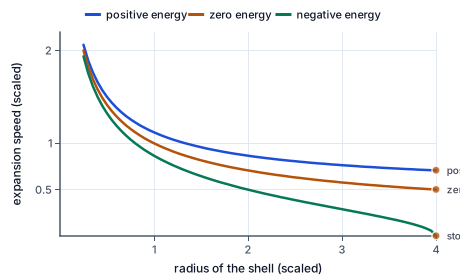
The figure shows three spheres starting with the same speed at the same radius but different energies. The positive-energy shell slows but keeps a final speed, so it expands forever; the negative-energy shell stops at radius $4$ and would recollapse. The critical shell, between them, slows toward zero but never stops. In cosmology the three curves are open, closed and flat universes of matter alone. Dark energy changes the fates, as a later lesson shows, but not the link between density and geometry.
Critical densities for modern Hubble constants are near $10^{-26}$ kg/m³, a few to ten atoms per cubic meter; an answer near $1$ kg/m³ means a unit slip with megaparsecs. Doubling $H_0$ quadruples the critical density. $\Omega - 1$ and $k$ must have the same sign, which is easy to reverse: more matter than critical closes space. And at $z = 0$ the shares in $H^2/H_0^2$ must add to one.
For most of the twentieth century cosmologists tried to measure $\Omega$ by adding up the matter they could find. In the 1930s Fritz Zwicky, at the California Institute of Technology in Pasadena, weighed the Coma cluster and found far more mass than its stars; by the 1990s, cluster surveys put the total matter density near $\Omega = 0.3$.
With $H_0 = 70$ that is $2.8 \times 10^{-27}$ kg/m³, under two atoms' worth per cubic meter, of which stars are only about $0.05$. A universe of matter alone at that density would be open. The cosmic microwave background later showed the geometry is flat, $\Omega_{\text{total}} = 1$ to within about half a percent, which meant something other than matter makes up the remaining seventy percent of the critical density.
Alexander Friedmann, a mathematician in Petrograd, found the expanding solutions of Einstein's equations in 1922. Einstein at first thought them mistaken. Georges Lemaître rediscovered them in 1927 and linked them to the redshifts of galaxies, two years before Hubble's famous paper, which is why the law is now often called the Hubble-Lemaître law.
The Newtonian derivation used here was published by Edward Milne and William McCrea in 1934. It gives exactly the same equation as general relativity for matter, and it is how most introductory courses, including MIT's 8.286, first present the Friedmann equation.
The critical density sounds as if it should be enormous, but it is about five hydrogen atoms per cubic meter, emptier than any laboratory vacuum. The universe can be balanced between expansion and recollapse by so little matter because it is so large: gravity acts over billions of light-years.
A second slip is reversing the sign: thinking that more density means open space. More matter than critical means negative energy, positive curvature $k > 0$, a closed universe that, with matter alone, would stop and recollapse.
Convert the Hubble constant to inverse seconds.
$H_0 = 70 \div (3.086 \times 10^{19}) = 2.269 \times 10^{-18}\ \text{s}^{-1}$
Kilometers cancel.
Square the rate.
$H_0^2 = 5.15 \times 10^{-36}\ \text{s}^{-2}$
Needed in the formula.
Multiply by three and divide by eight pi G.
$\rho_c = 3 \times 5.15 \times 10^{-36} \div (8\pi \times 6.674 \times 10^{-11})$
The critical density.
Evaluate the result.
$\rho_c = 9.20 \times 10^{-27}\ \text{kg/m}^3$
A near-perfect vacuum.
Divide by the mass of a hydrogen atom.
$9.20 \times 10^{-27} \div (1.673 \times 10^{-27}) = 5.50$
Atoms per cubic meter.
A matter universe with $H_0 = 70$ has density $2.76 \times 10^{-27}$ kg/m³. Divide by the critical density.
$\Omega = 2.76 \div 9.20 = 0.3$
Thirty percent of critical.
Subtract one from it.
$\Omega - 1 = -0.7$
Negative.
Read the sign of the curvature.
$k < 0$
Open space.
State the Newtonian fate.
$E > 0$
It expands forever.
Find the density that would close it.
$\rho > 9.20 \times 10^{-27}\ \text{kg/m}^3$
More than three times as much.
Take a matter universe with $\Omega = 0.3$ today. Write the shares.
$\Omega = 0.3,\ 1 - \Omega = 0.7$
Matter and curvature.
Scale the matter term.
$0.3(1+z)^3$
Density as a cubed.
Scale the curvature term.
$0.7(1+z)^2$
As a squared.
Add the two terms.
$\dfrac{H^2}{H_0^2} = 0.3(1+z)^3 + 0.7(1+z)^2$
The history of the rate.
Evaluate at a redshift of one.
$0.3 \times 8 + 0.7 \times 4 = 5.2$
H was 2.28 times larger.
Find the matter share then.
$2.4 \div 5.2 = 0.46$
Omega grows toward 1 in the past.
Find the critical density for this constant.
$\rho_c = 18.78 \times 0.25 = 4.70$
In units of 10^-27 kg/m^3.
Divide the density by it.
$\Omega = 4.70 \div 4.70$
The density parameter.
State the geometry.
In the Friedmann equation $H^2 = \tfrac{8\pi G}{3}\rho - kc^2/a^2$, what is special about a universe whose density equals the critical density?
Complete the worked solution: find the critical density for $H_0 = 50$ km/s per Mpc, and how many hydrogen atoms, of mass $1.673 \times 10^{-27}$ kg, per cubic meter it equals.
Turn the Hubble constant into inverse seconds.
$H_0 =$ s $\times 10^{-18}\ \text{s}^{-1}$
Divide by kilometers per megaparsec.
Put it into three H squared over eight pi G.
$\rho_c =$ c $\times 10^{-27}\ \text{kg/m}^3$
The critical density.
Divide by the mass of a hydrogen atom.
$n =$ n $\text{atoms per cubic meter}$
A feel for how little it is.
Put the steps of the Newtonian derivation of the Friedmann equation in order.
Number the steps in order (write the number in the box):
For $H_0 = 67.4$ km/s per Mpc the critical density is $8.53 \times 10^{-27}$ kg/m³. A universe of matter alone has density $12.80 \times 10^{-27}$ kg/m³. Fill in its density parameter, and $\Omega - 1$, which has the sign of its curvature $k$.
| value | |
|---|---|
| density parameter | |
| Omega minus 1 |
A universe contains only matter, with density parameter $\Omega = 1.5$ today, so its curvature term today is $1 - \Omega = -0.5$ of $H_0^2$. Matter density scales as $a^{-3}$ and the curvature term as $a^{-2}$, with $a = 1/(1+z)$. Write $H^2/H_0^2$ as a function of $z$.
Answer:
A universe has density $3 \times 10^{-27}$ kg/m³. Taking $G = 6.674 \times 10^{-11}$ in SI units and $1$ Mpc $= 3.086 \times 10^{19}$ km, what Hubble constant, in km/s per Mpc, would make this exactly the critical density?
Answer: km/s per Mpc
A survey with $H_0 = 60$ km/s per Mpc reports average densities of $0.2$ for stars, $1.5$ for gas and $8.44$ for dark matter, all in units of $10^{-27}$ kg/m³. Treating the universe as matter alone, find its total density parameter and the geometry it implies. The critical density is $18.78 \times 10^{-27}$ kg/m³ times $(H_0/100)^2$.
| density parameter | geometry | |
|---|---|---|
| the survey |
Lesson test: one question per skill, one attempt each, no hints. Your answers are checked when you submit.
A universe contains only matter, with density parameter $\Omega = 1.5$ today, so its curvature term today is $1 - \Omega = -0.5$ of $H_0^2$. Matter density scales as $a^{-3}$ and the curvature term as $a^{-2}$, with $a = 1/(1+z)$. Write $H^2/H_0^2$ as a function of $z$.
Answer:
You can weigh the universe against its expansion. Find the critical density for H0 = 70, and the geometry of a matter universe with 2.76 x 10^-27 kg/m^3.
21. Your turn: a matter universe with $H_0 = 50$ has density $4.70 \times 10^{-27}$ kg/m³. What is its geometry?, step 3
$\Omega = 1,\ k = 0$
Flat.