Back to the on-screen lesson ·
A horizon at decoupling spans about a degree yet the sky has one temperature, and today's flatness needs |Omega - 1| below 10^-16 when nuclei formed; about 60 e-folds of inflation solve both, its ripple predictions are confirmed, and its gravitational waves are not yet seen.
Paper packet. Every task here also exists on screen, where it is checked automatically; answers written on paper are not assessed by Nydus. When you are back at a device, enter your answers there.
By the end of this lesson you will be able to state the horizon and flatness problems and how inflation addresses them, separating tested predictions from speculation.
You know how $|\Omega - 1|$ is tied to curvature, that the background is uniform to a part in $100{,}000$ and that its ripples are the seeds of structure, and that a vacuum-dominated universe expands exponentially. This lesson shows why the standard hot Big Bang, for all its success, leaves two deep puzzles, and how a brief early era of exponential expansion, inflation, addresses them.
| Term | What it means |
|---|---|
| Horizon problem | Regions of the background that could never have exchanged signals nonetheless share one temperature. |
| Flatness problem | Space is so close to flat today that it must have been flat to extraordinary precision early on. |
| Inflation | A brief early era of exponential expansion driven by a vacuum-like energy. |
| E-fold | Growth by a factor of e, about 2.718; 60 e-folds multiply sizes by about 10^26. |
| Spectral index (n_s) | How the strength of the primordial ripples depends on scale; 1 would be exactly scale-invariant. |
| Tensor-to-scalar ratio (r) | The strength of primordial gravitational waves relative to density ripples; not yet detected. |
In the standard hot Big Bang, light could travel only about $280$ Mpc (comoving) before decoupling, which spans about a degree on today's sky, yet the whole background has one temperature: the horizon problem. And $|\Omega - 1|$ grows with time, as $a$ in the matter era and $a^2$ in the radiation era, so today's flatness means the early universe was tuned to near $10^{-16}$ or better: the flatness problem. Inflation, exponential expansion by $N \gtrsim 60$ e-folds, solves both:
$$|\Omega - 1| \propto e^{-2N},$$
and one small, connected patch becomes all we see. Its predictions for the ripples are confirmed; its gravitational waves are not yet seen.
Another way: picture
Picture an ant on a beach ball. It sees its surface as clearly curved. Now inflate the ball to the size of Earth: the ant's whole neighborhood looks flat, and every part of it was once a tiny region the ant could cross in a step. Inflation does the same to space: whatever the starting curvature, enormous expansion makes it look flat and uniform.
Another way: steps
In a universe that has always decelerated, the distance light could have traveled since the beginning, the particle horizon, was about $280$ Mpc in comoving units at decoupling. The background lies $13{,}900$ Mpc away, so a horizon-sized region subtends only about $1.2$ degrees on our sky. Regions on opposite sides of the sky were separated by more than a hundred horizon lengths. No signal, no heat, could have passed between them, yet their temperatures agree to a part in $100{,}000$. In the standard model this uniformity must simply be assumed as a starting condition.
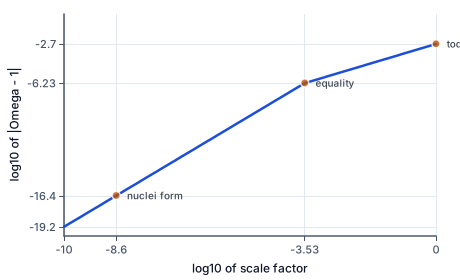
Dividing the Friedmann equation by $H^2$ gives $|\Omega - 1| = |k|c^2/(aH)^2$. In the matter era $aH \propto a^{-1/2}$, so $|\Omega - 1| \propto a$; in the radiation era $aH \propto a^{-1}$, so $|\Omega - 1| \propto a^2$. Any departure from flatness grows. Measured today, $|\Omega - 1| < 0.002$. Run backward, it was below about $6 \times 10^{-7}$ at equality and below $10^{-16}$ when nuclei formed. Any noticeable departure at the start would by now have produced either a quick recollapse or an almost empty universe.
In 1980 Alan Guth, then at the Stanford Linear Accelerator Center, proposed that the very early universe went through a phase dominated by a vacuum-like energy, with $w \approx -1$. Then $H$ is nearly constant and $a \propto e^{Ht}$. During inflation $aH$ grows instead of shrinking, so $|\Omega - 1| \propto (aH)^{-2}$ falls as $e^{-2N}$ after $N$ e-folds. Sixty e-folds, a growth of $10^{26}$, reduce any reasonable starting curvature to far below what we measure. Inflation then ends, its energy turning into hot particles: the hot Big Bang begins.
Before inflation, the region that would become our whole observable universe was far smaller than its horizon, small enough for light to cross many times and for its temperature to even out. Inflation then stretched it by $10^{26}$ or more, carrying regions that had been in contact far beyond each other's later horizons. When the decelerating expansion afterward brought them back into view, they already shared a temperature. The puzzle disappears because the true horizon is far larger than the standard calculation, which leaves inflation out, suggests.
Inflation's most important prediction concerns the ripples. Quantum fluctuations of the field driving inflation, at microscopic scales, were stretched to cosmic size, becoming density variations of about $10^{-5}$. Simple models predict they are Gaussian, adiabatic, affecting all components alike, and nearly scale-invariant, slightly stronger on large scales: a spectral index just below one. Planck measured $n_s = 0.965 \pm 0.004$, and found the ripples Gaussian and adiabatic to high precision. These are genuine tests, passed.
Inflation also predicts primordial gravitational waves, which would leave a twisting B-mode pattern in the background's polarization. None has been found; the BICEP and Keck experiments at the South Pole set $r < 0.036$, ruling out some of the simplest models, including inflation driven by a field with a simple quadratic potential. Other ideas built on inflation, such as eternal inflation, in which inflation never stops everywhere, and a multiverse of separate bubble universes, make no testable predictions so far. They are theoretical extrapolations, not observational results, and some physicists argue inflation itself needs fine-tuning of its own.
Inflation is the leading explanation, but not the only one considered. Bouncing cosmologies propose a contracting phase before the Big Bang that smooths the universe; others suggest the speed of light or the laws of physics were different at the earliest times. So far none matches inflation's record of predictions confirmed by later data, notably the slight tilt of the ripples, predicted before Planck measured it.
Open questions remain inside inflation too. What field drove it, and why did its energy have the value it did? How did inflation start, and does it need finely tuned initial conditions of its own, partly undoing its solution to the flatness problem? How exactly did its energy turn into the hot particles of the Big Bang? These questions concern physics at energies far beyond any laboratory, so for now the evidence for inflation comes entirely from the sky. A careful summary keeps three things apart: what the background shows, what inflation predicts and has passed, and what inflation's theorists conjecture.
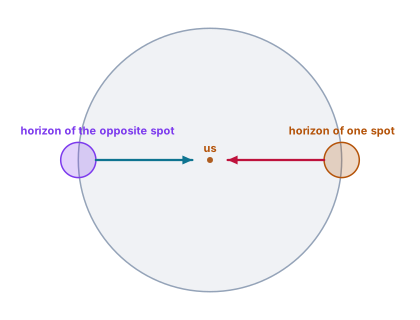
The scene puts the horizon problem in one picture. We sit at the center of the last-scattering surface; on opposite sides of it, each small sphere marks how far light could have traveled from that spot by decoupling, in a hot Big Bang without inflation. The two spheres are separated by the full diameter of the shell, many times their own size, so no signal could have evened out their temperatures, and yet they match. Inflation makes them one small patch before it began.
The figure follows $\log_{10}|\Omega - 1|$ backward from its present upper limit of $0.002$. During the matter era it falls by one power of ten for every power of ten in the scale factor, reaching $-6.2$ at equality, $a \approx 3 \times 10^{-4}$. During the radiation era it falls twice as fast, to about $-16.4$ when nuclei formed and $-19.2$ at $a = 10^{-10}$. Continued back to the earliest moments, the required tuning reaches $10^{-60}$. Inflation replaces this tuning with sixty e-folds of growth.
Sixty e-folds is about $26$ powers of ten in size and $52$ in flatness; the flatness factor is the square of the growth factor's reciprocal. $|\Omega - 1|$ was smaller in the past, never larger, for a decelerating universe. A horizon-sized region at decoupling covers about a degree, not a radian. When judging an inflationary model, compare each prediction with its measurement and uncertainty, and keep separate the parts of a claim that data test from the parts that rest on theory alone.
Logarithms keep these huge numbers manageable: work in powers of ten throughout, add them when factors multiply, and convert back only at the end. A slip of a sign in an exponent turns a tiny tuning into an enormous one, so check that every step backward in time makes the curvature share smaller.
The BICEP and Keck Array telescopes, run by teams from Harvard, Caltech, Stanford and the University of Minnesota at the Amundsen-Scott South Pole Station, scan the same patch of sky for years to find the faint B-mode polarization that primordial gravitational waves would leave.
In 2014 BICEP2 announced a detection with $r \approx 0.2$. Within a year a joint analysis with Planck showed the signal was dust in the Milky Way. Their combined limit is now $r < 0.036$, which excludes the simplest quadratic-potential model, predicting $r \approx 0.13$, while models like Starobinsky's, predicting $r \approx 0.004$, survive. It is a case study in separating a claimed result from its assumptions.
The Simons Observatory in Chile's Atacama Desert, together with continuing South Pole experiments, aims to reach $r$ of a few thousandths, enough to test many of the models that remain. A detection would measure the energy scale of inflation directly, near $10^{16}$ GeV, a trillion times beyond the Large Hadron Collider.
A firm non-detection at that level would not kill inflation, which has models with smaller $r$, but would rule out the whole simple family that matched $n_s = 0.965$ most naturally. Either outcome would be a real test, the kind that separates inflation's observational support from its theoretical flexibility.
Inflation is not the Big Bang; it is a proposed brief phase before the hot Big Bang, which ended by heating the universe. Its broad predictions, a flat universe with nearly scale-invariant, Gaussian, adiabatic ripples, are confirmed, and that support is real. But no specific model is established, its gravitational waves have not been seen, and what drove it is unknown.
A second slip is treating speculative extensions, such as eternal inflation or a multiverse, as findings. They follow from some models but make no tested predictions so far, and they should be reported as hypotheses, separate from the observations that support inflation.
Take a comoving horizon of $280$ Mpc and a distance of $13{,}900$ Mpc. Divide.
$\theta = 280 \div 13{,}900 = 0.0201\ \text{rad}$
Both comoving.
Convert to degrees.
$0.0201 \times 57.3 = 1.15^\circ$
About two full Moons.
Count horizons across the sky.
$180 \div 1.15 \approx 156$
Disconnected regions in a line.
Count patches over the whole sky.
$41{,}253 \div (1.15^2) \approx 31{,}000$
Square degrees on the sky over each patch's area.
State the puzzle.
$\text{all at } 2.7255\ \text{K}$
Without contact.
Take $|\Omega - 1| = 0.002$ today. Take its logarithm.
$\log_{10} 0.002 = -2.70$
Today.
Go back to equality by subtracting log10 3,401.
$-2.70 - 3.53 = -6.23$
Matter era: one power of a.
Find the radiation-era span to when nuclei formed.
$\log_{10}(3 \times 10^8 \div 3{,}401) = 4.95$
In powers of ten of a.
Subtract twice that.
$-6.23 - 2 \times 4.95 = -16.13$
Radiation era: two powers of a.
Interpret the number.
$|\Omega - 1| < 10^{-16}$
Astonishingly precise.
Inflation lasts $60$ e-folds. Convert to powers of ten.
$60 \times 0.4343 = 26.06$
Growth of 10^26.
Square the growth for the curvature term.
$|\Omega - 1| \propto a^{-2}$
During inflation.
Double the exponent.
$2 \times 26.06 = 52.12$
Powers of ten of flattening.
Start from an unremarkable curvature.
$|\Omega - 1| \approx 1$
Before inflation.
Apply the flattening.
$|\Omega - 1| \approx 10^{-52}$
After inflation.
Compare with what is needed.
$\text{flat enough for today}$
With e-folds to spare.
Convert e-folds to powers of ten.
$70 \times 0.4343 = 30.4$
Growth in size.
Double the exponent.
$2 \times 30.4$
Curvature falls as a^-2.
State the reduction.
Which observation is the horizon problem?
Complete the worked solution: today $\log_{10}|\Omega - 1| = -2$. In the matter era $|\Omega - 1|$ grows as $a$, and in the radiation era as $a^2$. Matter-radiation equality was at $1 + z = 3{,}401$, and nuclei formed at $1 + z = 3 \times 10^8$. Find $\log_{10}|\Omega - 1|$ at equality and when nuclei formed.
Subtract log10 of 3,401 for the matter era.
$\log_{10}|\Omega - 1|_{\text{eq}} =$ e
One power of a.
Subtract twice 4.95 for the radiation era.
$\log_{10}|\Omega - 1|_{\text{nuc}} =$ n
Two powers of a.
Interpret the number.
$\text{tuned to about one part in } 10^{16}$
The flatness problem.
Match each puzzle of the hot Big Bang to how inflation addresses it.
| they were in contact before being stretched apart | exponential growth drives the density parameter to one | any early relics were diluted to almost nothing | quantum fluctuations were stretched to cosmic size | |
|---|---|---|---|---|
| distant regions share one temperature | ||||
| space is extremely close to flat | ||||
| no magnetic monopoles are seen | ||||
| the universe has small density ripples |
Inflation lasts $55$ e-folds, multiplying every distance by $e^{55}$. Fill in the base-10 logarithm of that growth, and the base-10 logarithm of the factor by which $|\Omega - 1|$ is reduced.
| value | |
|---|---|
| log10 of the growth | |
| log10 of the flattening |
Suppose $|\Omega - 1| = 0.005$ today, and the universe has been matter-dominated throughout the period of interest, so that $|\Omega - 1|$ grows in proportion to the scale factor. Write $|\Omega - 1|$ as a function of redshift $z$.
Answer:
Without inflation, the distance light could travel from the beginning to decoupling is $300$ Mpc in comoving units. The background lies at a comoving distance of $14000$ Mpc. In flat space, what angle on the sky does such a causally connected region subtend, in degrees?
Answer: degrees
A paper proposes an inflationary model predicting a spectral index $n_s = 0.967$ and a tensor-to-scalar ratio $r = 0.004$, and claims it explains the early universe. The background gives $n_s = 0.965 \pm 0.004$ and $r < 0.036$. Find how many uncertainties the predicted index lies from $0.965$, and judge the model, treating more than two uncertainties as ruling it out.
| uncertainties from 0.965 | verdict | |
|---|---|---|
| the model |
Lesson test: one question per skill, one attempt each, no hints. Your answers are checked when you submit.
Suppose $|\Omega - 1| = 0.001$ today, and the universe has been matter-dominated throughout the period of interest, so that $|\Omega - 1|$ grows in proportion to the scale factor. Write $|\Omega - 1|$ as a function of redshift $z$.
Answer:
You can weigh the case for inflation. Find the angle of a 280-Mpc horizon at 13,900 Mpc, and the flattening from 60 e-folds, and say which of inflation's claims are tested.
21. Your turn: inflation lasts $70$ e-folds. By how many powers of ten does it reduce $|\Omega - 1|$?, step 3
$60.8 \text{ powers of ten}$
More than enough.