Back to the on-screen lesson ·
The Hubble time 1/H0 = 977.8/H0 billion years is the constant-rate age; matter makes the universe younger (two thirds) and dark energy older (0.964), and only the dark-energy model clears the 12.5-billion-year globular clusters.
Paper packet. Every task here also exists on screen, where it is checked automatically; answers written on paper are not assessed by Nydus. When you are back at a device, enter your answers there.
By the end of this lesson you will be able to estimate the Hubble time and compare it with the ages of the oldest stars.
You can fit $H_0$ to galaxy data and you know that the scale factor $a(t)$ measures the size of the universe relative to today. From Astrophysics you can date a star cluster from its main-sequence turnoff. This lesson asks how old the universe must be, given its expansion rate, and checks the answer against the oldest stars, the first real test any cosmological model must pass.
| Term | What it means |
|---|---|
| Hubble time | 1 / H0, the age the universe would have if it had always expanded at today's rate; 977.8 / H0 billion years. |
| Deceleration | A slowing of the expansion, caused by the gravity of matter and radiation. |
| Acceleration | A speeding up of the expansion, caused by dark energy. |
| Age of the universe (t0) | The time since the scale factor was zero, a fraction of the Hubble time set by the expansion history. |
| Globular cluster | A dense ball of hundreds of thousands of old stars, whose turnoff gives some of the oldest stellar ages. |
| Age problem | The conflict, in the 1990s, between a matter-only universe's age and the older ages of globular clusters. |
If every galaxy had always receded at its present speed, all would have been together a time $d/v = 1/H_0$ ago, the Hubble time:
$$t_H = \frac{1}{H_0} = \frac{977.8}{H_0}\ \text{billion years}$$
for $H_0$ in km/s per Mpc, about $14$ billion years for $H_0 = 70$. The real age $t_0$ depends on how the expansion rate changed. Gravity decelerates it, so a matter-only universe was expanding faster in the past and is younger, $t_0 = \tfrac{2}{3} t_H$. Dark energy accelerates it and adds age. The oldest stars, about $12.5$ billion years old, set a floor any model must clear.
Another way: picture
Picture finding a car $100$ miles from home, traveling at $50$ miles an hour. If it always went $50$, it left two hours ago. If it has been slowing down, it was going faster earlier and left less than two hours ago; if it has been speeding up, more. The Hubble time is the constant-speed guess, and the real age depends on the braking or the acceleration.
Another way: steps
$H_0$ is quoted in km/s per Mpc, a speed per distance, which is really an inverse time. One megaparsec is $3.086 \times 10^{19}$ km, so $H_0 = 70$ km/s per Mpc is $70 / (3.086 \times 10^{19})$ per second, $2.27 \times 10^{-18}\ \text{s}^{-1}$. Inverting gives $4.41 \times 10^{17}$ s, and dividing by $3.156 \times 10^{16}$ s per billion years gives $13.97$ billion years. Folding both conversions together, $3.086 \times 10^{19} / (3.156 \times 10^{16}) = 977.8$, so the Hubble time in billions of years is just $977.8/H_0$.
Matter attracts matter, so the expansion of a universe full of matter slows. The expansion rate was larger in the past, and the scale factor grew from zero to today's size faster than a constant rate would have done. Solving the Friedmann equation, the subject of the next unit, gives $a \propto t^{2/3}$ for flat matter, so $H = \dot a/a = 2/(3t)$ and the age today is $t_0 = 2/(3H_0)$. Radiation brakes harder still, $a \propto t^{1/2}$, and its universe would be only half the Hubble time old.
Dark energy pushes the expansion to accelerate. A universe that is speeding up today was expanding more slowly in the recent past, so it took longer to reach its present size. A flat universe with $30$ percent matter and $70$ percent dark energy first decelerated, while matter dominated, then began accelerating about six billion years ago; the two effects nearly cancel, and its age is $0.964\, t_H$. A universe of dark energy alone expands exponentially and has no beginning at all; its scale factor never reaches zero.
Globular clusters are the oldest well-dated objects in the Milky Way. Their main-sequence turnoffs, fitted with stellar models of very low heavy-element content, give ages of about $12$ to $13$ billion years, with an uncertainty of about a billion years from distances, chemical composition and convection in the models. The coolest white dwarfs and the radioactive thorium and uranium in a few ancient stars give independent ages in the same range. A universe must be older than every star in it, with time to spare for the first stars to form, a few hundred million years after the beginning.
In the early 1990s, most cosmologists expected a flat universe of matter alone. With $H_0$ near $70$, it would be $9.3$ billion years old, three billion years younger than the oldest stars. Either $H_0$ was nearer $50$, the stellar ages were badly wrong, or the model was. The supernova discovery of acceleration in 1998 resolved it: with dark energy, the age rose to about $13.5$ billion years. Planck's fit, with matter at $31.5$ percent and $H_0 = 67.4$, gives $13.8$ billion years.
The age is a powerful check because stars and cosmology are measured completely independently: one by nuclear physics and stellar models, the other by expansion rates and densities. If the Hubble tension were resolved at $H_0 = 73$, the standard model's age would fall to about $13$ billion years, uncomfortably close to some stellar ages. A future measurement of an $H_0$ much above $80$ would push even the dark-energy model below the oldest stars, a contradiction that no adjustment of matter could fix.
The same reasoning dates the light from distant galaxies. The lookback time to a galaxy is how long its light has been traveling, the age of the universe now minus its age when the light left. For a flat matter-only universe the age at scale factor $a$ is $\tfrac{2}{3} t_H\, a^{3/2}$, so light from $z = 3$, when $a = 1/4$, left when the universe was an eighth of its present age. In the standard model with dark energy the numbers shift, but the pattern holds: light from $z = 1$ left about eight billion years ago, and light from $z = 3$ about eleven and a half billion years ago, when the universe was only about two billion years old.
Lookback times matter whenever galaxies are compared across cosmic history. A galaxy at $z = 3$ whose stars look a billion years old is no contradiction, but one whose stars look three billion years old would be, because there was not yet that much time. Webb's early massive galaxies at $z$ above $7$ are tested exactly this way.
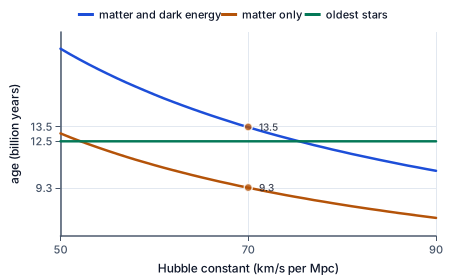
The figure plots both model ages against $H_0$, beside a flat line at $12.5$ billion years for the oldest stars. Both curves fall as $1/H_0$: a faster expansion means a younger universe. The matter-only curve crosses the stellar line at $H_0 \approx 52$, so every modern measurement rules it out. The dark-energy curve stays above until $H_0 \approx 75$, comfortably clear of the cosmic background's $67.4$ and just clear of the distance ladder's $73$. The vertical gap between the curves at any $H_0$ is about four billion years.
A Hubble time for a modern $H_0$ is $13$ to $15$ billion years; a value near $1$ means the conversion from megaparsecs was skipped. A model age must be less than the Hubble time for any decelerating model, and a matter-only age is always two thirds of it, never three halves. When comparing with stars, compare the model's age, not the Hubble time, with the cluster: the Hubble time is not the age of any real universe with matter in it.
Globular cluster ages come from fitting stellar models to their turnoffs, a field in which Brian Chaboyer's group at Dartmouth College in Hanover, New Hampshire, has led much of the error analysis. In the 1990s their ages, about $14$ to $15$ billion years with older distances, clashed hard with matter-only cosmology. Gaia's parallaxes have since pinned the distances, and the oldest clusters now come out near $12.5$ to $13$ billion years, with roughly a billion years of uncertainty.
Independent clocks agree. The star HD 140283, a nearby metal-poor subgiant, has an age near $13.7$ billion years with an uncertainty of about $0.7$ billion, and the coolest white dwarfs in the Milky Way's halo give $11$ to $12$ billion years from how long they have taken to fade. All sit just below the standard model's $13.8$, which is the test passing.
In 1998 two teams, the Supernova Cosmology Project at Lawrence Berkeley National Laboratory in California and the High-z Supernova Search Team, found that distant type Ia supernovae were fainter than a decelerating universe allowed. The expansion was accelerating. Saul Perlmutter, Brian Schmidt and Adam Riess shared the 2011 Nobel Prize in Physics for it.
One welcome consequence was that the age problem disappeared. With $70$ percent dark energy and $H_0 = 70$, the age rose from $9.3$ to $13.5$ billion years, older than the oldest stars, and the conflict that had troubled cosmology for a decade was gone.
The Hubble time $1/H_0$ assumes the expansion has always run at today's rate, which is true of no universe containing matter. Gravity slowed the early expansion and dark energy speeds the later one, and the true age is a fraction of the Hubble time that depends on the mix: two thirds for matter alone, $0.964$ for the standard mixture. That the measured age, $13.8$ billion years, is close to $1/H_0$ is a near coincidence of our epoch.
A second slip is thinking the universe could be younger than its stars if the stellar ages are only roughly known. The gap for matter alone, three billion years, is several times the uncertainty in cluster ages.
Take $H_0 = 70$ km/s per Mpc. Convert megaparsecs to kilometers.
$H_0 = 70 \div (3.086 \times 10^{19})\ \text{s}^{-1}$
Kilometers cancel.
Evaluate the rate per second.
$H_0 = 2.27 \times 10^{-18}\ \text{s}^{-1}$
A tiny rate.
Invert for the time in seconds.
$t_H = 4.41 \times 10^{17}\ \text{s}$
One over the rate.
Convert to billions of years.
$t_H = 4.41 \times 10^{17} \div (3.156 \times 10^{16}) = 13.97$
Billion years.
Check with the shortcut.
$977.8 \div 70 = 13.97$
The same answer.
Take $H_0 = 70$ and find the Hubble time.
$t_H = 977.8 \div 70 = 13.97$
Billion years.
Take two thirds for a matter-only universe.
$t_0 = \tfrac{2}{3} \times 13.97 = 9.31$
Billion years.
Compare with a cluster of $12.5$ billion years.
$12.5 - 9.31 = 3.19$
The stars would be too old.
Find the H0 at which they would just agree.
$651.9 \div 12.5 = 52.2$
Ruled out by modern values.
Conclude about the model.
$\text{matter alone fails}$
Something adds age.
Take $H_0 = 73$ and find the Hubble time.
$t_H = 977.8 \div 73 = 13.39$
Billion years.
Multiply by 0.964 for 30 percent matter.
$t_0 = 0.964 \times 13.39 = 12.91$
The dark-energy model.
Find the matter-only age for comparison.
$t_0 = \tfrac{2}{3} \times 13.39 = 8.93$
Billion years.
Compare both with a cluster of $12$ billion years.
$12.91 > 12 > 8.93$
Only dark energy passes.
Note the margin left for the first stars.
$12.91 - 12 = 0.91$
Less than a billion years.
Judge how tight that is.
$\text{similar to the age uncertainty}$
A test that could fail.
Divide 977.8 by the constant.
$t_H = 977.8 \div 67.4 = 14.51$
Billion years.
Take two thirds of it.
$t_0 = \tfrac{2}{3} \times 14.51$
The matter-only age.
State the age.
A flat universe containing only matter has an age of two thirds of its Hubble time, $1/H_0$. Why is it younger than $1/H_0$?
Complete the worked solution: with $H_0 = 67.4$ km/s per Mpc, compare a flat universe of matter alone with a globular cluster $12.5$ billion years old.
Divide 977.8 by the Hubble constant.
$t_H =$ t $\text{billion years}$
The Hubble time.
Take two thirds of the Hubble time.
$t_0 =$ m $\text{billion years}$
The matter-only age.
Subtract that age from the cluster's age.
$\text{shortfall} =$ d $\text{billion years}$
The stars would be older than the universe.
All of these model universes have the same Hubble constant today. Order them from youngest to oldest.
Number the steps in order (write the number in the box):
Take $H_0 = 60$ km/s per Mpc. Fill in the Hubble time and the age of a flat universe containing only matter, both in billions of years.
| value | |
|---|---|
| Hubble time (billion years) | |
| matter-only age (billion years) |
A model universe's age is $1$ of its Hubble time, and the Hubble time in billions of years is $977.8/H$ for $H$ in km/s per Mpc. Write the model's age, in billions of years, as a function of $H$.
Answer:
Take $H_0 = 70$ km/s per Mpc, with $1$ Mpc $= 3.086 \times 10^{19}$ km and $1$ billion years $= 3.156 \times 10^{16}$ s. What is the Hubble time $1/H_0$, in billions of years?
Answer: billion years
Suppose a survey measures $H_0 = 90$ km/s per Mpc and a globular cluster's turnoff gives it an age of $12.5$ billion years. Find the age of a flat universe of $30$ percent matter and $70$ percent dark energy, $0.964$ of the Hubble time, and decide which flat models, that one or matter alone, are at least as old as the cluster.
| dark-energy age (billion years) | models at least as old as the cluster | |
|---|---|---|
| the models |
Lesson test: one question per skill, one attempt each, no hints. Your answers are checked when you submit.
A model universe's age is $1/2$ of its Hubble time, and the Hubble time in billions of years is $977.8/H$ for $H$ in km/s per Mpc. Write the model's age, in billions of years, as a function of $H$.
Answer:
You can test a model by its age. For H0 = 70, find the Hubble time and the age of a matter-only universe, and say why the oldest globular clusters rule that model out.
20. Your turn: with $H_0 = 67.4$, find the Hubble time and the age of a flat matter-only universe., step 3
$t_0 = 9.67$
Billion years, too young for the oldest stars.