Back to the on-screen lesson ·
Earth turns west to east once a day, 15 degrees an hour, so the Sun appears to rise in the east and set in the west, and noon reaches places farther west later.
Paper packet. Every task here also exists on screen, where it is checked automatically; answers written on paper are not assessed by Nydus. When you are back at a device, enter your answers there.
By the end of this lesson you will be able to explain day and night and the Sun's daily path from Earth's rotation, and calculate how the time of noon changes with longitude.
You have watched the Sun rise in the morning, climb across the sky and set in the evening, and you know that the stars come out at night. In earlier grades you learned that Earth is a ball that spins, and that the Sun is a star. This lesson puts those facts together carefully, so that you can explain the daily motion of the sky from a model rather than from memory, and so that you can calculate with it.
| Term | What it means |
|---|---|
| Axis | The imaginary line through the North and South Poles that Earth spins around. |
| Rotation | One body spinning on its own axis; Earth rotates once in about a day. |
| Apparent motion | How something seems to move because the observer is moving, not because it is. |
| Longitude | The angle east or west of the Prime Meridian through Greenwich, England. |
| Solar noon | The moment the Sun is highest in a place's sky, when it crosses due south for most of the United States. |
Earth spins on its axis from west to east, once in about $24$ hours. Wherever you stand, the ground carries you around with it.
A full turn is $360^\circ$ in $24$ hours, so Earth turns
$$360^\circ \div 24 = 15^\circ \text{ every hour}, \quad\text{or } 1^\circ \text{ every } 4 \text{ minutes}.$$
Another way: picture
Picture riding a merry-go-round while a friend stands still beside it. As you turn, your friend seems to slide past you and disappear behind you, then appear again. Your friend has not moved at all. The Sun is the friend, and Earth is the merry-go-round.
Another way: steps
It is easy to say that Earth turns, but a good model has to explain what we actually see. Watch the sky for a whole day and three things stand out. The Sun rises somewhere on the eastern side of the horizon. It moves smoothly and steadily across the sky, highest around the middle of the day. It sets on the western side. At night the stars do the same thing: they rise in the east, wheel across the sky and set in the west, and near the North Star they turn in small circles that never set at all.
A spinning Earth explains all of these with one idea. Because the whole sky appears to turn together, it is far simpler to say that the ground is turning than to say that the Sun, the Moon and thousands of stars all race around Earth at once, each at exactly the right speed to keep their patterns fixed. Scientists prefer the model that explains the most with the fewest assumptions.
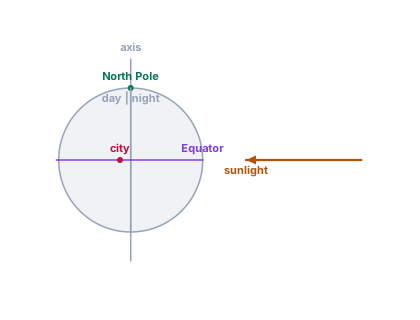
A reference frame is the point of view from which motion is described. From the ground, it is perfectly correct to say that the Sun rose, crossed the sky and set; that is exactly what an observer sees. From a point far out in space, above the North Pole, the same events look different: Earth is turning counterclockwise, and a city on it is carried around into the sunlit half and back out again.
Both descriptions are true in their own frame. The space view is the one that explains why the motion happens, which is why astronomers use it. When you explain day and night, say which frame you are using. Mixing them up is where most confusion begins: someone who imagines standing on Earth and also watching it from space at the same time can easily get the direction of turning backward.
Seen from above the North Pole, Earth turns counterclockwise. A useful way to remember the direction is this: the Sun rises in the east, so the ground must be carrying us toward the east to meet it. If Earth turned the other way, the Sun would rise in the west.
Because the ground moves east, everything that is fixed in the sky appears to move the opposite way, toward the west. That is why the Sun, the Moon and the stars all set in the west. It is the same effect you see from a moving car: trees beside the road appear to rush backward, opposite to the direction you are traveling.
Earth turns through a full circle, $360^\circ$, in about $24$ hours. Dividing, it turns $15^\circ$ every hour. Divide again by $60$ minutes and it turns one degree every $4$ minutes.
These two numbers let you calculate with the model. In $3$ hours Earth turns $3 \times 15 = 45^\circ$. To turn through $90^\circ$, a quarter of a circle, it takes $90 \div 15 = 6$ hours, which is roughly the time from sunrise to noon on the Equator at an equinox. The angle turned grows steadily with time, so a graph of angle against hours is a straight line through zero with a slope of fifteen.
Lines of longitude run from pole to pole and measure how far east or west a place is from the Prime Meridian at Greenwich, England. New York City is at about $74^\circ$ west; Los Angeles is at about $118^\circ$ west.
Because Earth turns toward the east, a place farther east is carried under the Sun first. A place $15^\circ$ farther west reaches its solar noon one hour later, and a place one degree farther west reaches it four minutes later. Los Angeles is $118 - 74 = 44^\circ$ west of New York, so the Sun is highest over Los Angeles about $44 \times 4 = 176$ minutes, nearly three hours, after it is highest over New York.
Before railroads, every town kept its own time by the Sun, so noon in one town differed by a few minutes from noon in the next town to the west. That was fine for farmers but chaotic for train schedules. In 1883 the American railroads adopted standard time zones, and the system later became law.
A time zone is a band of the globe, roughly $15^\circ$ of longitude wide, in which everyone sets their clocks the same. Fifteen degrees is exactly one hour of turning, so neighboring zones differ by one hour. The mainland United States spans four zones, Eastern, Central, Mountain and Pacific, about $60^\circ$ of longitude in all. Within a zone, clock noon and solar noon can differ by up to half an hour or more, because the zone rounds a smooth motion into whole hours, and because zone boundaries follow state and county lines rather than exact meridians.
At any moment, half of Earth faces the Sun and is in daylight, and half faces away and is in night. The line that divides them is called the terminator. As Earth turns, the terminator sweeps across the surface; places crossing it from the dark side into the light have sunrise, and places crossing it the other way have sunset.
Notice that it is always sunrise somewhere and always sunset somewhere else. When it is noon in Chicago, it is about midnight on the opposite side of the globe, in the Indian Ocean. The globe in the figure shows the lit half facing the arrow of sunlight; turning it shows a single city making its daily trip through dawn, noon, dusk and midnight.
Three quick checks catch most mistakes in these calculations. First, an angle smaller than a full circle must take less than $24$ hours; if dividing gives more than $24$, you probably multiplied instead. Second, a place farther west always meets the Sun later, never earlier; if your answer says the western city has noon first, the subtraction or the direction is backward. Third, the two ways of converting must agree: degrees divided by fifteen gives hours, and degrees times four gives minutes, and the minutes should be sixty times the hours.
Finally, keep units in view. Longitude differences are in degrees; times are in hours or minutes. Writing the unit at every step stops you from adding degrees to hours by accident.
This lesson treats Earth's day as exactly $24$ hours and its turning as perfectly steady. That is close enough for every calculation here, but it is a model, and a good scientist knows its limits. The time from one noon to the next varies by a few seconds through the year, because Earth's orbit is not a perfect circle and its axis is tilted. Measured against the distant stars rather than the Sun, Earth actually turns once in about $23$ hours $56$ minutes; the extra four minutes in a solar day come from Earth moving along its orbit, which the lesson on the stars will explain.
The model also says nothing about how high the Sun climbs or how long the day lasts. Those depend on where you are and on the season, and they are explained by the tilt of Earth's axis, which is the subject of the next lesson.
Pilots, sailors and astronomers all calculate with Earth's rotation. Before satellite navigation, sailors found their longitude by comparing local noon, measured with the Sun, against the time at Greenwich kept on an accurate clock called a chronometer. Every four minutes of difference meant one degree of longitude.
Astronomers point telescopes using the same rate. A telescope that tracks a star has a motor that turns it at exactly the speed of Earth's rotation, in the opposite direction, so the star stays fixed in view while Earth turns beneath it. Without that motor, a star would drift out of a powerful telescope's field of view in seconds.
In the 1870s every American city kept its own local time, set by the Sun. When it was noon in Chicago, it was about 12:31 in Pittsburgh, which lies roughly $8^\circ$ farther east. Railroads ran on dozens of different local times, and a traveler changing trains could find their watch half an hour wrong.
On November 18, 1883, the railroads switched to four standard time zones across the country, each about $15^\circ$ of longitude wide, so that clocks in neighboring zones differed by exactly one hour. The arithmetic behind the choice is the rate of Earth's rotation: $360^\circ$ in $24$ hours is $15^\circ$ an hour. Congress made the zones law in 1918.
Today the Sun is still the true clock. In Detroit, near the western edge of the Eastern zone, solar noon comes after one o'clock in summer, while in Boston, near the eastern edge, it comes before one. Both cities share one clock time, but the turning Earth carries them under the Sun about $12^\circ$, or $48$ minutes, apart.
At the McDonald Observatory in the Davis Mountains of Texas, large telescopes photograph faint galaxies with exposures lasting many minutes. During one of those exposures Earth keeps turning, at one degree every four minutes, and a galaxy would drift right out of the picture.
To stop that, each telescope is driven by motors that turn it at exactly Earth's rate, in the opposite direction, about an axis parallel to Earth's own axis. The telescope then follows the sky as it appears to turn, and the galaxy stays fixed in the camera.
Amateur astronomers use the same idea. A small backyard telescope on a motorized mount, pointed so that one axis aims at the North Star, can follow the Moon or a planet for an hour without being touched. Pointed wrongly, its motor turns at the right rate around the wrong axis, and the target slowly wanders off, which is a practical demonstration that the sky turns about Earth's axis.
From the ground it really does look as if the Sun travels around us. But the whole sky, Sun, Moon and stars, moves together, and a single turning Earth explains all of it at once. Another common mix-up is to think that Earth's trip around the Sun causes day and night; that trip takes a whole year and causes the seasons' cycle, not the daily one.
When you explain sunrise, say which way the ground is moving: Earth turns toward the east, so the Sun appears in the east and sets in the west.
Earth must turn $60^\circ$. Recall the rate.
$15^\circ \text{ per hour}$
A full turn of 360 degrees in 24 hours.
Divide the angle by the rate.
$60 \div 15$
How many lots of fifteen degrees.
Evaluate the result.
$4\ \text{h}$
The time taken.
Check by multiplying back.
$4 \times 15 = 60^\circ$
The answer reproduces the angle.
Town A is at $80^\circ$ W and town B at $95^\circ$ W. Subtract the longitudes.
$95 - 80 = 15^\circ$
How far apart they are around the globe.
Decide which town is farther west.
$\text{B, the larger west longitude}$
West longitudes grow toward the west.
Divide by the rate of turning.
$15 \div 15 = 1\ \text{h}$
One hour of turning.
Convert to minutes.
$1 \times 60 = 60\ \text{min}$
Sixty minutes in an hour.
State the result.
$\text{B's noon is 60 min after A's}$
Earth carries the east under the Sun first.
New York City is near $74^\circ$ W and Los Angeles near $118^\circ$ W. Subtract the longitudes.
$118 - 74 = 44^\circ$
Los Angeles lies 44 degrees farther west.
Use four minutes a degree.
$44 \times 4$
Earth turns one degree every four minutes.
Evaluate the result.
$176\ \text{min}$
The delay in solar time.
Convert to hours and minutes.
$176 = 2 \times 60 + 56$
Two hours and fifty-six minutes.
Compare with the clocks.
$\text{Eastern and Pacific differ by 3 h}$
Time zones round the smooth delay to whole hours.
Explain the difference.
$180 - 176 = 4\ \text{min}$
Clock noon and solar noon are not the same in either city.
Subtract the longitudes.
$100 - 85 = 15^\circ$
Degrees apart.
Multiply by four minutes a degree.
$15 \times 4 = 60$
Minutes of turning.
State the answer.
Why does the Sun appear to rise in the east and set in the west?
Complete the worked solution: a town at $70^\circ$ W has its noon. How many minutes later does the Sun stand highest over a town at $115^\circ$ W?
Subtract the longitudes.
$\text{west} - \text{east} =$ d
Degrees apart around the globe.
Multiply by four minutes a degree.
$\text{degrees} \times 4 =$ m
Earth turns one degree in four minutes.
Say which town sees noon first.
$\text{the eastern town}$
Earth turns toward the east, so the east meets the Sun first.
Match each angle Earth turns through to the time it takes.
| 2 hours | 6 hours | 12 hours | 24 hours | |
|---|---|---|---|---|
| 30° | ||||
| 90° | ||||
| 180° | ||||
| 360° |
One town is at $85^\circ$ W and another at $145^\circ$ W. Fill in the difference in longitude, and how many hours and how many minutes later noon reaches the western town.
| value | |
|---|---|
| difference in longitude (degrees) | |
| hours later | |
| minutes later |
A planet in a story turns once on its axis every $12$ hours, at a steady rate. Write the angle it turns through, in degrees, as a function of the number of hours $h$ that pass.
Answer:
How many hours does Earth take to turn through $150^\circ$?
Answer: hours of turning
New York City is at about $74^\circ$ W and Los Angeles at about $118^\circ$ W. Measured by the Sun rather than by the clock, about how many minutes after the Sun is highest over New York City is it highest over Los Angeles?
Answer: minutes of solar time
Lesson test: one question per skill, one attempt each, no hints. Your answers are checked when you submit.
Saturn turns once on its axis every $10$ hours, at a steady rate. Write the angle it turns through, in degrees, as a function of the number of hours $h$ that pass.
Answer:
You can explain sunrise and sunset from a turning Earth. Explain why the Sun rises in the east, and how many minutes later noon comes 10 degrees farther west.
21. Your turn: how many minutes later is solar noon at $100^\circ$ W than at $85^\circ$ W?, step 3
$60\ \text{min later}$
The western town meets the Sun later.