Back to the on-screen lesson ·
One astronomical unit is about 150 million km, and light crosses it in about 500 seconds; light time measures distance across the solar system, sets the delay in talking to spacecraft, and means we see things as they were.
Paper packet. Every task here also exists on screen, where it is checked automatically; answers written on paper are not assessed by Nydus. When you are back at a device, enter your answers there.
By the end of this lesson you will be able to convert solar-system distances between kilometers and astronomical units, find light travel times, and explain signal delays to spacecraft.
You know the planets' sizes from the last lesson, and that Kepler's law measures orbits in astronomical units. You know that speed, distance and time are linked: distance is speed times time. This lesson uses those ideas to measure the solar system in the units astronomers use, and in the time light takes to cross it.
| Term | What it means |
|---|---|
| Astronomical unit (AU) | Earth's average distance from the Sun, about 150 million km or 93 million miles. |
| Speed of light | About 300,000 km every second, the fastest speed there is. |
| Light travel time | How long light takes to cross a distance. |
| Light-minute | The distance light travels in one minute, about 18 million km. |
| Signal delay | The time a radio message takes to reach a spacecraft. |
Across the solar system, kilometers become awkward. Astronomers use two better rulers.
$$150{,}000{,}000 \div 300{,}000 = 500 \text{ seconds} \approx 8.3 \text{ minutes}.$$
To find the light time to anything in the solar system, multiply its distance in AU by $500$ seconds. Radio signals travel at the same speed, so the same rule gives the delay in talking to a spacecraft. And because light takes time, we always see things as they were: the Sun as it was 8.3 minutes ago.
Another way: picture
When you see lightning and hear thunder seconds later, the gap tells you how far away the storm is, because sound travels at a known speed. Astronomers do the same with light: its known speed turns travel time into distance.
Another way: steps
Earth is about $150{,}000{,}000$ km from the Sun and Neptune about $4{,}500{,}000{,}000$ km. Numbers that long are hard to read and easy to get wrong by a zero. So astronomers measure the solar system in astronomical units: Earth is $1$ AU from the Sun and Neptune about $30$ AU. Now the comparison is clear: Neptune is thirty times as far from the Sun as Earth is.
Converting is a single multiplication. Jupiter at $5.2$ AU is $5.2 \times 150 = 780$ million km from the Sun. Going the other way, divide kilometers by $150$ million.
Light is the fastest thing in the universe, traveling about $300{,}000$ km every second. In one second it could circle Earth more than seven times. Even so, the solar system is so large that light takes a noticeable time to cross it.
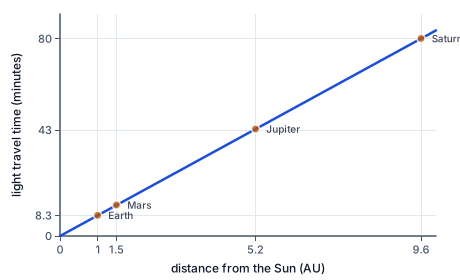
Dividing one AU by light's speed gives $150{,}000{,}000 \div 300{,}000 = 500$ seconds, or $8$ minutes $20$ seconds. That is how long sunlight takes to reach Earth. To reach Jupiter, at $5.2$ AU, it takes $5.2 \times 500 = 2{,}600$ seconds, about $43$ minutes; to reach Neptune, about four hours. The chart shows the straight line: every AU adds another $8.3$ minutes.
Because light takes time to travel, we never see anything as it is right now. We see the Sun as it was about $8$ minutes ago; if it suddenly went dark, we would not know for eight minutes. We see Jupiter as it was about three quarters of an hour ago, and the Moon, about $1.3$ light-seconds away, as it was just over a second ago.
This is not a trick of the eye; it is a basic fact of nature. The farther away we look, the further back in time we see. In the next lesson that idea grows enormous, because the light from distant stars and galaxies has been traveling for years, centuries and even billions of years.
Radio waves are a form of light and travel at the same speed. So when NASA sends a command to a spacecraft, it takes time to arrive. A probe at $10$ AU receives a command $10 \times 500 = 5{,}000$ seconds, about $83$ minutes, after it was sent, and any reply takes another $83$ minutes to come back.
As a probe travels away, the delay grows steadily. The Voyager 1 spacecraft, launched in 1977, is now more than $160$ AU from Earth, so a radio signal takes nearly a full day to reach it one way. Engineers plan every command around that delay, and they send instructions in long, carefully checked batches.
Mars is between about $0.4$ and $2.7$ AU from Earth, depending on where the two planets are in their orbits. At $1.2$ AU, a command takes $1.2 \times 500 = 600$ seconds, ten minutes, to arrive, and the rover's reply another ten minutes to return. A driver on Earth watching a live camera would see a cliff edge twenty minutes too late.
That is why Mars rovers use autonomous navigation. Engineers send a goal and a planned route; the rover photographs the ground ahead, picks a safe path itself, and drives carefully, reporting back afterward. The delay set by the speed of light shapes how every planetary mission is designed.
In the last lesson's playground model, with a model Sun $218$ cm wide, Earth was a $2$-cm marble. At that scale, one AU, about $108$ Sun widths, is about $235$ m. Jupiter would sit more than a kilometer away, and Neptune about seven kilometers away, in another part of town.
That is the real lesson of a scale model: the solar system is almost entirely empty space. The planets are tiny specks spread across enormous distances, which is why every diagram that shows them together has to break the scale.
Three checks help. Farther objects always have longer light times, and the time grows in proportion to the distance: twice as far, twice as long. A light time for something in the solar system should be from seconds to hours, never years; if you get years, you have used the wrong unit. And a there-and-back time is always exactly twice the one-way time.
The figures here are rounded: one AU is $149{,}597{,}871$ km and light's speed $299{,}792$ km/s, giving $499$ seconds per AU. Distances between planets also change all the time as they move in their orbits, so the delay to Mars changes from day to day, and engineers use exact predictions.
The light time to a planet from Earth is not the same as from the Sun: Jupiter is about $4.2$ AU from Earth at its closest and $6.2$ AU at its farthest, so the delay in talking to a Jupiter probe changes through the year.
NASA's Perseverance rover is driven by a team at the Jet Propulsion Laboratory in Pasadena, California. Mars's distance from Earth changes between about $0.4$ and $2.7$ AU, so the one-way delay ranges from about $3$ to $22$ minutes.
At $1.2$ AU, a command takes $1.2 \times 500 = 600$ seconds, ten minutes, to reach Mars, and the rover's reply another ten minutes to come back: a twenty-minute wait before the team even knows the command arrived. Live steering is impossible.
Instead, each day the team studies the rover's latest pictures, plans the next drive, and sends a sequence of commands in one batch. The rover carries them out on its own, using its cameras and onboard computer to choose safe paths around rocks. Perseverance set a record by driving hundreds of meters in a single day this way.
Voyager 1, launched from Cape Canaveral, Florida, in 1977, is the most distant human-made object. It moves away from the Sun at about $3.6$ AU every year, so the delay in talking to it grows by about $3.6 \times 500 = 1{,}800$ seconds, half an hour, every year.
At more than $160$ AU, a one-way signal takes about $160 \times 500 = 80{,}000$ seconds, over $22$ hours. When engineers at JPL send a command, they wait almost two days to learn whether it worked. Its signal is now so faint that it is caught by the huge dish antennas of NASA's Deep Space Network, including one at Goldstone in California's Mojave Desert.
The delay is a direct, everyday measure of distance: the speed of light turns hours of waiting into billions of kilometers.
Because the name includes minute, a light-minute sounds like a length of time. It is a distance: how far light travels in one minute, about 18 million km. Saying the Sun is 8.3 light-minutes away is saying how far away it is, by using light's travel time as a ruler.
The same goes for the light-year in the next lesson: it measures distance, not time.
Saturn is about $9.5$ AU from the Sun. Recall the light time per AU.
$500\ \text{s}$
150 million km at 300,000 km/s.
Multiply by the distance.
$9.5 \times 500$
The same time for each AU.
Evaluate the product.
$4750\ \text{s}$
Seconds of travel.
Convert to minutes.
$4750 \div 60 \approx 79\ \text{min}$
About an hour and twenty minutes.
An asteroid is $4$ AU from the Sun. Multiply by 150 million km.
$4 \times 150 = 600$
Millions of kilometers.
Write the full number.
$600{,}000{,}000\ \text{km}$
Six hundred million.
Multiply by 500 seconds.
$4 \times 500 = 2000\ \text{s}$
One-way light time.
Convert to minutes.
$2000 \div 60 \approx 33\ \text{min}$
About half an hour.
Check with light's speed.
$600{,}000{,}000 \div 300{,}000 = 2000$
The same answer.
A probe is $5$ AU from Earth. Find the one-way delay.
$5 \times 500 = 2500\ \text{s}$
Radio travels at the speed of light.
Convert to minutes.
$2500 \div 60 \approx 42\ \text{min}$
One way.
Double it for a reply.
$2 \times 2500 = 5000\ \text{s}$
Command and response.
Convert the round trip.
$5000 \div 60 \approx 83\ \text{min}$
Nearly an hour and a half.
Find the delay a year later at 3 AU per year.
$(5 + 3) \times 500 = 4000\ \text{s}$
The probe has moved farther away.
Say how engineers cope.
$\text{send batches of commands}$
The probe carries them out on its own.
Multiply by 500 seconds.
$19.2 \times 500$
The same time for each AU.
Evaluate the product.
$9600\ \text{s}$
Seconds of travel.
Convert to hours.
Astronomers say the Sun is about 8.3 light-minutes away. What does that measure?
Complete the worked solution: an asteroid is $10$ AU from the Sun. Find its distance in millions of kilometers and the light time in seconds.
Multiply the AU by 150 million kilometers.
$\text{AU} \times 150 =$ k
Millions of kilometers.
Multiply the AU by 500 seconds.
$\text{AU} \times 500 =$ s
Seconds of light time.
Say what the light time tells us.
$\text{we see it as it was}$
Its light left that many seconds ago.
Match each distance from the Sun to the time its sunlight takes to arrive.
| about 8.3 minutes | about 16.7 minutes | about 83 minutes | about 4.2 hours | |
|---|---|---|---|---|
| 1 AU | ||||
| 2 AU | ||||
| 10 AU | ||||
| 30 AU |
A spacecraft is $10$ AU from the Sun. Using 150 million km per AU and 500 seconds of light time per AU, fill in its distance in millions of kilometers, the one-way light time and the there-and-back radio time, in seconds.
| value | |
|---|---|
| distance (millions of km) | |
| one-way light time (s) | |
| there-and-back radio time (s) |
A space probe is now $2$ AU from Earth and moves $2$ AU farther away each year. At 500 seconds per AU, write the one-way delay of its radio signals, in seconds, as a function of the years $t$ from now.
Answer:
Jupiter is about $5.2$ AU from the Sun. How many seconds does sunlight take to reach it?
Answer: seconds of light travel
Engineers at NASA's Jet Propulsion Laboratory in California send a command to a Mars rover when Mars is $0.6$ AU from Earth. How many minutes pass before they can receive the rover's reply, counting only the travel of the signals?
Answer: minutes for a reply
Lesson test: one question per skill, one attempt each, no hints. Your answers are checked when you submit.
A space probe is now $10$ AU from Earth and moves $4$ AU farther away each year. At 500 seconds per AU, write the one-way delay of its radio signals, in seconds, as a function of the years $t$ from now.
Answer:
You can measure the solar system with light. Explain what a light-minute is, and find the light time to an object 4 AU away.
19. Your turn: how many seconds does sunlight take to reach Uranus, at about $19.2$ AU?, step 3
$9600 \div 3600 \approx 2.7\ \text{h}$
About two hours forty minutes.