Back to the on-screen lesson ·
A solar eclipse at new Moon and a lunar eclipse at full Moon need an exact line-up; the Moon's orbit is tilted about 5 degrees, so eclipses come only in eclipse seasons about 173 days apart.
Paper packet. Every task here also exists on screen, where it is checked automatically; answers written on paper are not assessed by Nydus. When you are back at a device, enter your answers there.
By the end of this lesson you will be able to explain solar and lunar eclipses with a model, explain why they are rare, and calculate when eclipse seasons come and how long totality lasts.
You know that the Moon goes around Earth once a month, that its phase depends on its angle from the Sun, and that new Moon is when it lies roughly between Earth and the Sun while full Moon is when it lies opposite. You know that a ball in sunlight casts a shadow on the side away from the light. This lesson uses those ideas to explain solar and lunar eclipses, why they are rare, and when they can happen.
| Term | What it means |
|---|---|
| Solar eclipse | The Moon passes between the Sun and Earth, and its shadow falls on Earth. |
| Lunar eclipse | Earth passes between the Sun and the Moon, and the Moon moves through Earth's shadow. |
| Umbra | The dark central part of a shadow, where the light source is fully blocked. |
| Node | One of the two points where the Moon's tilted orbit crosses Earth's orbit plane. |
| Eclipse season | A stretch of about five weeks, twice a year, when an eclipse can happen. |
An eclipse is a shadow falling on a world.
The nodes line up with the Sun twice in an eclipse year of $346$ days, so eclipse seasons come about
$$346 \div 2 = 173 \text{ days apart}.$$
Another way: picture
Picture two hula hoops, one big and one small, laid one inside the other but with the small one tipped a little. They touch the same flat level at only two places. A marble rolling around the small hoop is level with the big hoop only when it passes those two places.
Another way: steps
In a solar eclipse the Moon blocks the Sun. It can only happen at new Moon, because that is the only time the Moon is between the Sun and Earth. The Moon's shadow is small by the time it reaches Earth, so a solar eclipse is total only along a narrow path, often around a hundred kilometers wide, while a much wider region sees a partial eclipse.
In a lunar eclipse the Moon moves into Earth's shadow. It can only happen at full Moon, the only time Earth is between the Sun and the Moon. Earth's shadow is much bigger than the Moon, so a lunar eclipse can last for hours, and everyone on the night side of Earth sees it at the same time.
If the Moon's orbit lay in exactly the same flat plane as Earth's orbit, every new Moon would cross in front of the Sun and every full Moon would pass through Earth's shadow. We would have two eclipses every month.
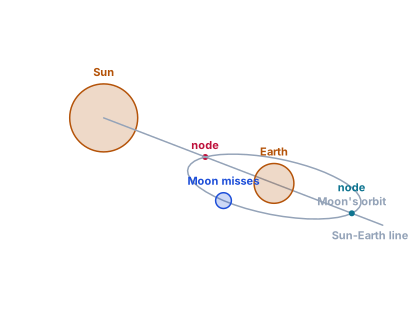
But the Moon's orbit is tilted by about $5^\circ$. That sounds small, yet the Moon is so far away that five degrees carries it about ten Moon widths above or below the Sun at most new Moons, far enough for its shadow to miss Earth entirely. The same tilt carries most full Moons above or below Earth's shadow. The figure exaggerates the tilt to make it visible.
The Moon's tilted orbit crosses the plane of Earth's orbit at two points called nodes. Only when a new or full Moon happens near a node are the three bodies lined up closely enough for an eclipse.
Twice a year, as Earth goes around the Sun, the line through the two nodes points at the Sun. For a few weeks around each of those times, called an eclipse season, any new or full Moon produces an eclipse. Each season lasts about $35$ days, longer than the gap between new and full Moon, so every eclipse season has at least two eclipses, a solar one and a lunar one, about two weeks apart.
The nodes slowly drift backward around the orbit, so the line of nodes points at the Sun again after only $346$ days, not a full $365$. That $346$-day period is called an eclipse year, and with two seasons in it, eclipse seasons come about $173$ days apart.
Because $346$ is $19$ days shorter than a calendar year, eclipse seasons come about $19$ days earlier each year. If one season is centered in late April, the next is in mid-October, and a year later the spring season comes in early April.
The Sun is about $1{,}392{,}000$ km wide and the Moon about $3{,}474$ km, so the Sun is roughly $400$ times wider. But the Sun is also about $150$ million km away and the Moon about $384{,}000$ km, so the Sun is roughly $390$ times farther.
Something $400$ times wider and about $400$ times farther away looks the same size. That is why the Moon can just cover the Sun's bright disk, letting us see the faint, pearly corona around it, one of nature's most beautiful sights. It is a coincidence: no other planet in the solar system has a moon that matches the Sun so closely.
The Moon's orbit is an ellipse, so its distance from Earth changes. When an eclipse happens with the Moon near its closest, it looks slightly bigger than the Sun and can cover it completely: a total eclipse. When the Moon is near its farthest, it looks slightly smaller and leaves a bright ring of Sun around its edge: an annular eclipse, from the Latin word for ring.
Away from the narrow central path, observers see the Moon cover only part of the Sun: a partial eclipse. On October 14, 2023, an annular eclipse crossed the western United States, and on April 8, 2024, a total eclipse crossed from Texas to Maine.
During a total lunar eclipse the Moon rarely disappears completely. Instead it turns a coppery red. Sunlight passing through Earth's atmosphere is bent into the shadow, and the atmosphere scatters away the blue light, just as it does at sunset, leaving red light to fall on the Moon.
In effect, the Moon is lit by all the sunrises and sunsets on Earth at once. Because the color depends on how much dust and cloud is in our atmosphere, astronomers have even used the darkness of lunar eclipses to track volcanic eruptions.
Never look at the Sun directly, during an eclipse or at any other time, and never through binoculars or a telescope without a proper solar filter. Even a thin crescent of Sun can burn the retina without pain.
Watching a solar eclipse needs certified eclipse glasses or an indirect method such as a pinhole projector, which casts a small image of the Sun onto paper. A lunar eclipse is completely safe to watch with the naked eye, binoculars or a telescope, because it is only moonlight.
Three checks catch most mistakes. A solar eclipse must be at new Moon and a lunar eclipse at full Moon; an answer that mixes them has the bodies in the wrong order. Totality at one place lasts only minutes, never hours, because the shadow is small and moves fast; if your answer is hours, you have divided the wrong way. And eclipse seasons are about half a year apart; a date only a month later cannot be the next season.
On August 21, 2017, the Moon's dark shadow touched the Oregon coast at about 10:16 am Pacific time and left South Carolina about an hour and a half later, the first total eclipse to cross the whole country from coast to coast since 1918. The path of totality was about $110$ km wide, and along it the sky darkened, stars and planets appeared, and the temperature dropped several degrees.
Near Carbondale, Illinois, totality lasted about $2$ minutes $40$ seconds, among the longest on the path. The shadow raced across the ground at over $2{,}000$ km/h, so dividing its width by its speed gives a total of only a few minutes at any one place.
Millions of people drove into the path, and towns along it prepared for traffic months ahead. Carbondale was lucky: it sat where the 2017 path crossed the path of the April 8, 2024 eclipse, giving it two total eclipses in under seven years.
NASA publishes maps of eclipses for thousands of years into the past and future. Those predictions rest on the regular motions in this lesson: the lunar month, the eclipse year of $346$ days, and the slow turning of the nodes.
Ancient astronomers found a pattern long before the physics was known. After about $18$ years and $11$ days, called a saros, the Sun, Moon and nodes return to nearly the same arrangement, so an eclipse is followed by a very similar one a saros later, shifted about a third of the way around the world. Babylonian astronomers used the saros to predict lunar eclipses more than two thousand years ago.
Modern predictions are far more exact. The next total solar eclipse visible from the mainland United States comes on August 23, 2044, by universal time, near sunset in Montana and North Dakota, and its path was mapped decades in advance.
Since the Moon goes around Earth every month, it seems it should cross the Sun every month. It does pass the Sun's direction, but usually above or below it, because its orbit is tilted about five degrees.
Another confusion is to think that phases and eclipses are the same thing. Phases are a monthly change in viewing angle; eclipses are rare line-ups in which a shadow falls on Earth or on the Moon.
Earth lies between the Sun and the Moon. Find the body in the middle.
$\text{Earth}$
The middle body casts the shadow.
Say where the shadow falls.
$\text{on the Moon}$
Earth's shadow points away from the Sun.
Name the eclipse.
$\text{lunar eclipse}$
The Moon is darkened.
Name the phase.
$\text{full Moon}$
The Moon is opposite the Sun.
The shadow is $180$ km wide and moves at $2700$ km/h. Divide width by speed.
$\dfrac{180}{2700}\ \text{h}$
Time for the shadow to pass.
Simplify the fraction.
$\dfrac{180}{2700} = \dfrac{1}{15}$
Divide top and bottom by 180.
Multiply by sixty minutes.
$\dfrac{1}{15} \times 60$
Hours into minutes.
Evaluate the minutes.
$4\ \text{min}$
Totality at the center of the path.
Check against the record.
$4 < 7.5$
Totality never lasts more than about seven and a half minutes.
An eclipse season is centered on day $98$, early April. Recall the gap.
$173\ \text{days}$
Half an eclipse year.
Add the gap.
$98 + 173 = 271$
Day 271 is late September.
Find the eclipse year.
$2 \times 173 = 346\ \text{days}$
Two seasons.
Find next year's spring season.
$98 + 346 - 365 = 79$
Day 79 is about March 20.
Find the drift.
$98 - 79 = 19\ \text{days earlier}$
The seasons slide through the calendar.
Say which eclipses each season holds.
$\text{a solar and a lunar eclipse}$
New and full Moon both fall inside the season.
Recall the gap between seasons.
$173\ \text{days}$
Half an eclipse year.
Add the gap.
$140 + 173$
Counting on.
State the day.
The Moon passes between Earth and the Sun at every new Moon. Why is there not a solar eclipse every month?
Complete the worked solution: an eclipse season is centered on day $100$ of the year. Find the day of the next season, and the day of the same season next year.
Add the gap between seasons.
$\text{day} + 173 =$ a
Seasons come about 173 days apart.
Find the same season a year later.
$\text{day} + 346 - 365 =$ b
Two seasons make 346 days, short of a calendar year.
Say why the dates drift.
$\text{the nodes slowly turn}$
The Moon's crossing points move backward around the orbit.
Match each arrangement to what is seen from Earth.
| total solar eclipse | lunar eclipse | annular solar eclipse | full Moon, no eclipse | |
|---|---|---|---|---|
| Sun, Moon, Earth in a line, Moon close to Earth | ||||
| Sun, Earth, Moon in a line | ||||
| Sun, Moon, Earth in a line, Moon at its farthest | ||||
| Moon opposite the Sun but above the line |
An eclipse season is centered on day $60$ of the year. Fill in the day of the next eclipse season, the days in a full eclipse year, and the day of the same season next year.
| value | |
|---|---|
| day of the next eclipse season | |
| days in an eclipse year | |
| day of the same season next year |
An eclipse season is centered on day $110$ of a year. Counting days on from the start of that year, write the day on which the $k$th eclipse season after it is centered.
Answer:
The Moon's dark shadow is $150$ km wide and races across the ground at $2250$ km/h. About how many minutes does totality last at the center of the path?
Answer: minutes of totality
Suppose the Moon's shadow in a total eclipse crosses the United States along a path about $4500$ km long, at an average speed of about $2700$ km/h. About how many minutes does the shadow take to cross the country?
Answer: minutes to cross the country
Lesson test: one question per skill, one attempt each, no hints. Your answers are checked when you submit.
An eclipse season is centered on day $110$ of a year. Counting days on from the start of that year, write the day on which the $k$th eclipse season after it is centered.
Answer:
You can explain eclipses. Explain why there is not a solar eclipse at every new Moon, and why a lunar eclipse can only happen at full Moon.
20. Your turn: an eclipse season is centered on day $140$. When is the next one?, step 3
$313$
Early November.