Back to the on-screen lesson ·
Every mass pulls on every other, more strongly for bigger masses and weaker with the square of the distance; gravity holds the planets, moons and galaxies in orbit, and a world's surface gravity sets what things weigh there.
Paper packet. Every task here also exists on screen, where it is checked automatically; answers written on paper are not assessed by Nydus. When you are back at a device, enter your answers there.
By the end of this lesson you will be able to explain the role of gravity in the motions of the solar system and galaxies, use the inverse square law, and calculate weights on other worlds.
You know that things fall when you let go of them, and that this pull is called gravity. You know Earth goes around the Sun and the Moon goes around Earth. This lesson connects those facts: the same gravity that pulls an apple to the ground holds the Moon in its orbit, keeps the planets circling the Sun, and holds whole galaxies together.
| Term | What it means |
|---|---|
| Gravity | The attraction between any two masses. |
| Mass | The amount of matter in an object, measured in kilograms; it is the same everywhere. |
| Weight | The pull of gravity on an object, measured in newtons or pounds; it changes from world to world. |
| Orbit | The curved path of one body around another, held by gravity. |
| Inverse square | Changing as one over the square of the distance: twice as far, a quarter as strong. |
Every mass pulls on every other mass. The pull between two bodies:
If the distance is multiplied by $k$, the pull is divided by $k^2$:
$$\text{new pull} = \frac{\text{old pull}}{k^2}.$$
Twice as far gives a quarter of the pull; three times as far, a ninth. The pull never reaches zero, so gravity reaches across the whole solar system and between the stars. That inward pull, combined with each body's sideways motion, makes an orbit.
Another way: picture
Swing a ball on a string in a circle. The string pulls the ball inward all the time, and the ball keeps trying to fly off in a straight line. Let go and it does fly off. For a planet, the Sun's gravity is the string.
Another way: steps
In the 1680s Isaac Newton realized that the force pulling an apple to the ground might be the same force that holds the Moon in its orbit. He tested the idea with numbers. The Moon is about $60$ Earth radii from Earth's center, so if gravity weakens with the square of distance, the Moon should feel $60 \times 60 = 3{,}600$ times less pull than an apple does.
Newton worked out how fast the Moon must be falling toward Earth to curve around its orbit, and found it was almost exactly $3{,}600$ times smaller than an apple's fall. One law explained both. It was the first time anyone showed that the heavens obey the same rules as the ground beneath our feet.
Imagine throwing a ball sideways from a tall mountain. It curves down and lands. Throw it faster, and it lands farther away. Throw it fast enough, and as it falls, Earth's curved surface curves away beneath it just as fast, so it never lands: it keeps falling around Earth forever. That is an orbit.
The Moon is doing exactly this. It is falling toward Earth all the time, but it is also moving sideways at about $1$ km every second, so it keeps missing. The planets do the same around the Sun. Without gravity they would travel in straight lines and leave the solar system; without their sideways motion they would fall straight in.
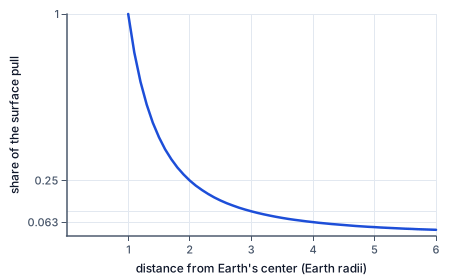
Gravity gets weaker with distance in a particular way. Picture the pull spreading out from a planet in every direction, like light from a bulb. At twice the distance, the same pull is spread over a sphere with four times the area, so each square meter gets a quarter as much. At three times the distance, nine times the area, a ninth of the pull.
This is called an inverse square law. It is why the outer planets feel only a weak tug from the Sun and move slowly, and why a spacecraft far from Earth needs far less effort to keep going. The chart shows the curve: steep at first, then flatter, but never touching zero.
Your mass is how much matter you are made of. It is the same on Earth, on the Moon and floating in space. Your weight is how hard gravity pulls on that mass, and it depends on where you are.
On the Moon, which has much less mass than Earth, surface gravity is about a sixth of Earth's, so a student who weighs $120$ lb on Earth would weigh about $20$ lb there, yet still have the same mass and be just as hard to stop when running. On Mars the surface gravity is about $0.38$ of Earth's. At the cloud tops of Jupiter, the most massive planet, it is about $2.5$ times Earth's.
The Sun holds about $99.8$ percent of all the mass in the solar system, so its gravity dominates. It holds Mercury, the nearest planet, in a fast orbit of $88$ days and Neptune, thirty times farther, in a slow one of $165$ years. It holds the dwarf planets, the asteroids and the comets, some of which swing out tens of thousands of times farther than Earth.
Each planet's gravity also holds its moons. Jupiter, the most massive planet, holds nearly a hundred known moons. Gravity even shapes the bodies themselves: anything with enough mass is pulled into a round shape, which is why planets and large moons are spheres while small asteroids are lumpy.
Gravity works between stars too. The Sun is one of a few hundred billion stars in the Milky Way, a vast spinning disk about $100{,}000$ light-years across. The combined pull of all that matter holds the stars in orbit around the galaxy's center, just as the Sun holds the planets.
The Sun takes about $230$ million years to go once around the galaxy. When astronomers measure how fast stars orbit, they find the outer stars moving too fast to be held by the visible stars and gas alone, which is one of the main pieces of evidence for invisible dark matter, a puzzle that later courses take up.
Two checks keep gravity calculations honest. Moving farther away always makes the pull weaker, so a new pull larger than the old one means you multiplied instead of divided. And the pull shrinks by the square of the multiplier: three times as far divides by nine, not three.
For weights on other worlds, a smaller world like the Moon or Mars gives a smaller weight, and a giant like Jupiter a larger one. Mass never changes, so if your answer changes a mass in kilograms, you have mixed up mass and weight.
This lesson treats planets as points and orbits as simple. Newton's law is accurate enough to send spacecraft to Pluto and beyond, but it needs one correction in very strong gravity: near the Sun, Mercury's orbit turns slightly faster than Newton predicts, which Albert Einstein's general relativity explains. GPS satellites must also correct for Einstein's effects to give accurate positions.
The weights here use rounded surface gravities. Jupiter has no solid surface, so its figure is for the pressure level at the top of its clouds; a probe descending into Jupiter would never find ground to stand on.
NASA's Artemis astronauts train for walking on the Moon, where they will weigh about a sixth of what they weigh on Earth. An astronaut who weighs $180$ lb and wears a spacesuit and backpack weighing about $120$ lb on Earth carries $300$ lb in all, which is $300 \div 6 = 50$ lb on the Moon.
That sounds easy, but the mass is unchanged: all $300$ lb worth of matter is just as hard to start, stop and turn as on Earth. Apollo astronauts found that out the hard way, and adopted a hopping gait to move efficiently. To practice, NASA uses a large pool at the Neutral Buoyancy Laboratory in Houston, Texas, and harness rigs that hold up five sixths of a person's weight.
Engineers designing lunar rovers and landing legs use the same factor of one sixth for loads, while still designing for the full mass in every turn and stop.
NASA's Perseverance rover weighs about $2{,}250$ lb on Earth, but on Mars, where surface gravity is about $0.38$ of Earth's, it weighs about $2{,}250 \times 0.38 = 855$ lb. Engineers at the Jet Propulsion Laboratory in Pasadena, California, design its wheels and suspension for the lighter Martian load, then test them on Earth with special lightweight copies of the rover.
The weaker gravity matters even more for flight. The Ingenuity helicopter, which weighs about $4$ lb on Earth and only about $1.5$ lb on Mars, flew 72 times between 2021 and 2024. Mars's thin air made flying hard, but the lower weight helped its small rotors lift it.
Every one of those designs starts from the same idea as this lesson: a world's mass and size set its surface gravity, and weight is mass times that pull.
Astronauts float on the space station, so it seems there is no gravity up there. In fact Earth's gravity at the station's height is still about 90 percent as strong as on the ground. The astronauts float because they are falling around Earth together with the station, which the next lessons explain.
Gravity weakens with distance but never switches off. It is the reason there are orbits at all.
A satellite feels a pull of $400$ N. It moves to twice the distance. Square the multiplier.
$2 \times 2 = 4$
Gravity falls with the square of distance.
Divide the pull by it.
$400 \div 4$
The pull shrinks by that factor.
Evaluate the new pull.
$100\ \text{N}$
A quarter of the old pull.
Check the direction of change.
$100 < 400$
Farther means weaker.
An astronaut weighs $180$ lb on Earth with gear. Recall the Moon factor.
$\tfrac{1}{6}$
The Moon's surface gravity.
Divide by six.
$180 \div 6 = 30\ \text{lb}$
Weight on the Moon.
Recall the Mars factor.
$0.38$
Mars's surface gravity.
Multiply by it.
$180 \times 0.38 = 68.4\ \text{lb}$
Weight on Mars.
Say what stays the same.
$\text{the mass}$
Matter does not change with place.
The Moon is about $60$ Earth radii away. Write the multiplier.
$k = 60$
Compared with an apple one radius from Earth's center.
Square the multiplier.
$60 \times 60 = 3600$
Gravity falls with the square of distance.
Write the Moon's share of an apple's pull.
$\tfrac{1}{3600}$
Each kilogram of Moon feels this share.
Find an apple's fall in one second.
$\approx 4.9\ \text{m}$
Measured on Earth.
Divide by the factor.
$4.9 \div 3600 \approx 0.0014\ \text{m}$
About a millimeter and a half in the first second.
Compare with the Moon's real fall.
$\text{the same}$
The Moon curves toward Earth by just that much each second.
Square the multiplier.
$3 \times 3 = 9$
Inverse square.
Divide the pull.
$900 \div 9$
Shrinks by nine.
State the new pull.
What keeps the planets moving around the Sun instead of flying off?
Complete the worked solution: a backpack weighs $60$ lb on Earth. Find what it would weigh on the Moon and at Jupiter's cloud tops.
Divide the Earth weight by six.
$\text{Earth weight} \div 6 =$ m
The Moon's surface gravity is about a sixth of Earth's.
Multiply the Earth weight by 2.5.
$\text{Earth weight} \times 2.5 =$ j
Jupiter's pull at its cloud tops.
Say what stays the same everywhere.
$\text{the backpack's mass}$
Only the pull of gravity changes.
Match each change in distance between two bodies to the share of the pull that remains.
| one quarter of the pull | one ninth of the pull | one sixteenth of the pull | one hundredth of the pull | |
|---|---|---|---|---|
| 2 times as far | ||||
| 3 times as far | ||||
| 4 times as far | ||||
| 10 times as far |
A student weighs $180$ lb on Earth. Using the Moon's gravity as one sixth of Earth's, Mars's as 0.38 and Jupiter's as 2.5 times, fill in the student's weight on each.
| value | |
|---|---|
| weight on the Moon (lb) | |
| weight on Mars (lb) | |
| weight on Jupiter (lb) |
A space probe weighs $2000$ N at Earth's surface, one Earth radius from Earth's center. Write its weight, in newtons, when it is $k$ Earth radii from Earth's center.
Answer:
Gravity pulls a satellite with a force of $500$ N. If it moves to $5$ times its distance from the planet's center, what is the pull, in newtons?
Answer: newtons of pull
NASA's the Ingenuity helicopter weighs about $4$ lb on Earth. Mars's surface gravity is about 0.38 of Earth's. About how much does it weigh on Mars, in pounds?
Answer: pounds on Mars
Lesson test: one question per skill, one attempt each, no hints. Your answers are checked when you submit.
A space probe weighs $2000$ N at Earth's surface, one Earth radius from Earth's center. Write its weight, in newtons, when it is $k$ Earth radii from Earth's center.
Answer:
You can explain what holds the solar system together. Explain why the Moon does not fall into Earth, and what happens to the pull of gravity at three times the distance.
19. Your turn: a pull of $900$ N, at three times the distance., step 3
$100\ \text{N}$
A ninth of the pull.