Back to the on-screen lesson ·
The Moon moves about 12 degrees east a day, so it rises about 50 minutes later; its uneven pull raises two ocean bulges, giving high tides about 12 hours 25 minutes apart, with spring tides at new and full Moon.
Paper packet. Every task here also exists on screen, where it is checked automatically; answers written on paper are not assessed by Nydus. When you are back at a device, enter your answers there.
By the end of this lesson you will be able to explain why the Moon rises later each day and why there are two tides a day, and predict moonrise, high tides and spring tides.
You know that the Moon orbits Earth about once a month, moving about twelve degrees east each day, and that Earth turns fifteen degrees an hour. You may have visited a beach and seen the water creep up and then back down. This lesson uses the Moon's motion to explain why it rises later each day, and uses its gravity to explain the tides.
| Term | What it means |
|---|---|
| Moonrise | The moment the Moon appears above the eastern horizon. |
| High tide | The highest level the sea reaches in a tidal cycle. |
| Tidal bulge | A broad hump of ocean water raised by the Moon's uneven pull. |
| Spring tide | A large tide at new and full Moon, when the Sun and Moon pull in line. |
| Neap tide | A small tide at the quarter Moons, when the Sun and Moon pull at right angles. |
| Tidal range | The difference in height between high and low tide. |
Two facts about the Moon explain this lesson.
Earth turns under the two bulges, and the Moon returns overhead every $24$ h $50$ min, so a coast meets a high tide about every
$$\frac{24 \text{ h } 50 \text{ min}}{2} = 12 \text{ h } 25 \text{ min} = 745 \text{ min}.$$
Another way: picture
Picture three runners joined by stretchy ropes, with a coach pulling the front runner hardest, the middle one less and the back one least. The front runner pulls ahead, the back runner lags behind, and the group stretches out at both ends. The ocean stretches the same way along the line to the Moon.
Another way: steps
Suppose the Moon rises at 6:00 pm tonight. Over the next day Earth turns once, but meanwhile the Moon moves about $12^\circ$ east along its orbit. When Earth has turned once, the Moon is not yet at the horizon; Earth must turn about $12^\circ$ more. At $15^\circ$ an hour, that takes about $12 \div 15 = 0.8$ hours, close to $50$ minutes. So tomorrow the Moon rises at about 6:50 pm.
Notice that this is the opposite of the stars, which rise four minutes earlier each night. The stars stay put while the Sun drifts east, but the Moon drifts east much faster than the Sun, so it falls behind. In about a month the delays add up to a whole day, and the cycle of phases repeats.
The delay ties moonrise to the phase. A full Moon, opposite the Sun, rises around sunset. A day later it rises about 50 minutes after sunset, and a week later, at third quarter, around midnight. Near new Moon it rises and sets with the Sun.
That is why the full Moon is up all night, while a waning crescent appears only in the early morning before sunrise, and a waxing crescent only in the early evening after sunset. If you know the phase, you know roughly when to look.
Gravity gets weaker with distance. The ocean on the side of Earth facing the Moon is about $6{,}400$ km closer to the Moon than Earth's center, so it is pulled a little harder than the center. The ocean on the far side is $6{,}400$ km farther away, so it is pulled a little less.
What matters for the tides is the difference between each pull and the pull on Earth's center. The near ocean is pulled toward the Moon more than the solid Earth is, so it heaps up facing the Moon. The solid Earth is pulled toward the Moon more than the far ocean is, so it moves away from that water and leaves it heaped up on the far side. The result is two bulges, one facing the Moon and one facing away.
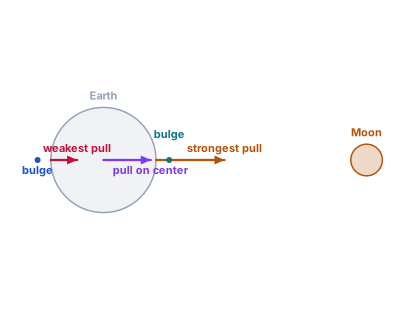
Earth turns once a day underneath the two bulges, so a place on the coast is carried through a bulge, a trough, the other bulge and another trough: high tide, low tide, high tide, low tide. Because the Moon itself moves east, it comes back overhead every $24$ hours $50$ minutes rather than every $24$ hours, and the high tides come about $12$ hours $25$ minutes apart.
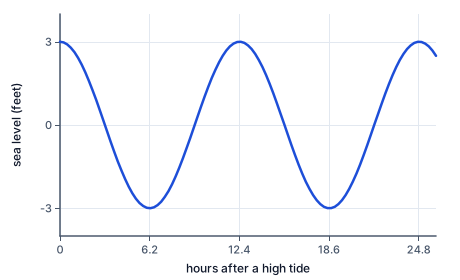
That steady rhythm is why tide tables can be printed a year ahead, and why each day's high tides come about 50 minutes later than the day before, the same delay as moonrise. The chart shows the pattern: high tides near hours $0$, $12.4$ and $24.8$, with low tides halfway between.
The Sun also raises tides, about half as big as the Moon's. At new Moon and full Moon the Sun, Moon and Earth are in a line, so the two sets of bulges point the same way and add. High tides are especially high and low tides especially low: spring tides. The name has nothing to do with the season; it comes from an old word meaning to leap up.
At first and third quarter the Sun and Moon pull at right angles. The Sun's bulges partly fill in the Moon's low tides and lower its high tides, and the tidal range is smallest: neap tides. Spring tides therefore come about every $15$ days, half of the $29.5$-day lunar month, and neap tides fall halfway between.
The two-bulge model explains the pattern, but real tides also depend on the shape of the coast and the ocean floor. Water cannot simply flow around the whole planet, because continents are in the way, so tides slosh around ocean basins. Some places, such as parts of the Gulf of Mexico, have only one high tide a day.
Funnel-shaped bays amplify tides. The Bay of Fundy between Maine and Nova Scotia has the largest tidal range in the world, up to about $16$ meters. Cook Inlet near Anchorage, Alaska, has a range of about $9$ meters, among the largest in the United States. In open ocean, far from land, the tide is only about a meter.
Tide and moonrise answers can be checked against two rules. Each high tide comes about $745$ minutes after the one before, so two of them come $1490$ minutes later, $50$ minutes more than a full day. Moonrise comes about $50$ minutes later each day, so after a week it is about six hours later: a Moon that rose at sunset now rises around midnight.
If an answer has the Moon rising earlier each day, or the tides coming further apart than half a day, a sign or a unit is wrong.
The fifty-minute delay is an average. Because the Moon's orbit is tilted and elliptical, the actual delay varies from about half an hour to over an hour, and near the autumn equinox the full Moon rises only a little later each night, which gave the harvest Moon its name: farmers had moonlight right after sunset for several evenings.
Tides also lag behind the Moon. Friction with the ocean floor slows the water, so high tide at a given harbor usually comes some time after the Moon is highest, and that lag is part of what a tide table records for each place.
The National Oceanic and Atmospheric Administration publishes tide predictions for thousands of places along the American coast. A charter boat captain in Bar Harbor, Maine, checks them every day, because the tidal range there is about three to four meters, enough to leave boats sitting on the mud at low tide in a shallow cove.
If a high tide comes at 6:10 am, the captain knows the next will come about $745$ minutes later, around 6:35 pm, and the next morning's around 7:00 am, about fifty minutes later than today's. Low tides fall about six hours twelve minutes after each high tide.
The published tables add local corrections for the lag behind the Moon and for the shape of the harbor, but the rhythm underneath is the one in this lesson: two bulges, and a Moon that comes back overhead every $24$ hours $50$ minutes.
Along the coast of Maine and in Washington's Puget Sound, people dig for clams on mud flats that are covered by water most of the time. The best digging comes at the very lowest tides, which are the low tides of the spring tides, just after new and full Moon.
Clam diggers therefore plan by the Moon. If the full Moon falls on the 9th, spring tides come around the 9th to the 11th, and the next set around the 24th, about fifteen days later, near new Moon. During the neap tides in between, around the quarter Moons, the low tides do not fall as far and the best flats stay underwater.
State wildlife agencies sometimes open recreational shellfish seasons on exactly those spring-tide days, and they set the dates a year in advance using the same lunar cycle.
It is easy to picture the Moon simply pulling the ocean toward itself, which would give one bulge and one high tide a day. But tides come from the difference in the Moon's pull across Earth, which stretches the oceans out on both sides.
Another common mix-up is to think spring tides happen in the spring. Spring and neap tides come every two weeks all year, set by the phase of the Moon.
Find the extra turning in one day.
$12^\circ$
The Moon moves about twelve degrees east a day.
Divide by Earth's turning rate.
$12 \div 15 = 0.8\ \text{h}$
Fifteen degrees an hour.
Convert the hours into minutes.
$0.8 \times 60 = 48\ \text{min}$
About fifty minutes.
Find the delay after 5 days.
$5 \times 50 = 250\ \text{min}$
About four hours later.
A high tide comes at 3:00 am, $180$ minutes after midnight. Turn the gap into minutes.
$12 \times 60 + 25 = 745$
Twelve hours twenty-five minutes.
Add one gap.
$180 + 745 = 925$
925 minutes after midnight.
Convert into a clock time.
$925 = 15 \times 60 + 25$
3:25 pm.
Add another gap.
$925 + 745 = 1670$
The next morning's high tide.
Convert into the next day.
$1670 - 1440 = 230 = 3 \times 60 + 50$
3:50 am, fifty minutes later than today's.
Full Moon falls on the 6th. Recall when spring tides come.
$\text{new and full Moon}$
Sun and Moon in line.
Find half a lunar month.
$29.5 \div 2 \approx 15\ \text{days}$
Full Moon to new Moon.
Add it to the full Moon date.
$6 + 15 = 21$
New Moon on about the 21st.
Find the neap tides between.
$6 + 7 = 13$
Third quarter, about a week after full.
Compare the tidal ranges.
$\text{largest on the 6th and 21st}$
Smallest near the 13th.
Allow for the lag.
$\text{a day or two later}$
Spring tides peak shortly after new and full Moon.
Recall the daily delay.
$50\ \text{min per day}$
The Moon's eastward motion.
Multiply by the days.
$8 \times 50$
The delays add up.
State the delay.
Why do most coasts have two high tides a day, not one?
Complete the worked solution: a high tide comes $390$ minutes after midnight. Find the next two high tides, in minutes after the same midnight.
Add one gap of 745 minutes.
$\text{first} + 745 =$ a
Twelve hours twenty-five minutes later.
Add a second gap.
$\text{next} + 745 =$ b
The high tide after that.
Say why the tide keeps pace with the Moon.
$\text{the bulges follow the Moon}$
The Moon returns overhead every 24 hours 50 minutes.
Match each phase of the Moon to the tides it brings.
| spring tides, after new Moon | neap tides, at first quarter | spring tides, after full Moon | neap tides, at third quarter | |
|---|---|---|---|---|
| new Moon | ||||
| first quarter | ||||
| full Moon | ||||
| third quarter |
A harbor has a high tide $200$ minutes after midnight. Fill in, in minutes after the same midnight, the next high tide, the one after that, and the gap between them.
| value | |
|---|---|
| next high tide (minutes after midnight) | |
| following high tide (minutes after midnight) | |
| gap between high tides (minutes) |
Tonight the full Moon rises $40$ minutes after sunset. Taking sunset as the same time each day and a delay of about fifty minutes a day, write how many minutes after sunset the Moon rises $d$ days from now.
Answer:
About how many minutes later does the Moon rise $2$ days from now than it rises tonight?
Answer: minutes later
On the coast of Maine, the biggest tides of the month, spring tides, come on day $11$ just after a full Moon. A clam digger wants the next spring tides, when the low tides uncover the most mud flat. On about which day of the month will they come?
Answer: day of the month
Lesson test: one question per skill, one attempt each, no hints. Your answers are checked when you submit.
Tonight the full Moon rises $30$ minutes after sunset. Taking sunset as the same time each day and a delay of about fifty minutes a day, write how many minutes after sunset the Moon rises $d$ days from now.
Answer:
You can explain the tides. Explain why a coast has two high tides a day, and why spring tides come at new and full Moon.
19. Your turn: how many minutes later does the Moon rise in 8 days?, step 3
$400\ \text{min}$
About six hours forty minutes.