Back to the on-screen lesson ·
Farther planets have longer paths and move more slowly, so with distance in AU and period in years, the period squared equals the distance cubed; around a heavier star orbits are quicker.
Paper packet. Every task here also exists on screen, where it is checked automatically; answers written on paper are not assessed by Nydus. When you are back at a device, enter your answers there.
By the end of this lesson you will be able to explain why outer planets have long years, and use Kepler's third law to find a period from a distance and a distance from a period.
You know that gravity holds the planets in orbit around the Sun and that it weakens with the square of the distance. You know that Earth takes one year to go around the Sun, and that the outer planets are farther away. This lesson finds the exact rule connecting a planet's distance to the length of its year, and uses it to predict orbits anywhere.
| Term | What it means |
|---|---|
| Astronomical unit (AU) | Earth's average distance from the Sun, about 150 million km or 93 million miles. |
| Orbital period | The time a body takes to go once around its orbit. |
| Ellipse | A stretched circle; planets move in slightly elliptical orbits. |
| Kepler's third law | For orbits around the Sun, the period in years squared equals the distance in AU cubed. |
| Cube | A number multiplied by itself three times, such as 4 × 4 × 4 = 64. |
Measure an orbit's average distance from the Sun $a$ in astronomical units and its period $P$ in years. Then for every planet, asteroid and comet:
$$P^2 = a^3.$$
At $4$ AU: $4^3 = 64 = 8^2$, so the period is $8$ years. At $9$ AU: $9^3 = 729 = 27^2$, so $27$ years. A planet farther out takes much longer, because its path is longer and it moves more slowly. Around a star $M$ times the Sun's mass, the rule becomes $P^2 = a^3 / M$.
Another way: picture
Imagine runners on circular tracks of different sizes around a field, where the runners on the outer tracks are also more tired and jog more slowly. The outer runners take far longer to finish a lap, both because their track is longer and because they are slower.
Another way: steps
Johannes Kepler spent years working with the careful planet positions measured by the Danish astronomer Tycho Brahe. In 1609 he showed that planets move in ellipses with the Sun at one focus, and that they speed up when nearer the Sun. In 1619 he found a third rule, connecting the size of each orbit to its period.
Kepler had no explanation for why the rule held. Seventy years later Isaac Newton showed that it follows directly from gravity weakening with the square of distance. The third law is therefore not just a pattern in the numbers but a test of gravity itself, and it has passed that test for every planet, moon and satellite measured since.
The law takes its simplest form when distance is measured in astronomical units and time in years, because then Earth's own orbit gives $1^2 = 1^3$. One AU is Earth's average distance from the Sun, about $150$ million km or $93$ million miles.
In these units, you can compare any orbit around the Sun directly with Earth's. Mars averages $1.52$ AU from the Sun; Jupiter $5.2$ AU; Neptune about $30$ AU. A comet that swings far out past Neptune might average $100$ AU, and its period would be $\sqrt{100^3} = \sqrt{1{,}000{,}000} = 1{,}000$ years.
To find a period from a distance, cube the distance and take the square root. For an asteroid at $4$ AU: $4^3 = 4 \times 4 \times 4 = 64$, and $\sqrt{64} = 8$, so it takes $8$ years. Distances that are perfect squares, such as $4$, $9$, $16$ and $25$, give whole-number periods: $8$, $27$, $64$ and $125$ years.
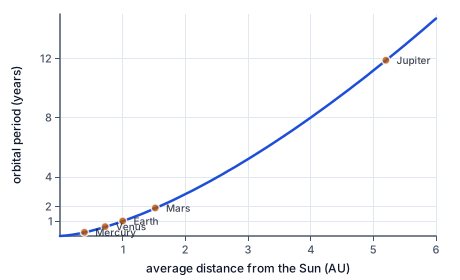
For real planets the numbers are not so tidy, and a calculator is needed. For Mars, $1.52^3 \approx 3.51$ and $\sqrt{3.51} \approx 1.87$ years, very close to the measured $1.88$ years. The chart shows the real planets sitting right on the curve.
To find a distance from a period, square the period and take the cube root. Halley's Comet returns about every $76$ years. Then $76^2 = 5{,}776$, and the cube root of $5{,}776$ is about $17.9$, so its average distance from the Sun is about $18$ AU, between Uranus and Neptune.
Periods that are perfect cubes give tidy answers: a period of $8$ years means a distance of $4$ AU, because $8^2 = 64 = 4^3$. This backward use is how astronomers find the sizes of orbits they cannot measure directly, from timing alone.
If every planet moved at Earth's speed, a planet twice as far would simply take twice as long, because its path would be twice as long. But the Sun's pull is four times weaker at twice the distance, and a weaker pull can only hold a slower planet in orbit; a fast planet would fly off.
Earth moves along its orbit at about $30$ km every second. Jupiter, $5.2$ times farther out, moves at only about $13$ km/s, and Neptune at about $5.4$ km/s. Longer paths at lower speeds make the outer planets' years very long: Neptune has gone around the Sun only about once since it was discovered in 1846.
Kepler's law in its simple form works only for orbits around the Sun. Around a more massive star, gravity is stronger at every distance, so a planet at the same distance must move faster to stay in orbit, and its year is shorter. The rule becomes $P^2 = a^3 / M$, where $M$ is the star's mass in units of the Sun's mass.
Astronomers use this the other way around. By timing a planet around another star and measuring its distance, they can weigh the star. The same idea, applied to the stars orbiting the center of our galaxy, revealed a black hole about four million times the mass of the Sun.
Three checks catch most errors. A period in years should be larger than the distance in AU for any orbit beyond Earth's, and smaller for any orbit inside it: $P = a\sqrt{a}$. If your period for $9$ AU is $9$ years or $3$ years, you forgot the cube. Square your period and cube your distance; the two should match. And a farther orbit must always have a longer period.
The law treats the planet's mass as tiny compared with the Sun's, which is very nearly true even for Jupiter, at about a thousandth of the Sun's mass. It also uses the average distance of an elliptical orbit, which is the right measure for the period.
The law says nothing about the planet's own spin, its size or what it is made of. A pebble and a planet at the same distance have the same period. That surprising fact, that mass does not matter for the orbiting body, is the same reason a feather and a hammer fall together on the airless Moon.
Edmond Halley used Newton's laws in 1705 to show that bright comets seen in 1531, 1607 and 1682 were the same object returning about every $76$ years. He predicted it would return in 1758. He died before then, but the comet appeared on schedule, and it has carried his name ever since.
Kepler's third law turns that period into an orbit size: $76^2 = 5{,}776$, and its cube root is about $17.9$ AU. Halley's Comet swings in closer than Venus at its nearest and out beyond Neptune at its farthest, averaging about $18$ AU.
Its last visit was in 1986, when spacecraft flew past it, and it is due back in 2061. Astronomers at NASA's Jet Propulsion Laboratory in Pasadena track thousands of comets and asteroids the same way, using their periods to predict exactly where they will be.
Since 1995, astronomers have found thousands of planets orbiting other stars. NASA's Kepler space telescope, named after Johannes Kepler, watched about $150{,}000$ stars for the tiny dimming that happens when a planet passes in front of its star, and timed how often each planet came around.
With a planet's period and the star's mass, the third law gives the size of its orbit, which tells astronomers whether the planet is close enough to its star to be scorching hot, or at a distance where water could be liquid. A planet around a star four times the Sun's mass, at $4$ AU, would orbit in $4$ years rather than the $8$ years it would take around the Sun.
The same law, applied to stars whipping around the center of the Milky Way, weighed the black hole there at about four million Suns, work that shared the 2020 Nobel Prize in Physics.
It seems natural that a planet twice as far would take twice as long to go around, but that assumes every planet moves at the same speed. Farther planets feel a weaker pull and move more slowly, so their years are much longer: twice as far takes about 2.8 times as long.
Another mix-up is between a planet's spin, which gives its day, and its orbit, which gives its year. Kepler's law is about the orbit.
An asteroid orbits at $9$ AU. Cube the distance.
$9^3 = 729$
Nine times nine times nine.
Set the period squared equal to it.
$P^2 = 729$
Kepler's third law.
Take the square root.
$P = 27\ \text{years}$
Since 27 squared is 729.
Compare with the distance.
$27 > 9$
Farther orbits are also slower.
A comet returns every $64$ years. Square the period.
$64^2 = 4096$
Kepler's law gives the period squared.
Set the distance cubed equal to it.
$a^3 = 4096$
Period squared equals distance cubed.
Take the cube root.
$a = 16\ \text{AU}$
Since 16 cubed is 4096.
Place it in the solar system.
$\text{between Saturn and Uranus}$
Saturn is near 9.6 AU and Uranus near 19 AU.
Check by cubing.
$16 \times 16 \times 16 = 4096$
The law holds.
A planet orbits $4$ AU from a star $4$ times the Sun's mass. Cube the distance.
$4^3 = 64$
Distance in AU, cubed.
Divide by the star's mass.
$64 \div 4 = 16$
A heavier star pulls harder.
Take the square root.
$P = 4\ \text{years}$
The period squared is 16.
Compare with the same orbit around the Sun.
$\sqrt{64} = 8\ \text{years}$
The Sun's lighter pull gives a slower orbit.
Find how many times faster.
$8 \div 4 = 2$
Twice as fast around the heavier star.
Say how astronomers use this.
$\text{weigh the star}$
Timing an orbit reveals the central mass.
Cube the distance.
$16^3 = 4096$
The period squared.
Take the square root.
$\sqrt{4096}$
Undo the square.
State the period.
Jupiter is about 5 times as far from the Sun as Earth, but its year is about 12 Earth years, not 5. Why?
Complete the worked solution: a dwarf planet orbits the Sun at an average distance of $16$ AU. Find its period in years.
Cube the distance.
$\text{distance}^3 =$ c
This is the period squared.
Take the square root.
$\text{period} =$ p
The number whose square is the cube.
Compare with Earth's year.
$\text{much longer than one year}$
A longer path traveled more slowly.
Match each orbit's average distance from the Sun to its period, using the period squared equals the distance cubed.
| 1 year | 8 years | 27 years | 64 years | |
|---|---|---|---|---|
| 1 AU | ||||
| 4 AU | ||||
| 9 AU | ||||
| 16 AU |
An asteroid orbits the Sun at an average distance of $9$ AU. Fill in the distance cubed, the period squared and the period in years.
| value | |
|---|---|
| distance cubed | |
| period squared | |
| period (years) |
A planet orbits a star $16$ times as massive as the Sun. Around that star, the period in years squared equals the distance in AU cubed divided by $16$. Write the period squared, $P^2$, as a function of the distance $a$ in AU.
Answer:
A comet goes around the Sun once every $27$ years. What is its average distance from the Sun, in AU?
Answer: AU from the Sun on average
Uranus orbits the Sun at an average distance of $19.2$ AU. Using Kepler's third law and a calculator, about how many Earth years does it take to go around once? Give three significant figures.
Answer: Earth years per orbit
Lesson test: one question per skill, one attempt each, no hints. Your answers are checked when you submit.
A planet orbits a star $9$ times as massive as the Sun. Around that star, the period in years squared equals the distance in AU cubed divided by $9$. Write the period squared, $P^2$, as a function of the distance $a$ in AU.
Answer:
You can use Kepler's third law. Find the period of an orbit at 4 AU, and explain why it is more than 4 years.
19. Your turn: what is the period of an orbit at $16$ AU?, step 3
$64\ \text{years}$
Since 64 squared is 4096.