Back to the on-screen lesson ·
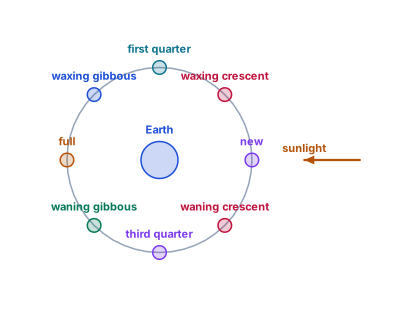
The Sun always lights half the Moon; as the Moon orbits Earth we see more or less of that half, so its phase is set by its angle from the Sun, about 12 degrees more each day in a 29.5-day cycle.
Paper packet. Every task here also exists on screen, where it is checked automatically; answers written on paper are not assessed by Nydus. When you are back at a device, enter your answers there.
By the end of this lesson you will be able to explain the Moon's phases with a model, name the phase from the Moon's angle from the Sun, and predict phases and their dates.
You have seen the Moon as a thin crescent, a half Moon and a bright full Moon, and you know it goes through these shapes every month. You also know that the Sun lights the day side of Earth while the other side has night. This lesson uses that same idea, a ball lit on one side, to explain exactly why the Moon's shape changes and to predict which phase you will see on any night.
| Term | What it means |
|---|---|
| Phase | The shape of the lit part of the Moon as seen from Earth. |
| Waxing | Growing: the lit part seen from Earth is getting larger, toward full. |
| Waning | Shrinking: the lit part seen from Earth is getting smaller, toward new. |
| Crescent | A phase with less than half of the Moon's face lit. |
| Gibbous | A phase with more than half, but not all, of the Moon's face lit. |
| Lunar month | The time from one new Moon to the next, about 29.5 days. |
The Moon is a ball of rock lit by the Sun, so half of it is always lit: the half facing the Sun. As the Moon orbits Earth, we see different amounts of that lit half.
The cycle from new Moon to new Moon takes about $29.5$ days, so the Moon gains about
$$360^\circ \div 30 \approx 12^\circ \text{ on the Sun each day}.$$
Another way: picture
In a dark room, hold a ball at arm's length and turn slowly in a circle with a single lamp across the room. The lamp always lights half the ball, but you see a crescent, a half, a full ball and back again as you turn. You have just made the Moon's phases.
Another way: steps
The Moon does not glow. It is a dark, rocky world that reflects sunlight, and its surface is actually about as dark as worn asphalt. It looks bright only because the sunlight striking it is so intense and the sky around it is dark.
Like any ball standing in sunlight, the Moon is always lit on exactly the half that faces the Sun, and dark on the half that faces away. That never changes. What changes from night to night is our point of view: how much of the lit half happens to face Earth.
Start at new Moon. The Moon is roughly between Earth and the Sun, so its lit half faces away from us, and it is up in the daytime sky near the Sun, invisible in the glare.
A few days later the Moon has moved east of the Sun along its orbit, and we see a thin sliver of the lit half: a waxing crescent, low in the west after sunset. About a week after new, the Moon is $90^\circ$ from the Sun, and we see a half disk: first quarter. The name means a quarter of the way through the cycle, not a quarter of the disk. Then the lit part grows past half, a waxing gibbous, until about two weeks after new the Moon stands opposite the Sun and we see the whole lit half: full Moon, rising at sunset and setting at sunrise.
In the second half of the cycle the same shapes repeat in reverse, waning gibbous, third quarter and waning crescent, with the lit side now on the left, until the Moon returns to new.
The phase is decided by one angle: how far around from the Sun the Moon appears, as seen from Earth, measured eastward. At $0^\circ$ it is new, at $90^\circ$ first quarter, at $180^\circ$ full, at $270^\circ$ third quarter. Angles between those give crescents and gibbous phases.
Because the cycle lasts about $29.5$ days, the Moon gains roughly $360 \div 29.5 \approx 12.2^\circ$ on the Sun each day. For planning, twelve degrees a day and a rounded thirty-day cycle are close enough. After $5$ days the Moon is about $5 \times 12 = 60^\circ$ from the Sun, a fat crescent; after $15$ days, about $180^\circ$, full.
Seen from the Northern Hemisphere, a waxing Moon is lit on its right side and a waning Moon on its left. The lit side always points toward the Sun. In the evening after new Moon, the Moon is east of the Sun, which has just set in the west, so its lit side faces west, to the right as you face south.
In the Southern Hemisphere, people face north to see the Moon, so the same Moon looks flipped: a waxing crescent is lit on the left. The Moon is the same; the observer is upside down compared with someone in the north.
Because the phase depends on the angle from the Sun, it also decides when the Moon is up. A full Moon, opposite the Sun, rises around sunset and is up all night. A first quarter Moon, $90^\circ$ east of the Sun, rises around noon and sets around midnight, so it is high in the south at sunset. A third quarter Moon rises around midnight and is high in the south at sunrise, which is why it is often seen in the morning sky.
A new Moon rises and sets with the Sun and cannot be seen. A thin crescent can only be seen low in the twilight, just after sunset or just before sunrise.
A popular idea is that the dark part of the Moon is Earth's shadow. Check it against the geometry. Earth's shadow points straight away from the Sun. To fall on the Moon at all, the Moon must be nearly opposite the Sun, which is full Moon.
So the shadow idea predicts the opposite of what we see: if Earth's shadow made the phases, the full Moon would be the darkest. Earth's shadow does fall on the Moon sometimes, in a lunar eclipse, and it looks completely different: a curved, reddish shadow that crosses a full Moon in a few hours. Phases take a whole month.
The Moon goes once around Earth, measured against the stars, in about $27.3$ days. But the cycle of phases takes longer, about $29.5$ days. The difference comes from Earth's motion around the Sun.
While the Moon circles Earth, Earth carries the whole system about a twelfth of the way around the Sun. To get back to new Moon, lined up with the Sun again, the Moon has to travel a little farther, about two more days. It is the same effect that makes the solar day four minutes longer than the star day.
A few checks keep phase calculations honest. An angle from the Sun under $180^\circ$ means a waxing Moon, seen in the evening; over $180^\circ$, a waning Moon, seen in the morning. The days since new Moon must lie between $0$ and about $29.5$; a larger number means you multiplied where you should have divided.
Full Moon always comes about two weeks after new, and the quarters about a week either side of full. If your answer puts first quarter three weeks after new, the order is wrong.
The twelve-degree rule assumes the Moon moves at a steady speed. In fact its orbit is an ellipse, and it moves faster when nearer Earth, so the time between quarters can differ by up to a day. Printed calendars and apps use the exact orbit.
The model also treats the Moon's orbit as lying flat in the same plane as Earth's orbit. It is tilted about five degrees, which is why we do not get an eclipse every month. That tilt is the subject of the next lesson.
At Kitt Peak National Observatory near Tucson, Arizona, astronomers studying faint galaxies ask for observing time during the dark weeks around new Moon. A full Moon lights up the sky so much that faint objects disappear, just as stars vanish in the daytime sky.
Telescope schedules are therefore built around the lunar cycle. The week either side of new Moon is called dark time and goes to projects that need the darkest skies. The week around full Moon, bright time, goes to bright targets, such as stars and planets, and to work at infrared wavelengths, where moonlight matters less.
With a cycle of about $29.5$ days and full Moon about $15$ days after new, planners can lay out dark and bright time for years ahead, and the same arithmetic lets an amateur choose the best weekend to look for the Milky Way.
A science teacher in Ohio wants students to see craters through a small telescope. The best views of craters come near first quarter, when sunlight strikes the Moon's surface at a slant along the line between light and dark, and the craters cast long shadows. At full Moon the sunlight comes straight on, shadows vanish and the craters look flat.
The teacher looks up the month's new Moon, for example on the 4th, and adds about seven days: first quarter falls around the 11th, when the Moon is high in the south at sunset, perfect for an early-evening event. A week later, near the 19th, the full Moon rises at sunset and would wash out the craters.
The calculation is the phase cycle from this lesson: about twelve degrees a day, a quarter of the way around in about a week.
The dark part of a crescent Moon looks like a shadow, so it is natural to blame Earth. But Earth's shadow points away from the Sun and can only touch the Moon when it is full, opposite the Sun, and then it makes an eclipse, not a phase.
Explain phases with viewing angle: half the Moon is always lit, and as the Moon goes around Earth we see more or less of that lit half.
The Moon is $90^\circ$ east of the Sun. Recall the quarter positions.
$90^\circ \Rightarrow \text{first quarter}$
A right angle east of the Sun.
Say how much of the face is lit.
$\text{half the disk}$
Half of the lit half faces Earth.
Say which side is lit from the north.
$\text{the right side}$
The lit side points toward the Sun in the west.
Say when it is highest.
$\text{around sunset, in the south}$
It rose around noon.
The Moon is $60^\circ$ east of the Sun. Recall the daily gain.
$12^\circ \text{ per day}$
About 360 degrees in 30 days.
Divide the angle by the gain.
$60 \div 12$
Days of twelve degrees each.
Evaluate the quotient.
$5\ \text{days}$
Days since new Moon.
Name the phase.
$\text{waxing crescent}$
Under 90 degrees and still growing.
Find the days left to first quarter.
$(90 - 60) \div 12 = 2.5\ \text{days}$
Thirty more degrees to go.
A new Moon falls on September 3. Find the full Moon date with a 29.5-day cycle.
$29.5 \div 2 \approx 15\ \text{days}$
Full Moon is halfway through the cycle.
Add the days to the new Moon date.
$3 + 15 = 18$
September 18.
Find the next new Moon.
$3 + 29.5 \approx 32.5$
Past the end of September's 30 days.
Convert into October.
$32.5 - 30 \approx 2.5$
About October 2 or 3.
Say when the full Moon rises.
$\text{around sunset}$
It is opposite the Sun.
Say why stargazers avoid that week.
$\text{moonlight hides faint stars}$
A dark sky needs a new Moon.
Divide the angle by twelve degrees a day.
$144 \div 12$
Days of twelve degrees.
Evaluate the quotient.
$12\ \text{days}$
Days since new Moon.
Name the phase.
Why does the Moon show different phases during a month?
Complete the worked solution: the Moon is $7$ days past new. Find its angle east of the Sun and the days left until full Moon, in a rounded 30-day cycle.
Multiply the days by twelve degrees.
$\text{days} \times 12 =$ a
The Moon's daily gain on the Sun.
Subtract the days from fifteen.
$15 - \text{days} =$ f
Full Moon is halfway through the cycle.
Say which way the phase is changing.
$\text{waxing, growing toward full}$
The angle is still under 180 degrees.
Match each angle between the Moon and the Sun, measured eastward as seen from Earth, to the Moon's phase.
| new Moon | first quarter | full Moon | third quarter | |
|---|---|---|---|---|
| 0° | ||||
| 90° | ||||
| 180° | ||||
| 270° |
In a rounded 30-day cycle, the Moon is $11$ days past new. Fill in its angle east of the Sun, the days until full Moon and the days until the next new Moon.
| value | |
|---|---|
| angle east of the Sun (degrees) | |
| days until full Moon | |
| days until the next new Moon |
Tonight the sky shows a waxing gibbous 120 degrees from the Sun, $120$ degrees east of the Sun. Using about twelve degrees a day, write the Moon's angle east of the Sun, in degrees, $d$ days from now, before it passes the full circle.
Answer:
The Moon is $48$ degrees east of the Sun. About how many days have passed since new Moon, at twelve degrees a day?
Answer: days since new Moon
A school in Ohio plans a telescope night for when the Moon is at first quarter. This month's new Moon falls on day $8$. In a 29.5-day cycle, first quarter comes about $7$ whole days after new. On which day of the month should the night be held?
Answer: day of the month
Lesson test: one question per skill, one attempt each, no hints. Your answers are checked when you submit.
Tonight the sky shows a waxing crescent 30 degrees from the Sun, $30$ degrees east of the Sun. Using about twelve degrees a day, write the Moon's angle east of the Sun, in degrees, $d$ days from now, before it passes the full circle.
Answer:
You can explain the Moon's phases. Explain why Earth's shadow cannot cause them, and how many days after new Moon the full Moon comes.
20. Your turn: the Moon is $144^\circ$ east of the Sun. How many days since new Moon?, step 3
$\text{waxing gibbous}$
Between 90 and 180 degrees.