Back to the on-screen lesson ·
A satellite falls around Earth, moving sideways fast enough to keep missing the ground; low orbits take about 90 minutes, higher ones longer, and astronauts float because they fall with their spacecraft.
Paper packet. Every task here also exists on screen, where it is checked automatically; answers written on paper are not assessed by Nydus. When you are back at a device, enter your answers there.
By the end of this lesson you will be able to explain how satellites stay in orbit and why astronauts float, and calculate orbital periods, speeds and orbits per day.
You know that gravity holds the Moon and planets in orbit, that an orbit is a kind of falling, and that farther orbits are slower. You have seen videos of astronauts floating inside the International Space Station. This lesson explains how satellites stay up, why different satellites take different times to go around, and why astronauts float even though Earth's gravity is still pulling on them.
| Term | What it means |
|---|---|
| Satellite | Any object in orbit around a planet; the Moon is a natural satellite. |
| Low Earth orbit | An orbit a few hundred kilometers up, taking about 90 minutes. |
| Geostationary orbit | An orbit about 36,000 km above the Equator that takes exactly one day. |
| Free fall | Falling with nothing holding you up, so you feel weightless. |
| Orbital period | The time to go once around an orbit. |
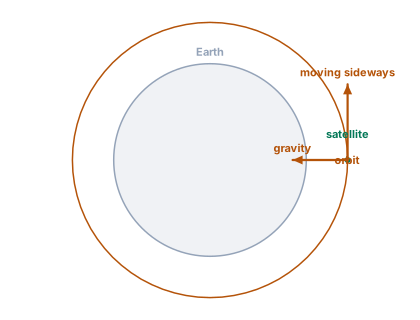
A satellite is falling toward Earth all the time, pulled by gravity. It stays up because it is also moving sideways very fast.
In a low orbit, about $400$ km up, the sideways speed needed is about $7.7$ km/s, about $28{,}000$ km/h, and one trip around takes about $90$ minutes. A day has $1440$ minutes, so such a satellite goes around
$$1440 \div 90 = 16 \text{ times a day}.$$
Another way: picture
Throw a ball sideways and it curves to the ground. Throw it faster and it lands farther away. Isaac Newton imagined a cannon on a very tall mountain firing faster and faster, until the ball fell around the whole Earth and came back to the mountain. That ball would be a satellite.
Another way: steps
Newton described a thought experiment in which a cannon on a tall mountain fires a ball sideways. A slow ball falls to the ground nearby. A faster ball falls farther away, because it covers more ground before it lands. Because Earth is round, the ground curves away from a very fast ball as it falls.
At just the right speed, the ball falls toward Earth exactly as fast as the curved surface drops away beneath it. It never lands; it circles Earth and comes back to the mountain. Near Earth's surface that speed is about $7.9$ km every second. Newton could not build such a cannon, but rockets now do the job, lifting satellites above the air and then pushing them sideways to orbital speed.
Close to the ground, air would slow a fast-moving satellite almost instantly, the way air slows a thrown ball. So satellites orbit above nearly all of the atmosphere. The International Space Station flies about $400$ km up, where the air is so thin that it slows the station only a little, and its engines give it a boost every few months to make up the loss.
Satellites in lower orbits eventually slow down, sink and burn up as they plunge into thicker air. That is how many old satellites end their lives, and it keeps the busiest low orbits from filling with debris forever.
Just as Kepler's law showed for the planets, satellites farther from Earth feel a weaker pull, move more slowly and take longer to go around. The space station, about $400$ km up, takes about $90$ minutes. GPS satellites, about $20{,}000$ km up, take about $12$ hours. The Moon, $384{,}000$ km away, takes about $27.3$ days.
To count orbits in a day, divide the $1440$ minutes in a day by the period. A satellite with a $120$-minute period goes around $1440 \div 120 = 12$ times a day; one with a $96$-minute period, $15$ times.
At one special height, about $36{,}000$ km above the Equator, a satellite takes exactly one day to go around, the same time Earth takes to turn. Moving eastward at that height, it keeps pace with the ground below and seems to hover over one spot. That is a geostationary orbit.
Weather satellites such as NOAA's GOES satellites sit there and watch the same half of Earth continuously, sending the cloud pictures you see in weather forecasts. Satellite TV dishes on houses can point at one fixed spot in the sky for the same reason: the satellite never moves as seen from the ground.
At the space station's height, Earth's gravity is still about $90$ percent as strong as at the ground. Astronauts are not weightless because gravity has vanished. They float because they are in free fall: they and the station are falling around Earth together, at the same rate.
You can feel a little of this on a roller coaster or in an elevator that suddenly drops: for a moment, you feel light, because the floor is falling with you and is no longer pushing up. In orbit the fall never stops, so the feeling never stops. A cup of water released in the station floats in place because the cup, the water and the astronaut all fall together.
Orbital speeds are easiest to handle with distance, speed and time. Once around a low orbit is about $42{,}000$ km. Covering that in $1.5$ hours gives a speed of $42{,}000 \div 1.5 = 28{,}000$ km/h, which is $28{,}000 \div 3600 \approx 7.8$ km/s. In one minute the station covers about $460$ km, roughly the distance from Washington, D.C., to Boston, and in $t$ minutes about $460t$ km.
At that speed a trip from Los Angeles to New York, about $4{,}000$ km, would take under nine minutes, compared with about five hours on a jet airliner.
A few checks help. A low orbit takes about an hour and a half, so the number of orbits in a day should be around $15$ or $16$; if you get $0.06$, you divided the wrong way. A higher orbit must have a longer period and a lower speed. And speed is distance divided by time: if your speed is larger than the distance around the whole orbit for a period over an hour, you multiplied instead.
This lesson treats orbits as circles at a steady speed. Many satellites follow slightly elliptical orbits, moving faster when nearer Earth, exactly as Kepler's laws describe for the planets. Earth's slightly flattened shape also makes orbits slowly turn, which engineers use to keep some satellites passing over places at the same local time every day.
It also ignores the Moon's and Sun's small pulls, which matter for geostationary satellites over years, and the thin air that slowly drags low satellites down.
The International Space Station has been crewed continuously since November 2000. It orbits about $400$ km up at about $28{,}000$ km/h, completing an orbit roughly every $92$ minutes, so its crew sees about $1440 \div 92 \approx 16$ sunrises and sunsets every day.
To keep a normal routine, the crew lives on Greenwich time and sleeps in small cabins with window shades closed, strapped into sleeping bags so they do not drift. Floating changes the body, too: without the steady load of weight, muscles and bones weaken, so astronauts exercise about two hours a day on special treadmills and resistance machines.
From the ground you can see the station yourself. NASA's Spot the Station service lists when it will pass over your town; it looks like a bright, steady light crossing the sky in a few minutes, faster than any airplane.
The Global Positioning System is a set of about thirty U.S. satellites orbiting about $20{,}000$ km up, each going around Earth twice a day. They are arranged so that from almost anywhere on Earth, at least four are above the horizon at once.
Each satellite broadcasts the exact time from an atomic clock on board. A phone receives signals from several satellites and works out how far away each one is from how long the signals took to arrive, at the speed of light. With four distances, it can pin down its position to within a few meters.
The satellites are high enough to be seen over wide areas but in a much quicker orbit than a geostationary one, which spreads them around the sky. The system depends on the orbital rules in this lesson, and also on tiny corrections from Einstein's relativity to keep the clocks in step.
Floating astronauts make it look as if gravity has switched off, but at the station's height Earth's pull is still about 90 percent as strong as on the ground. Without that pull, the station would fly off in a straight line.
Astronauts float because they are in free fall, falling around Earth together with their spacecraft, so nothing pushes up on them.
A satellite takes $120$ minutes per orbit. Find the minutes in a day.
$24 \times 60 = 1440$
Twenty-four hours of sixty minutes.
Divide by the period.
$1440 \div 120$
Orbits that fit in a day.
Evaluate the quotient.
$12$
Orbits each day.
Convert the period to hours.
$120 \div 60 = 2\ \text{h}$
Twelve two-hour orbits fill a day.
Once around is $42{,}000$ km in $1.5$ hours. Recall speed.
$\text{speed} = \dfrac{\text{distance}}{\text{time}}$
Distance each hour.
Substitute the values.
$\dfrac{42000}{1.5}$
Kilometers over hours.
Evaluate the speed.
$28000\ \text{km/h}$
Kilometers each hour.
Convert to kilometers per second.
$28000 \div 3600 \approx 7.8\ \text{km/s}$
Seconds in an hour.
Compare with a jet.
$28000 \div 900 \approx 31$
About thirty times faster than an airliner.
A satellite $36{,}000$ km above the Equator takes one day. Recall Earth's turn.
$\text{once a day}$
Earth turns once in a day.
Compare the two periods.
$1\ \text{day} = 1\ \text{day}$
The satellite and the ground keep pace.
Say which way it must move.
$\text{eastward}$
The same direction Earth turns.
Say how it looks from the ground.
$\text{fixed in the sky}$
It stays over one spot.
Name a use.
$\text{weather pictures and satellite TV}$
A dish or camera never needs to move.
Count its orbits in a day.
$1440 \div 1440 = 1$
Exactly one, by design.
Recall the minutes in a day.
$1440$
Twenty-four times sixty.
Divide by the period.
$1440 \div 96$
Orbits that fit.
State the number of orbits.
Why do astronauts float inside the International Space Station?
Complete the worked solution: a satellite takes $180$ minutes to go around Earth. Find how many orbits it completes in a day and its period in hours.
Divide the minutes in a day by the period.
$1440 \div \text{period} =$ n
Orbits that fit in a day.
Divide the period by sixty.
$\text{period} \div 60 =$ h
The period in hours.
Say why lower orbits are quicker.
$\text{stronger pull, faster speed}$
A shorter path traveled faster.
Match each orbiting object to how long it takes to go around Earth once.
| about 90 minutes | about 12 hours | one day | about 27 days | |
|---|---|---|---|---|
| the International Space Station | ||||
| a GPS satellite | ||||
| a geostationary weather satellite | ||||
| the Moon |
A satellite goes around Earth once every $180$ minutes. Fill in the minutes in a day, the orbits it completes in a day, and its period in hours.
| value | |
|---|---|
| minutes in a day | |
| orbits in a day | |
| period (hours) |
A satellite in low orbit travels at $450$ km every minute. Write the distance it travels, in kilometers, as a function of the minutes $t$ that pass.
Answer:
One trip around a satellite's orbit is $48000$ km, and it takes $2.4$ hours. What is its speed, in kilometers per hour?
Answer: kilometers per hour
Astronauts on a space station see a sunrise every time they come around from Earth's night side. If the station takes $96$ minutes per orbit, about how many sunrises do they see in one day of 1,440 minutes?
Answer: sunrises a day
Lesson test: one question per skill, one attempt each, no hints. Your answers are checked when you submit.
A satellite in low orbit travels at $450$ km every minute. Write the distance it travels, in kilometers, as a function of the minutes $t$ that pass.
Answer:
You can explain orbits around Earth. Explain why astronauts float, and how many times a day a satellite with a 90-minute period goes around.
19. Your turn: a satellite takes $96$ minutes per orbit. How many orbits in a day?, step 3
$15$
Orbits each day.