Back to the on-screen lesson ·
Measured diameters show the true sizes: Jupiter about 11 Earths wide and the Sun about 109; size and density against distance reveal two families of planets; a scale model divides every size by the same number.
Paper packet. Every task here also exists on screen, where it is checked automatically; answers written on paper are not assessed by Nydus. When you are back at a device, enter your answers there.
By the end of this lesson you will be able to analyze planetary data to compare sizes, identify the two families of planets, and build a scale model of the planets and the Sun.
You know the names of the eight planets and that they orbit the Sun at different distances, and you can work with ratios and scale drawings from math class. Most pictures of the solar system draw the planets close together and almost the same size. This lesson uses real measurements to show how different they really are, and how to build a scale model that tells the truth.
| Term | What it means |
|---|---|
| Diameter | The distance straight across a planet through its center. |
| Scale model | A model in which every size is divided by the same number. |
| Scale | How much real distance one unit of the model stands for. |
| Density | Mass divided by volume: how tightly packed a material is. |
| Terrestrial planet | A small, rocky planet: Mercury, Venus, Earth or Mars. |
| Giant planet | A large planet made mostly of gas and ice: Jupiter, Saturn, Uranus or Neptune. |
To compare sizes honestly, use measurements and ratios.
A scale model divides every real size by the same number, the scale, so every ratio survives:
$$\text{model size} = \frac{\text{real size}}{\text{scale}}.$$
Plotting size against distance shows two families of planets.
Another way: picture
If Earth were a peppercorn, Jupiter would be a large grape, the Sun a ball about as wide as a basketball hoop, and Mercury a grain of sand. Every one of those comparisons comes from dividing real diameters by the same number.
Another way: steps
Almost every poster of the solar system draws the planets in a row, close together, with the Sun as a curved edge at one side. That is useful for naming them, but it gets the sizes and spacing badly wrong. If the planets were drawn to the same scale as the Sun on a normal page, the four inner planets would be dots too small to see, and the planets would be spread across several kilometers of paper.
To understand what the solar system is really like, we have to work with measurements. NASA's planetary fact sheets list each planet's diameter, mass, density and distance, measured by spacecraft and telescopes. With those numbers and a little division, the true picture appears.
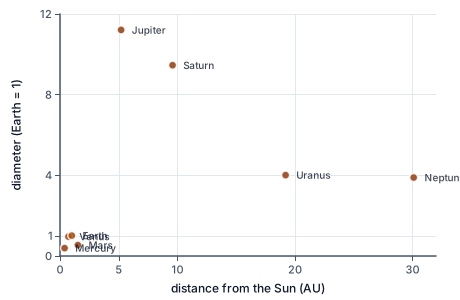
The easiest way to compare sizes is to divide each diameter by Earth's. Mercury, $4{,}879$ km across, is about $0.38$ Earths wide. Mars, $6{,}792$ km, is about half. Venus, $12{,}104$ km, is almost Earth's twin. Then the jump: Uranus and Neptune are about $4$ Earths wide, Saturn about $9.5$, and Jupiter about $11.2$.
The Sun is in a class of its own: $1{,}392{,}000$ km across, about $109$ Earths. Because volume grows with the cube of width, the Sun could hold about $109^3$, roughly $1.3$ million Earths, and Jupiter about $1{,}300$. Even the largest planet is tiny compared with the star at the center.
Plotting each planet's size against its distance from the Sun shows a clear pattern. The four planets closest to the Sun, within $1.5$ astronomical units, are all small: none is wider than Earth. These are the terrestrial planets, rocky worlds with solid surfaces. The four planets beyond the asteroid belt, from $5$ to $30$ AU, are all large: these are the giant planets.
Density adds a second piece of evidence. Earth's average density is about $5.5$ grams per cubic centimeter, heavier than rock alone because of its iron core. Jupiter's is about $1.3$ and Saturn's only about $0.7$, less than water. They cannot be made of rock; they are mostly hydrogen and helium, with ices and rock deep inside.
A scale model divides every real size by the same number. Suppose $1$ cm stands for $1{,}600$ km. Then Earth, about $12{,}800$ km across, becomes $12{,}800 \div 1{,}600 = 8$ cm, the size of an orange. Jupiter, about $144{,}000$ km, becomes $90$ cm, and the Sun, about $1{,}400{,}000$ km, becomes $875$ cm, nearly nine meters across.
Because every size was divided by the same number, the model keeps every ratio: the model Jupiter is still about $11$ times the model Earth. That is what makes it a scale model rather than just a collection of balls. Changing the scale makes the whole model bigger or smaller but never changes the comparisons.
Scientists use data like these to answer questions. Why are the inner planets small and rocky while the outer ones are giants? Measurements of other planetary systems suggest an answer: close to a young star it is too hot for ices to freeze, so only rock and metal clump together, building small planets. Farther out, ices freeze too, giving much more solid material to build large cores that then pull in thick envelopes of gas.
That explanation came from asking what pattern the data show and testing it, not from memorizing a list. When you analyze a table of planets, look for patterns, ask what could cause them, and check them with another measurement.
Some moons are surprisingly large. Jupiter's moon Ganymede, $5{,}268$ km across, is larger than the planet Mercury, and Saturn's moon Titan is nearly as large. Earth's Moon, $3{,}475$ km across, is about a quarter of Earth's width, unusually large for its planet.
Pluto, $2{,}377$ km across, is smaller than our Moon. Its small size, and the discovery of other similar bodies beyond Neptune, led astronomers in 2006 to call it a dwarf planet. A scale model that includes Pluto shows why: it sits among other small icy worlds, not among the planets.
A few checks help. A body smaller than Earth must give a ratio less than $1$, and the Sun must give about $109$. In a scale model, the model sizes must be in the same ratios as the real ones: if your model Jupiter is not about eleven times your model Earth, one division used the wrong scale. And a smaller scale number, fewer kilometers per centimeter, makes a bigger model, not a smaller one.
The diameters here are rounded, and the giant planets are slightly squashed by their fast spin, so their widths at the poles are a little smaller. A ball model also hides that the giants have no solid surface to measure; their sizes are measured at a particular pressure in their atmospheres.
Most importantly, a model of sizes says nothing yet about distances. Placing the model planets at the right distances from the model Sun turns out to need far more space than a classroom, which is the subject of the next lesson.
In Ithaca, New York, the Sagan Planet Walk is a scale model of the solar system laid out along the city's streets, at a scale of one to five billion. The Sun is a disk about $28$ cm wide on a stone pillar in the town square, and Earth is a bead about $2.5$ mm across, mounted on another pillar.
Those model sizes follow straight from dividing by the same number: the Sun's $1{,}392{,}000$ km divided by five billion is about $0.28$ m, and Earth's $12{,}756$ km is about $2.5$ mm. Jupiter's model, about $29$ mm across, is the size of a large grape.
Visitors are often surprised that the planets are so small compared with the Sun, and even more surprised by how far apart the pillars are, which the next lesson calculates.
A middle school in Tucson, Arizona, paints a model of the Sun and planets on its playground. The students choose to make the model Sun $218$ cm wide, a little taller than a person. Since the Sun is about $109$ times as wide as Earth, the model Earth must be $218 \div 109 = 2$ cm wide, about the size of a large marble.
At the same scale, Jupiter is about $11.2 \times 2 \approx 22$ cm, the size of a soccer ball, and Mercury only about $0.8$ cm, the size of a pea. The students are struck by how much of the model is the Sun.
When they try to place the model planets at the right distances from the model Sun, they discover that Earth would have to sit more than $230$ meters away, beyond the school's fence, a problem they solve in the next lesson.
Diagrams usually draw the planets as similar balls in a neat row, which leaves a lasting impression that they are similar in size. In fact Jupiter is about 11 Earths wide and Mercury less than half of one, and the Sun is about 109 Earths across.
When you compare planets, use measured diameters and ratios, and when you build a model, divide every size by the same scale.
Neptune is $49{,}528$ km across. Write the ratio to Earth.
$\dfrac{49528}{12756}$
Earth diameters across.
Divide on a calculator.
$49528 \div 12756$
Both in kilometers.
Evaluate the ratio.
$\approx 3.88$
About four Earths.
Classify the planet.
$\text{a giant planet}$
Several times wider than Earth.
Choose a scale.
$1\ \text{cm} \leftrightarrow 3200\ \text{km}$
Every centimeter stands for the same distance.
Divide Earth's diameter by it.
$12800 \div 3200 = 4\ \text{cm}$
About a golf ball.
Divide Jupiter's diameter by it.
$144000 \div 3200 = 45\ \text{cm}$
About a beach ball.
Divide the Sun's diameter by it.
$1400000 \div 3200 = 437.5\ \text{cm}$
Over four meters across.
Check one ratio.
$45 \div 4 \approx 11$
The model keeps Jupiter's size ratio.
List the inner planets' widths in Earths.
$0.38, 0.95, 1, 0.53$
Mercury, Venus, Earth, Mars.
List the outer planets' widths.
$11.2, 9.45, 4.01, 3.88$
Jupiter, Saturn, Uranus, Neptune.
Compare the largest inner with the smallest outer.
$1 < 3.88$
A gap with no planets in between.
Compare the two densities.
$5.5 \text{ against } 1.3\ \text{g/cm}^3$
Earth against Jupiter.
Name the two families.
$\text{terrestrial and giant}$
Small and rocky, or large and gas-rich.
Suggest a cause.
$\text{ices freeze only far from the Sun}$
More building material out there.
Divide by the scale.
$12800 \div 800$
Centimeters in the model.
Evaluate the quotient.
$16\ \text{cm}$
About a grapefruit.
Find model Jupiter at the same scale.
Which measurement shows that Jupiter is a giant planet made mostly of gas, not a giant ball of rock like Earth?
Complete the worked solution: in a model where $1$ cm stands for $1600$ km, find the model diameters of Earth, 12,800 km across, and Jupiter, 144,000 km across.
Divide Earth's diameter by the scale.
$\text{Earth} \div \text{scale} =$ e
Centimeters for Earth.
Divide Jupiter's diameter by the scale.
$\text{Jupiter} \div \text{scale} =$ j
Centimeters for Jupiter.
Compare the two models.
$\text{Jupiter about 11 times wider}$
The ratio of the real sizes.
Match each body to about how many Earths wide it is.
| about 109 Earths wide | about 11 Earths wide | about 4 Earths wide | about half of Earth's width | |
|---|---|---|---|---|
| the Sun | ||||
| Jupiter | ||||
| Uranus | ||||
| Mars |
In a scale model, $1$ cm stands for $3200$ km. Using rounded diameters of 12,800 km for Earth, 144,000 km for Jupiter and 1,400,000 km for the Sun, fill in each model's diameter in centimeters.
| value | |
|---|---|
| model Earth (cm) | |
| model Jupiter (cm) | |
| model Sun (cm) |
In a scale model, $1$ cm stands for $1600$ km. Write the model diameter, in centimeters, of a body whose real diameter is $d$ km.
Answer:
The diameter of Uranus is $51118$ km and Earth's is $12{,}756$ km. How many Earths wide is Uranus? Give three significant figures.
Answer: Earth diameters across
A science class in Arizona paints a model Sun $545$ cm wide on the playground. The Sun is about 109 times as wide as Earth. How wide, in centimeters, should their model Earth be?
Answer: centimeters wide
Lesson test: one question per skill, one attempt each, no hints. Your answers are checked when you submit.
In a scale model, $1$ cm stands for $1600$ km. Write the model diameter, in centimeters, of a body whose real diameter is $d$ km.
Answer:
You can compare planets with data. Explain how density shows Jupiter is not rocky, and how wide a model Earth is beside a model Sun 109 cm across.
19. Your turn: with $1$ cm for $800$ km, how wide is a model Earth, $12{,}800$ km across?, step 3
$144000 \div 800 = 180\ \text{cm}$
About eleven times wider.