Back to the on-screen lesson ·
Earth's axis is tilted 23.4 degrees and keeps its direction, so each hemisphere leans toward the Sun for half the year, with a higher noon Sun and longer days; the noon height is 90 minus the latitude, plus or minus the tilt.
Paper packet. Every task here also exists on screen, where it is checked automatically; answers written on paper are not assessed by Nydus. When you are back at a device, enter your answers there.
By the end of this lesson you will be able to explain the seasons from Earth's tilt, reject the distance explanation with evidence, and calculate the noon Sun's height for any latitude and season.
You know that Earth turns once a day, which gives day and night, and that it travels around the Sun once a year. You have noticed that summer days are long and hot and winter days short and cold, and that the Sun climbs higher in summer. This lesson explains all of those with one fact about Earth: its axis is tilted, and the tilt always points the same way in space.
| Term | What it means |
|---|---|
| Axial tilt | The angle between Earth's spin axis and a line at right angles to its orbit, about 23.4 degrees. |
| Solstice | One of the two days when the noon Sun is highest or lowest of the year. |
| Equinox | One of the two days when the Sun is overhead at the Equator. |
| Latitude | The angle north or south of the Equator, from 0 to 90 degrees. |
| Noon Sun height | The angle between the horizon and the Sun when it is highest in the day. |
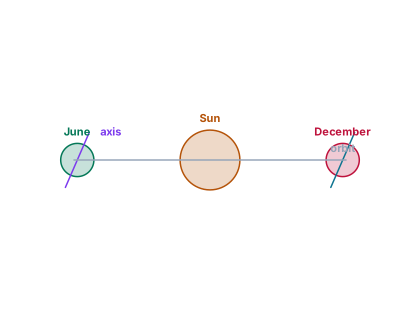
Earth's axis is tilted 23.4 degrees and keeps pointing the same way in space, toward the North Star, all year. As Earth travels around the Sun:
The noon Sun's height at latitude $x$ degrees north is
$$90 - x \text{ at an equinox}, \quad 90 - x + 23.4 \text{ in June}, \quad 90 - x - 23.4 \text{ in December}.$$
Another way: picture
Shine a flashlight straight down at a table and it makes a small, bright circle. Tilt the flashlight and the same light spreads into a long, dim oval. A high summer Sun is the straight-down flashlight; a low winter Sun is the tilted one.
Another way: steps
Imagine Earth as a spinning top that is leaning a little to one side. A top that spins steadily keeps its lean pointing the same direction, and so does Earth. All year long, its North Pole points toward the same spot in the sky, very close to Polaris, the North Star.
Now carry that leaning Earth around the Sun. On one side of the orbit the North Pole leans toward the Sun; half a year later, on the opposite side of the orbit, the North Pole still points at Polaris, but now that direction leans away from the Sun. Nothing about Earth has changed except where it is in its orbit. That single fact is the whole cause of the seasons.
When the Sun is high, its light strikes the ground nearly straight on, and the energy is concentrated on a small area. When the Sun is low, the same beam of light strikes at a slant and is spread over a much larger area, so each square foot of ground receives less energy and warms less.
Low sunlight also passes through more air before it reaches the ground. The atmosphere scatters and absorbs some of it along the way, which is why a winter Sun feels weak even on a clear day and why a sunset can be looked at without the glare of noon. Both effects make the low winter Sun a poor heater.
The tilt changes the length of the day as well as the height of the Sun. In June, the leaning Northern Hemisphere spends more than half of each turn in sunlight, so days are long and nights short. In Seattle the June day lasts about sixteen hours; in December, about eight and a half.
More hours of sunlight means more time for the ground and air to absorb energy and less time at night to lose it. In summer, a high Sun and long days work together. In winter, a low Sun and short days work together the other way. That is why the difference between summer and winter is so large away from the Equator.
Astronomers describe the Sun's position by its height above the horizon, measured as an angle: $0^\circ$ on the horizon, $90^\circ$ straight overhead. The Sun is highest at solar noon each day.
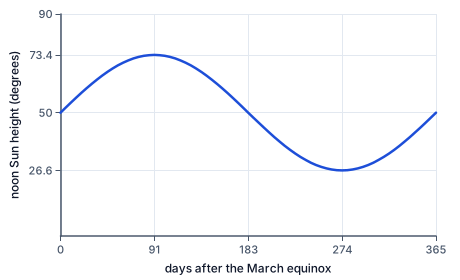
At an equinox the Sun is directly overhead at noon on the Equator. Every degree you travel north lowers the noon Sun by one degree, so at latitude $x$ the noon Sun stands at $90 - x$ degrees. At $40^\circ$ N, the latitude of Philadelphia and Denver, that is $90 - 40 = 50^\circ$.
At the June solstice the Sun is overhead $23.4^\circ$ north of the Equator, at the Tropic of Cancer, so every northern place sees it $23.4^\circ$ higher: $50 + 23.4 = 73.4^\circ$ at $40^\circ$ N. At the December solstice it is overhead at the Tropic of Capricorn, $23.4^\circ$ south, so every northern place sees it $23.4^\circ$ lower: $50 - 23.4 = 26.6^\circ$.
The two solstices fall around June 20 or 21 and December 21 or 22. The word comes from Latin for the Sun stands still, because around those dates the noon Sun stops climbing or sinking and turns back. The June solstice has the year's longest day in the Northern Hemisphere and the December solstice the shortest.
The equinoxes fall around March 20 and September 22. Equinox means equal night: on those days the Sun rises almost exactly due east and sets almost exactly due west everywhere on Earth, and day and night are each about twelve hours long. The chart shows the noon Sun at $40^\circ$ N rising from $50^\circ$ at the March equinox to $73.4^\circ$ in June, falling back through $50^\circ$ in September, and sinking to $26.6^\circ$ in December.
When the Northern Hemisphere leans toward the Sun, the Southern Hemisphere leans away, and the reverse. So the seasons are opposite: June is winter in Australia, Argentina and South Africa, and Christmas comes in the middle of summer there.
This is one of the strongest pieces of evidence against the idea that distance causes the seasons. If being closer to the Sun made summer, the whole Earth would have summer at the same time. Instead, the two hemispheres always have opposite seasons, exactly as the tilt predicts.
Earth's orbit is very nearly a circle, but not quite. Earth is closest to the Sun, about $147$ million kilometers (about $91$ million miles), in early January, and farthest, about $152$ million kilometers ($94.5$ million miles), in early July. The difference is only about three percent.
Notice when the closest point comes: January, the middle of the northern winter. If distance controlled the seasons, January would be the hottest month in Chicago. A scientific explanation has to fit the evidence, and the distance explanation fails the test twice: it gets the timing backward and it cannot explain opposite seasons in the two hemispheres.
The tilt sets two special pairs of latitudes. The Tropics of Cancer and Capricorn, at $23.4^\circ$ N and S, are the farthest places from the Equator where the Sun can ever be straight overhead. Between them lies the tropical zone, where the noon Sun is always high and the seasons are mild.
The Arctic and Antarctic Circles, at $90 - 23.4 = 66.6^\circ$ N and S, mark where the Sun can stay above the horizon all day at the summer solstice and below it all day at the winter solstice. In northern Alaska, inside the Arctic Circle, the town of Utqiagvik has about two months without a sunset in summer and about two months without a sunrise in winter.
A noon Sun height must lie between $0^\circ$ and $90^\circ$ for any place outside the tropics. If you get a negative number, the Sun would be below the horizon at noon, which only happens inside the polar circles in winter. If you get more than $90^\circ$, you have probably added where you should subtract.
Two more checks help. The June height minus the December height is always $46.8^\circ$, twice the tilt, at any latitude outside the tropics. And a place farther north always has a lower noon Sun on the same date, by exactly as many degrees as it is farther north.
The rule for the noon Sun treats the tilt as exactly $23.4^\circ$ and ignores the bending of light by the atmosphere, which lifts the Sun's image by about half a degree near the horizon. Those details matter to navigators but not to the pattern.
The model also explains why the hottest weather comes in July and August, not on the June solstice. Land and oceans take weeks to warm up, just as a pot of water keeps getting hotter for a while after you turn the burner to its highest setting. The same lag makes January and February colder than the December solstice itself.
A solar panel collects the most energy when sunlight strikes it straight on. In Phoenix, Arizona, at about $33^\circ$ N, the noon Sun stands $90 - 33 + 23.4 = 80.4^\circ$ high in June but only $90 - 33 - 23.4 = 33.6^\circ$ in December. A panel lying flat on a roof catches the high summer Sun well but misses much of the low winter Sun.
Installers solve this by tilting fixed panels toward the south at an angle close to the latitude, about $33^\circ$ in Phoenix, which is a compromise between the summer and winter Suns. Some large solar farms in the desert Southwest mount their panels on motors that track the Sun across the sky each day, and the most elaborate ones also adjust for the season.
The calculation behind every one of those choices is the noon-Sun rule from this lesson: ninety minus the latitude, plus or minus the tilt.
Utqiagvik, Alaska, the northernmost town in the United States, lies at about $71^\circ$ N, well inside the Arctic Circle at $66.6^\circ$ N. At the June solstice its noon Sun stands $90 - 71 + 23.4 = 42.4^\circ$ high, and because the whole region around the North Pole leans toward the Sun, the Sun never sets: it circles the sky for about eighty days in a row.
At the December solstice the arithmetic gives $90 - 71 - 23.4 = -4.4^\circ$. A negative noon height means the Sun stays below the horizon all day, and for about two months the town has no sunrise at all, only a few hours of twilight around noon.
Residents live with both extremes. In summer, people play softball at midnight; in winter, the cold and dark make travel and work harder. The tilt of Earth's axis, the same 23.4 degrees that gives the rest of the country its seasons, makes the polar seasons extreme.
It sounds sensible that being nearer a fire makes you warmer, and Earth's distance from the Sun does change a little. But Earth is closest in early January, during the northern winter, and the two hemispheres always have opposite seasons, which a change in distance could never cause.
Explain the seasons with the angle of sunlight and the length of the day: the hemisphere leaning toward the Sun has a higher noon Sun and longer days.
A town is at $35^\circ$ N. Recall the equinox rule.
$90 - \text{latitude}$
The Sun is overhead at the Equator.
Substitute the latitude.
$90 - 35$
Thirty-five degrees north of the Equator.
Evaluate the noon height.
$55^\circ$
The Sun's height at noon.
Check against the Equator.
$55 < 90$
Farther north, the noon Sun is lower.
A town is at $45^\circ$ N. Find the equinox height.
$90 - 45 = 45^\circ$
Ninety minus the latitude.
Add the tilt for June.
$45 + 23.4 = 68.4^\circ$
The north leans toward the Sun.
Subtract the tilt for December.
$45 - 23.4 = 21.6^\circ$
The north leans away.
Find the range through the year.
$68.4 - 21.6 = 46.8^\circ$
Twice the tilt.
Say what the range means.
$\text{a large swing in sunlight}$
Strong seasons at middle latitudes.
Denver, Colorado, is near $40^\circ$ N. Find the equinox height.
$90 - 40 = 50^\circ$
Ninety minus the latitude.
Find the June solstice height.
$50 + 23.4 = 73.4^\circ$
Add the tilt.
Find the December solstice height.
$50 - 23.4 = 26.6^\circ$
Subtract the tilt.
Compare the day lengths.
$\text{about } 15 \text{ h in June}, 9.5 \text{ h in December}$
The tilt also changes the length of the day.
Combine the two effects.
$\text{high Sun and long days in June}$
Both warm the hemisphere together.
Rule out distance with the January date.
$\text{Earth closest in January}$
Yet January is Denver's coldest month.
Find the equinox height.
$90 - 30 = 60^\circ$
Ninety minus the latitude.
Subtract the tilt for December.
$60 - 23.4$
The north leans away from the Sun.
State the noon height.
Why is it warmer in the Northern Hemisphere in July than in January?
Complete the worked solution: how high is the noon Sun at the June solstice in a town at $25^\circ$ N?
Find the equinox height.
$90 - \text{latitude} =$ e
The Sun stands over the Equator at an equinox.
Add the tilt for June.
$\text{equinox height} + 23.4 =$ j
The Northern Hemisphere leans toward the Sun.
Say what the high Sun does.
$\text{concentrates the sunlight}$
Each square foot of ground catches more energy.
Match each place and date to the height of the noon Sun.
| 60° | 83.4° | 36.6° | 90° | |
|---|---|---|---|---|
| 30° N at an equinox | ||||
| 30° N at the June solstice | ||||
| 30° N at the December solstice | ||||
| the Equator at an equinox |
A town lies at $40^\circ$ N. Fill in the height of the noon Sun there at an equinox, at the June solstice and at the December solstice.
| value | |
|---|---|
| noon Sun at an equinox (degrees) | |
| noon Sun at the June solstice (degrees) | |
| noon Sun at the December solstice (degrees) |
Write the height of the noon Sun, in degrees, on the December solstice as a function of the latitude $x$, in degrees north, for places in the Northern Hemisphere outside the tropics.
Answer:
How high above the horizon, in degrees, is the noon Sun on the September equinox at $42^\circ$ N?
Answer: degrees above the horizon
Denver, Colorado lies at about $40^\circ$ N. How high above the horizon, in degrees, does the Sun stand at noon on the December solstice, the shortest day of the year?
Answer: degrees above the horizon at noon
Lesson test: one question per skill, one attempt each, no hints. Your answers are checked when you submit.
Write the height of the noon Sun, in degrees, on the December solstice as a function of the latitude $x$, in degrees north, for places in the Northern Hemisphere outside the tropics.
Answer:
You can explain the seasons. Give two pieces of evidence that the changing distance to the Sun does not cause them.
21. Your turn: how high is the noon Sun at the December solstice at $30^\circ$ N?, step 3
$36.6^\circ$
The lowest noon Sun of the year there.