Back to the on-screen lesson ·
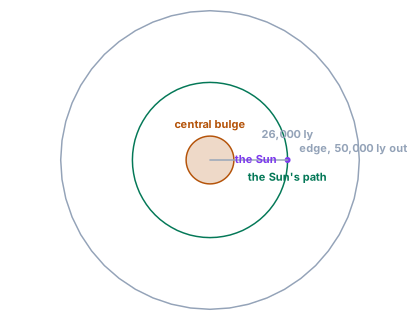
A light-year, about 9.5 trillion km, measures the distances to stars: the nearest is 4.2 light-years away, and the Sun lies 26,000 light-years from the center of a Milky Way 100,000 light-years across, going around it once in 230 million years.
Paper packet. Every task here also exists on screen, where it is checked automatically; answers written on paper are not assessed by Nydus. When you are back at a device, enter your answers there.
By the end of this lesson you will be able to use light-years to describe the distances to stars, place the solar system in the Milky Way, and calculate with those distances.
You can measure the solar system in astronomical units and in light travel time, and you know that light covers one AU in about 500 seconds. You know that gravity holds the planets around the Sun. This lesson steps out past Neptune, to the nearest stars and the whole Milky Way, where even the astronomical unit becomes too small to use comfortably.
| Term | What it means |
|---|---|
| Light-year | The distance light travels in one year, about 9.5 trillion km. |
| Galaxy | A huge system of stars, gas and dust held together by gravity. |
| Milky Way | Our galaxy, a disk about 100,000 light-years across. |
| Proxima Centauri | The nearest star to the Sun, about 4.2 light-years away. |
| Galactic year | The time the Sun takes to go once around the Milky Way's center. |
Beyond the solar system, astronomers measure distance in light-years: the distance light travels in one year,
$$300{,}000 \text{ km/s} \times 31{,}500{,}000 \text{ s} \approx 9.5 \text{ trillion km}.$$
A star $d$ light-years away is seen as it was $d$ years ago.
Another way: picture
If the whole solar system out to Neptune fit on a dinner plate, the nearest star would be another dinner plate more than a kilometer away, and the Milky Way would be larger than the whole United States. Almost everything is empty space.
Another way: steps
Proxima Centauri, the nearest star, is about $40$ trillion km away, which is about $270{,}000$ AU. Numbers like that are awkward even in astronomical units, so for the stars astronomers use a bigger ruler, the light-year.
A year has about $31.5$ million seconds, and light covers $300{,}000$ km each second, so in a year it travels about $9.5$ trillion km. To convert, multiply light-years by $9.5$ to get trillions of kilometers: a star $10$ light-years away is about $95$ trillion km away. The light-year is a distance, even though its name contains a unit of time.
Proxima Centauri is a small, dim red star about $4.2$ light-years away. It belongs to the Alpha Centauri system, whose two bright stars, about $4.4$ light-years away, appear as one brilliant point in the southern sky, too far south to see from most of the United States. Barnard's Star is about $6$ light-years away, and Sirius, the brightest star in our night sky, about $8.6$.
Within about $20$ light-years of the Sun there are roughly a hundred known stars, most of them dim red dwarfs invisible without a telescope. The stars that look bright to us are a mix of nearby ordinary stars and distant, enormously luminous ones.
Because light takes a year to cross each light-year, we see a star $d$ light-years away as it was $d$ years ago. Sirius appears to us as it was about $8.6$ years ago; Polaris as it was about four centuries ago; and some of the stars of Orion as they were more than a thousand years ago.
A message sent to a star would take as many years to arrive as the star is light-years away, and a reply just as long to come back. A conversation with someone near Sirius would have more than $17$ years between asking and hearing the answer. The speed of light sets a hard limit on how quickly the universe can communicate.
On a dark night far from city lights, a faint band of light arches across the sky. Through a telescope it turns out to be countless distant stars. That band is our view of the Milky Way from inside it: we live in a flat disk of stars, and when we look along the disk, we see the stars piled up in a band.
The disk is about $100{,}000$ light-years across but only about a thousand light-years thick, with a bulge of older stars at the center and spiral arms of young stars and glowing gas. It holds a few hundred billion stars. The Sun sits in a minor arm about $26{,}000$ light-years from the center, a little over halfway to the edge.
Gravity, which holds the planets around the Sun, also holds the stars of the Milky Way together. The combined pull of all the stars, gas, dust and dark matter keeps the Sun moving on a nearly circular path around the center, at about $230$ km every second.
Even at that speed, the trip is so long that it takes about $230$ million years, one galactic year. In the Sun's whole lifetime of about $4.6$ billion years it has gone around only about $4600 \div 230 = 20$ times. One galactic year ago, the first dinosaurs were appearing on Earth.
The Milky Way is one of perhaps two trillion galaxies in the observable universe. Its nearest large neighbor, the Andromeda Galaxy, is about $2.5$ million light-years away, yet it can be seen with the naked eye on a dark autumn night as a faint smudge, the most distant object most people can see without a telescope.
The light from Andromeda reaching your eye tonight left it about $2.5$ million years ago, before modern humans existed. Galaxies, their structure and the universe beyond them are the subject of the next course.
A few checks help. Distances to stars are in light-years, from a few to thousands; a star a fraction of a light-year away would be inside the solar system's outskirts. Converting to kilometers always gives trillions, never millions. A light-year count and the years since the light left are the same number. And any spacecraft slower than light must take more years than the light-year distance, never fewer.
The galaxy's numbers are uncertain because we see it from inside, through clouds of dust that hide much of it. Its size, its number of stars and the Sun's distance from the center are all known to within perhaps ten percent. Measuring distances to stars is itself a major task; the nearest are found by parallax, the tiny shift in a star's position as Earth goes around the Sun, which the high school course takes up.
The picture of the galaxy as a flat disk is also simplified: the disk is slightly warped, and it is surrounded by a vast, faint halo of old stars and dark matter.
From most American cities, light pollution hides the Milky Way completely. In International Dark Sky Parks such as Big Bend National Park in Texas or Cherry Springs State Park in Pennsylvania, the band of the Milky Way stretches across the whole summer sky, bright enough to cast faint shadows from the clouds of stars in it.
The brightest, thickest part of the band lies toward the constellation Sagittarius, low in the south on summer evenings. That is the direction of the galaxy's center, about $26{,}000$ light-years away, hidden behind dust. The light from those distant star clouds left them about $26{,}000$ years ago, during the last ice age.
Park rangers use the scale to help visitors: if the Sun were a grain of sand, the nearest star would be another grain about seven kilometers away, and the galaxy's center would be farther away than the Moon.
In 2012 NASA's Voyager 1 became the first spacecraft to cross into interstellar space, beyond the bubble of the Sun's own wind. It travels at about $17$ km/s, about one eighteen-thousandth of the speed of light, faster than any other craft leaving the solar system.
Even so, at that speed Voyager 1 would need about $4.2 \times 18{,}000 = 75{,}600$ years to cover the distance to Proxima Centauri, and it is not even heading that way. In about $40{,}000$ years it will pass within about $1.6$ light-years of a small star called Gliese 445.
Voyager carries a gold-plated record of sounds and pictures from Earth, a message for anyone who might find it. Its journey makes the scale of the galaxy real: humanity's fastest messenger will take tens of thousands of years to reach even the nearest stars.
Because its name ends in year, a light-year sounds like a length of time. It is a distance, how far light travels in a year, about 9.5 trillion km. Saying a star is 8.6 light-years away says how far it is, not how old it is or how long a rocket would take.
The connection to time is real but different: we see a star 8.6 light-years away as it was 8.6 years ago, because that is how long its light has been traveling.
Sirius is $8.6$ light-years away. Recall a light-year.
$9.5\ \text{trillion km}$
Light's distance in a year.
Multiply by the distance.
$8.6 \times 9.5$
Trillions of kilometers.
Evaluate the product.
$81.7\ \text{trillion km}$
About 82 trillion km.
Say how old its light is.
$8.6\ \text{years}$
We see Sirius as it was.
The Sun is about $4600$ million years old. Recall one galactic year.
$230\ \text{million years}$
One trip around the center.
Divide the age by it.
$4600 \div 230$
Both in millions of years.
Evaluate the trips.
$20$
Trips so far.
Find how far it went on one trip.
$2 \times 3.14 \times 26000 \approx 163000\ \text{ly}$
The circumference of its path.
Say what holds it on that path.
$\text{gravity of the whole galaxy}$
The same force that holds the planets.
Proxima Centauri is $4.2$ light-years away. Find light's time.
$4.2\ \text{years}$
A light-year each year.
A probe moves at a hundredth of light's speed. Find the factor.
$100 \text{ times slower}$
One hundredth of the speed.
Multiply light's time.
$4.2 \times 100 = 420\ \text{years}$
The probe's journey.
Compare with Voyager's speed.
$4.2 \times 18000 = 75600\ \text{years}$
Voyager is much slower than a hundredth of light's speed.
Compare with the light time for a reply.
$2 \times 4.2 = 8.4\ \text{years}$
Even a radio reply takes years.
Draw the conclusion.
$\text{interstellar travel is extremely hard}$
The distances are enormous.
Recall a light-year.
$9.5\ \text{trillion km}$
Light's distance in a year.
Multiply by the distance.
$20 \times 9.5$
Trillions of kilometers.
State the distance.
The star Sirius is about 8.6 light-years away. What does that number measure?
Complete the worked solution: a star is $20$ light-years away. Find its distance in trillions of kilometers, and the years a radio message and its reply would take.
Multiply the light-years by 9.5.
$\text{light-years} \times 9.5 =$ k
Trillions of kilometers.
Double the light-years.
$\text{light-years} \times 2 =$ r
A message out and a reply back.
Say why we cannot chat with other stars.
$\text{years between each reply}$
Even at the speed of light.
Match each object to its distance from us, measured in light travel time.
| about 1.3 light-seconds | about 8.3 light-minutes | about 4.2 light-years | about 26,000 light-years | |
|---|---|---|---|---|
| the Moon | ||||
| the Sun | ||||
| Proxima Centauri | ||||
| the center of the Milky Way |
A star is $50$ light-years away. Using 9.5 trillion km per light-year, fill in its distance in trillions of kilometers, how many years ago the light we see left it, and how many years a radio message and its reply would take.
| value | |
|---|---|
| distance (trillions of km) | |
| years since the light left | |
| years for a message and reply |
A spacecraft travels at a hundredth of the speed of light. Write the years it takes to reach a star $d$ light-years away.
Answer:
The Sun goes around the center of the Milky Way once in about 230 million years. How many trips does it make in $2300$ million years?
Answer: trips around the galaxy
NASA's Voyager 1, the fastest spacecraft leaving the solar system, travels at about one eighteen-thousandth of the speed of light. Proxima Centauri is about $4.2$ light-years away. About how many years would Voyager 1 take to travel that far?
Answer: years of travel
Lesson test: one question per skill, one attempt each, no hints. Your answers are checked when you submit.
A spacecraft travels at a hundredth of the speed of light. Write the years it takes to reach a star $d$ light-years away.
Answer:
You can place the solar system in the galaxy. Explain what a light-year is, and why we see a star 10 light-years away as it was 10 years ago.
19. Your turn: a star is $20$ light-years away. How far is it in trillions of kilometers?, step 3
$190\ \text{trillion km}$
And its light is 20 years old.