Back to the on-screen lesson ·
Earth's orbit makes each star rise about 4 minutes earlier every night, an hour every 15 nights, so each season has its constellations; Polaris stands as high as the latitude, and stars near it never set.
Paper packet. Every task here also exists on screen, where it is checked automatically; answers written on paper are not assessed by Nydus. When you are back at a device, enter your answers there.
By the end of this lesson you will be able to explain why the night sky changes with the seasons, predict when a star will be up, and use Polaris to find latitude.
You know that Earth turns once a day, which makes the Sun and the stars rise in the east and set in the west, and that Earth travels around the Sun once a year, which with the tilt of the axis gives the seasons. This lesson puts the two motions together to explain how the night sky changes from one night to the next and from season to season, and why some stars never set at all.
| Term | What it means |
|---|---|
| Constellation | A named pattern of stars, and the region of sky around it. |
| Sidereal day | The time Earth takes to turn once measured against the stars: 23 hours 56 minutes. |
| Circumpolar star | A star close enough to the pole of the sky that it circles it without ever setting. |
| Polaris | The North Star, which lies almost exactly above Earth's North Pole. |
| Meridian | The line across the sky from due north through overhead to due south. |
The night sky changes for two reasons at once.
Four minutes a night adds up to
$$15 \times 4 = 60 \text{ minutes every 15 nights}, \quad 365 \times 4 \approx 24 \text{ hours in a year},$$
so over a year every star is in the night sky for part of the year and hidden in daylight for the rest.
Another way: picture
Picture walking slowly around a lamp in the middle of a room while spinning. Each time you spin, you face the walls, but because you have moved a little around the lamp, the wall you face when your back is to the lamp slowly changes. The lamp is the Sun, the walls are the stars, and facing away from the lamp is night.
Another way: steps
Suppose a bright star is exactly due south at midnight tonight. Earth turns once and brings that star back to due south after one full turn, measured against the distant stars. But in the same time, Earth has also moved about one degree along its orbit around the Sun, so to bring the Sun back to the same place in the sky, Earth must turn about one degree more.
One degree of turning takes four minutes. So the day measured by the Sun, which our clocks keep, is about four minutes longer than the day measured by the stars. Astronomers call the star day a sidereal day: $23$ hours $56$ minutes. Because the star day is shorter, each star comes back to the same place four minutes earlier by the clock every night.
Four minutes a night sounds small, but it adds up quickly. After $15$ nights a star rises $15 \times 4 = 60$ minutes, a whole hour, earlier. After a month, about two hours earlier. After three months, $90 \times 4 = 360$ minutes, which is six hours.
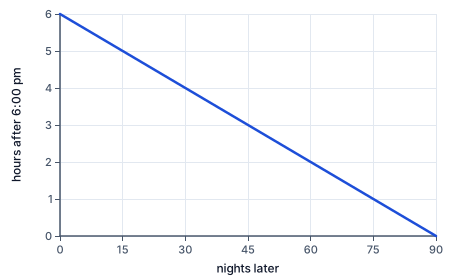
The chart shows one star that crosses due south at midnight tonight. Every night it crosses four minutes earlier, so its crossing time falls in a straight line, one hour every fifteen nights. Ninety nights later it crosses at six in the evening, as darkness falls. A few weeks after that it crosses in daylight and can no longer be seen at all, until the year comes around again.
Because the shift adds up to a whole day over a year, each constellation has its season. In the United States, Orion, with its belt of three stars, rules the winter evening sky. Scorpius, with the red star Antares, is low in the south on summer evenings. Leo is a spring constellation and Pegasus an autumn one.
The reason is the direction the night side faces. At night we look away from the Sun. In December the night side of Earth faces toward Orion; in June Earth is on the other side of the Sun, the night side faces toward Scorpius, and Orion is up during the day, lost in the Sun's glare. Orion has not moved; Earth has.
Look north on any clear night from most of the United States and you will find the Big Dipper. Unlike Orion, it never sets from places like Seattle or Boston. It simply circles around Polaris once a day, sometimes high above it and sometimes below, but always above the horizon.
Stars that never set are called circumpolar. Whether a star is circumpolar depends on where you stand. From latitude $x$ degrees north, any star within $x$ degrees of Polaris stays up all night, every night. From Seattle at about $48^\circ$ N, a large cap of sky around Polaris never sets. From Miami at about $26^\circ$ N, the cap is smaller, and much of the Big Dipper dips below the horizon on autumn evenings.
Polaris sits almost exactly above Earth's North Pole, so as Earth turns, it barely moves. An observer at the North Pole sees it straight overhead, $90^\circ$ up. An observer on the Equator sees it right on the northern horizon, $0^\circ$ up. In between, Polaris stands exactly as many degrees above the horizon as the observer's latitude.
This simple rule was one of the most useful facts in history. Sailors crossing the Atlantic could find their latitude on any clear night by measuring the height of Polaris with an instrument such as a sextant. From Denver, at about $40^\circ$ N, Polaris stands $40^\circ$ above the northern horizon; from Miami, about $26^\circ$.
We cannot see the stars in daylight, but if we could, we would see the Sun slowly moving eastward against them, about one degree a day, all the way around the sky in a year. That path is called the ecliptic, and the constellations along it are the zodiac constellations.
This is the same effect seen from the other side. Because Earth orbits the Sun, the Sun appears to move against the background stars. It is in front of the stars of Sagittarius in December, which is why we cannot see Sagittarius then, and opposite to Orion, which is why Orion is high at midnight in December.
Star charts and astronomy apps show the sky for a chosen date and time. A chart printed for 10:00 pm on January 1 shows the same sky as one for 8:00 pm on February 1, because over those 31 nights the stars have shifted about two hours earlier.
That is why many printed charts list several dates and times together: the sky at midnight in mid-November, at 10:00 pm in mid-December and at 8:00 pm in mid-January is the same. Each step of a month moves the same view two hours earlier in the evening.
Three checks help. First, stars shift earlier each night, never later; if your answer has a star rising later as the weeks pass, the sign is wrong. Second, an hour of shift always takes fifteen nights; if your answer for one hour is four nights or sixty nights, you have mixed up minutes and nights. Third, a shift of a whole day, $24$ hours, takes $24 \times 15 = 360$ nights, close to a year, as it must, because the shift comes from the yearly orbit.
The four-minute rule is rounded. The true difference between a solar day and a sidereal day is about $3$ minutes $56$ seconds, and it adds up to exactly one extra turn in a year. For a few weeks of planning, four minutes is plenty accurate.
The model also treats the stars as fixed. They do move through space, often at dozens of kilometers a second, but they are so far away that their patterns change only over thousands of years. The constellations ancient Greek astronomers named look almost the same today. Planets are different: they wander against the stars from month to month, which is why the ancient Greeks called them wanderers.
A middle school in Denver, Colorado, wants to hold a star party to show students Orion and the Orion Nebula through a telescope, but the event must end by 9:00 pm. In late November, Orion's belt crosses due south at about 1:00 am, far too late.
The teacher works forward with the four-minute rule. To cross due south at about 9:00 pm, Orion must come four hours earlier, $4 \times 60 = 240$ minutes, and at four minutes a night that takes $240 \div 4 = 60$ nights. Sixty nights after late November is late January, so the star party is set for the last week of January.
The same arithmetic tells the teacher that by late April Orion will cross the south in daylight and sink into the western twilight soon after sunset, so a spring star party should feature Leo and the Big Dipper instead. Planetarium software does the same calculation, but the four-minute rule lets anyone check it in their head.
Before satellite navigation, ships' navigators found their latitude at night by measuring the height of Polaris above the horizon with a sextant. Crossing the Atlantic toward New York at about $41^\circ$ N, a navigator would keep Polaris about $41^\circ$ high; seeing it climb meant the ship was drifting north.
Polaris is not exactly at the pole of the sky. It sits about two thirds of a degree away, so it traces a tiny circle each night, and careful navigators corrected for that with printed tables. Those corrections are small compared with the main rule: the height of the pole star equals the latitude.
Today, Scouts and hikers still use the rule as a check. In Yellowstone National Park, at about $44.5^\circ$ N, a fist held at arm's length covers about $10^\circ$ of sky, so Polaris stands a little over four fists above the northern horizon, a quick way to confirm both north and latitude without a phone.
Because Orion disappears in summer, it is tempting to think it has moved. But the stars keep the same patterns for thousands of years. What changes is the direction Earth's night side faces as Earth travels around the Sun.
Another mix-up is to blame Earth's daily rotation or its tilt. Rotation carries the stars across the sky every single night; the tilt makes the seasons warm and cold. Only the yearly orbit changes which stars are up at night.
A star rises tonight. Recall the nightly shift.
$4\ \text{min per night}$
The star day is four minutes shorter.
Multiply by 12 nights.
$12 \times 4$
The shifts add up.
Evaluate the product.
$48\ \text{min}$
Minutes earlier.
State the result.
$\text{rises 48 min earlier in 12 nights}$
Earlier, because Earth moves along its orbit.
An observer is at $36^\circ$ N. Recall the Polaris rule.
$\text{height} = \text{latitude}$
Polaris is above Earth's North Pole.
Apply the rule.
$36^\circ$
Above the northern horizon.
Find the never-setting limit.
$36^\circ \text{ from Polaris}$
Stars that close circle without setting.
Check at the North Pole.
$90^\circ \Rightarrow \text{overhead}$
The rule works at the extremes.
Check at the Equator.
$0^\circ \Rightarrow \text{on the horizon}$
Polaris sits on the northern horizon.
A star crosses due south at $1{:}00$ am tonight. The goal is $9{:}00$ pm. Find the hours earlier.
$4\ \text{h}$
From 1:00 am back to 9:00 pm.
Convert the hours into minutes.
$4 \times 60 = 240\ \text{min}$
The shift is counted in minutes.
Divide by four minutes a night.
$240 \div 4$
Nights needed.
Evaluate the nights.
$60\ \text{nights}$
About two months.
Check with fifteen nights an hour.
$4 \times 15 = 60$
The same answer.
Say what happens much later.
$\text{it crosses in daylight}$
Then it cannot be seen until next year.
Turn the hours into minutes.
$2 \times 60 = 120\ \text{min}$
Counted in minutes.
Divide by four minutes a night.
$120 \div 4$
Each night gains four minutes.
State the number of nights.
Orion is easy to see on winter evenings in the United States but cannot be seen on summer evenings. Why?
Complete the worked solution: a star crosses due south at midnight tonight. How many minutes, and how many hours, earlier does it cross $45$ nights from now?
Multiply the nights by four minutes.
$\text{nights} \times 4 =$ q
Four minutes earlier every night.
Divide the minutes by sixty.
$\text{minutes} \div 60 =$ h
Sixty minutes in an hour.
Say when the star now crosses.
$\text{midnight minus those hours}$
It crosses earlier in the evening.
Match each number of nights to how much earlier a star then rises.
| 1 hour earlier | 2 hours earlier | 3 hours earlier | 6 hours earlier | |
|---|---|---|---|---|
| 15 nights later | ||||
| 30 nights later | ||||
| 45 nights later | ||||
| 90 nights later |
An observer stands at $48^\circ$ N. Fill in how high Polaris stands, how close to Polaris a star must be never to set, and how high the noon Sun stands at an equinox.
| value | |
|---|---|
| height of Polaris (degrees) | |
| never-setting limit from Polaris (degrees) | |
| equinox noon Sun (degrees) |
Tonight a star crosses due south at 10:00 pm, which is $120$ minutes after 8:00 pm. Write the number of minutes after 8:00 pm at which it crosses due south $d$ nights from now.
Answer:
A bright star rises at a certain time tonight. How many minutes earlier does it rise $25$ nights from now?
Answer: minutes earlier
A science club in Boston sees Orion due south at midnight. About how many nights later will Orion be due south at 7:00 pm, so younger members can see it before bedtime?
Answer: nights later
Lesson test: one question per skill, one attempt each, no hints. Your answers are checked when you submit.
Tonight a star crosses due south at midnight, which is $240$ minutes after 8:00 pm. Write the number of minutes after 8:00 pm at which it crosses due south $d$ nights from now.
Answer:
You can predict how the night sky changes. Explain why Orion is seen in winter but not in summer, and how many nights it takes a star to rise three hours earlier.
20. Your turn: how many nights until a star rises 2 hours earlier?, step 3
$30\ \text{nights}$
About a month.