Back to the on-screen lesson ·
Four months of money in and money out, each month opening where the last one closed, read for the lowest point rather than the total — and how moving one payment changes it.
Paper packet. Every task here also exists on screen, where it is checked automatically; answers written on paper are not assessed by Nydus. When you are back at a device, enter your answers there.
You will build a four-month cash forecast — opening balance, money in, money out, closing balance — carry each closing balance forward as the next month's opening balance, and read the result for its lowest point rather than its total. You will say how many dollars have to be arranged and before which month, plot the balances, and work out what moving a payment into an earlier month does to the low point.
You know that revenue, profit and cash answer three different questions, that a month can show a profit and end with less in the account, and you can lay a month out as a profit and loss. This lesson builds the statement that sees a cash shortfall coming months before it arrives, while there is still time to do something cheap about it.
| Term | What it means |
|---|---|
| Opening balance | What the account holds when a month begins. |
| Closing balance | What it holds at the end: opening plus money in, less money out. |
| Money in | Money that actually arrives in the month, on the day it arrives. |
| Money out | Money that actually leaves in the month, on the day it leaves. |
| Low point | The smallest closing balance in the forecast. |
| Shortfall | How far below zero the low point goes: what must be arranged. |
| Rolling forecast | A forecast updated each month, dropping the month just gone and adding one at the end. |
A cash forecast is four columns — month, money in, money out, closing balance — and one rule:
$$\text{closing} = \text{opening} + \text{money in} - \text{money out}$$
Each month's closing balance is the next month's opening balance. That is the whole mechanism; start each month from the original balance instead and nothing ever looks like trouble.
It is built from when money moves, not when a sale is made: an invoice raised in March and paid in April is April's money in. That is why a profitable business can run out of money.
What you want is not the average and not the total. It is the lowest point: the month the account would go below zero, and how much has to be arranged before then. Four comfortable totals can still hide one month nobody can pay for.
Another way: steps
To build one:
Another way: table
Four months at Maya's Ceramics, in dollars. She opens with 800.
| Month | Money in | Money out | Closing |
|---|---|---|---|
| 1 | 2000 | 1900 | 900 |
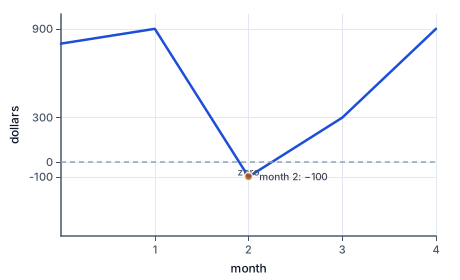
| 2 | 1400 | 2400 | −100 |
| 3 | 2600 | 2200 | 300 |
| 4 | 3000 | 2400 | 900 |
Over four months she takes 9000 and pays 8900, so every total looks fine. Month 2 still goes 100 below zero, and the 100 has to be there before month 2, not after it.
Start from the actual balance today. Read it from the account, not from memory.
List the money in by the month it will arrive. Cash and card sales arrive within days; invoices arrive at the end of their terms, and often later — use what customers actually do, not what the invoice says. Deposits arrive when they are taken. Money the owner will put in goes here too, labeled.
List the money out by the month it will leave. Stock, rent, wages, fuel and the phone every month; then the irregular payments — annual insurance, quarterly bills, a planned equipment purchase, a tax payment, the owner's drawings. The irregular ones are the ones that make a low month, so go through last year's record looking for them.
Close each month and carry the balance forward.
Read the closing column for its lowest figure. Note the month and the amount below zero, if any. That pair is the forecast's answer.
Check it three ways. The closing balance of the last month should equal the opening balance plus all the money in less all the money out; if not, a month was carried wrongly. Compare each month's money in with the profit and loss for the same month: a large gap should be explained by payment terms or stock. And when a month has passed, compare the forecast with what happened, and adjust the next months — a forecast that is never compared with reality stops being believed.
Once the forecast names a month and an amount, there are four kinds of move: bring money in sooner (deposits, shorter terms, chasing), push money out later (pay later, delay a purchase), arrange money in advance, or change the trading. Each has a price — goodwill, hours, interest, or uncertainty.
Notice the order. The first two cost only conversations and can start today; the third takes weeks and is easier before a low month than during one; the fourth is least likely to land in time.
What is right for any business depends on a market nobody here can see; the forecast's job is to say how much, and by when.
A forecast built once and filed is useful for a month. A forecast kept rolling — updated at the end of each month by replacing the forecast figures for the month just gone with what actually happened, and adding a new month at the far end — stays useful for as long as the business trades.
The monthly update takes a quarter of an hour once the records are kept, and it does three things. It shows how good the forecasting has been: an owner who always forecasts money in too high learns to be more cautious. It moves the low point into view early: a shortfall five months away is easy to arrange for; one next week is not. And it builds a record of the business's seasons, so next year's forecast starts from what really happened rather than from hope.
Many owners keep a minimum balance they never plan to go below — perhaps a month of fixed costs — and treat any forecast month under that line as a shortfall to act on, not only months below zero. The cushion absorbs the customer who pays late and the bill nobody remembered, which are exactly the things a forecast never quite captures.
The weakest part of most forecasts is the money-in column, because it is built on hope. Three habits make it more honest.
Use what customers actually do, not what the terms say. If invoices on thirty-day terms are paid on average after forty days, put them forty days out. The daily record shows the real pattern: note, for each invoice, when it was raised and when it was paid.
Start from last year's same months. A business with a season should forecast next March from last March, adjusted for anything known to have changed — a new product, a lost customer, a price rise — rather than from this month's figure. Without a last year, use a cautious estimate and replace it with the real figure as soon as each month closes.
Keep the uncertain money separate. A large order that has been discussed but not confirmed, a grant that has been applied for, a customer who has promised to pay soon: put each on its own line, and look at the forecast with and without them. If the business only survives the low month when the uncertain money arrives, the forecast has found a risk, and the owner should plan as though it might not.
The money-out column needs the opposite habit: include everything, even the small and the irregular, because a forgotten payment always arrives. Between a cautious money in and a complete money out, a forecast errs on the safe side, which is the side that keeps the business open. A forecast that turns out too gloomy costs nothing; one that turns out too cheerful can cost the business itself, in the one month that nobody had planned for at all, or even imagined.
A garden center's year is lopsided: most of its takings come in April to June, but its biggest bills — plants and compost for the spring — must be paid in February and March. The owner builds a six-month forecast in December, opening with 11,000 in the account.
January brings in 9,000 and pays out 12,000: closing at 8,000. February brings in 10,000 against 21,000, including the first spring stock payment: closing at −3,000. March brings in 18,000 against 24,000: closing at −9,000. April brings in 38,000 against 20,000: closing at 9,000. May and June are strongly positive. Over the six months the business is 30,000 ahead — and it still needs 9,000 arranged before March.
Because she sees it in December, she has three cheap options before an expensive one. She asks the main plant supplier to take a third of the spring order on 60-day terms, moving 7,000 from March into May. She offers pre-orders on hanging baskets with a deposit, bringing 2,500 into February. The new low point is March at +500, and she arranges a small line of credit as a cushion rather than a necessity. Found in March instead of December, the same shortfall would have meant bounced payments to the suppliers the spring depends on.
Banks and other lenders to small businesses commonly ask for a twelve-month cash forecast alongside a profit forecast. The profit forecast says whether the business is worth lending to; the cash forecast says how much it needs and when — which is the question a loan actually answers.
Starting every month from the original balance. The commonest error, and it makes a forecast that can never show trouble. Each month opens where the last one closed.
Forecasting sales instead of receipts. A sale on thirty-day terms is money next month; putting it in the month it was sold makes a forecast cheerful and useless.
Leaving out what goes irregularly. The annual insurance, the quarterly bill, the stock bought before a busy season — exactly the payments that make a low month.
Reading the total or the average. The account has to get through every month; the lowest one is the one that stops it.
Treating a shortfall as a verdict on the business. It is a timing problem, and it does not get better by being found late.
Close month 1 from the opening 800.
$800 + 2000 - 1900 = 900$
Opening plus in, less out.
Close month 2 from 900.
$900 + 1400 - 2400 = -100$
The carried balance goes below zero.
Close month 3 from −100.
$-100 + 2600 - 2200 = 300$
Back above zero.
Close month 4 from 300.
$300 + 3000 - 2400 = 900$
The forecast ends comfortably.
Read the low point and the shortfall.
$\text{month 2 at } -100 \Rightarrow 100 \text{ before month 2}$
The totals hid it; the column shows it.
Close month 1 from the opening 300.
$300 + 3400 - 3000 = 700$
Opening plus in, less out.
Close month 2, with a big parts order.
$700 + 2400 - 3600 = -500$
The carried balance is what bites.
Close month 3.
$-500 + 3300 - 3000 = -200$
Still below zero.
Close month 4.
$-200 + 3700 - 3000 = 500$
Back above zero.
Read the low point.
$\text{month 2 at } -500$
500 must be in place before month 2.
Compare with the four-month total.
$12\,800 - 12\,600 = +200$
The total says he is fine; the low point says he is not.
Write the problem.
$\text{month 2 short by } 500$
An amount and a deadline.
Ask the supplier to split the parts order across months 2 and 3.
$\text{month 2 out } 3600 \to 3000; \ \text{month 3 out } 3000 \to 3600$
Money out later, for the cost of a conversation.
Close month 2 again.
$700 + 2400 - 3000 = 100$
No longer below zero.
Close month 3 again.
$100 + 3300 - 3600 = -200$
The gap has moved, not vanished.
Ask two business clients for 14-day terms, bringing 300 into month 3.
$-200 + 300 = 100$
Money in sooner.
Close month 4.
$100 + 3400 - 3000 = 500$
The month 4 receipts are 300 lower, because they arrived earlier.
Read the new low point.
$\text{lowest} = 100, \text{ never below zero}$
Two conversations closed the gap without borrowing.
Close month 1.
$600 + 4500 - 4700 = 400$
Opening plus in, less out.
Close month 2 from month 1's balance.
$400 + 4800 - 4600 = 600$
Each month opens where the last closed.
Read the low point.
Neighborhood Kitchen is trading profitably, and its forecast still shows the account closing month $3$ at $-700$ dollars — below zero. What does that forecast say to do?
Complete the worked solution: an account opens at $600$ dollars. Month 1 brings in $2100$ and pays out $2200$; month 2 brings in $2500$ and pays out $3100$; month 3 brings in $3500$ and pays out $2700$. Find each closing balance and what must be arranged.
Close month 1.
$600 + 2100 - 2200 =$ a
Opening plus in, less out.
Close month 2 from month 1's closing balance.
$(\text{month 1}) + 2500 - 3100 =$ b
Each month opens where the last one closed.
Close month 3 from month 2's.
$(\text{month 2}) + 3500 - 2700 =$ c
The carried balance again.
Find the lowest closing balance and what must be arranged.
$\text{shortfall} =$ n
The size of the hole in the lowest month.
Say the deadline.
$\text{before month 2}$
The amount and the date are the two halves of the answer.
Bright Home Cleaning's four-month forecast opens at $400$ dollars and closes its months at $500$, $600$, $500$ and $-200$ dollars. How many dollars have to be arranged before the low month, to keep the account from going below zero?
Answer:
Neighborhood Kitchen's four months close at $700$, $400$, $-700$ and $100$ dollars. Plot the four closing balances, with the month number along the bottom and dollars up the side.
Plot your answer on the grid:
Monica's Market Stall's forecast closes month $3$ at $-600$ dollars. The owner asks a customer who was going to pay $200$ dollars later in the year for a deposit of that amount now, and it arrives in month 1. What does month $3$ now close at, in dollars?
Answer:
Northside Repairs starts the four months ahead with $300$ dollars in the business account. It expects to take $3400$, $2400$, $3800$ and $4000$ dollars in those four months, and to pay out $3000$, $3600$, $3500$ and $3300$. Work out what the account closes each month at. A balance below zero is written with a minus sign.
| Money in, dollars | Money out, dollars | Closing balance, dollars | |
|---|---|---|---|
| Month 1 | 3400 | 3000 | |
| Month 2 | 2400 | 3600 | |
| Month 3 | 3800 | 3500 | |
| Month 4 | 4000 | 3300 |
A plant nursery's quiet month opens with $450$ dollars in the account. Its fixed outgoings for the month — the polytunnel rent, the water and the insurance — come to $773$ dollars, and they go out whether anything is sold or not. Every order it fills brings in $19$ dollars. It has $22$ orders on the books and cannot fill more than that. For how many filled orders does the month end at or above zero?
This task has no paper form; do it on a device.
Lesson test: one question per skill, one attempt each, no hints. Your answers are checked when you submit.
Bright Home Cleaning starts the four months ahead with $400$ dollars in the business account. It expects to take $2200$, $2600$, $2200$ and $1800$ dollars in those four months, and to pay out $2100$, $2500$, $2300$ and $2500$. Work out what the account closes each month at. A balance below zero is written with a minus sign.
| Money in, dollars | Money out, dollars | Closing balance, dollars | |
|---|---|---|---|
| Month 1 | 2200 | 2100 | |
| Month 2 | 2600 | 2500 | |
| Month 3 | 2200 | 2300 | |
| Month 4 | 1800 | 2500 |
You can build a four-month forecast, plot the closing balances, say which month goes below zero and by how much, and show what a deposit or a delayed payment does to it. Tell someone why a profitable business can still run out of money, and why the total of a forecast is the least useful number in it. Next: reading a month against the one before it, and deciding what to change.
15. Your turn: open at 600, then 4500 in against 4700 out, then 4800 against 4600, step 3
$\text{month 1 at } 400$
Above zero, so nothing to arrange yet.