Back to the on-screen lesson ·
The share of each dollar that survives the variable cost, the takings a period needs, and why the form works when a business sells more than one thing.
Paper packet. Every task here also exists on screen, where it is checked automatically; answers written on paper are not assessed by Nydus. When you are back at a device, enter your answers there.
You will work out the contribution margin ratio, use it to find the takings a period needs to break even or to clear a target profit, turn that into a daily figure, and check the answer against the same point expressed in units. You will also say why the money form survives a business selling many different things, and how a change in the mix moves the ratio without any price moving.
You can find break-even in units: fixed cost divided by contribution per sale. That works while there is one kind of unit, and most businesses have several — a café sells coffee and cake, a shop sells hundreds of lines, a cleaner does standard and deep cleans. This lesson finds the same point in money, which works however many different things a business sells, and turns it into a daily figure the register can answer.
| Term | What it means |
|---|---|
| Takings | Money in from sales, before anything comes out; also called revenue or sales. |
| Contribution margin ratio | Contribution divided by price: the share of each dollar of takings still there after the variable cost. |
| Break-even takings | The takings at which total contribution exactly meets the fixed costs. |
| Sales mix | The proportions in which a business's different products are sold. |
| Blended ratio | The contribution margin ratio of a whole mix: total contribution over total takings. |
| Daily break-even | Break-even takings divided by the trading days. |
$$\text{ratio} = \frac{\text{contribution}}{\text{price}}, \qquad \text{break-even takings} = \frac{\text{fixed cost}}{\text{ratio}}$$
The ratio is the useful object. It says: of every dollar that comes over the counter, this much is still here once the variable cost is paid. A ratio of 0.375 means 37.5 cents in the dollar, so 1800 dollars of fixed cost needs 4800 dollars of takings.
Why bother, when units worked? Because units stop working the moment a business sells two different things. A hardware shop cannot say we break even at 600 items; it can say we break even at 8000 dollars a month, and that number is checkable against the register at the end of every week.
Always agree the two. Break-even units multiplied by the price must equal break-even takings. It is the only check either calculation gets, and it catches the commonest slip: dividing by the percentage instead of by the decimal, which makes the answer a hundred times too small and looks perfectly plausible on a page.
Another way: steps
Another way: table
Four businesses, one method, in dollars.
| Business | Fixed | Ratio | Break-even takings |
|---|---|---|---|
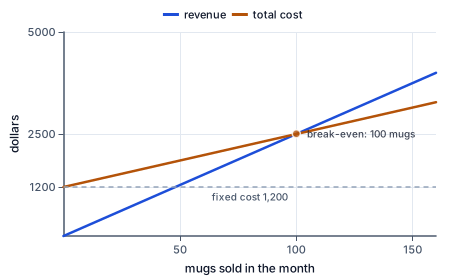
| Ceramics | 1200 | 0.48 | 2500 |
| Kitchen | 1800 | 0.375 | 4800 |
| Cleaning | 900 | 0.46875 | 1920 |
| Market stall | 750 | 0.2 | 3750 |
The stall has the smallest fixed cost and needs the second-largest takings, because only a fifth of each dollar survives buying the stock. A low ratio is a business that has to move a great deal of money to stay level.
Find the ratio from one sale or from a whole period. For a single product, divide the contribution per sale by the price. For a business selling many things, divide the period's total contribution by its total takings — the same idea, averaged over the mix. Write it as a decimal: 42 percent is 0.42.
Divide the fixed cost by the ratio. Every dollar of takings leaves the ratio behind; enough dollars to leave the whole fixed cost behind is the fixed cost over the ratio. Dividing by a number less than one makes the answer bigger than the fixed cost, which is right: only part of each dollar is available to pay the rent.
Add a target the same way. For a profit target, divide the fixed cost plus the target by the ratio.
Turn it into a daily or weekly figure. Divide by the trading days. A monthly figure is checked once a month; a daily one every evening.
Check it. Multiply the takings by the ratio: you should get the fixed cost back. For a single product, divide the takings by the price: you should get break-even units. And look at the size: break-even takings are always larger than the fixed cost, and if yours is smaller, you multiplied where you should have divided.
A business that sells several things has a blended ratio, and it moves whenever the mix moves. A café where coffee keeps 75 cents in the dollar and sandwiches keep 40 has a blended ratio somewhere between the two, closer to whichever sells more. If a hot summer moves customers from coffee to cold sandwiches, the blended ratio falls, break-even takings rise, and the owner can have a month of record takings that still loses money.
So the ratio is not a fixed fact about the business; it is a fact about last period's mix. Recompute it each month from the actual totals, and when planning, ask what mix the plan assumes. A plan to grow by selling more of the low-ratio line needs much more growth in takings than one that grows the high-ratio line, even though both might be described as ten percent more sales.
The same reasoning explains why shops put high-ratio items near the register and why restaurants train staff to suggest drinks and desserts: those lines move the blended ratio up, and every point on the ratio lowers the takings the month needs.
Different trades have very different ratios, and the ratio says a lot about how the business has to be run. A reseller buying finished goods — a market stall, a grocer — keeps a small share of each dollar, often 20 to 40 cents, because most of the price goes straight back to the supplier. It needs large takings to cover even modest fixed costs, and its owners watch volume closely.
A service business — a cleaner, a tutor, a repairer — often keeps 60 cents or more, because its variable costs are small beside its price. It can break even on modest takings, but its capacity is limited by hours, so it cannot simply sell more when the month is short. Knowing which kind of business you run tells you which lever — volume or price — is most worth pulling.
Break-even takings become most useful when they are set beside the takings the business actually expects. The gap between the two is the margin of safety in money: how far takings could fall before the month makes a loss. A bookshop that expects 19,000 and breaks even at 16,100 has a margin of safety of 2,900, or about 15 percent of its takings. A single bad week in a four-week month could use most of that up.
Two businesses with the same profit can have very different margins of safety. One with high fixed costs and a high ratio makes its profit from the last few thousand dollars of takings, so a small fall in sales wipes it out. One with low fixed costs and a low ratio needs big takings to break even but has less to lose in a slow month, because most of its costs fall away when sales do. The first kind of business is said to have high operating leverage: its profit swings a lot for each change in takings, upwards as well as down.
An owner deciding whether to take on a new fixed cost — a bigger unit, a salaried helper, a lease on a machine — can use the ratio to see what it will do. Every extra dollar of fixed cost needs one dollar divided by the ratio of extra takings. At a ratio of 0.4, a 600-dollar monthly lease needs 1,500 dollars more takings every month before it pays for itself, and it narrows the margin of safety by the same amount. That is the question to ask before signing, not after.
An independent bookshop pays 7,200 dollars a month in rent, wages for one assistant, insurance, software and utilities. It sells new books, where it keeps about 40 cents of each dollar after paying the publisher, and coffee from a small counter, where it keeps about 70 cents. Last month it took 16,000 on books and 3,000 on coffee.
Its contribution was 16,000 × 0.40 + 3,000 × 0.70 = 6,400 + 2,100 = 8,500, on takings of 19,000, a blended ratio of about 0.447. Break-even takings are 7,200 ÷ 0.447 ≈ 16,100 a month, and the shop cleared them by about 2,900 of takings, which left 8,500 − 7,200 = 1,300 of profit.
The owner opens 26 days a month, so her daily break-even is about 620 dollars, and she writes it on a card by the register. On slow weekdays the register often shows 450, on Saturdays 1,100; the card makes the pattern visible and turns we're having a quiet month into a number to act on. She also notices that every 1,000 dollars moved from books to coffee raises the month's contribution by 300, which is why the coffee counter is by the door and the reading chairs are next to it.
Airlines report a breakeven load factor: the share of seats they must fill for a route to cover its costs, often around 70 to 80 percent. It is break-even in money turned into the unit the business actually manages, and it moves with fuel prices and fares just as a café's break-even moves with its mix.
Dividing by the percentage. 1800 ÷ 37.5 is 48 dollars, not 4800. Use the decimal, and sanity-check against the unit answer.
Multiplying by the ratio. That gives the variable cost of breaking even, which answers nothing. Break-even takings are always larger than the fixed cost; if yours is smaller, you multiplied.
Reading the ratio as the margin on a price list. It is contribution over price, so it uses variable cost. Gross margin as an accountant computes it may have fixed production costs in it, and the two are not interchangeable.
One ratio for a changing mix. A shop's ratio is an average over what it happens to sell. Sell more of the low-margin line and the ratio falls without a single price changing, so recompute it when the mix moves.
Break-even is the goal. It is the floor. A month exactly at break-even pays every bill and leaves nothing for the owner, the buffer or the next repair.
Find the contribution of a box at 8 with 5 of variable cost.
$8 - 5 = 3$
Price minus variable cost.
Divide by the price for the ratio.
$3 \div 8 = 0.375$
The share that survives.
Divide the fixed cost of 1800 by the ratio.
$1800 \div 0.375 = 4800$
Break-even takings for the month.
Check with the units route.
$1800 \div 3 = 600; \quad 600 \times 8 = 4800$
The two routes agree, so both are probably right.
Turn it into a daily figure over 24 trading days.
$4800 \div 24 = 200$
A figure the register answers every evening.
Find the ratio on a stall's crates: 25 a crate with 20 of cost.
$5 \div 25 = 0.2$
One line.
Find the ratio on a herb line: 4 a bunch with 1 of cost.
$3 \div 4 = 0.75$
A very different line.
Total the takings from 100 crates and 200 bunches.
$100 \times 25 + 200 \times 4 = 3300$
The mix's takings.
Total the contribution.
$100 \times 5 + 200 \times 3 = 1100$
The mix's contribution.
Divide for the blended ratio.
$1100 \div 3300 \approx 0.33$
A blended ratio belongs to a mix, not to either line.
Find break-even takings on fixed costs of 750.
$750 \div 0.33 \approx 2250$
True only while the mix stays as it is.
In winter the café takes 6000 on coffee at a 0.75 ratio and 4000 on food at 0.40. Find the contribution.
$6000 \times 0.75 + 4000 \times 0.40 = 4500 + 1600 = 6100$
Each line's takings times its ratio.
Find the winter blended ratio.
$6100 \div 10000 = 0.61$
Total contribution over total takings.
Find winter break-even takings on fixed costs of 4880.
$4880 \div 0.61 = 8000$
Winter takings of 10000 clear it comfortably.
In summer the same 10000 of takings splits 3000 coffee and 7000 food. Find the contribution.
$3000 \times 0.75 + 7000 \times 0.40 = 2250 + 2800 = 5050$
Same takings, different mix.
Find the summer blended ratio.
$5050 \div 10000 = 0.505$
The mix has moved toward the low-ratio line.
Find summer break-even takings.
$4880 \div 0.505 \approx 9663$
The same fixed costs need far more takings.
Compare the two months' profit.
$6100 - 4880 = 1220; \quad 5050 - 4880 = 170$
Identical takings, very different months, and no price changed.
Find the contribution and the ratio.
$50 - 18 = 32; \quad 32 \div 50 = 0.64$
Gap over price.
Divide the fixed cost by the ratio.
$1600 \div 0.64 = 2500$
Break-even takings.
Check with the units route.
A business has $1380$ dollars of fixed cost and wants its break-even in takings rather than in units. Put the four steps in order.
Number the steps in order (write the number in the box):
Complete the worked solution: a unit sells for $50$ dollars with $40$ of variable cost, and the month's fixed costs are $600$. What takings does the month need to break even?
Find the contribution per sale.
$50 - 40 =$ m
Price minus variable cost.
Divide it by the price for the ratio.
$(\text{contribution}) \div 50 =$ r
The share of each dollar of takings that survives.
Divide the fixed cost by the ratio.
$600 \div (\text{ratio}) =$ b
The takings whose surviving share meets the fixed cost.
Check by multiplying back.
$(\text{takings}) \times (\text{ratio}) = 600$
The surviving share of the takings must equal the fixed cost.
Check the size of the answer.
$(\text{takings}) > 600$
Break-even takings are always larger than the fixed cost.
Maya's Ceramics has $1200$ dollars of fixed cost a month. A mug sells for $25$ and costs $13$ in variable cost. How many dollars of takings does the month need to break even?
Answer:
Northside Repairs wants $800$ dollars of profit on fixed costs of $1600$, with $64$ percent of each dollar of takings left after variable cost. What takings does the month need, in dollars?
Answer:
Maya's Ceramics pays $1200$ dollars of fixed cost a month, keeps $48$ percent of each dollar of takings after variable cost, and trades on $20$ days in the month. What must the register take on an average day to break even, in dollars?
Answer:
Work down to break-even in money for Neighborhood Kitchen, which pays $1800$ dollars of fixed cost a month and sells a lunch box at $8$ with $5$ of variable cost.
| Amount | |
|---|---|
| Price of one lunch box, dollars | 8 |
| Variable cost of one, dollars | 5 |
| Contribution per sale, dollars | |
| Contribution margin, percent of price | |
| Break-even takings for the month, dollars |
A hardware shop sells several hundred different items and pays $2440$ dollars a month in fixed costs. Across everything it sells, $40$ cents of each dollar taken is left after the cost of the goods. What does it need to take in a month to break even, in dollars?
| Amount | |
|---|---|
| Share of each dollar left after the goods, as a decimal | |
| Break-even takings for the month, dollars |
Lesson test: one question per skill, one attempt each, no hints. Your answers are checked when you submit.
Work down to break-even in money for Northside Repairs, which pays $1600$ dollars of fixed cost a month and sells a screen replacement at $50$ with $18$ of variable cost.
| Amount | |
|---|---|
| Price of one screen replacement, dollars | 50 |
| Variable cost of one, dollars | 18 |
| Contribution per sale, dollars | |
| Contribution margin, percent of price | |
| Break-even takings for the month, dollars |
You can find a contribution margin ratio, the takings that break even, and a daily target, and check them against the unit figure. Tell someone why a business with a low ratio has to move a great deal of money to stay level. Next: turning a monthly figure into something you can act on this afternoon.
15. Your turn: 1600 fixed, a repair at 50 with 18 of variable cost, step 3
$1600 \div 32 = 50; \quad 50 \times 50 = 2500$
The two routes agree.