Back to the on-screen lesson ·
Fixed cost divided by contribution per sale: how many sales a month needs, how many a target profit needs, and how every price, cost and commitment moves the answer.
Paper packet. Every task here also exists on screen, where it is checked automatically; answers written on paper are not assessed by Nydus. When you are back at a device, enter your answers there.
You will find the volume at which a month's profit is exactly zero, by dividing the fixed cost by the contribution one sale makes, and the volume a target profit needs by putting that target on top of the fixed cost. You will also be able to say which way break-even moves when a price, a cost or a commitment changes, read any new fixed cost as a number of extra sales, and check every answer against capacity.
You know what a sale contributes: its price less the costs that come with it, such as materials, packaging and card fees. You also know that the month's fixed costs — rent, insurance, the phone plan, the software subscription — come off the total once, whatever the month sells. Break-even is that arithmetic run backwards. Instead of asking what profit a given volume makes, it asks how many sales the month needs before there is any profit at all.
| Term | What it means |
|---|---|
| Fixed cost | A cost that stays the same when the volume sold changes, within the range the business trades in: rent, insurance, subscriptions. |
| Variable cost | A cost that comes with each unit sold: materials, packaging, the card fee on the sale. |
| Contribution per unit | Price less variable cost: what one sale has left to pay toward the fixed costs. |
| Break-even volume | The number of units at which profit is exactly zero: fixed cost divided by contribution per unit. |
| Target profit | An amount the owner wants left over in the period; it behaves like extra fixed cost. |
| Margin of safety | How far current sales sit above break-even, in units or as a share of current sales. |
| Capacity | The most the business can produce or serve in the period, which caps the profitable range. |
$$\text{break-even units} = \frac{\text{fixed cost for the period}}{\text{contribution per unit}}$$
Each sale hands over its contribution toward the fixed costs. Keep handing them over and at some point the fixed costs are met; everything after that is profit. Dividing by the price instead of by the contribution is the one mistake to guard against, and it always understates: it assumes a sale brings in its whole price, when part of the price has already gone on making and delivering the thing.
A target profit is more fixed cost. If you want 600 dollars left over, the month has 600 more to cover before you are satisfied, so it goes on top:
$$\text{units for a target} = \frac{\text{fixed cost} + \text{target profit}}{\text{contribution per unit}}$$
Break-even is not a property of the product. It belongs to a period and its fixed costs. Take on a lease and it rises the day you sign, with nothing having changed on the workbench. Lower the variable cost, by buying materials in bulk or moving to a card reader with a smaller fee, and it falls, because each sale contributes more.
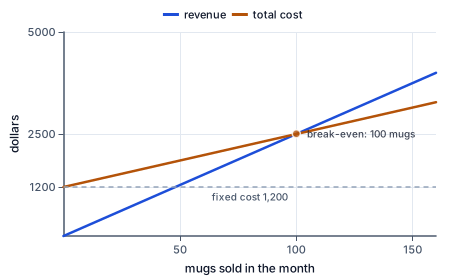
The same month as a chart. Revenue starts at nothing and climbs 25 dollars a mug; total cost starts at the 1,200 dollars of fixed cost and climbs only 13 a mug, so the gap between them closes by 12 dollars, the contribution, with every sale. They meet at 100 mugs. Left of the crossing the cost line is on top and the month loses money; right of it revenue is on top.
Another way: table
1,200 of fixed cost, a mug at 25 with 13 of variable cost.
| Mugs | Contribution | Fixed | Profit |
|---|---|---|---|
| 50 | 600 | 1,200 | −600 |
| 100 | 1,200 | 1,200 | 0 |
| 150 | 1,800 | 1,200 | 600 |
One hundred is break-even. The rows are 50 apart and the profit column moves by 600 each time, which is 50 mugs at 12 dollars — so contribution per unit is also the slope of the profit line, and break-even is where that line crosses zero.
Another way: steps
The calculation has three moves and one check, and every move has a reason.
Collect the right figures. Break-even needs exactly three numbers: the fixed cost for one period, and the price and variable cost of one unit. The period matters. A break-even computed on a month's fixed costs is a number of sales a month; mix a year's rent into a month's other costs and the answer means nothing. If a cost is paid quarterly or yearly, divide it down to the month first: an insurance premium of 1,440 a year is 120 a month.
Subtract to find the contribution. Price less variable cost. If the price includes a sales tax that is passed on to the tax authority, take the tax out first: it was never the business's money. If a card processor keeps 2.9% of each sale, that 2.9% is a variable cost too.
Divide. Fixed cost over contribution per unit. The answer is a count of units, so it is rounded up: 100.4 mugs means 101, because at 100 the month is still a few dollars short.
Check by multiplying back. Break-even times contribution should give the fixed cost. Then do the check that the formula cannot do for you: compare the answer with what the business can actually make or serve in the period. A break-even of 900 haircuts a month in a one-chair salon open 22 days is 41 haircuts a day, which is not a target but a warning.
Read the answer as a daily or weekly figure. A month of 20 trading days that breaks even at 100 units needs 5 a day. Five a day is something an owner can watch on a Friday; 100 a month is only a number on a sheet.
Because break-even is a fraction, every change to a business touches either its top or its bottom, and the direction follows.
| Change | Part of the fraction | Break-even |
|---|---|---|
| A new lease, a software subscription, a salaried hire | fixed cost, the top | rises |
| Cheaper materials, a smaller card fee | contribution, the bottom, grows | falls |
| A higher price, if the volume assumed still sells | contribution grows | falls |
| A discount on every sale | contribution shrinks | rises, often sharply |
| Paying a commission on each sale | contribution shrinks | rises |
The last two rows catch most people. A 10% discount on a 25-dollar mug takes 2.50 off the price, but all 2.50 comes off the 12 of contribution, which falls to 9.50. Break-even rises from 100 to 127 mugs — a 27% rise from a 10% discount — because the discount is paid entirely out of the contribution, never out of the variable cost.
Reading a fixed cost in sales is the habit worth building. A 180-dollar store room, at 12 dollars of contribution a mug, costs 15 mugs a month, every month, before a cent is earned. Put that way, the question is not whether the room is affordable but whether it will help sell at least fifteen more mugs.
Break-even tells you where the floor is; the margin of safety tells you how far above it you are standing. It is current sales less break-even: a studio selling 120 mugs a month with a break-even of 100 has a margin of safety of 20 mugs, or 20 ÷ 120 ≈ 17% of current sales. A slow month that sells 17% less still breaks even; one that sells 20% less loses money.
The margin is the number that tells an owner how exposed the business is. Two businesses with the same profit can have very different margins: one sells far above a low break-even, the other just above a high one, and the second is the one a bad month hurts.
A café's fixed costs do not follow the weather, but its customers do, and break-even is how an owner sees whether the good months carry the bad ones.
Take a café with 4,200 dollars a month of fixed cost: rent, insurance, the espresso machine's lease and the salaried manager. The average customer spends 9.50, and the food, coffee, cups and card fees for that order come to 3.80. Each customer contributes 9.50 − 3.80 = 5.70, so the café breaks even at 4,200 ÷ 5.70 = 736.8, which rounds up to 737 customers a month — about 34 a day over 22 trading days.
In summer the terrace brings 1,300 customers a month: profit is 1,300 × 5.70 − 4,200 = 3,210. In winter it drops to 600: 600 × 5.70 − 4,200 = −780, a loss. Four summer months earn 12,840; four winter months lose 3,120; four in-between months at 900 customers earn 4 × (900 × 5.70 − 4,200) = 3,720. The year makes 13,440, but only because the summer carries the winter, and the cash has to be kept from June to cover January.
Break-even also prices the owner's ideas. A winter soup menu that lifts the average spend to 11 with a variable cost of 4.50 raises the contribution to 6.50 and lowers break-even to 4,200 ÷ 6.50 ≈ 647 customers. At 600 winter customers the loss shrinks from 780 to 300 — not a profit, but 480 dollars a month better, found by asking which part of the fraction an idea moves.
An airline's costs for a flight are almost all fixed once the flight is scheduled: the aircraft, the crew, the fuel for the route and the airport fees are paid whether the plane is full or half empty. The variable cost of one more passenger is small — a meal, a little extra fuel, the booking fee. So the industry states break-even as a load factor: the share of seats that must be sold for a flight to cover its costs.
A 180-seat flight costing 21,600 dollars to operate, with an average fare of 180 and a variable cost of 20 a passenger, contributes 160 a seat and breaks even at 21,600 ÷ 160 = 135 passengers: a load factor of 135 ÷ 180 = 75%. Cut the average fare to 150 in a price war and the contribution falls to 130; break-even rises to 167 passengers, a load factor of 93%. That is why fare wars are so dangerous to airlines: a small cut in the price moves break-even to nearly every seat on the plane, and a flight that is 90% full still loses money.
Dividing the fixed cost by the price. A mug at 25 does not bring 25 to the rent; it brings 12. Break-even is 100 mugs, not 48, and a business planning on 48 will be halfway to its own figure and losing money.
Treating break-even as a goal. It is the point at which the month was not worth opening for. A goal is break-even plus a target profit.
One break-even for the business. One per period, and it moves whenever the fixed costs or the contribution do. Recompute it when you sign anything or change a price.
Rounding down. 100.4 mugs means 101, because the 100th leaves you slightly short. Round a break-even up, always.
Forgetting capacity. A break-even or a target above what the business can make is not a plan. Check every answer against the hours, the kiln or the chairs.
Neighborhood Kitchen has 1,800 of fixed cost a month. Write down the three figures.
$F = 1800, \quad P = 8, \quad V = 5$
Break-even needs the period's fixed cost and one unit's price and variable cost, and nothing else.
Subtract the variable cost from the price.
$8 - 5 = 3$
A lunch box contributes 3 dollars toward the fixed cost.
Divide the fixed cost by the contribution.
$1800 \div 3 = 600$
The fixed cost is met after 600 contributions of 3.
Check by multiplying back.
$600 \times 3 = 1800$
At break-even the contribution earned equals the fixed cost, so profit is zero.
Cost the common mistake of dividing by the price.
$1800 \div 8 = 225, \qquad 225 \times 3 - 1800 = -1125$
At 225 boxes the month is 1,125 dollars down: dividing by the price always understates.
Bright Home cleans homes at 90 a clean, with 60 of variable cost, on 900 of fixed cost a month. Find the contribution.
$90 - 60 = 30$
Supplies and travel come with each clean; the rest pays the fixed cost.
Find the break-even.
$900 \div 30 = 30$
Thirty cleans a month cover the fixed cost exactly.
A storage unit at 150 a month joins the fixed cost.
$900 + 150 = 1050$
It is the same whatever the month sells, so it is fixed.
Find the new break-even.
$1050 \div 30 = 35$
The contribution per clean did not change; only the amount to cover did.
Read the change in sales.
$35 - 30 = 5$
The storage unit costs five extra cleans every month before anything is earned.
Turn the new figure into a weekly target over a four-week month.
$35 \div 4 = 8.75 \Rightarrow 9 \text{ cleans a week}$
A count of cleans rounds up: at 8 a week the month falls short.
Maya's Ceramics has 1,200 of fixed cost and sells a mug at 25 with 13 of variable cost. Find the break-even.
$25 - 13 = 12, \qquad 1200 \div 12 = 100$
Contribution first, then the fixed cost divided by it.
She is asked to offer 10% off every mug. Find the new price.
$25 \times 0.9 = 22.50$
Ten percent off leaves ninety percent of the price.
Find the new contribution.
$22.50 - 13 = 9.50$
The whole discount comes out of the contribution; the clay and glaze cost the same.
Find the new break-even, rounding up.
$1200 \div 9.50 = 126.3 \Rightarrow 127$
A count of mugs rounds up: at 126 the month is still short.
She wants 600 of profit at the discounted price. Add it to the fixed cost.
$1200 + 600 = 1800$
A target is one more amount the month has to cover.
Divide by the discounted contribution, rounding up.
$1800 \div 9.50 = 189.5 \Rightarrow 190$
At full price the same target needed $1800 \div 12 = 150$ mugs.
Check against capacity: the kiln fires 160 mugs a month.
$190 > 160$
The target cannot be reached at the discount, whatever demand does, so the discount has to be refused or the capacity raised.
Find what one repair contributes.
$50 - 18 = 32$
Price less the parts and fees that come with each repair.
Find the break-even.
$1600 \div 32 = 50$
The fixed cost is met after fifty contributions of 32.
Find the volume for 800 of profit.
Check the break-even.
Northside Repairs breaks even at $50$ screen replacements a month. It now rents a small store room for $160$ dollars a month, which changes nothing about how a screen replacement is made or sold. What happens to break-even?
Complete the worked solution: fixed costs of $1976$ dollars a month, a price of $34$ and a variable cost of $8$ a unit. How many units break even?
Write down the three figures the calculation needs.
$F = 1976, \quad P = 34, \quad V = 8$
Break-even needs the period's fixed cost and one unit's price and variable cost, and nothing else.
Subtract the variable cost from the price.
$34 - 8 =$ c
That is what one sale contributes toward the fixed cost.
Divide the fixed cost by the contribution per unit.
$1976 \div (\text{contribution}) =$ b
Each sale hands over its contribution, so the fixed cost is met after that many sales.
Check by multiplying back.
$(\text{break-even}) \times (\text{contribution}) = 1976$
At break-even the contribution earned equals the fixed cost exactly, and profit is zero.
Say what the next sale does.
$\text{one sale past break-even} \Rightarrow \text{profit} = \text{contribution}$
Once the fixed cost is covered, each further sale's contribution is all profit.
Fixed costs are $3102$ dollars for the month. One unit sells for $46$ dollars and has a variable cost of $13$ dollars. How many units must be sold to break even?
Answer:
Neighborhood Kitchen wants to clear $900$ dollars of profit in the month, on fixed costs of $1800$ and a contribution of $3$ dollars a lunch box. How many lunch boxes does it need to sell?
Answer:
A month's fixed cost is $900$ dollars. One unit sells for $64$ dollars and costs $34$ dollars in variable cost. The owner wants $600$ dollars of profit. Fill in the contribution per unit, the break-even volume and the volume that earns the target.
| Amount | |
|---|---|
| Fixed cost for the month, dollars | 900 |
| Price of one unit, dollars | 64 |
| Variable cost of one unit, dollars | 34 |
| Target profit, dollars | 600 |
| Contribution per unit, dollars | |
| Break-even, units a month | |
| Units for the target profit |
Monica's Market Stall breaks even at $150$ crates of mangoes a month. It now rents a small store room for $100$ dollars a month, which changes nothing about how a crate of mangoes is made or sold. What happens to break-even?
A food truck pays $1800$ dollars a month in pitch fees, license and insurance. A meal sells for $10$ and costs $4$ in ingredients and packaging. The truck can serve at most $464$ meals a month. For which monthly volumes does it make a profit?
This task has no paper form; do it on a device.
Lesson test: one question per skill, one attempt each, no hints. Your answers are checked when you submit.
A month's fixed cost is $750$ dollars. One unit sells for $25$ dollars and costs $20$ dollars in variable cost. The owner wants $300$ dollars of profit. Fill in the contribution per unit, the break-even volume and the volume that earns the target.
| Amount | |
|---|---|
| Fixed cost for the month, dollars | 750 |
| Price of one unit, dollars | 25 |
| Variable cost of one unit, dollars | 20 |
| Target profit, dollars | 300 |
| Contribution per unit, dollars | |
| Break-even, units a month | |
| Units for the target profit |
You can find break-even in units and the volume a target profit needs. Tell someone why dividing the fixed cost by the price gives an answer that is always too small, and why a discount moves break-even by more than its percentage. Next: the same point, said in money rather than in units.
14. Your turn: 1,600 fixed, a repair at 50 with 18 of variable cost, step 3
$(1600 + 800) \div 32 = 75$
The target sits on top of the fixed cost before dividing.
14. Your turn: 1,600 fixed, a repair at 50 with 18 of variable cost, step 4
$50 \times 32 = 1600$
The contribution earned at break-even equals the fixed cost exactly.