Back to the on-screen lesson ·
Which costs move when the volume moves, how to write a month's cost as a line, why cost per unit is a fact about volume, and where a fixed cost stops being fixed.
Paper packet. Every task here also exists on screen, where it is checked automatically; answers written on paper are not assessed by Nydus. When you are back at a device, enter your answers there.
You will sort any spending list by whether each cost moves with the volume, total the fixed part and write the variable part as a rate, and work out what a month costs at any volume inside the range. You will also split a mixed bill from two months, say why cost per unit falls as volume rises, and find where a fixed cost stops being fixed.
You can sort a spending list by which unit does this belong to, and total a unit's direct cost. This lesson is the second cut through the same list, and it asks a different question: not whose is it but does it move. The answer to that question is what lets you say what next month will cost before it happens, and it is the raw material of contribution and break-even later in the course.
| Term | What it means |
|---|---|
| Volume | How many units are made or sold in the period: boxes, cleans, repairs, crates. |
| Variable cost | A cost that moves with the volume: twice the units, roughly twice the cost. |
| Fixed cost | A cost that stays where it is when the volume moves, inside the range the business trades in. |
| Relevant range | The span of volumes over which a fixed cost really is fixed. |
| Step cost | A cost that is fixed across a range and jumps once at its edge, such as a second oven. |
| Total cost | Fixed cost plus variable cost a unit times the units. |
| Cost per unit | Total cost divided by the units; it falls as volume rises because the fixed part is shared more thinly. |
Fixed does not mean permanent and it does not mean unavoidable. It means the number does not move when the volume moves, inside the range the business is actually trading in. Rent is fixed this year and negotiable next year, and that is still fixed for the purpose of asking what one more sale costs.
That is the whole test, and it is a different test from the one in lesson 1. There the question was which unit; here it is does it move. The two answers are independent, which is why a cost needs both:
| Fixed | Variable | |
|---|---|---|
| Direct | a kiln rented for the mugs alone | the clay in a mug |
| Indirect | the liability insurance | the workshop lighting |
All four boxes have something in them, so neither cut can be read off the other. Pricing a single job needs the direct cut. Break-even needs the variable one, because the only costs that grow as you sell are the variable ones.
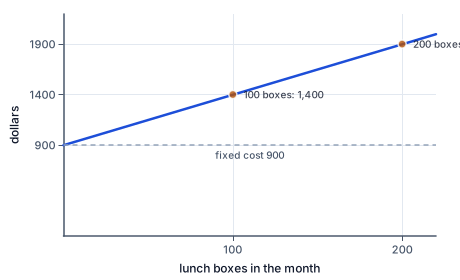
Once each line is sorted, a month's cost has a shape you can write down: total cost = fixed cost + variable cost a unit × units. That one line predicts the cost of any volume inside the range.
Another way: steps
For each line:
Another way: table
The same month at two volumes, in dollars.
| 100 boxes | 200 boxes | |
|---|---|---|
| Ingredients and packaging | 500 | 1000 |
| Rent and insurance | 900 | 900 |
| Total | 1400 | 1900 |
| Cost per box | 14.00 | 9.50 |
Doubling the sales did not double the cost. That gap is where profit comes from, and the whole of the pricing unit is about measuring it.
Splitting a month's costs takes five moves.
Fix the period and the volume. Say this month, 180 crates. Fixed and variable are both about a period: a monthly fee is fixed for the month, and the volume is the units in that same month.
Ask the movement question of each line. If the month had brought twice the units, would this number be different? Ask it of the way the bill is worked out, not of whether you like paying it. A card fee charged as a share of each sale moves; a monthly subscription does not, however much you would like to cancel it.
Turn the variable lines into a rate. Divide each variable line by the units: 3,600 of crates for 180 crates is 20 a crate. The rate is what lets you predict another month; the total only describes this one.
Total the fixed lines once. Rent 600 and insurance 60 make 660, and that figure is the cost of being open whether one crate sells or two hundred.
Write the cost line and use it. Total cost = 660 + 20 × units. At 250 crates that is 660 + 5,000 = 5,660.
Three checks. At zero units the line should give the fixed cost alone — if it gives zero, a fixed cost has been hidden inside the rate. Doubling the units should raise the total by less than double while there is any fixed cost. And the new volume should still be inside the range: if 250 crates needs a second stall, the 660 is no longer the fixed cost, and the line has to be rewritten with the step included.
Owners often quote my cost per unit as if it belonged to the product. It belongs to the month. Cost per unit is total cost divided by units, and the total contains a fixed part that is the same whatever the units are. Divide a fixed 900 by 100 boxes and each box carries 9; divide it by 200 and each carries 4.50. The ingredients in a box have not changed at all.
That has two consequences. A business that grows sees its cost per unit fall without doing anything clever, and should not mistake that for efficiency. And a business whose sales fall sees its cost per unit rise, which tempts the owner to raise prices in the very month customers are already buying less. Before comparing two months' costs per unit, check whether the volumes were the same; if they were not, compare the variable rates and the fixed totals instead, because those are the numbers that describe the business.
Some bills are part fixed and part variable. A phone plan with a monthly charge and a fee per minute over the allowance; electricity with a standing charge and a rate per unit; a delivery van leased monthly and fueled per mile. Treat each part as its own line: the standing charge is fixed and the usage is variable.
When the bill does not show the split, two months can. If electricity was 310 in a month of 400 units made and 370 in a month of 600, the extra 200 units added 60 dollars, so the variable rate is 60 ÷ 200 = 0.30 a unit. Take that away from either month to find the fixed part: 310 − 0.30 × 400 = 190. Check it on the other month: 190 + 0.30 × 600 = 370. This is called the high-low method, and it is rough — two months, and anything else that changed between them lands in the rate — but it turns a lump into a line you can plan with.
A small gym pays 4,200 dollars a month in rent, 1,100 for equipment leases and insurance, and 2,700 for the two staff who open and close it: 8,000 a month that does not move whether 150 members come or 400. Each member adds a little variable cost — towels washed, water, the payment processor's fee, wear on the machines — which the owner estimates at 6 dollars a member a month.
At 200 members the month costs 8,000 + 6 × 200 = 9,200, or 46 a member. At 400 members it costs 8,000 + 2,400 = 10,400, or 26 a member. That is why gyms push so hard for sign-ups and are relaxed about members who rarely come: almost all of the cost is fixed, so every extra member paying 35 a month adds 29 toward the rent. It is also why a gym at 150 members is in trouble even though nothing about its prices is wrong: 8,900 of cost over 150 members is 59 each, and no one will pay that for the same room.
The step costs matter too. At about 450 members the floor is full at peak hours, and growing further means a larger unit and a third member of staff — a jump of several thousand in fixed cost that the owner has to plan for before the waiting list forms, not after.
An online shop that sells T-shirts printed on demand has almost the opposite shape. The print company charges 11 dollars a shirt including postage, and only when a shirt is ordered; the shop's fixed costs are a 39-dollar website plan and a 20-dollar design tool subscription. At 30 shirts a month, the cost is 59 + 330 = 389, about 12.97 a shirt; at 300 shirts it is 59 + 3,300 = 3,359, about 11.20.
Because nearly every cost is variable, growth barely lowers the cost per shirt, and a slow month barely hurts: there is little fixed cost to cover. The same split that makes the gym hungry for volume makes the T-shirt shop safe but thin, and an owner choosing between the two models is choosing between those shapes.
Fixed means unavoidable. It does not. You could cancel the insurance tomorrow. Fixed says only that selling one more unit will not change it.
Fixed means indirect. A kiln rented for one product line is fixed and direct; workshop lighting is variable and indirect. Two cuts, four boxes.
Cost per unit is a property of the unit. It is not. Divide the month's total by the units and the answer falls as volume rises, because the fixed part is being shared out more thinly. Quoting my cost per unit without saying at what volume is quoting a number that moves.
Doubling the volume doubles the cost. Only the variable part doubles; the fixed part is added once.
Fixed forever. Every fixed cost is fixed inside a range. Rent is fixed until you need a second unit; one oven is fixed until the four-hundredth box. Knowing roughly where your range ends is the difference between a useful plan and a surprise.
List the costs that leave whether or not she books a clean.
$\text{insurance } 40 + \text{phone } 15 + \text{van } 180 = 235$
These do not move with the number of cleans, so they are fixed.
Write the cost that arrives with each clean as a rate.
$\text{fuel and materials} = 7 \text{ a clean}$
It is spent only when a clean happens, so it is variable.
Find the variable cost at forty cleans.
$7 \times 40 = 280$
A rate times the volume gives the variable total.
Add the fixed cost once.
$235 + 280 = 515$
Total cost is fixed plus variable, with the fixed part counted once.
Divide by the cleans to find the cost per clean.
$515 \div 40 \approx 12.88$
Cost per clean is the total shared over the cleans, at this volume only.
Keep the fixed cost from the full month.
$\text{fixed} = 235$
Fewer cleans do not change a cost that does not move with volume.
Find the variable cost at twenty cleans.
$7 \times 20 = 140$
Half the cleans, half the variable cost.
Add the two.
$235 + 140 = 375$
Half the work cost more than half the money, because 235 did not halve.
Divide by twenty.
$375 \div 20 = 18.75$
The same fixed cost is now shared over half as many cleans.
Compare the two costs per clean.
$18.75 - 12.88 = 5.87$
Nothing about a clean changed; only the volume did.
Check the rise against the fixed share.
$235 \div 20 - 235 \div 40 = 11.75 - 5.88 = 5.87$
The whole rise is the fixed cost spread more thinly, which confirms the split.
Write the kitchen's cost line inside its range: one oven, up to 400 boxes.
$\text{total} = 900 + 5 \times \text{boxes}, \quad 0 \le \text{boxes} \le 400$
The 900 includes one oven lease of 300; the line holds only inside the range.
Find the cost at 400 boxes.
$900 + 5 \times 400 = 2900$
This is the top of the range.
At 401 boxes a second oven is needed. Raise the fixed cost by one lease.
$900 + 300 = 1200$
A step cost jumps once at the edge of the range and is fixed again after it.
Find the cost at 401 boxes.
$1200 + 5 \times 401 = 3205$
One more box added 305 dollars: 5 of ingredients and 300 of oven.
Find the cost at 500 boxes on the new line.
$1200 + 5 \times 500 = 3700$
Inside the new range the cost line is straight again.
Compare the cost per box at 400 and at 401.
$2900 \div 400 = 7.25; \quad 3205 \div 401 \approx 7.99$
Just past a step, cost per unit rises: the new oven is barely used.
Say what a plan to grow to 500 must include.
$\text{plan: } 900 \to 1200 \text{ fixed at } 401 \text{ boxes}$
Name your range before you use the word fixed; the jump is known in advance.
Find the clay and glaze at 150 mugs, at 2.75 a mug.
$2.75 \times 150 = 412.50$
Variable: the rate times the new volume.
Keep the kiln rent and insurance of 340 a month.
$\text{fixed} = 340$
They do not move between 100 mugs and 150.
Add the two to find the month's cost.
Compare with the month at 100 mugs, which cost 615.
Northside Repairs took $47$ jobs last month. Sort each cost by whether it would have been different if the number of jobs had doubled.
| Variable — it moves with the volume | Fixed — it stays where it is | |
|---|---|---|
| Replacement parts fitted to customers' phones | ||
| The card processor's cut of each sale | ||
| The rent on the bench | ||
| The insurance premium for the year |
Complete the worked solution: a business has fixed costs of $301$ dollars a month and a variable cost of $8$ dollars a unit. What does the month cost at $45$ units, and at twice that?
Find the variable cost at the first volume.
$8 \times 45 =$ a
A variable cost is a rate a unit times the number of units.
Add the fixed cost once.
$301 + (\text{variable}) =$ b
The fixed cost is paid once for the month, not once per unit.
Find the variable cost at twice the volume.
$8 \times 90 = 720$
Doubling the units doubles the variable part and nothing else.
Add the same fixed cost.
$301 + 720 =$ c
The fixed cost has not moved: that is what fixed means.
Compare the two totals with the two volumes.
$\text{units} \times 2, \quad \text{cost} \times \text{less than } 2$
Doubling the volume does not double the cost while part of it is fixed.
Neighborhood Kitchen pays $1246$ dollars a month in fixed costs, and each lunch box costs $5$ dollars in ingredients and packaging. If it sells $649$ boxes next month, what will its total cost be, in dollars?
Answer:
A workshop has fixed costs of $420$ dollars a month and a variable cost of $3$ dollars a unit. At $21$ units its cost per unit is $23$ dollars. What is its cost per unit at $42$ units?
| Amount | |
|---|---|
| Variable cost at the new volume, dollars | |
| Total cost at the new volume, dollars | |
| Cost per unit at the new volume, dollars |
Monica's Market Stall last month, in dollars. Say whether each cost is fixed or variable, then give the two totals.
| Dollars | Fixed or variable? | |
|---|---|---|
| Pitch fee for the month | 821 | |
| Insurance for the month | 73 | |
| Crates bought, 152 at 21 dollars | 3192 | |
| Total fixed cost | — | |
| Total cost for the month | — |
Northside Repairs took $43$ jobs last month. Sort each cost by whether it would have been different if the number of jobs had doubled.
| Variable — it moves with the volume | Fixed — it stays where it is | |
|---|---|---|
| Replacement parts fitted to customers' phones | ||
| The card processor's cut of each sale | ||
| The rent on the bench | ||
| The insurance premium for the year |
A bicycle courier pays $55$ dollars a month for the phone plan the dispatch app runs on, and about $2$ dollars a delivery in food, tires and wear. What does a month of $113$ deliveries cost him, in dollars?
| Amount | |
|---|---|
| Variable cost of the month, dollars | |
| Total cost of the month, dollars |
Lesson test: one question per skill, one attempt each, no hints. Your answers are checked when you submit.
Monica's Market Stall last month, in dollars. Say whether each cost is fixed or variable, then give the two totals.
| Dollars | Fixed or variable? | |
|---|---|---|
| Pitch fee for the month | 869 | |
| Insurance for the month | 65 | |
| Crates bought, 143 at 21 dollars | 3003 | |
| Total fixed cost | — | |
| Total cost for the month | — |
You can split a month's costs into fixed and variable, write total cost as fixed plus a rate times the units, and find the cost of any volume. Tell someone why your cost per unit changes when nothing about the unit changed. Next: putting the two cuts together on one batch.
14. Your turn: Maya raises output from 100 mugs to 150, step 3
$340 + 412.50 = 752.50$
Fixed once plus variable at the new volume.
14. Your turn: Maya raises output from 100 mugs to 150, step 4
$752.50 \div 615 \approx 1.22$
Half as many mugs again raised the cost by only about a fifth.