Back to the on-screen lesson ·
Lifetime value is contribution per purchase times purchases a year times years — a conditional estimate from the business's records, set against acquisition cost to see what winning a customer is worth.
Paper packet. Every task here also exists on screen, where it is checked automatically; answers written on paper are not assessed by Nydus. When you are back at a device, enter your answers there.
You will estimate a returning customer's lifetime value from contribution, purchase frequency and duration with the assumptions named, set it against acquisition cost and payback time, and find the acquisition costs it can justify.
You know what one purchase contributes, what a new customer cost, how many customers come back and how often. Lifetime value puts those together into one estimate of what a returning customer is worth to the business.
| Term | What it means |
|---|---|
| Lifetime value | Contribution a typical returning customer is expected to make over the relationship. |
| Frequency | Purchases a year, from the business's own records. |
| Duration | Years a typical returning customer stays. |
| Conditional estimate | A figure true only if the pattern and duration assumed hold. |
| Payback time | How long the customer's contribution takes to cover their acquisition cost. |
| Lifetime revenue | Price times purchases times years: not what pays for customers. |
$$\text{lifetime value} = \text{contribution per purchase} \times \text{purchases a year} \times \text{years}$$
A weekly client of Bright Home Cleaning books about 12 cleans a year (not 52, because many book every two weeks or monthly) and, from last year's records, stays about 2 years. Each clean is priced at 90 dollars and contributes 40. Lifetime value: 40 × 12 × 2 = 960 dollars of contribution.
Two mistakes are common. The first uses the price: 90 × 12 × 2 = 2,160 dollars. That is lifetime revenue, most of which pays for supplies, travel and the cleaner's time; only contribution is available to pay for winning the customer. The second treats the figure as money in the bank. It is an estimate built on 'about 12 a year' and 'about 2 years', and both come from records that could change. Say so whenever it is used: 'about 960 dollars, if clients stay two years as last year's did'.
Another way: table
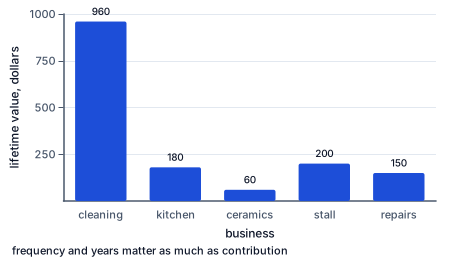
Lifetime value in the five businesses.
| Business | Contribution | Purchases a year | Years | Lifetime value |
|---|---|---|---|---|
| Bright Home Cleaning | 40 | 12 | 2 | 960 |
| Neighborhood Kitchen | 4 | 30 | 1.5 | 180 |
| Maya's Ceramics | 10 | 2 | 3 | 60 |
| Monica's Market Stall | 5 | 20 | 2 | 200 |
| Northside Repairs | 25 | 1.5 | 4 | 150 |
Another way: steps
Lifetime value exists to answer one question. If a returning Bright Home Cleaning client is worth about 960 dollars of contribution, any acquisition cost below 960 leaves the business better off, in principle. The 80 dollars the newspaper advert cost per client is well inside that; the client pays it back in 80 ÷ (40 × 12) × 12 = 2 months.
Two cautions keep this honest. First, not every new customer becomes a returning one; lifetime value describes the typical returning customer, so a channel whose customers rarely return is worth far less than the figure suggests. Second, the whole range from zero to the lifetime value is not a target: spending close to it leaves almost nothing over, and a small fall in retention wipes it out. Use lifetime value to rule channels out, and payback time to judge how much risk a channel carries. Recheck both every time new retention figures come in.
Take the contribution. What one purchase leaves after the costs it causes, from the costing course: not the price.
Take the frequency from records. Count purchases a year for returning customers in the booking log or order history. Use 'about', because it is an average.
Take the duration from retention. How long a typical returning customer has stayed, from groups followed in the retention lesson.
Multiply. Contribution times purchases a year times years.
Set it against acquisition. Take the acquisition cost off to see what the relationship leaves, and divide the acquisition cost by a year's contribution, times twelve, for payback in months.
State the assumptions. 'About 960 dollars, if clients stay two years.'
Check the answer. Lifetime value must be smaller than lifetime revenue, because contribution is less than price. The payback time must be shorter than the years assumed, or the customer never pays for themselves. And every input must come from the business's records, not hopes.
Multiplying the three is allowed because each purchase contributes the same amount on average, the purchases come at a steady rate, and the rate lasts for the years assumed. If any of those changes, the product changes too, which is why the assumptions must be named.
Using contribution rather than price is needed because only contribution is left over to pay for winning the customer. Revenue also pays for the supplies, the travel and the time that the purchase itself uses up.
Comparing lifetime value with acquisition cost is allowed because both are measured in the same dollars of contribution. And payback in months is allowed because a year's contribution spread over twelve months gives a monthly figure that the acquisition cost can be divided by.
The bar chart above shows how far apart the five lifetime values are. Bright Home Cleaning's 960 dollars is five times Neighborhood Kitchen's, even though a lunch order is bought far more often. The cleaner wins because each clean contributes ten times as much and clients stay longer. Maya's 60 dollars is the lowest: her customers buy rarely, about twice a year.
Each figure points to a different lever. For Maya, the best lever is frequency: a reason to buy again, such as a seasonal glaze. For the kitchen, duration: keeping offices for a second year. For the cleaner, protecting the long relationships it already has. Knowing which of the three numbers is weakest tells the owner where to work.
A lifetime value is only as good as its inputs, and the inputs drift. Recheck it at least once a year, when the new retention figures are in. If clients who used to stay two years now stay eighteen months, the cleaner's lifetime value falls from 960 to 720 dollars, and a channel that was comfortably inside it may no longer be.
When the figure is shared, in a plan, with a lender or with a partner, share the inputs too: contribution, frequency and years, each with its source. A reader who can see the inputs can judge the estimate; a reader who sees only the total cannot.
One lifetime value for the whole business hides the differences that matter. Bright Home Cleaning's weekly households and its move-out tenants are both customers, but a move-out tenant books once and leaves the area, so their lifetime value is one clean's contribution, about 60 dollars, against 960 for a weekly household. A channel that brings mostly move-out tenants can afford to pay far less for each customer than one that brings weekly households.
Work the figure out for each segment, and where the records allow, for the customers each channel brought. Customers from referrals often stay longer than customers from discount sites, which raises their lifetime value and the amount it is sensible to spend winning them. The comparison is the same arithmetic, done more than once.
This is also why the acquisition cost of a channel cannot be judged on its own. Eighty dollars is cheap for a weekly household and expensive for a tenant who will book once. The right question is always the pair: what does a customer from this channel cost, and what is a customer from this channel worth?
Each of the three inputs can be raised, and each in a different way. Contribution rises when costs fall or the offer is worth a higher price; the costing course covered both. Frequency rises when customers have a reason to come back sooner: a reminder, a seasonal offer, a service plan. Duration rises when the first months go well, which the retention lesson showed is where most customers are lost.
Small changes multiply. If the cleaner raised frequency from 12 to 13 cleans a year and duration from 2 to 2.5 years, lifetime value would rise from 960 to 40 × 13 × 2.5 = 1,300 dollars, more than a third higher, without one new customer.
A family-owned car wash in Tampa was deciding whether to offer an unlimited monthly membership at 30 dollars, and how much it could spend on flyers and signs to sell it. The owner worked out lifetime value from the records of a small trial.
A member washed about three times a month, and each wash cost the business about 4 dollars in water, soap and power, so a month of membership contributed about 30 − 12 = 18 dollars. Trial members had stayed about eight months on average. Lifetime value: 18 × 8 = 144 dollars of contribution, if the pattern held.
The owner set an acquisition limit well below that, about 40 dollars a member, so a member would pay back in a little over two months. When a promotion with a local radio station came in at 65 dollars a member, she turned it down, and put the money into a sign at the pump island instead, which brought members at about 20 dollars each. A year later she rechecked: members were staying ten months, and the lifetime value had risen to 180 dollars.
Subscription companies watch the ratio of customer lifetime value to acquisition cost closely, and investors often look for lifetime value of at least three times the acquisition cost. Whatever the target, the ingredients are the ones in this lesson: contribution, frequency and how long customers stay.
Lifetime value is guaranteed future revenue. It is an estimate of contribution, conditional on a pattern continuing.
Use the price to calculate it. Revenue is not what is available to pay for customers.
Spend up to the lifetime value on acquisition. That leaves nothing for risk.
Every customer is worth the lifetime value. Only returning customers are; many buy once.
Work it out once. The inputs drift; recheck it with each year's retention.
Take the contribution of one bag.
$5$
Not the 16-dollar price.
Take the frequency.
$20 \text{ a year}$
From the loyalty cards.
Take the duration.
$2 \text{ years}$
From retention records.
Multiply the three inputs.
$5 \times 20 \times 2 = 200$
Lifetime value.
Take off the acquisition cost.
$200 - 12.5 = 187.5$
If the customer keeps coming.
Take the contribution of one repair.
$25$
Not the 60-dollar price.
Take the frequency.
$1.5 \text{ a year}$
From the repair tickets.
Take the duration.
$4 \text{ years}$
From retention records.
Multiply the three inputs.
$25 \times 1.5 \times 4 = 150$
Lifetime value.
Work out the payback.
$37.5 \div 37.5 \times 12 = 12$
Months to cover the forum cost.
Take off the acquisition cost.
$150 - 37.5 = 112.5$
If the customer returns.
Take the contribution of one clean.
$40$
Not the 90-dollar price.
Take the frequency.
$12 \text{ a year}$
From the booking log.
Work out last year's value.
$40 \times 12 \times 2 = 960$
Clients stayed two years.
Take this year's duration.
$1.5 \text{ years}$
Retention has slipped.
Work out the new value.
$40 \times 12 \times 1.5 = 720$
A quarter lower.
Check the advert still fits.
$80 < 720$
Still well inside.
Decide where to work.
$\text{find out why clients leave sooner}$
Duration is the weak input now.
Find the lifetime value: 10 dollars an order, 2 orders a year, 3 years.
$10 \times 2 \times 3 = 60$
Contribution times frequency times years.
Take off the 15-dollar acquisition cost.
$60 - 15 = 45$
What the relationship leaves.
Name the weakest input.
A typical returning customer of Northside Repairs makes about $1.5$ purchases a year for about $4$ years, from the business's own records. Each repair is priced at $60$ dollars and contributes $25$ dollars. Winning a customer costs about $37.5$ dollars. Which statement gives the customer's lifetime value?
Complete the worked solution: a returning customer of a dog groomer visits about $12$ times a year for about $4$ years, from her booking records. Each visit contributes $15$ dollars, and winning a customer costs about $77$ dollars. Find a year's contribution, the lifetime value, and what is left after the acquisition cost.
Find a year's contribution.
$(\text{contribution a visit}) \times (\text{visits a year}) =$ w
What one year of visits brings.
Find the lifetime value.
$(\text{a year}) \times (\text{years}) =$ v
Over the whole relationship.
Find what is left after acquisition.
$(\text{lifetime value}) - (\text{acquisition cost}) =$ n
What the relationship leaves.
Say what the figure rests on.
$\text{the visits and years holding}$
It is an estimate, not money in the bank.
Four sentences from Bright Home Cleaning's plan. Mark every sentence that uses lifetime value honestly.
This task has no paper form; do it on a device.
A typical returning customer of Maya's Ceramics makes about $2$ purchases a year for about $3$ years, from the business's own records. Each online order is priced at $28$ dollars and contributes $10$ dollars. Winning a customer costs about $15$ dollars. Fill in the lifetime value and what is left after the acquisition cost, in dollars.
| Dollars | |
|---|---|
| Lifetime value | |
| Left after acquisition cost |
A typical returning customer of Northside Repairs makes about $1.5$ purchases a year for about $4$ years, from the business's own records. Each repair is priced at $60$ dollars and contributes $25$ dollars. Winning a customer costs about $37.5$ dollars. How many months of purchases does it take for the customer's contribution to cover what it cost to win them?
Answer:
A lawn-mowing service in Minneapolis finds from its records that a returning client books about $21$ mows a season for about $3$ seasons. Each mow contributes $17$ dollars. Door hangers cost the service about $110$ dollars for each new client they bring. How many dollars of contribution does a returning client leave after paying back the door hangers?
Answer:
A dog groomer's returning customers visit about $29$ times a year for about $2$ years, from her booking records. Each visit contributes $7$ dollars. What is a returning customer's lifetime value, in dollars of contribution?
Answer:
Lesson test: one question per skill, one attempt each, no hints. Your answers are checked when you submit.
A typical returning customer of Neighborhood Kitchen makes about $30$ purchases a year for about $1.5$ years, from the business's own records. Each office lunch order is priced at $10$ dollars and contributes $4$ dollars. Winning a customer costs about $12$ dollars. For which acquisition costs $a$, in dollars, would a returning customer leave the business better off?
This task has no paper form; do it on a device.
You can work out what a returning customer is worth and what it is sensible to pay to win one. Tell someone why lifetime value uses contribution, not price. Next: what a marketing campaign actually returned.
18. Your turn: Maya's online customers, step 3
$\text{frequency: two orders a year}$
The lever to work on.