Back to the on-screen lesson ·
Months to pay back, the cash left against the owner's buffer, buying against borrowing or leasing, the running cash effect month by month, and whether the capacity it adds is capacity that was short.
Paper packet. Every task here also exists on screen, where it is checked automatically; answers written on paper are not assessed by Nydus. When you are back at a device, enter your answers there.
You will work out how long a piece of equipment takes to pay back, check what buying it outright leaves against the owner's buffer, compare buying with borrowing or leasing, draw its running effect on cash, and judge whether the capacity it adds is at the resource that runs out.
You can find the resource that runs out first, set a cash buffer against a named risk, trace a loan's repayments through a forecast, and explain a month where equipment took the profit. A purchase decision uses all four.
| Term | What it means |
|---|---|
| Payback | The months the extra contribution takes to bring back the price. |
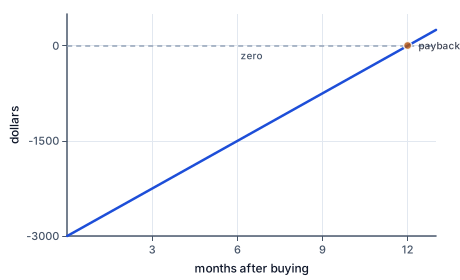
| Running cash effect | The price below zero on the day of purchase, rising by the extra contribution each month. |
| Buffer | The balance the owner has decided never to go below. |
| Constraint | The resource that runs out first and so sets how much the business can sell. |
| Lease | Paying monthly to use equipment instead of paying its whole price at once. |
Corner Bean is looking at a second espresso machine for 3000 dollars. With two machines the morning rush can serve 600 more coffees a month, adding 250 dollars of contribution.
The cash question. When does it pay back, and can the café afford the day it is bought?
$$\text{payback} = \frac{\text{price}}{\text{extra contribution a month}} = \frac{3000}{250} = 12 \text{ months}$$
Alexa holds 3400 and keeps a buffer of 1000. Paying outright leaves 400: the machine pays back in a year and still breaks her floor tomorrow. Paying back well and being affordable today are separate tests, and a purchase must pass both — or be paid for another way.
The capacity question. Does the machine relieve the resource that runs out? In the rush, the café has two limits: shots the machine can pull, and the barista's minutes. If the barista is already flat out, a second machine stands idle and the 250 a month never arrives. The contribution figure in the payback is only as good as the claim that the machine was what was short — and even when it was, the extra sales stop at whatever runs out next.
Another way: table
Five purchases across the three businesses.
| Purchase | Price | Extra a month | Payback, months | Cash after | Buffer |
|---|---|---|---|---|---|
| Second espresso machine | 3000 | 250 | 12 | 400 | 1000 |
| Reflow station | 1800 | 300 | 6 | 1400 | 1000 |
| Second polytunnel | 4200 | 350 | 12 | −2900 | 500 |
| Display fridge | 1200 | 150 | 8 | 1400 | 1200 |
| Second bench | 2400 | 400 | 6 | −300 | 800 |
The bench pays back fastest and cannot be bought outright today.
Another way: steps
Start with the line, not the quote. Before any price is asked for, the owner should be able to name the work the equipment will clear and count it: coffees turned away at eight, repairs sent to a rival, orders declined in December. No line, no purchase.
Cap it at the next constraint. More ovens bake more loaves only as far as the shelf, the staff and the customers can take them. The extra sales are the smaller of what the machine adds and what the next resource allows.
Price the contribution. Extra units times contribution a unit, not revenue: the ingredients, the card fees and the power the machine uses all come out first.
Divide for the payback, then test the day of purchase. Price over monthly contribution gives the months; cash less price less buffer gives the room.
Check the payback by multiplying back: payback times monthly contribution must give the price. Check the room by adding back: room plus buffer plus price must give the cash held. And check the contribution against the machine's working life: a purchase whose payback is longer than the machine will last never pays back at all.
A purchase that passes the capacity test and fails the cash test is not a bad purchase; it is a badly timed one. Three ways round it, each with its own cost: wait and save until paying leaves the buffer intact; borrow, and put the repayments into the forecast before signing; or lease, which swaps a large payment now for a monthly one. Each moves cash around in time, which the last two lessons taught you to trace.
A purchase that fails the capacity test fails outright. No financing turns a machine nobody is waiting for into sales.
Buying outright is the cheapest way to own equipment and the hardest on the day. Borrowing spreads the price over the loan's term and adds interest; the test is whether the monthly contribution covers the monthly repayment, so that the purchase adds to the account from the first month. Leasing usually costs more again in total — the leasing company is earning its own return — but often needs no deposit, can include servicing, and hands the machine back at the end, which suits equipment that dates quickly.
Compare them on two figures: the total paid over the period, and the cash the account keeps today. A lease at 110 dollars a month for 36 months costs 3960 against a 3000 price, 960 more; it also leaves all 3400 in the account on day one. Whether 960 is worth paying for that depends on what the buffer is protecting against.
Payback is a simple, honest test of cash timing, and it has blind spots. It ignores everything after the payback month: a machine that pays back in ten months and lasts ten years is far better than one that pays back in eight and lasts one year. It treats the extra contribution as certain, when it is a forecast, so it should be tested the way the sensitivity lesson tested any assumption: what is the payback if the extra sales come in at half? And it ignores the running costs the machine adds — power, servicing, insurance — unless they are taken off the contribution first. Used with those three checks, payback is the right first question for a small business, because the risk it measures is the one that closes small businesses: cash gone before the benefit arrives.
Take Fixit Mobile's reflow station and run the three checks on it. The station costs 1800 and the plan says 20 extra board repairs a month at 15 dollars of contribution each, 300 a month.
Running costs first. The station draws power and needs a new nozzle set every few months; together about 30 dollars a month. The contribution the station really adds is 300 − 30 = 270, and the payback becomes 1800 ÷ 270, a little under 7 months rather than 6.
Then the weaker case. Suppose only half the turned-away repairs come back once customers hear Dan can do them: 10 a month, 150 of contribution, 120 after running costs. The payback stretches to 1800 ÷ 120 = 15 months. Still well inside the station's working life of several years, so the purchase survives its weak case.
Then the working life. A station expected to last five years that pays back in fifteen months earns its price back four times over its life, even at half the planned repairs.
Compare the display fridge at Corner Bean: 1200, with 150 a month of contribution in the plan. Its weak case at half the lunches is 75 a month, a payback of 16 months — and a secondhand fridge that may last two years. That purchase is still sound, but with far less room for error, and a sensible owner would want to see the lunches selling from a cool box for a month before buying the fridge.
The weak case does not have to be the likely case. Its job is to show whether the purchase needs the plan to be right, or merely not badly wrong.
A neighborhood bakery sold out by ten every morning and turned customers away until closing. Its owner got a quote of 6,000 dollars for a second deck oven that could bake 120 more loaves a morning. At 1.50 dollars of contribution a loaf over 26 baking days, that looked like 4,680 a month and a payback of under two months.
Before signing she counted the next constraint. Her one baker could shape only 60 more loaves a morning before the oven needed loading, and the shop's shelves held 80 more. So the real extra was 60 loaves: 60 × 1.50 × 26 = 2,340 a month, a payback of about two and a half months — still excellent, but half the first figure.
The cash test was harder. The account held 7,500 and she kept a buffer of 3,000 for the months when flour prices jumped. Paying outright left 1,500, 1,500 below the buffer. A supplier's lease at 210 a month for 36 months cost 7,560 in total, 1,560 more than the price, while a bank loan at 280 a month over two years cost 6,720. She took the loan, whose repayment was covered many times by the 2,340, kept her buffer whole, and hired a part-time shaper three months later — the next constraint, now paid for by the oven.
Equipment lenders often ask what a machine will earn a month, because a payback well inside the loan's term means the repayments are covered by what the machine itself brings in. A payback longer than the machine's life is the clearest sign a purchase should not be made at any price.
The cheapest equipment is always the best choice. The cheapest one that relieves the constraint might be; one that relieves nothing is dear at any price.
A fast payback means it is affordable. Payback says when the money comes back, not whether the account survives the day it leaves.
More capacity means more sales. Only capacity at the constraint, and only until the next one.
The extra contribution is certain. It is an assumption, and a sensitivity test on it belongs in the decision.
Leasing is always a waste of money. It costs more in total and keeps cash in the account; sometimes that is worth paying for.
Name the line: 20 board repairs a month now turned away.
$20 \text{ repairs a month}$
The capacity it adds is capacity that was short.
Price the extra contribution.
$300 \text{ a month}$
Twenty repairs at 15 dollars of contribution each: 20 × 15 = 300.
Find the payback.
$1800 \div 300 = 6 \text{ months}$
Price over extra contribution a month.
Find the room above the buffer.
$3200 - 1800 - 1000 = 400$
Cash less price less the floor.
Give the verdict.
$\text{buy outright}$
It passes both tests.
Check the barista has time for the extra coffees.
$\text{a second barista on at the rush}$
Otherwise the machine stands idle.
Find the payback.
$3000 \div 250 = 12 \text{ months}$
Price over extra contribution a month.
Find the room above the buffer if bought outright.
$3400 - 3000 - 1000 = -600$
Below the floor: not outright, not today.
Cost the lease.
$110 \times 36 = 3960$
The total over its three years.
Find what the lease costs over buying.
$3960 - 3000 = 960$
The price of keeping cash in the account.
Find the lease's monthly effect.
$250 - 110 = 140$
Positive from the first month, with the buffer untouched.
Name the line: restaurants asking for 400 more bags a month.
$400 \text{ bags}$
Growing space is what runs out.
Find the payback.
$4200 \div 350 = 12 \text{ months}$
Price over extra contribution a month.
Find the room if bought outright.
$1300 - 4200 - 500 = -3400$
Far below the floor.
Cost a two-year loan with 336 of interest.
$4200 + 336 = 4536$
Everything repaid over the term.
Find the monthly repayment.
$4536 \div 24 = 189$
Spread evenly over 24 months.
Find the monthly effect on cash.
$350 - 189 = 161$
Above zero from the first month.
Give the verdict.
$\text{borrow; cash stays at } 1300$
The buffer is kept and the tunnel pays its own way.
Find the payback.
$2400 \div 400 = 6$
Price over extra contribution a month.
Find what buying outright leaves.
$2100 - 2400 = -300$
Price off the cash.
Find the room above the buffer.
Long Row Gardens is thinking of buying a second polytunnel for $4200$ dollars. It would add $400$ salad bags a month of capacity and bring in $350$ dollars of extra contribution a month. How many months of that extra contribution does it take to pay the price back?
Answer:
Complete the worked solution: a van costs $1140$ dollars and would bring in $190$ of extra contribution a month. The business holds $7500$ and keeps a buffer of $1400$. Check the purchase on cash.
Divide the price by the monthly contribution.
$1140 \div 190 =$ t
The payback, in months.
Take the price off the cash.
$7500 - 1140 =$ l
What buying outright leaves.
Take the buffer off what is left.
$(\text{cash left}) - 1400 =$ o
The room above the owner's floor.
Read the room's sign.
$\text{room} \geq 0 \Rightarrow \text{affordable today}$
Paying outright keeps the floor.
Check the capacity before signing.
$\text{is the van what was short?}$
The contribution is only real if it was.
Corner Bean is thinking of buying a second espresso machine for $3000$ dollars. It would add $600$ coffees a month of capacity and bring in $250$ dollars of extra contribution a month. The account holds $3400$ and the owner never lets it fall below $1000$. Can it be paid for outright today without breaking that buffer?
Corner Bean holds $2600$ dollars and has decided never to let the account fall below $1200$. It is thinking of paying $1200$ outright for a display fridge for grab-and-go lunches. Fill in what buying it today would leave and the room left above the buffer, in dollars, with a minus sign for a figure below zero.
| Dollars | |
|---|---|
| Cash held now | 2600 |
| Price paid today | 1200 |
| Cash left after buying | |
| Buffer the owner keeps | 1200 |
| Room above the buffer |
Long Row Gardens is thinking of buying a second polytunnel for $4200$ dollars. It would add $400$ salad bags a month of capacity and bring in $350$ dollars of extra contribution a month. It is paid for outright. Plot the purchase's running effect on cash, in hundreds of dollars, on the day of purchase and after $4$, $8$ and $12$ months.
Plot your answer on the grid:
A bakery sells out by ten every morning because its oven cannot bake more; the counter staff have time to spare, and a little bread is left over only on Mondays. Match each purchase to what it would do.
| More sales, until the next resource runs out | No extra sales, since the counter was not what ran out | New customers for output that was spare | A lower cost a loaf, with more cash tied up in stock | |
|---|---|---|---|---|
| A second oven, baking $250$ more loaves a morning | ||||
| A second register at the counter | ||||
| A delivery bike for Monday's leftover loaves | ||||
| A season's flour bought at once for a lower price |
A print shop is quoted $1960$ dollars for a second press that could print $21$ more jobs a month, each worth $40$ dollars of contribution. But the one person who trims and binds the jobs has time for only $7$ more a month. The shop holds $4400$ and keeps a buffer of $500$. Fill in the check, in dollars and months, with a minus sign for a room below zero.
| Amount | |
|---|---|
| Extra jobs a month the shop can sell | |
| Extra contribution a month | |
| Months to pay back | |
| Room above the buffer after buying outright |
Lesson test: one question per skill, one attempt each, no hints. Your answers are checked when you submit.
Corner Bean holds $3400$ dollars and never lets the account fall below $1000$. Before choosing any equipment, the owner wants to know the most that could be paid outright today. How many dollars is that?
Answer:
You can judge a purchase on cash and on capacity together. Tell someone why a machine that pays back in six months can still be the wrong thing to buy today. Next: a monthly review that ends in one number, one cause and one check.
16. Your turn: a 2400 bench adding 400 a month; cash 2100, buffer 800, step 3
$-300 - 800 = -1100$
Not outright, not today.