Back to the on-screen lesson ·
What a loan costs over its life, the account month by month after it lands, each repayment split into interest and principal, which movements are cash and which are costs, and how owner money differs.
Paper packet. Every task here also exists on screen, where it is checked automatically; answers written on paper are not assessed by Nydus. When you are back at a device, enter your answers there.
You will work out what a loan costs over its life, follow the account month by month after it lands, split a repayment into interest and principal, sort borrowing's movements into cash and costs, and compare it with the owner putting in the same money.
You can build a cash forecast, find its low point, and test which assumption could overturn it. When the low point is below zero, one answer is money from outside: a loan, or the owner's own. This lesson is about what each does to the forecast — the cash that arrives, the claim a loan puts on every later month, and what borrowing costs — and it opens one repayment up to show the interest and the returned principal inside it.
| Term | What it means |
|---|---|
| Financing | Money that comes in without anything being sold. |
| Loan | Financing that must be repaid, usually with interest. |
| Owner investment | Money the owner puts in, which need not be repaid. |
| Principal | The part of a repayment that returns the money borrowed. |
| Interest | What borrowing costs on top: the rate times what is still owed. |
| Amortization | Paying a loan off in equal repayments, each part interest and part principal. |
Corner Bean borrows 3000 dollars for a second espresso machine, repaid at 275 a month for 12 months. Follow the money:
$$\text{cost of borrowing} = \text{months} \times \text{repayment} - \text{amount borrowed}$$
So a loan changes the shape of the forecast: a high month now, and every later month lower by the repayment. It can lift a low point that comes soon, and push down a low point that comes later.
Owner investment brings the same 3000 today and no repayment, so every later month is untouched. What it takes instead is the owner's own savings, which is its own kind of cost.
Another way: steps
Another way: table
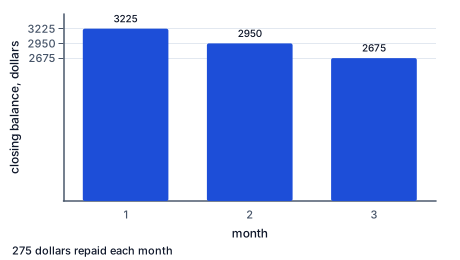
Corner Bean's account after the loan, following the loan alone, from an opening 500.
| Month | Loan in | Repayment | Closing |
|---|---|---|---|
| 1 | 3000 | 275 | 3225 |
| 2 | 275 | 2950 | |
| 3 | 275 | 2675 |
The first month looks rich; every month after is 275 lower than it would have been.
Read the loan offer for three figures. The amount, the monthly repayment, and the number of months. Everything else follows from them.
Put the loan in the forecast. The amount in the month it lands, and the repayment in every month from the first repayment date to the last.
Put in what the loan is for. A machine bought, stock paid for, a fit-out — and any extra takings or savings it is expected to bring, in the months they arrive.
Read the low point again. With the loan, the repayments and what the loan buys all in place, is the lowest month now above zero? Is there a new low point later, when the repayments have piled up and the benefits have not yet arrived?
Work the cost. Months times repayment, less the amount borrowed.
Check the forecast by adding the repayments up across all the months: they must equal the months times the repayment, and the amount still owed at the end of the forecast must be the loan's remaining repayments. A forecast that shows the loan arriving but not every repayment is showing only the good half.
First, what is it for, and when does that pay back? A loan for a machine that adds contribution each month can pay its own repayments; a loan to cover a low month simply moves the low month.
Second, does the forecast survive the repayments? Put them in, every month, and read the low point again. A loan whose repayments create a new low point further on has not solved anything.
Third, what does it cost in total? The monthly figure hides it; the sum of the repayments less the amount borrowed shows it.
This is how to work the figure out and read it, not a recommendation about what any business should do. That depends on a market and on rules nobody here can see.
A loan repaid in equal monthly amounts is not repaid in equal parts. Each month, the lender first charges interest on what is still owed; the rest of the repayment then reduces the debt.
$$\text{interest} = \text{still owed} \times \text{monthly rate}; \quad \text{principal} = \text{repayment} - \text{interest}$$
Early in the loan, a lot is owed, so a large part of each repayment is interest and the debt falls slowly. Later, less is owed, the interest shrinks, and more of each repayment goes to the principal. The repayment stays the same; the split inside it shifts month by month. A lender's statement shows the split for each payment.
The split matters for the other statements. Only the interest is a cost on the income statement; the principal is a financing movement on the cash-flow statement and a smaller loan on the balance sheet. An owner who treats the whole repayment as a cost understates the month's profit and overstates how expensive the loan is.
A term loan is one way among several, each with a different shape in the forecast. A line of credit lends only what is used, only while it is used, and suits a dip that comes and goes; it is often cheaper for a short dip and dearer if left in use for months. Supplier credit moves a payment later at no charge, if the supplier agrees. Owner investment adds cash with no repayment. Leasing equipment spreads its cost into monthly payments without a large sum up front. A later lesson compares them in full; this one's arithmetic — cash in, claims later, and the cost between — applies to each.
Two lenders offer the same 6,000. One wants 280 a month for 24 months; the other 190 a month for 36. The second looks cheaper, because the monthly figure is lower, and it is the dearer loan: 36 × 190 = 6,840 against 24 × 280 = 6,720. The lower payment buys a longer claim on the future, and costs 120 more in all.
So two offers are compared on three things together. The total cost: repayments less the amount borrowed. The monthly repayment against the forecast: the lower payment may be the only one the low months can carry, and that can make the dearer loan the right one. The length of the claim: a loan that outlives the thing it paid for — three years of repayments on equipment that lasts two — leaves the business paying for something it no longer has.
Write the three side by side for each offer, and the choice is usually clear. Where it is not, the forecast decides it: the offer whose repayments keep every month above zero, at the lowest total cost, is the one to take.
A bakery borrows 10,000 dollars for a new oven at 8 percent a year, repaid over thirty-six months. The bank's schedule gives a monthly repayment of 313.36: 36 × 313.36 = 11,280.96 in all, so the loan costs 1,280.96.
The first month's interest is 10,000 × 0.08 ÷ 12 ≈ 66.67, so 313.36 − 66.67 = 246.69 of the first repayment is principal, and 9,753.31 is owed after it. By the last year the interest each month is under 20 dollars and nearly all of the repayment reduces the debt. The owner's accountant puts only the interest on the income statement each month: 66.67 in the first month, falling from there.
In the cash forecast, the 10,000 arrives in the month the oven is delivered and leaves the same month to pay for it, so the balance barely moves. Then 313.36 leaves every month for three years. The oven is expected to save about 180 a month in gas against the old one and to allow 60 more loaves a day at 1.20 of contribution, about 1,800 a month over 25 trading days.
So the oven pays for its repayments several times over, and the forecast confirms there is no new low point: the extra contribution arrives from the first month. The owner could have paid cash from savings instead and saved the 1,280.96 of interest; she keeps the savings as the bakery's buffer, which the sensitivity test said it needed, and treats the interest as the price of keeping it.
Lenders publish an amortization schedule with every term loan: for each payment, the interest, the principal and the balance left. Reading the first and last lines shows how the split shifts over the life of the loan, and the total of the interest column is the loan's cost. It is also the figure to compare between two offers, because a lower monthly payment over more months can cost more in all.
Borrowed cash is profit. It is cash with a claim attached, and nothing was earned.
A repayment is a cost. Only the interest part is; the rest returns the money borrowed.
A loan with small monthly payments is cheap. Multiply by the months before deciding.
Owner money and a loan do the same thing. They bring the same cash now; only one takes it back every month.
Borrowing fixes a shortage of cash. It moves the shortage. The low month rises by the loan, and every month after it falls by the repayment, so a business that was short because it trades at a loss will be short again, with a repayment to find as well.
Each repayment is half interest and half principal. Early on it is mostly interest; the split shifts toward principal as the debt falls.
The lower monthly payment is the cheaper loan. Over more months it can cost more in all; compare the totals, and the months of the claim, before the monthly figure.
Note the loan: 2,000, repaid at 350 a month for six months.
$2000, \ 350, \ 6$
The three figures that matter.
Close month 1 on the loan alone, from 1,200.
$1200 + 2000 - 350 = 2850$
The loan lands; the first repayment leaves.
Close month 2.
$2850 - 350 = 2500$
The repayments keep coming.
Total the repayments.
$6 \times 350 = 2100$
The whole claim.
Find the cost.
$2100 - 2000 = 100$
Worth it only if the rush sells the parts before the later repayments bite.
Note what is owed: 4,800 at 1 percent a month.
$4800 \times 0.01 = 48$
The first month's interest.
Find the principal in the first repayment of 220.
$220 - 48 = 172$
What actually lowers the debt.
Find what is owed after the first repayment.
$4800 - 172 = 4628$
Only the principal comes off.
Find the second month's interest.
$4628 \times 0.01 \approx 46.28$
A little less, because less is owed.
Find the second month's principal.
$220 - 46.28 = 173.72$
A little more goes to the debt.
Read the pattern.
$\text{interest falls; principal rises; repayment the same}$
Only the interest belongs on the income statement.
Note the loan: 3,000, repaid at 275 for 12 months.
$12 \times 275 = 3300$
The whole claim.
Find the loan's cost.
$3300 - 3000 = 300$
The price of borrowing.
Close month 3 with the loan, from 500.
$500 + 3000 - 3 \times 275 = 2675$
Following the loan alone.
Close month 3 with owner money instead.
$500 + 3000 = 3500$
No repayments.
Find the difference after three months.
$3500 - 2675 = 825$
Three repayments that owner money would not take.
Find the difference after a year.
$12 \times 275 = 3300$
The whole claim, of which 300 is cost.
Say what the owner money costs instead.
$3000 \text{ of Alexa's savings}$
Money she cannot then use for anything else; neither choice is free.
Find what is repaid in total.
$24 \times 220 = 5280$
Months times repayment.
Find what the borrowing costs.
$5280 - 4800 = 480$
The repayments less the amount borrowed.
Find the cost for each month.
Long Row Gardens has $250$ dollars in the account and borrows $4800$ for a second-hand van. The loan arrives at the start of month $1$ and is repaid at $220$ dollars at the end of each month for $24$ months, starting with month $1$. Complete the sentence about the loan's whole life, in dollars.
The repayments add to t dollars, so the borrowing costs c dollars.
Complete the worked solution: a shop with $300$ dollars borrows $6000$, repaid at $600$ dollars at the end of each month for $17$ months. Find what the loan costs and the balance after two months, following the loan alone.
Add every repayment.
$17 \times 600 =$ t
The whole claim on later months.
Take off the money borrowed.
$(\text{repayments}) - 6000 =$ k
What the borrowing costs.
Close month one.
$300 + 6000 - 600 =$ a
The loan lands and the first repayment leaves.
Close month two.
$(\text{month one}) - 600 =$ b
One more repayment.
Say what the balance shows.
$\text{borrowed money, not profit}$
Nothing was earned; the rise is owed back.
Corner Bean has $900$ dollars in the account and borrows $6000$ for fitting out the back room. The loan arrives at the start of month $1$ and is repaid at $190$ dollars at the end of each month for $36$ months, starting with month $1$. At the end of month $1$ the account shows $6710$, up $5810$ on the start of the month. Which reading of that rise is right?
Corner Bean has $500$ dollars in the account and borrows $3000$ for a second espresso machine. The loan arrives at the start of month $1$ and is repaid at $275$ dollars at the end of each month for $12$ months, starting with month $1$. Following the loan alone, fill in the account's closing balance for the first three months, in dollars.
| Closing balance | |
|---|---|
| Month 1 | |
| Month 2 | |
| Month 3 |
Five movements in Long Row Gardens' account in one month. Match each to what it is.
| Cash in, and not revenue | Cash out, and not a cost | Cash out, and a cost | Cash in, and revenue | |
|---|---|---|---|---|
| The van loan arriving from the bank | ||||
| Tomasz putting in $5100$ dollars of his savings | ||||
| The part of the repayment that returns the money borrowed | ||||
| The interest charged on the loan this month | ||||
| Salad paid for at the market stall |
An equipment loan has $10000$ dollars still owed. The lender charges 1 percent a month on what is owed, and the monthly repayment is $400$ dollars. Fill in this month's repayment split and what is owed after it.
| Amount | |
|---|---|
| Interest this month, dollars | |
| Principal repaid | |
| Still owed afterwards |
A dog groomer with $300$ dollars in the account borrows $1000$ for a new grooming table and repays $300$ at the end of each month. Following the loan alone, plot the balance in hundreds of dollars just after the loan lands, at month $0$, and at the end of months $1$ to $4$.
Plot your answer on the grid:
Lesson test: one question per skill, one attempt each, no hints. Your answers are checked when you submit.
Corner Bean has $500$ dollars in the account. Instead of borrowing $3000$ for a second espresso machine, repaid at $275$ a month, the owner puts in $3000$ of their own money at the start of month $1$. Following that money alone, what will the account hold at the end of month $2$?
Answer:
You can trace a loan through the account, put a total cost on it, and split a repayment into interest and principal. Tell someone why a balance that leaps when a loan lands says nothing about profit. Next: a profitable month that ends with less cash.
16. Your turn: borrow 4800, repay 220 a month for 24 months, step 3
$480 \div 24 = 20$
On average; early months carry more of it.