Back to the on-screen lesson ·
Straight-line and reducing-balance depreciation, the value left on the balance sheet year by year, the gain or loss on selling an asset, and why the charge lowers profit without moving any cash.
Paper packet. Every task here also exists on screen, where it is checked automatically; answers written on paper are not assessed by Nydus. When you are back at a device, enter your answers there.
You will spread an asset's cost over its working life on a straight line and on a reducing balance, follow its value on the balance sheet, find the gain or loss when it is sold, and keep its effect on profit apart from its effect on cash.
You can spread a year's insurance over the months it covers, and you have judged an equipment purchase on its payback and its cash. A machine is the same idea stretched over years: the price is paid once and the machine is used for a long time, so its cost is shared between the years that use it.
| Term | What it means |
|---|---|
| Fixed asset | Something bought to be used in the business for more than a year, such as a van or an oven. |
| Depreciation | The share of a fixed asset's cost counted in each year of its working life. |
| Residual value | What the asset is expected to fetch at the end of its working life. |
| Straight line | The same charge every year: price less residual value, over the years of use. |
| Reducing balance | A fixed percentage of the value at the start of each year, so the charge shrinks. |
| Net book value | The price less the depreciation taken so far: the value on the balance sheet. |
Fixit Mobile's sister business, a courier, buys a van for 18,000 dollars. The owner expects to use it for five years and then sell it for about 3,000. So the van will cost the business 18,000 − 3,000 = 15,000 over its life, and the five years that use it should share that cost:
$$\text{yearly depreciation} = \frac{\text{price} - \text{residual value}}{\text{years of use}} = \frac{18000 - 3000}{5} = 3000$$
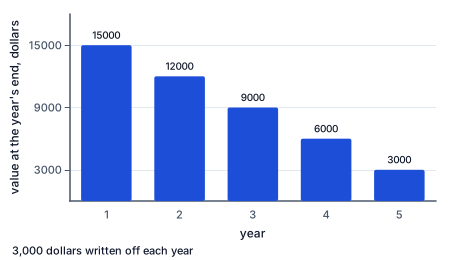
Each year's income statement carries 3,000 of van. The balance sheet carries the van at its net book value: 15,000 at the end of year one, 12,000 at the end of year two, down to 3,000 at the end of year five.
| Year | Charge | Value at the year's end | Cash |
|---|---|---|---|
| 1 | 3000 | 15000 | −18000 |
| 2 | 3000 | 12000 | 0 |
| 3 | 3000 | 9000 | 0 |
| 4 | 3000 | 6000 | 0 |
| 5 | 3000 | 3000 | +3000 when sold |
The last column is the point the whole course keeps making. The 18,000 left the account once, in year one. Depreciation moves no money: it is how the income statement shares out a payment that has already happened. A year with a large depreciation charge can have plenty of cash, and the year the van was bought can be profitable and still empty the account.
Another way: steps
Decide the three figures. The price, including delivery and fitting, since those are part of getting the asset working; the years the business expects to use it; and what it should fetch at the end. The last two are estimates, and honest estimates matter more than precise ones.
Work the yearly charge. On the straight line, price less residual value, over the years.
Run the schedule. Each year's closing value is the opening value less the charge.
Keep the cash apart. The price is a cash payment in the year it is paid, or a series of loan repayments if it was borrowed. The sale at the end is a cash receipt. Nothing else about the asset moves money.
To check: the charges over the whole life must add up to the price less the residual value, and the value at the end of the last year must equal the residual value. If the schedule lands anywhere else, a charge has been miscounted.
Many assets lose value fastest when new: a van is worth much less after its first year than its price, and loses less each year after that. The reducing-balance method matches this by charging a fixed percentage of each year's opening value. At 20 percent, an oven bought for 10,000 is charged 2,000 in year one (value 8,000), 1,600 in year two (value 6,400) and 1,280 in year three (value 5,120).
The charges are larger early and smaller later, which also suits assets whose repair costs rise with age: the early years carry more depreciation and less repair, the later years less depreciation and more repair, and the yearly total stays steadier. The value never quite reaches zero, which is why the method is usually paired with a decision to sell or scrap the asset after a set number of years.
Which method a business uses is a choice about describing the asset honestly. It changes how the cost is shared between the years; it never changes the total, and it never changes the cash.
When an asset is sold, the balance sheet gives up its net book value and the account receives the price fetched. The difference is a gain or a loss on disposal, and it is a correction: it says the depreciation charged over the years was too much (a gain) or too little (a loss).
The courier sells the van after three years, when its value on the balance sheet is 9,000, for 10,500. The gain on disposal is 1,500: the van lost less value than the schedule assumed. Had it fetched 7,000, the loss of 2,000 would say the opposite. Either way the cash from the sale is the full 10,500 or 7,000; only the profit figure uses the difference.
The two estimates that drive the charge are the owner's own, and they deserve a moment's thought rather than a round number. The working life is how long the business expects to use the asset, not how long it could physically last: a café that replaces its espresso machine every four years to keep up with volume should depreciate it over four, even if the machine would run for ten. The residual value is what the asset will fetch at the end of that life, and the best guide is what similar assets of that age sell for now — a few minutes on a second-hand market gives a better figure than a guess.
Both can be revised. If after two years the van is clearly going to last seven years rather than five, the value left is spread over the years that now remain; the past charges are not rewritten. What matters is that the charge each year is a fair share of the cost of the years that use the asset.
Small items are usually not depreciated at all. A stapler bought for the office is simply a cost of the month it is bought, because spreading it over five years would take more effort than it could ever be worth. Most businesses set a level below which anything bought is treated this way; above it, the item is recorded as a fixed asset and depreciated. The choice of level is the owner's, kept the same from year to year, so that one year's profit can be compared fairly with the next. Changing it to flatter one year's figures is exactly what a careful reader looks for.
Depreciation belongs in a business's costs when it prices its work. A courier that charges only for fuel and wages is giving away the van, and in five years will need 18,000 for the next one with nothing set aside. Dividing the yearly charge by the year's deliveries gives the van's cost per delivery, a real cost of each job even though no money leaves when it is done.
In the cash-flow statement, depreciation is added back to profit to reach the cash from trading, for exactly the reason in this lesson: it was taken off profit and never left the account.
Tax authorities usually set their own rules for how much of an asset's cost can be deducted from taxable profit each year, often called capital allowances, and these can differ from the depreciation a business charges in its own accounts. The rules and rates are published by the tax authority and change from time to time; an owner or their accountant looks them up for the year in question.
A self-employed courier bought a used van for 14,000 and priced her deliveries from what she could see each week: fuel, insurance, her phone and what she wanted to earn. Her books showed a healthy profit, because her accountant charged depreciation only once a year, at the year end, and she did not read that line.
Four years later the van needed replacing. She expected to use each van for four years and sell it for about 2,000, so it had been costing her (14,000 − 2,000) ÷ 4 = 3,000 a year. She made about 6,000 deliveries a year, so the van cost her 50 cents a delivery — and her prices had never included it. The next van cost 16,000; she had 2,000 from selling the old one and nothing set aside.
She borrowed for the new van and changed two things. She added the van's depreciation per delivery to her price list, which, at about 0.60 a delivery for the dearer van, most customers accepted without comment. And each month she moved the month's depreciation, about 290, into a separate savings account, so that the next van would be paid for from money the business had already earned. Depreciation itself moves no money; she chose to move some.
Accounting rules in most countries require fixed assets to be depreciated over their useful lives, so that a year's profit carries the cost of the equipment used to earn it. A business that owns a lot of equipment and shows a large profit but little cash may simply have bought its equipment recently.
Depreciation is money set aside. It is a share of a cost already paid; nothing is put anywhere unless the owner chooses to.
Depreciation lowers cash. It lowers profit. The cash left when the asset was bought.
Net book value is what the asset would sell for. It is the price less the charges so far; the market may say otherwise.
Buying a van is a cost of the year it is bought. It is a cost of the years that use it.
A gain on disposal is extra trading profit. It corrects the charges of earlier years.
Find the cost to spread.
$18000 - 3000 = 15000$
Price less what it will fetch.
Divide by the years of use.
$15000 \div 5 = 3000$
The yearly charge.
Find the value after year one.
$18000 - 3000 = 15000$
One charge taken.
Find the value after year five.
$18000 - 5 \times 3000 = 3000$
It lands on the residual value.
Record the cash.
$-18000 \text{ in year one}; \ +3000 \text{ on sale}$
Nothing in between.
Find the yearly charge on 1800 over four years to nothing.
$1800 \div 4 = 450$
No residual value expected.
Find the charges after two years.
$2 \times 450 = 900$
Depreciation taken so far.
Find the value left.
$1800 - 900 = 900$
Net book value.
Read the sale price.
$1100$
Dan upgrades and sells the old station.
Find the gain on disposal.
$1100 - 900 = 200$
It lost less value than assumed.
Record the cash from the sale.
$+1100$
The whole price fetched, not the gain.
Read the price and the rate.
$10000 \text{ at } 20 \text{ percent}$
A fifth of each year's opening value.
Charge year one.
$10000 \times 0.2 = 2000$
Value 8000.
Charge year two.
$8000 \times 0.2 = 1600$
Value 6400.
Charge year three.
$6400 \times 0.2 = 1280$
Value 5120.
Compare with a straight line over five years to nothing.
$10000 \div 5 = 2000 \text{ every year}$
Same first year, larger later.
Add the three reducing-balance charges.
$2000 + 1600 + 1280 = 4880$
Against 6000 on the straight line.
Read the difference.
$\text{same cash, different profit by year}$
The method shares the cost; it never moves money.
Find the cost to spread.
$3000 - 600 = 2400$
Price less residual value.
Divide by the years.
$2400 \div 4 = 600$
The yearly charge.
Find the value after two years.
A delivery van costs $19000$ dollars. The owner expects to use it for $3$ years and then sell it for about $1000$. What is the yearly depreciation on a straight line, in dollars?
Answer:
Complete the worked solution: a van costs $27000$ dollars, will be used for five years and should fetch $2000$ at the end. Find its yearly charge and its value after $2$ years.
Take the end value from the price.
$27000 - 2000 =$ s
The cost to spread.
Divide it by the five years.
$(\text{cost to spread}) \div 5 =$ d
The yearly charge.
Take the charges so far off the price.
$27000 - 2 \times (\text{charge}) =$ v
The value on the balance sheet.
Record the cash separately.
$27000 \text{ out, in year one only}$
Depreciation moves no money.
Read the yearly profit effect.
$\text{profit down by the charge each year}$
The van's cost spread over the years that use it.
An oven costs $13000$ dollars, will be used for $4$ years and is expected to fetch $5000$ at the end. Fill in its straight-line depreciation and its value on the balance sheet at the end of each of the first three years, in dollars.
| Amount | |
|---|---|
| Yearly depreciation | |
| Value at the end of year one | |
| Value at the end of year two | |
| Value at the end of year three |
Fixit Mobile paid $2400$ dollars cash for a reflow station at the start of year one and depreciates it at $600$ a year over four years. In year three, what does the station's depreciation do?
Long Row Gardens pays $8000$ dollars cash for a polytunnel at the start of year one and depreciates it over four years to nothing. The crops it grows add $4100$ of contribution each year. Fill in what the polytunnel does to profit and to cash in its first two years, in dollars, with a minus sign below zero.
| Amount | |
|---|---|
| Profit effect, year one | |
| Cash effect, year one | |
| Profit effect, year two | |
| Cash effect, year two |
A café bought a coffee grinder for $13000$ dollars and has depreciated it by $2500$ a year. After $1$ years it sells it for $9700$. What is the gain on the sale, in dollars? Write a loss with a minus sign.
Answer:
A bakery depreciates its new oven, bought for $6000$ dollars, at 20 percent a year on the reducing balance: each year's charge is a fifth of the value at the start of that year. Fill in the oven's figures, in dollars.
| Amount | |
|---|---|
| Value at the end of year one | |
| Value at the end of year two | |
| Charge in year three | |
| Value at the end of year three |
Lesson test: one question per skill, one attempt each, no hints. Your answers are checked when you submit.
A florist's cold room cost $9000$ dollars. It will be used for $4$ years and should fetch $6000$ at the end, and it is depreciated on a straight line. What is its value on the balance sheet after $1$ years, in dollars?
Answer:
You can depreciate an asset and say what the charge does to profit and to cash. Tell someone why a big depreciation charge does not mean the business is short of money. Next: costs that stay fixed until capacity forces a step.
16. Your turn: an espresso machine for 3000, used four years, fetching 600, step 3
$3000 - 2 \times 600 = 1800$
Two charges taken.